

Close Menu
LawFilesLawFiles

    Subscribe to Updates

    Get the latest creative news from FooBar about art, design and business.

    What's Hot

    “Shocking That Even Educated People Are Falling Prey”: Supreme Court Flags Deepening Crisis of ‘Digital Arrest’ Scams

    April 20, 2026

    Short Breaks Cannot Defeat Continuity: Supreme Court Reaffirms Protection of Ad-Hoc Employees Against Arbitrary Service Interruptions

    April 20, 2026

    Supreme Court Warns Against Repetitive ‘Publicity PILs’: Netaji Plea Dismissed as Non-Justiciable

    April 20, 2026
    Facebook X (Twitter) Instagram Threads
    Tuesday, April 21
    LawFilesLawFiles
    Facebook X (Twitter)
    • Home
      • Who We Are
      • Our Mission
      • Advisory board
      • Contact US
    • Supreme Court
    • High Courts
      • Gujarat High Court
      • Jharkhand High Court
      • Rajasthan High Court
      • Karnataka High Court
      • Andhra Pradesh High Court
      • Allahabad High Court
      • Himachal Pradesh High Court
      • Chhattisgarh High Court
      • Jammu & Kashmir and Ladakh High Court
      • Kerala High Court
      • Punjab and Haryana High Court
      • Patna High Court
      • Madhya Pradesh High Court
      • Madras High Court
      • Bombay High Court
      • Orissa High Court
      • Calcutta High Court
      • Meghalaya High Court
      • Delhi High Court
      • Manipur High Court
      • Gauhati High Court
    • Corporate
    • Taxation Laws
      • Income Tax
      • GST
      • Customs & Excise
    • Global Affairs
    • Articles
      • Former Judge’s’ Views
      • Senior Advocate
      • Policy Analysis
      • Tax Expert
    • PILS
      • Free/Affordable Legal Aid
      • PIL Cell
      • Law student Volunteer Cell (research & Drafting)
      • NGO & Legal services Authority Tie-ups
      • Online Legal Formats
      • Online Legal Help Form
    Subscribe Premium
    LawFilesLawFiles
    Home»High Courts»Symbolic Possession Sufficient’: J&K High Court Interprets Migrant Property Law to Safeguard Right of Appeal, Prevent Arbitrariness
    High Courts

    Symbolic Possession Sufficient’: J&K High Court Interprets Migrant Property Law to Safeguard Right of Appeal, Prevent Arbitrariness

    Anvita DwivediBy Anvita DwivediMarch 17, 2026Updated:March 17, 2026No Comments5 Mins Read
    WhatsApp Facebook Twitter Copy Link
    Share
    Facebook Twitter Pinterest Copy Link WhatsApp

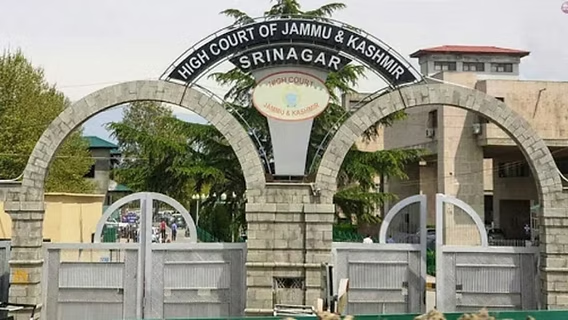
    In a significant ruling impacting property rights and procedural fairness in Jammu & Kashmir, the High Court of Jammu and Kashmir and Ladakh has held that “surrender of possession” under the migrant property law includes not just actual physical possession, but also constructive and symbolic possession.

    The judgment, delivered by a Division Bench comprising Justice Sanjeev Kumar and Justice Sanjay Parihar, interprets proviso (b) to Section 7 of the Jammu and Kashmir Migrant Immovable Property (Preservation, Protection and Restraint on Distress Sales) Act, 1997 in a manner that preserves the statutory right of appeal and prevents the provision from becoming arbitrary.

    At the core of the dispute was a crucial procedural requirement under Section 7 of the Act: an aggrieved person must “surrender possession” of the property before availing the remedy of appeal.

    The Court noted that if this requirement were interpreted strictly to mean only physical surrender, it would render the right of appeal illusory and practically inaccessible in many cases.

    Adopting a purposive interpretation, the Court held that “Possession” in law is not limited to physical control, it includes constructive and symbolic possession, depending on the statutory context and a broader interpretation is necessary to ensure the remedy of appeal remains meaningful.

    The Bench explicitly invoked the doctrine of “reading down”, clarifying that such an interpretation was necessary to save the provision from the vice of arbitrariness under Article 14 of the Constitution.

    The Court’s reasoning is rooted in fundamental constitutional principles. It observed that a statutory remedy such as the right to appeal cannot be made illusory or nugatory by imposing impractical preconditions.

    If “surrender of possession” were construed narrowly:

    • Individuals could be forced to vacate property entirely before even challenging the order
    • This would create a situation of irreversible harm, especially in residential cases
    • The appellate remedy would become ineffective and inaccessible

    By allowing symbolic or constructive surrender, the Court ensured that:

    • The authority retains legal control over the property
    • The aggrieved party retains access to judicial remedies

    This interpretation aligns with broader constitutional jurisprudence that procedural requirements must not defeat substantive rights.

    The 1997 Act was enacted in the aftermath of the mass displacement of communities from the Kashmir Valley in the late 1980s, with the objective of: namely protecting migrant properties from encroachment and distress sale and vesting control in state authorities to prevent illegal occupation

    Courts have repeatedly emphasised that the law is protective in nature, not punitive, and must be interpreted in a manner consistent with its objective.

    Consistency with Emerging Judicial Trend

    The present ruling is part of a broader trend where the High Court has scrutinised executive action under the migrant property regime.

    In recent cases, the Court has intervened against mechanical or excessive use of powers by authorities, emphasised that statutory authorities cannot act as mere “rubber stamps” and insisted on reasoned decision-making and fairness in eviction proceedings

    The current judgment reinforces this trajectory by ensuring that procedural safeguards are not diluted through rigid statutory interpretation.

    Political Significance: Property, Displacement, and State Power

    Beyond its legal reasoning, the ruling carries deep political implications, particularly in the sensitive context of Jammu & Kashmir.

    The migrant property law sits at the intersection of historical displacement and present-day occupation disputes. While the State has a legitimate interest in protecting migrant properties, the Court has clarified that such protection cannot come at the cost of procedural fairness and access to justice.

    Property disputes under the Act often involve district administration and executive authorities. By insisting on a reasonable interpretation, the Court has placed a judicial check on executive power, ensuring that statutory mechanisms are not used coercively.

    Depoliticising Property Conflicts

    Migrant property disputes in Kashmir are often politically sensitive, tied to issues of identity, return, and rehabilitation. The Court’s approach grounded in constitutional principles rather than political narratives helps depoliticise adjudication and reinforce rule of law.

    In a region marked by historical conflict and displacement, the judgment underscores that legal processes must remain humane, accessible, and constitutionally compliant, even in sensitive matters involving land and ownership.

    A Rights-Oriented Interpretation

    The High Court’s decision ultimately reinforces a core constitutional idea: legal remedies must be real, not illusory.

    By recognizing symbolic and constructive possession, the Court has preserved the effectiveness of appellate remedies, prevented arbitrary application of statutory provisions and strengthened the principle that procedure must serve justice, not defeat it

    The ruling marks an important development in the interpretation of property and procedural law in Jammu & Kashmir. It ensures that the protective framework of the migrant property legislation does not become a tool of injustice or exclusion.

    At a broader level, the judgment reflects a careful judicial effort to maintain the delicate balance between state authority, individual rights, and the constitutional guarantee of fairness a balance that is particularly crucial in politically and socially sensitive regions.


    J&K High Court Interprets Migrant Property Law to Safeguard Right of Appeal Prevent Arbitrariness Symbolic Possession Sufficient
    Share. WhatsApp Facebook Twitter Pinterest Email
    Anvita Dwivedi

    Related Posts

    “Shocking That Even Educated People Are Falling Prey”: Supreme Court Flags Deepening Crisis of ‘Digital Arrest’ Scams

    April 20, 2026

    Short Breaks Cannot Defeat Continuity: Supreme Court Reaffirms Protection of Ad-Hoc Employees Against Arbitrary Service Interruptions

    April 20, 2026

    Supreme Court Warns Against Repetitive ‘Publicity PILs’: Netaji Plea Dismissed as Non-Justiciable

    April 20, 2026
    Add A Comment
    Leave A Reply Cancel Reply

    Demo
    Top Posts

    Wrongful Claim Rejection Amounts to Deficiency in Service: Delhi Consumer Commission Holds Star Health Liable

    March 16, 202655 Views

    Bombay High Court Quashes POCSO Case, Directs Accused to Fund MacBook for Victim’s Education

    February 28, 202648 Views

    Siyahat Meri Syahi Se: A Journey That Transforms Travel into Thought and Entrepreneurship

    March 18, 202637 Views

    Supreme Court Notice on Muslim Personal Law: Reopening the Constitutional Debate on Gender Equality and Faith

    April 16, 202624 Views
    Don't Miss

    “Shocking That Even Educated People Are Falling Prey”: Supreme Court Flags Deepening Crisis of ‘Digital Arrest’ Scams

    By Anvita DwivediApril 20, 2026

    In a telling observation that reflects the growing anxiety within the judicial system over cyber…

    Short Breaks Cannot Defeat Continuity: Supreme Court Reaffirms Protection of Ad-Hoc Employees Against Arbitrary Service Interruptions

    April 20, 2026

    Supreme Court Warns Against Repetitive ‘Publicity PILs’: Netaji Plea Dismissed as Non-Justiciable

    April 20, 2026

    Delimitation Row in Lok Sabha: Did the Opposition Block the Government or Deny Women Their Political Future?

    April 18, 2026
    Stay In Touch
    • Facebook
    • Twitter

    Subscribe to Updates

    Get the latest creative news from SmartMag about art & design.

    Top Posts

    Wrongful Claim Rejection Amounts to Deficiency in Service: Delhi Consumer Commission Holds Star Health Liable

    March 16, 202655 Views

    Bombay High Court Quashes POCSO Case, Directs Accused to Fund MacBook for Victim’s Education

    February 28, 202648 Views

    Siyahat Meri Syahi Se: A Journey That Transforms Travel into Thought and Entrepreneurship

    March 18, 202637 Views
    Don't Miss

    “Shocking That Even Educated People Are Falling Prey”: Supreme Court Flags Deepening Crisis of ‘Digital Arrest’ Scams

    By Anvita DwivediApril 20, 2026

    In a telling observation that reflects the growing anxiety within the judicial system over cyber…

    Short Breaks Cannot Defeat Continuity: Supreme Court Reaffirms Protection of Ad-Hoc Employees Against Arbitrary Service Interruptions

    April 20, 2026

    Supreme Court Warns Against Repetitive ‘Publicity PILs’: Netaji Plea Dismissed as Non-Justiciable

    April 20, 2026

    Delimitation Row in Lok Sabha: Did the Opposition Block the Government or Deny Women Their Political Future?

    April 18, 2026
    Stay In Touch
    • Facebook
    • YouTube
    • TikTok
    • Instagram
    Top Trending
    About Us
    About Us

    LawFiles.in is a comprehensive legal news platform delivering real-time updates from the Supreme Court, High Courts, Tribunals, Corporate and Tax law, Regulators, Politics, Crime, Consumer cases, and Global Affairs.

    Email Us: lawfilesoffical@gmail.com
    Contact: +91 8800026066

    Contact Us:
    India International Centre
    40, Max Mueller Marg
    Lodhi Estate, New Delhi-110003

    Facebook X (Twitter)
    Our Picks

    “Shocking That Even Educated People Are Falling Prey”: Supreme Court Flags Deepening Crisis of ‘Digital Arrest’ Scams

    April 20, 2026

    Short Breaks Cannot Defeat Continuity: Supreme Court Reaffirms Protection of Ad-Hoc Employees Against Arbitrary Service Interruptions

    April 20, 2026

    Supreme Court Warns Against Repetitive ‘Publicity PILs’: Netaji Plea Dismissed as Non-Justiciable

    April 20, 2026

    Delimitation Row in Lok Sabha: Did the Opposition Block the Government or Deny Women Their Political Future?

    April 18, 2026

    Bombay High Court Seeks Centre’s Response on SSPE Inclusion in Rare Diseases Policy: A Constitutional Moment for the Right to Health

    April 18, 2026
    Most Popular

    ED Can Arrest Even If FIRs Are Added to ECIR Later: Punjab & Haryana High Court

    January 30, 20260 Views

    Non-Disclosure Of QCBS Criteria In Tender Alone Not Enough To Allege Malafides: Gauhati High Court

    January 31, 20260 Views

    January 2026 Monthly Digest: Important Rulings of the Jammu & Kashmir and Ladakh High Court

    February 2, 20260 Views

    Custodial Death and State Liability : A Critical Analysis of the Allahabad High Court’s ₹10 Lakh Compensation Judgment

    February 22, 20260 Views

    SC Reopens Debate on 3-Year Practice Rule for Judicial Service

    February 22, 20260 Views
    © 2026 LawFiles. Owned by Varta24 Media.
    • Articles
    • Careers
    • Corporate
    • Global Affairs
    • Law Firms & Lawyers
    • PILS
    • Regulatory

    Type above and press Enter to search. Press Esc to cancel.