


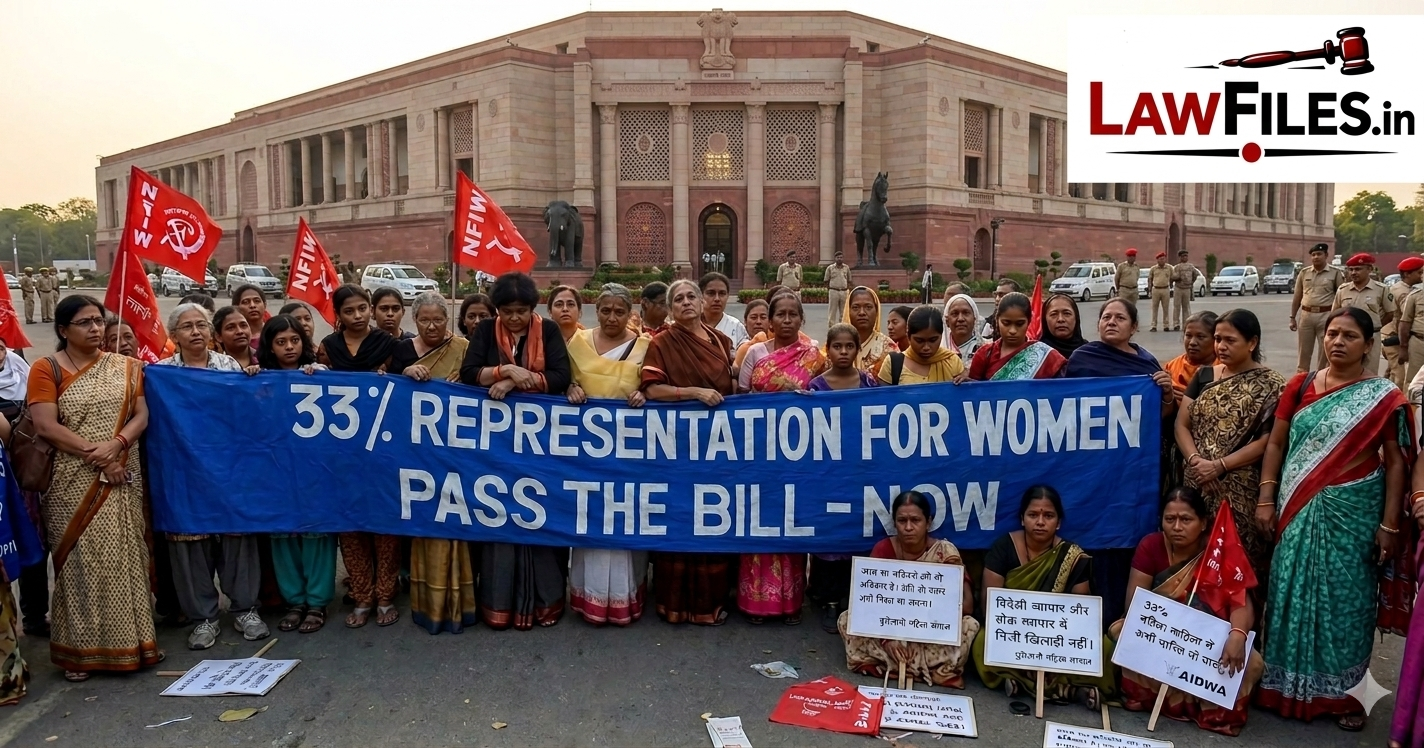
The rejection of the Constitution (131st Amendment) Bill, 2026 must be understood not merely as a parliamentary outcome, but as a defining constitutional moment that has once again postponed women’s entry into India’s highest decision-making forum. While the public discourse has been dominated by the politics of delimitation, the real and immediate consequence lies elsewhere women’s representation in Parliament continues to remain deferred, despite decades of legislative acknowledgement and constitutional commitment. As previously analysed, the collapse of the Bill has directly halted a pathway that could have operationalised one-third reservation in a time-bound manner.
At the centre of this debate was an attempt to align women’s reservation with a structural reform of electoral representation. The approach reflected a broader constitutional understanding that representation cannot be viewed in isolation from the architecture through which it operates. It also echoed a sentiment of true women empowerment which Prime Minister Narendra Modi articulated in his speech that the State is not “granting” rights to Nari Shakti, but restoring what has historically been denied. “It should not be viewed as an act of giving but a repentance of past deed”; rightly said by Prime Minsiter. In constitutional terms, this aligns with the idea of substantive equality, where corrective measures are necessary to remedy systemic exclusion rather than merely ensuring formal parity.
The legal foundation for such corrective measures is firmly rooted in the Constitution of India. Articles 14, 15, and 16 collectively permit the State to enact affirmative action policies to address historical disadvantage. Article 15(3), in particular, explicitly empowers the State to make special provisions for women. Judicial interpretation has consistently upheld that equality is not achieved through neutrality alone but through active intervention; an approach reinforced in cases such as State of Kerala v. N.M. Thomas and Indra Sawhney v. Union of India, where the Supreme Court recognised that affirmative action is intrinsic to the equality code of the Constitution. Women’s reservation in legislatures must therefore be seen not as an exception, but as a constitutionally sanctioned mechanism to achieve real equality.
However, the opposition’s response to this moment raises serious constitutional and political concerns. By rejecting the Bill outright, without advancing any viable alternative mechanism for ensuring immediate reservation, the opposition has effectively ensured that the status quo remains intact. The debate was framed around delimitation, but the consequence was the continued exclusion of women from legislative power. In constitutional theory, this reflects a failure to prioritise substantive rights over procedural objections. When a reform aimed at correcting structural inequality is blocked without a substitute, the effect is to preserve the very inequality the Constitution seeks to dismantle.
At the heart of the controversy was the Union Government’s attempt to link women’s reservation with a delimitation exercise. The Bill proposed expanding Lok Sabha seats from 543 to 850 and implementing reservation for women through this restructuring. However, it failed to secure the constitutionally mandated two-thirds majority, with 298 votes in favour and 230 against. This legislative defeat, rare in recent parliamentary history, has had immediate consequences women’s reservation, though constitutionally recognised in principle, remains practically deferred.
The opposition’s primary argument centred on delimitation. Leaders across parties contended that linking women’s reservation with redrawing electoral boundaries based on the 2011 Census could distort federal representation, particularly disadvantaging southern states with lower population growth. Public statements echoed this concern, with opposition figures alleging that the government was “hiding behind women” to push a politically motivated electoral restructuring.
However, this political framing conceals a critical contradiction. Even as opposition parties expressed support for women’s reservation in principle, their rejection of the Bill effectively prevented its early implementation. Reports indicate that women currently constitute only about 14% of the Lok Sabha, reflecting a longstanding democratic deficit. The Bill, despite its structural linkages, sought to accelerate this representation through a defined legislative mechanism. Its defeat, therefore, has immediate implications not for delimitation, but for women waiting for political inclusion.
A closer constitutional reading further complicates the opposition’s position. The existing legal framework the Constitution (106th Amendment) Act, 2023 already ties women’s reservation to delimitation following the next census. The 131st Amendment attempted to operationalise this promise sooner by advancing delimitation timelines. By opposing this mechanism without proposing an alternative pathway, critics arguably reinforced the very delay they criticised. In effect, the insistence on decoupling delimitation from reservation may have preserved procedural purity but postponed substantive equality.
What further weakens the opposition’s position is the absence of any constructive legislative engagement. Constitutional opposition is not merely about rejection; it carries with it a responsibility to refine, reshape, or propose alternatives. In the present case, no such effort is visible. The failure to suggest interim reservation, phased implementation, or decoupled legislative reform indicates that the resistance was not directed toward improving the framework, but toward stalling it altogether. This transforms the nature of opposition from constitutional scrutiny to political obstruction.
The historical context reinforces this critique. The trajectory of women’s reservation in India has been marked by prolonged delay, particularly during periods when the present opposition parties were in positions of power. Since the 1990s, the Women’s Reservation Bill has witnessed repeated disruptions, lack of consensus-building, and strategic inaction. This pattern reflects a deeper institutional reluctance to undertake reforms that redistribute political power. The present episode, therefore, is not an isolated failure but part of a broader continuum where women’s representation has been consistently deferred.
From a doctrinal standpoint, the episode also engages with the concept of transformative constitutionalism; the idea that the Constitution is not merely a governing document but an instrument for social change. The Supreme Court has repeatedly emphasised that constitutional interpretation must be oriented toward dismantling entrenched inequalities. In this light, women’s reservation is not simply a policy choice; it is a constitutional imperative aimed at achieving inclusive governance. Delaying such a reform, especially without offering an alternative pathway, runs counter to this transformative vision.
The delimitation debate, while important, cannot be allowed to become a constitutional veto point. Delimitation itself is a mechanism to ensure equal representation based on population, grounded in Articles 81 and 82 of the Constitution. However, when it is used to indefinitely postpone another constitutionally recognised reform, it ceases to function as a tool of equality and becomes an instrument of delay. The failure to reconcile these two aspects reflects a broader inability within the political system to balance structural reform with social justice.
In conclusion, the rejection of the Constitution (131st Amendment) Bill represents more than a legislative disagreement, it is a moment where constitutional purpose has been overshadowed by political calculation. The legal framework for women’s reservation is clear, the constitutional mandate is well-established, and the need for reform is undisputed. Yet, the absence of political will to translate this into reality continues to delay meaningful representation.
Ultimately, the episode underscores a critical constitutional truth: rights deferred are often rights denied in practice. And in this case, the continued deferral of women’s reservation reflects not a limitation of the Constitution, but a failure of the political process to honour its transformative promise.
