


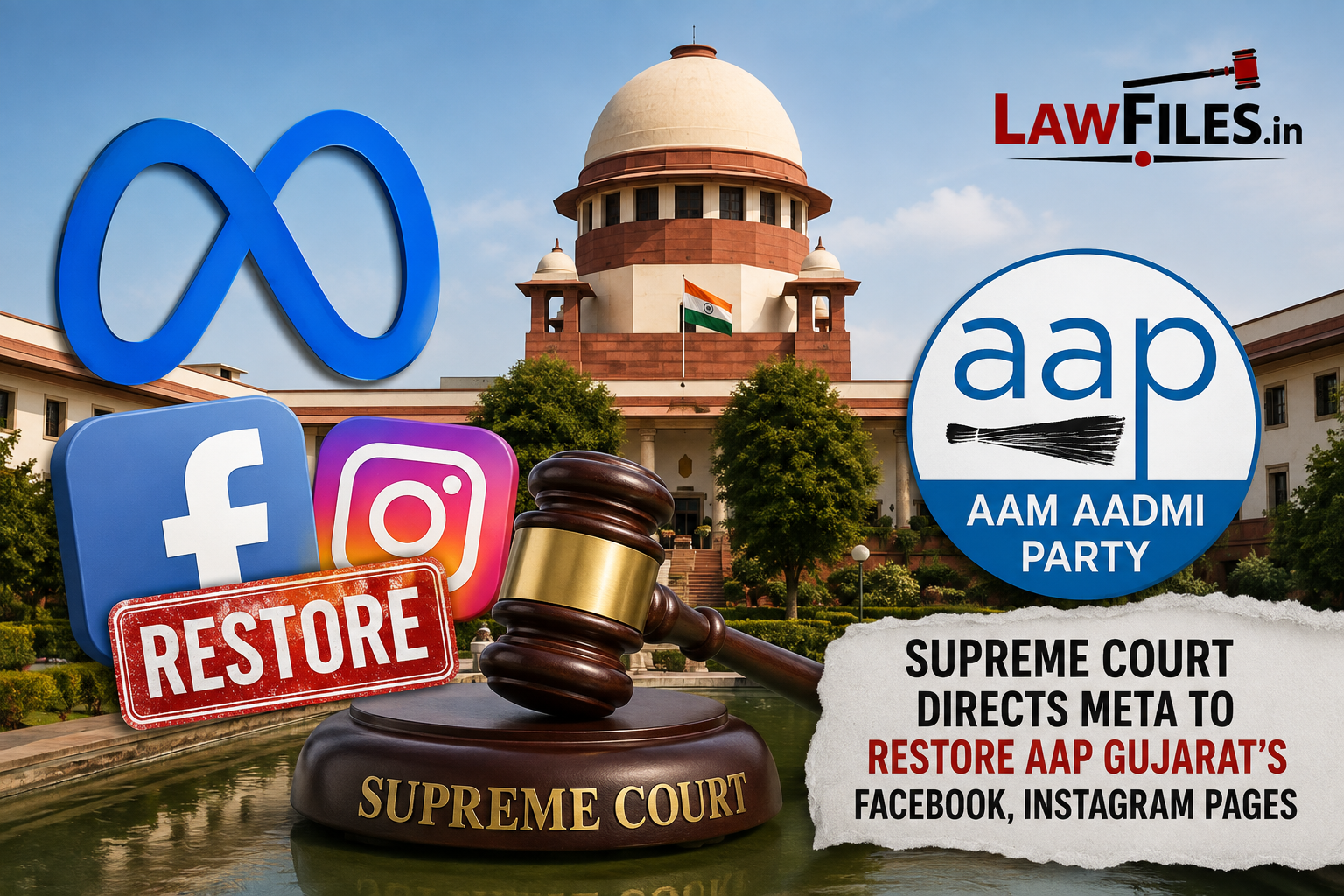
The Supreme Court has directed Meta to restore the Facebook page and Instagram account of the Gujarat unit of the Aam Aadmi Party, bringing into sharp focus the constitutional limits on the blocking or suspension of political parties from social-media platforms. The order assumes significance far beyond the immediate dispute because political communication in contemporary India increasingly takes place through privately owned digital platforms. When an established political party loses access to its official digital accounts, the consequence is not merely the temporary loss of an online profile. It can affect the party’s ability to communicate with voters, disseminate political programmes, respond to public issues and participate effectively in electoral discourse.
The controversy arose after the Gujarat unit of the Aam Aadmi Party’s official Instagram handle and Facebook page were suspended on April 25, 2026, shortly before local-body elections in the State. The party approached the Supreme Court challenging the action and questioned the legal basis on which its accounts had been blocked. According to the case placed before the Court, the suspension was connected with allegations of copyright violations concerning the use of scenes and clips from Gujarati films in political campaign material. The AAP, however, disputed the manner and timing of the action and alleged that the blocking was politically motivated.
The timing of the suspension became an important element in the controversy. A political party’s social-media accounts are not comparable to an ordinary individual’s personal account. They function as an extension of the party’s political communication machinery. Particularly during an election period, the ability to publish campaign material, explain policies and respond to allegations can have a direct bearing on the party’s participation in democratic discourse. Consequently, a decision by a platform to disable such accounts, especially when the action is based upon a government or law-enforcement direction, raises questions extending beyond contractual terms of service and into the constitutional protection of political expression.
The Supreme Court had initially sought responses from the Union Government, the State of Gujarat and Meta Platforms after the AAP approached it. The proceedings were also connected with broader litigation concerning the blocking of social-media accounts without adequate notice to users. The Court’s subsequent direction to restore the accounts represents a significant development in that continuing debate because it places the question of intermediary action within the larger framework of constitutional rights, procedural fairness and the special importance of political speech.
The legal controversy involves an important distinction between two different mechanisms under the Information Technology Act. Section 69A of the Information Technology Act provides the statutory framework for governmental blocking of public access to online information on specified grounds, including sovereignty and integrity of India, defence of India, security of the State, friendly relations with foreign States, public order and prevention of incitement to cognisable offences relating to those grounds. The provision is accompanied by procedural safeguards under the Blocking Rules.
Section 79, on the other hand, principally deals with the intermediary safe-harbour framework. It protects intermediaries from liability for third-party information in specified circumstances, subject to compliance with the statutory requirements. Section 79(3)(b) concerns circumstances in which an intermediary may lose the benefit of safe harbour when, after receiving actual knowledge or being notified by the appropriate government or its agency that unlawful information is being hosted, it fails to expeditiously remove or disable access to that material.
This distinction was central to the challenge brought by the AAP. Senior Advocate Shadan Farasat had argued that Section 79(3)(b) could not itself be treated as an independent source of governmental power to block an entire social-media account. According to the submission, the provision operates in the context of intermediary liability and safe harbour and cannot simply be transformed into a general power to silence an entire political account.
The argument raises a substantial question of statutory interpretation. A provision dealing with the circumstances in which an intermediary may lose immunity from liability is conceptually different from a provision that expressly empowers the State to direct blocking of online information. If the State seeks to restrict access to speech, the source of that power must be identifiable in law and the statutory procedure associated with that power must be followed.
This distinction is particularly important because blocking an entire account is qualitatively different from removing an individual post. If a particular video allegedly infringes copyright, the obvious question is why the remedy should necessarily extend to disabling an entire political party’s digital presence. The principle of proportionality becomes relevant at precisely this point.
A restriction may have a legitimate objective but still be legally excessive if the means adopted are substantially broader than necessary to achieve that objective. If the alleged violation concerns specific copyrighted clips, disabling an entire Facebook page and Instagram account could potentially affect hundreds or thousands of unrelated pieces of political speech. The legal justification for such a sweeping measure would therefore require closer scrutiny than a direction limited to the allegedly infringing material.
This is where the Supreme Court’s intervention acquires wider constitutional significance. Article 19(1)(a) protects freedom of speech and expression, and political speech occupies a particularly important position within that guarantee. Political expression is not merely another form of speech. It lies at the heart of representative democracy because citizens must be able to criticise governments, advocate alternative policies and communicate political choices.
The Supreme Court has repeatedly recognised the special importance of political speech in a constitutional democracy. Restrictions upon political communication therefore require particularly careful scrutiny. The government cannot ordinarily silence political expression merely because it is inconvenient or critical. Any restriction must fall within the constitutionally permissible framework of Article 19(2) and must satisfy the requirements of legality, necessity and proportionality.
The digital medium does not diminish this constitutional protection. The Constitution protects expression because of its democratic value, not because of the particular technology through which the expression is communicated. A political speech delivered at a public meeting, published in a newspaper or disseminated through an online platform may raise different regulatory questions, but the fundamental constitutional interest remains freedom of expression.
The present case consequently brings an important question to the forefront: can the State indirectly suppress political speech by requiring a private intermediary to disable the digital platform through which that speech is communicated? The answer cannot depend solely on the private nature of the platform.
Meta is a private company and its platforms are governed by contractual terms, community standards and copyright policies. Ordinarily, a private platform may regulate the content hosted on its services and may take action against material that violates its rules. But the legal position becomes considerably more complicated when the blocking is undertaken pursuant to governmental directions or when the consequence is the suppression of political communication.
The State cannot evade constitutional scrutiny simply by acting through an intermediary. If a government authority directs a private platform to restrict expression, the legality of the underlying State action must remain open to judicial examination. Otherwise, constitutional restrictions on State censorship could potentially be circumvented by outsourcing the actual act of blocking to a private corporation.
This does not mean that social-media platforms are constitutionally required to host every form of content. Copyright law, defamation law, criminal law, intellectual-property rights and platform policies continue to operate online. The constitutional question arises when State power is invoked to compel or facilitate restrictions upon expression.
The distinction is important because the AAP matter reportedly originated in allegations concerning copyrighted material used in campaign content. Copyright protection is itself a legitimate legal interest. Political parties cannot claim immunity from copyright law merely because the material is used for political communication. If copyrighted film footage has been used without permission in circumstances attracting liability, appropriate legal remedies remain available.
But the existence of copyright protection does not automatically answer the question of whether an entire political account can be disabled. The remedy must remain proportionate to the alleged infringement.
The issue can be understood through the broader principle of least restrictive intervention. If removing a particular infringing video adequately addresses the legal violation, disabling the entire account may require additional justification. If repeated violations demonstrate systematic disregard of copyright law, a platform may have stronger grounds under its own terms to impose broader restrictions. But where governmental authority is involved, the statutory basis and procedural safeguards become particularly important.
This is one reason the Court’s direction to restore the accounts is legally significant. It indicates that the dispute cannot be reduced to a simple contractual disagreement between AAP and Meta. The Court is examining the interface between intermediary regulation, governmental blocking powers and constitutional freedom of political expression.
The matter also raises the issue of procedural fairness. The AAP had alleged that the accounts were suspended without prior notice and without being furnished with the blocking order or adequate reasons. Affected parties cannot effectively challenge a restriction if they do not know the legal basis for the restriction, the material alleged to be unlawful or the authority responsible for ordering the action.
Natural justice does not require identical procedures in every situation. There may be circumstances involving national security, public order or other urgent concerns where prior notice cannot reasonably be provided. But where such exceptional considerations are absent, transparency becomes particularly important because the affected party must have some meaningful opportunity to challenge the decision.
This principle becomes even more compelling where the affected party is a political organisation. A political party whose official communication channels are disabled should ordinarily be able to ascertain why the restriction was imposed and what steps are available for restoration. Otherwise, the party may effectively be deprived of an important channel of democratic participation without a meaningful opportunity to contest the decision.
The timing of the suspension makes the procedural question still more sensitive. The accounts were reportedly blocked shortly before local-body elections. Election periods are precisely when political communication becomes most intense and most constitutionally significant. A restriction imposed immediately before an election can have consequences that extend beyond the duration of the suspension because lost communication opportunities cannot necessarily be recovered after the electoral process has moved forward.
The Supreme Court’s intervention therefore reflects an important constitutional insight: the temporal context of a restriction can affect its practical impact on fundamental rights.
A restriction lasting a few days during an ordinary period may have a very different effect from the same restriction imposed during an election campaign. During an election, political parties communicate with voters at an accelerated pace, announce candidates and programmes, respond to opponents and disseminate campaign material. Removing a party’s principal online channels at that stage can substantially alter the conditions under which political competition takes place.
This does not mean that political parties should receive immunity from lawful content regulation during elections. It means that any restriction affecting their political communication should be examined with heightened procedural care.
The case also highlights the changing nature of electoral democracy. Political campaigns are no longer confined to rallies, posters, newspapers and television broadcasts. Social media has become an important means through which parties communicate directly with citizens without relying upon traditional gatekeepers. The ability to publish instantly, respond to criticism and reach geographically dispersed audiences has fundamentally altered political campaigning.
That technological transformation creates both opportunities and risks. Digital platforms can increase political participation and provide smaller parties with an inexpensive means of reaching voters. At the same time, they can facilitate misinformation, copyright violations, hate speech, manipulated media and targeted propaganda. The regulatory challenge is therefore not to leave the digital space completely unregulated but to ensure that regulation does not become a disproportionate mechanism for controlling legitimate political speech.
The AAP case sits squarely within that tension. The Court’s decision also has implications for the relationship between government and technology companies. Intermediaries increasingly occupy a position between citizens and the State. They control access to platforms that have become essential to communication, yet they remain private entities governed by commercial terms. Governments, meanwhile, increasingly rely upon legal and administrative mechanisms to require removal or restriction of online material.
This creates what may be described as a new constitutional intermediary problem: when private platforms become essential spaces for public discourse, how should the law balance their private rights of platform governance against the public’s interest in preserving freedom of expression?
Indian constitutional law is still developing around this question. Traditional free-speech jurisprudence was developed primarily in relation to newspapers, public assemblies, broadcasting and State censorship. Social media introduces a different institutional structure in which private corporations can exercise enormous practical influence over the visibility of speech.
The answer cannot simply be that every social-media platform is a public authority. That would have significant consequences for private property, platform autonomy and business operations. Nor can the law ignore the democratic significance of these platforms merely because they are privately owned. The constitutional difficulty becomes especially pronounced where the State itself is involved.
If a platform independently removes content under its terms of service, the dispute may primarily concern contract, copyright, intermediary rules or private-law remedies. But when the platform acts because a governmental agency directs it to do so, constitutional scrutiny becomes more directly relevant.
The Supreme Court’s consideration of the AAP matter, particularly alongside other petitions challenging blocking without adequate notice, may therefore contribute to the development of a clearer legal framework governing State-directed restrictions on online speech.
One of the most important issues likely to emerge is whether notice and hearing should ordinarily precede account-level blocking. A blanket requirement could potentially create difficulties in urgent cases, particularly where content presents immediate threats to security or public order. But an absence of procedural safeguards altogether creates an equally serious danger: arbitrary restrictions can become effectively unchallengeable.
A balanced framework could distinguish between emergency blocking and ordinary restrictions. In genuinely urgent circumstances, immediate temporary action may be justified, but subsequent disclosure of reasons and an opportunity for review could provide a safeguard against indefinite restrictions. In ordinary cases, notice and reasons should ordinarily form part of the process.
Such safeguards would benefit platforms as well. A clear legal order identifies the authority behind the restriction and provides the intermediary with a definite statutory basis for action. It also protects the platform from being placed in the position of informally deciding politically sensitive questions without adequate governmental documentation.
The case also brings Section 69A into sharper focus. The provision contains specified grounds on which information may be blocked, and the Supreme Court has previously upheld the constitutional validity of the provision while emphasising procedural safeguards. A blocking order under Section 69A cannot therefore be treated as an unlimited executive power. The statutory grounds and prescribed procedure must be respected.
If the government relies upon another provision to justify account-level blocking, the source and scope of that power must equally be demonstrated. A statutory provision cannot ordinarily be stretched beyond its legislative purpose simply because the desired administrative result appears convenient.
This is the core of the challenge concerning Section 79(3)(b). If that provision is designed principally to regulate intermediary safe harbour, using it as a standalone source of power to block an entire political account could raise serious questions of statutory interpretation.
The principle of delegated or ancillary power is relevant here. An authority must ordinarily be able to identify the statutory provision under which it acts. Administrative convenience cannot create a power that Parliament has not granted. Where the exercise of power affects fundamental rights, courts traditionally insist upon greater clarity concerning the legal source of that power.
This is also why the Supreme Court’s decision could have implications beyond political parties. Journalists, activists, civil-society organisations, businesses and ordinary users increasingly depend upon social-media accounts to communicate with the public. If an entire account can be disabled without notice on the basis of an unclear statutory mechanism, the consequences could extend widely.
Conversely, if platforms are prevented from responding swiftly to genuine illegal content, copyright violations or threats, the regulatory system could become ineffective.
The solution therefore lies not in absolute freedom or absolute control, but in clear legal authority, procedural fairness and proportionality.
The Court’s restoration direction should accordingly not be read as granting political parties a special exemption from platform rules. AAP remains subject to applicable copyright law and Meta’s legitimate content policies. What the order underscores is that the State’s role in disabling political communication must be legally justified and procedurally defensible.
That distinction protects the autonomy of platforms as well. A private intermediary should not become a substitute for governmental decision-making. If the State believes that certain information must be blocked, it should issue a legally sustainable order under the appropriate statutory framework rather than rely upon informal communications that leave both the intermediary and the affected user uncertain about the basis of the restriction.
The controversy also demonstrates the importance of reasoned administrative action. Reasons serve several functions. They allow the affected person to understand the decision, enable a reviewing court to examine its legality and discipline the decision-maker by requiring the authority to justify its action. In digital-content regulation, where decisions can affect millions of users, reasoned orders are particularly important.
A vague direction stating that an account must be blocked does not adequately explain whether the entire account, a specific post or a particular category of content is considered unlawful. The scope of the restriction should correspond to the scope of the alleged violation. This is where proportionality and reasons operate together.
If a single copyrighted clip is the problem, why the entire account? If several posts are unlawful, why all political communication? If an emergency justifies immediate blocking, what safeguards ensure that the restriction does not continue after the emergency ends? These questions are central to any constitutionally sound digital-blocking regime.
The Supreme Court’s decision is also noteworthy because it demonstrates that freedom of speech in the digital era increasingly requires courts to examine the architecture of communication, not merely the content of individual statements. A political party’s Facebook page or Instagram account is effectively a digital communication infrastructure. Blocking the infrastructure can be more consequential than removing any individual piece of speech.
This raises the possibility that future courts may increasingly distinguish between content-level restrictions and account-level restrictions. The latter may require stronger justification because they affect lawful content that may have no connection whatsoever with the alleged violation. Such a distinction would be consistent with ordinary proportionality analysis. The greater the breadth of the restriction, the stronger the justification required.
The present case also reinforces the constitutional significance of opposition political activity. A democratic system does not protect expression only when it is directed towards government policy in abstract terms. Political parties must be able to criticise governments, mobilise supporters and present alternative programmes. Restrictions affecting the opposition therefore require particular care because the State itself may have an institutional interest in the political contest in which the restriction operates.
This does not mean that every government action against an opposition party is presumptively unconstitutional. It means that constitutional institutions must remain alert to the possibility of state power affecting the conditions of political competition.
The Supreme Court’s restoration order can therefore be understood as a reaffirmation that digital access has become an important component of political participation.
The larger legal significance of the case lies in the principle that technological platforms cannot become spaces where constitutional rights disappear merely because the underlying infrastructure is privately owned. At the same time, constitutional rights cannot be interpreted in a manner that eliminates legitimate private rights or statutory regulation.
The law must mediate between these competing interests. For Meta, the case underscores the importance of transparent procedures when responding to government directions. For the government, it reinforces the need to rely upon clearly identifiable statutory powers and follow prescribed safeguards. For political parties, it demonstrates that digital communication is increasingly treated as an important component of democratic participation. And for citizens, it raises a fundamental question about who ultimately controls the digital spaces through which political information reaches them.
The answer cannot be left entirely to either governments or corporations. The constitutional framework must provide meaningful safeguards. The Supreme Court’s intervention is therefore likely to have consequences extending beyond the restoration of two social-media accounts. It could contribute to a broader jurisprudence concerning government-directed online blocking, intermediary liability, political speech and procedural fairness. The pending litigation involving similar challenges to social-media blocking makes the issue particularly significant because a consistent legal standard could eventually emerge governing when and how the State can restrict access to digital platforms.
The immediate controversy may have originated in alleged copyright infringement, but the legal question is much wider. It concerns whether the remedy for a particular alleged illegality can be so broad that it disables an entire channel of political expression. The constitutional answer should ordinarily be guided by necessity and proportionality.
A government may protect copyright. It may protect public order. It may investigate unlawful content. It may require intermediaries to comply with legitimate statutory directions. But every such exercise of power must remain within the boundaries of law.
Similarly, a political party may campaign vigorously, but it cannot claim immunity from copyright law or other legitimate restrictions merely because its communication is political.
The Court’s intervention therefore does not establish a hierarchy in which political speech automatically defeats all competing rights. Rather, it reinforces a more fundamental proposition: restrictions upon political communication must have a clear legal foundation and must not be broader than what the law legitimately permits.
That proposition is particularly important in an election environment, where even a temporary restriction can have consequences that cannot later be fully remedied.
The digital age has made the question unavoidable. Political participation increasingly depends upon access to privately controlled communication infrastructure. If that infrastructure can be disabled without adequate reasons, notice or review, the practical content of freedom of expression can become significantly narrower than its formal constitutional guarantee.
The Supreme Court’s direction to restore the AAP Gujarat accounts thus represents an important judicial assertion that digital political communication remains subject to constitutional discipline. The State cannot simply bypass Article 19 by acting through a private intermediary, nor can an intermediary’s private status automatically insulate State-directed restrictions from judicial review.
At the same time, the judgment should not be misunderstood as creating an unrestricted right for political parties to maintain social-media accounts irrespective of unlawful content. The rule of law requires that copyright, criminal law, privacy, public order and other legitimate interests continue to be protected.
The real constitutional challenge is to ensure that those interests are protected through lawful, transparent and proportionate means.
Ultimately, the dispute presents a modern version of an old constitutional question: how far may the State go in restricting speech in the name of another legitimate interest? What has changed is the medium. A political party’s platform today may be a Facebook page or Instagram account rather than a newspaper press or public meeting. But the underlying constitutional principle remains familiar.
Freedom of political expression is indispensable to representative democracy. Restrictions upon it require legal authority. Legal authority requires procedure. Procedure must be fair. And the restriction itself must remain proportionate to the harm sought to be prevented.
The Supreme Court’s decision to restore the AAP Gujarat pages therefore carries significance beyond the immediate parties. It signals that as political discourse moves increasingly into privately operated digital spaces, constitutional courts will necessarily have to examine not only what is said online but who has the power to silence it, under what authority, through what procedure and to what extent.
That is the real constitutional question emerging from the case. The future of digital free speech in India will depend not on whether governments or platforms are given absolute control, but on whether the legal system succeeds in ensuring that neither can exercise that control arbitrarily.
