


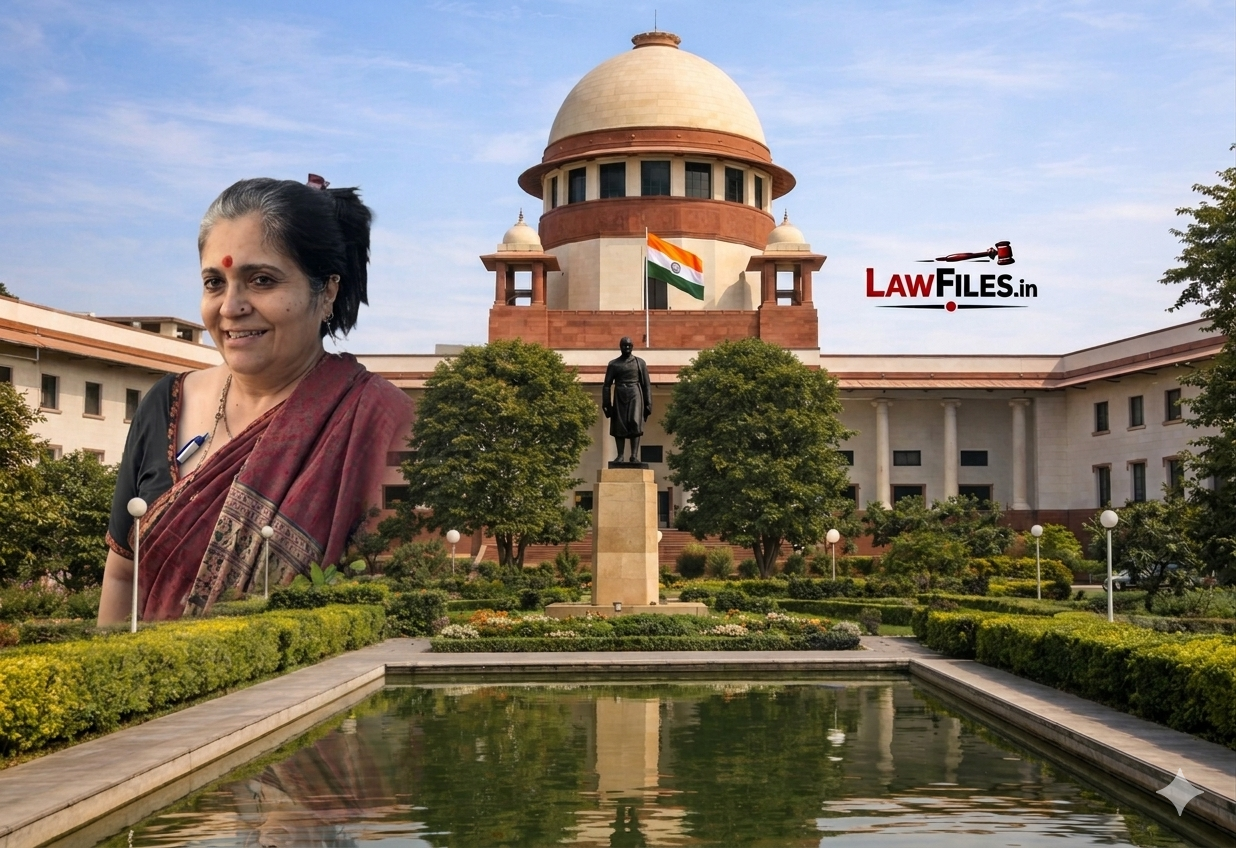
In a significant development engaging the intersection of personal liberty, procedural fairness, and bail jurisprudence, the Supreme Court of India has agreed to hear a plea filed by activist Teesta Setalvad seeking release of her passport, which was surrendered as a condition of bail.
The matter, now listed before a three-judge Bench, raises an important constitutional question whether prolonged restrictions on travel can be justified once an accused is enlarged on bail and cooperating with the investigation.
Teesta Setalvad was granted interim bail by the Supreme Court in September 2022 in a case alleging fabrication of evidence and conspiracy in connection with the 2002 Gujarat riots. As part of the bail conditions, she was directed to surrender her passport and cooperate with the investigation. Subsequently, in July 2023, the Supreme Court granted her regular bail, while criticising the Gujarat High Court’s earlier refusal as “perverse” and legally untenable.
Despite being on bail, the restriction on her travel has continued, prompting the present plea seeking restoration of her passport and freedom of movement. Setalvad’s arrest in June 2022 by the Gujarat Anti-Terrorism Squad came shortly after the Supreme Court dismissed a petition challenging the closure report of the Special Investigation Team (SIT) in the Gujarat riots cases.
She was accused of criminal conspiracy, forgery and fabrication of evidence. and attempting to implicate public officials through false testimonies. Investigating agencies alleged that she, along with others, had “tutored witnesses and fabricated material” in an attempt to reopen settled issues. On the other hand, Setalvad has consistently maintained that her actions were part of her long-standing work as a human rights defender advocating for victims of the 2002 riots, including through her organisation Citizens for Justice and Peace.
This dual narrative between allegations of fabrication and claims of rights-based advocacy continues to shape the legal and public discourse surrounding the case. The core issue before the Supreme Court now is narrow but significant: Whether retention of passport as a bail condition can continue indefinitely. Whether such restriction disproportionately curtails the right to travel abroad, which has been recognised as part of Article 21 (right to personal liberty)
The plea argues that once the accused is on bail, investigation has substantially progressed and there is no flight risk and continued restriction on travel becomes punitive rather than preventive. Indian constitutional jurisprudence has consistently held that the right to travel abroad is an integral part of personal liberty under Article 21, subject to reasonable restrictions.
Courts have also clarified that bail conditions must satisfy the test of necessity, proportionality and non-arbitrariness. A condition that is excessive or unrelated to securing the presence of the accused may be struck down as violative of fundamental rights. In this context, the Supreme Court’s consideration of Setalvad’s plea may further refine the law on how long and under what circumstances travel restrictions can be imposed on an accused person. The case reflects a recurring tension in criminal law. The State’s interest in ensuring fair investigation and trial. The individual’s right to live with dignity and freedom while on bail. The Supreme Court has, in several cases, emphasised that bail is the rule and jail is the exception. Extending that principle, restrictions attached to bail must not convert liberty into a conditional or illusory right.
The outcome of this case could have wider ramifications. It may set precedent on time limits and review of bail conditions. It could influence cases where passports are routinely seized as a matter of practice. It may strengthen the jurisprudence on proportionality in criminal procedure. For activists, journalists, and public figures facing criminal prosecution, the ruling may determine the extent to which movement and professional engagement can continue during trial.
The Supreme Court’s decision to examine Teesta Setalvad’s plea goes beyond an individual grievance, it touches upon a fundamental constitutional concern; can liberty be meaningfully exercised if it remains subject to indefinite executive or judicial restraint? As the Court deliberates, the case is likely to shape the contours of bail jurisprudence, personal freedom, and the balance between State power and individual rights in India’s criminal justice system.
