


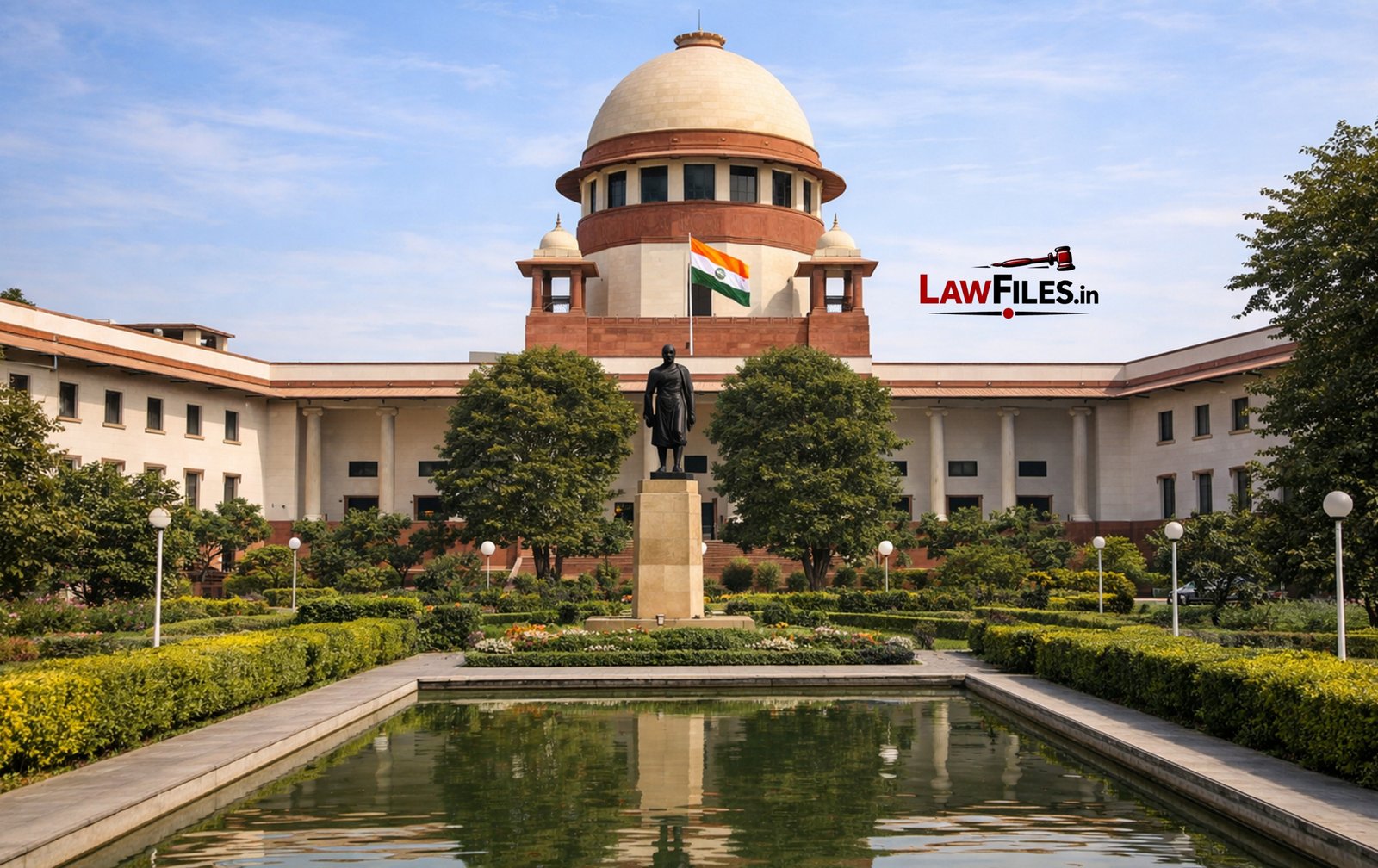
In a significant development for commercial litigation in India, the Supreme Court of India has laid down structured guidelines governing the exercise of summary judgment under Order XIII-A of the Code of Civil Procedure (CPC). The ruling marks a decisive judicial push toward procedural efficiency, signalling a shift away from the entrenched culture of full-fledged trials even in cases where disputes are legally or factually unsubstantial.
At its core, the judgment interprets Order XIII-A introduced through the Commercial Courts Act, 2015 as a transformative procedural tool designed to enable courts to decide commercial disputes without recording oral evidence where unnecessary. The Court emphasised that summary judgment is not an exception to justice but a means of delivering it efficiently, particularly in high-value commercial disputes where prolonged litigation undermines economic certainty.
A central pillar of the Court’s reasoning is the articulation of the “real prospect of success” standard. The Court clarified that summary judgment may be granted where:
- the plaintiff has no real prospect of succeeding, or
- the defendant has no real prospect of defending the claim.
This formulation elevates the threshold beyond mere arguability. It requires courts to distinguish between genuine disputes and illusory defences, cautioning against allowing litigation to proceed on speculative or “fanciful” grounds. The implication is profound: the traditional presumption in favour of trial is no longer absolute in commercial matters. The Court’s directive that judges must “grasp the nettle and decide” reflects a conscious doctrinal shift. It recognises that the conventional model of trial premised on exhaustive oral evidence is often disproportionate in commercial disputes where documentation and legal interpretation dominate.
In doing so, the Court aligns Indian procedure with global commercial litigation standards, where summary adjudication is a critical mechanism for reducing costs, delays, and judicial backlog. The emphasis is on proportionality ensuring that the procedure adopted is commensurate with the nature and complexity of the dispute.
The Supreme Court laid down non-exhaustive guidelines to discipline the exercise of summary judgment jurisdiction. Key principles include:
- strict compliance with procedural requirements under Order XIII-A,
- evaluation of whether a trial would serve any meaningful purpose,
- consideration of both existing evidence and evidence reasonably expected at trial, and
- recognition that the power is exceptional and must be exercised with caution.
These guidelines seek to strike a balance preventing both premature disposal and unnecessary prolongation of litigation. They also aim to standardise judicial practice, reducing inconsistencies across commercial courts.
A critical clarification emerging from the judgment is the rejection of “mini-trials” at the summary judgment stage. The Court warned that the purpose of Order XIII-A would be defeated if courts engage in detailed evidentiary analysis akin to a full trial. Instead, the inquiry must remain confined to assessing whether a real, not merely arguable, dispute exists.
This distinction is vital. It prevents summary judgment from degenerating into a procedural formality while preserving its core objective early resolution of meritless claims. The guidelines were articulated in the context of a commercial dispute involving refund claims arising from a failed land transaction with the Delhi Development Authority. The Court found that the defence raised was legally untenable and did not warrant a trial, thereby allowing summary judgment.
This application underscores the Court’s willingness to intervene where lower courts adopt an overly cautious approach, reinforcing that judicial hesitation cannot justify procedural inefficiency. The judgment reframes access to justice not merely as the right to a hearing, but as the right to a timely and proportionate resolution. By endorsing summary judgment as a legitimate and necessary tool, the Court challenges the long-standing assumption that justice necessarily requires a full trial.
This perspective is particularly relevant in commercial litigation, where delays translate into financial uncertainty and economic inefficiency. The Court’s approach thus integrates procedural law with broader economic considerations.
While the ruling advances efficiency, it also raises important concerns. The discretionary nature of summary judgment may lead to inconsistent application, particularly in borderline cases where the distinction between a “real” and “arguable” defence is subjective. There is also a risk that overzealous use of summary judgment could compromise procedural fairness, especially where parties lack equal access to documentary evidence.
Moreover, the success of this framework depends on judicial capacity and training. Without a nuanced understanding of commercial disputes, courts may either overuse or underutilise the mechanism, undermining its intended purpose.
The Supreme Court’s guidelines on Order XIII-A CPC mark a pivotal moment in the evolution of Indian civil procedure. By encouraging courts to decisively filter out meritless litigation, the judgment seeks to transform commercial adjudication from a trial-dominated system to an efficiency-driven model.
Yet, the true impact of this ruling will depend on its implementation. If applied judiciously, it has the potential to significantly reduce delays and enhance the credibility of India’s commercial dispute resolution framework. If misapplied, it risks creating new uncertainties. In essence, the Court has not merely interpreted a procedural provision, it has articulated a broader judicial philosophy: that justice, to be meaningful, must be not only fair but also swift, proportionate, and responsive to the realities of modern commercial life.
