


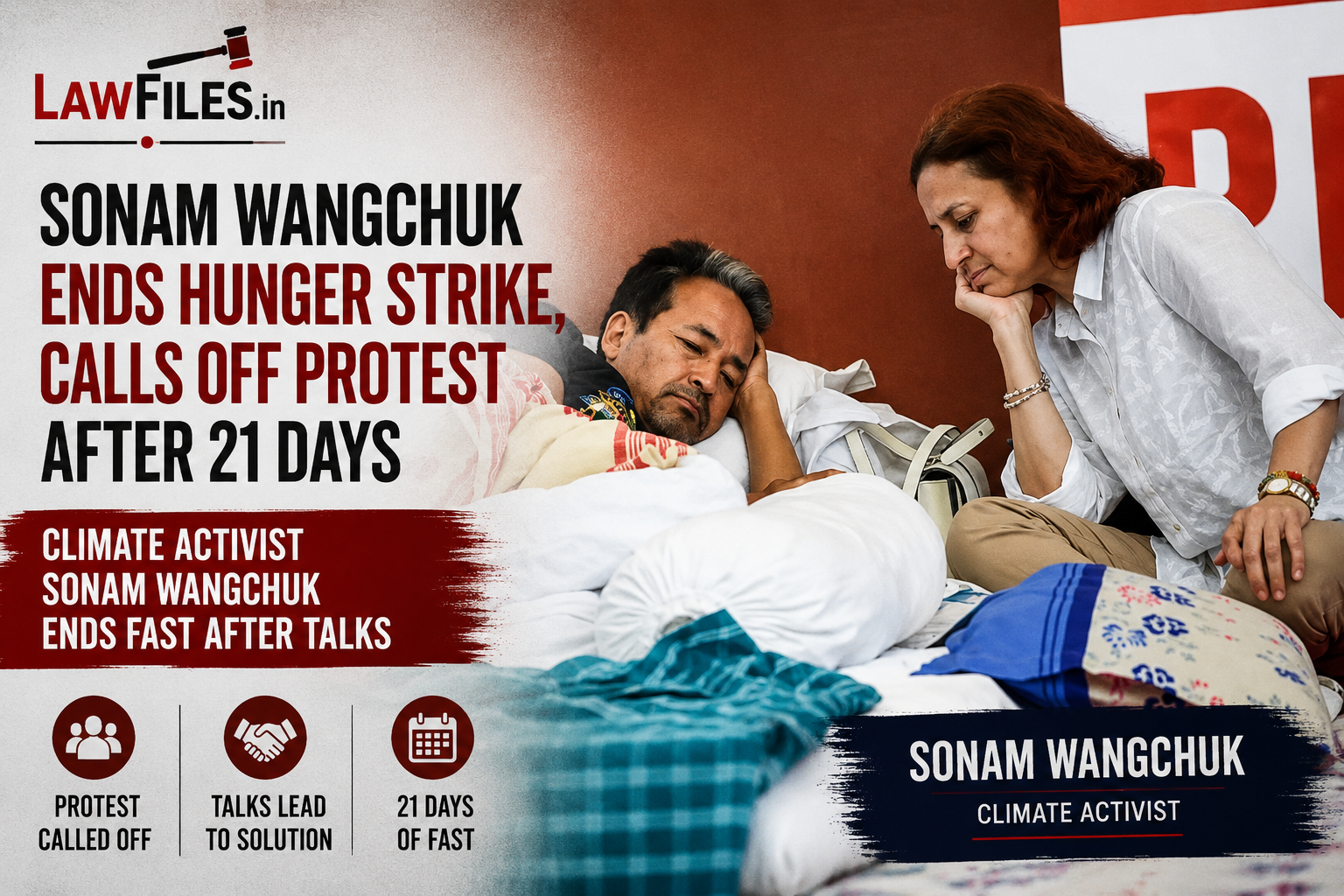
In a case that lies at the intersection of constitutional liberty, medical autonomy and the State’s obligation to preserve life, the Delhi High Court has refused to grant interim relief seeking the transfer of climate activist Sonam Wangchuk from Safdarjung Hospital to a private medical facility of his family’s choice. Hearing an urgent petition filed by Wangchuk’s wife, Dr. Gitanjali J. Angmo, the Court observed that the authorities had acted within the bounds of law in shifting the activist to a government hospital after his health deteriorated during a prolonged hunger strike. The Court noted that Wangchuk had not voluntarily sought medical treatment despite his worsening condition and that the administration could not be faulted for intervening to prevent a potentially life-threatening situation. At the same time, the Court clarified that the larger petition challenging the circumstances surrounding his hospitalisation remains pending and that its observations were confined only to the prayer for interim relief. The proceedings therefore raise a larger constitutional question: to what extent can the State intervene to protect the life of an individual who consciously refuses medical assistance as part of a political protest?
The matter was heard on an urgent basis after Dr. Angmo approached the Delhi High Court expressing concern over her husband’s continued admission at Safdarjung Hospital. She submitted that the family had lost confidence in the treatment being provided and sought permission to shift Wangchuk to a private hospital where he could receive medical care in an environment chosen by his family. Counsel appearing on her behalf argued that every competent adult possesses the autonomy to choose his treating doctors and medical institution and that the continued stay in a government hospital, particularly under substantial police presence, adversely affected both his physical recovery and psychological well-being. It was also contended that the activist had not voluntarily consented to being taken to Safdarjung Hospital and that his continued confinement there deserved judicial scrutiny.
Opposing the plea, the Government and the Delhi Police defended the decision to shift Wangchuk to Safdarjung Hospital after his health significantly deteriorated during his fast. According to the authorities, medical experts had repeatedly warned that his prolonged refusal to eat had created a serious risk to his life, including the possibility of life-threatening electrolyte imbalance. The State argued that when an individual’s physical condition reaches such a critical stage, public authorities cannot remain passive spectators merely because the person declines treatment. Their constitutional obligation under Article 21, it was submitted, extends not merely to respecting liberty but also to protecting life wherever immediate intervention becomes necessary. The authorities further maintained that the transfer to the hospital had been carried out without unnecessary force and solely upon medical advice.
After hearing both sides, the Delhi High Court declined to pass any interim order permitting Wangchuk’s transfer to a private medical institution. The Court observed that the administration was justified in shifting him to Safdarjung Hospital because he had not voluntarily admitted himself for treatment despite his deteriorating medical condition. Once the State became aware that his health had reached a stage requiring urgent medical intervention, it could not simply ignore the situation. The Court therefore held that, at least at the interim stage, there was no reason to interfere with the decision to continue treatment at the government hospital. Importantly, however, the Court refrained from expressing any final opinion on the broader issues raised in the petition, leaving those questions open for adjudication at a subsequent stage.
Although the order concerns an interim application, the issues raised by the litigation touch upon some of the most complex questions in constitutional jurisprudence. The first concerns the relationship between personal autonomy and the State’s duty to preserve life. Article 21 of the Constitution protects both the right to life and the right to personal liberty. Modern constitutional jurisprudence increasingly recognises bodily autonomy and informed medical consent as important components of personal liberty. Yet the same constitutional provision also imposes a positive obligation upon the State to protect human life. The present case illustrates the tension that arises when these two constitutional values appear to point in different directions. If a competent adult consciously refuses medical intervention as part of a political protest, should the State respect that decision in the name of autonomy, or intervene to prevent irreversible harm in discharge of its constitutional responsibilities? The High Court’s interim order leans towards the latter proposition where the medical condition becomes sufficiently grave.
The litigation also highlights the constitutional significance of hunger strikes as a form of political expression. Hunger strikes have historically occupied a unique place within democratic movements, functioning simultaneously as acts of protest, civil disobedience and moral persuasion. Indian constitutional courts have generally recognised peaceful protest as an aspect of the freedoms guaranteed under Article 19, subject to reasonable restrictions in the interests of public order and other constitutional considerations. However, when a hunger strike progresses to a stage where it threatens the protester’s life, constitutional values begin to overlap. The State’s obligation to maintain public health and protect life comes into direct engagement with the individual’s right to determine the manner in which political dissent is expressed.
Another important legal issue concerns the doctrine of patient choice. Ordinarily, a competent adult possesses considerable freedom to choose the doctor, hospital and treatment options available to him. Medical ethics emphasises informed consent and respect for patient autonomy. Nevertheless, this autonomy is not entirely absolute in all circumstances. Courts across jurisdictions have recognised that where immediate medical intervention becomes necessary to prevent imminent loss of life, especially when public authorities are already responsible for the individual’s safety, temporary restrictions upon absolute patient choice may be legally sustainable if they are proportionate and medically justified. The High Court’s observations indicate that the Government’s action, at least prima facie, fell within this limited constitutional space.
The case also raises broader questions regarding judicial review of executive medical decisions. Courts generally exercise restraint while evaluating specialised medical assessments unless the decision is demonstrably arbitrary, mala fide or unsupported by expert opinion. Here, the High Court appears to have accepted, at the interim stage, that the administration acted upon medical advice rather than political considerations. That does not preclude future judicial examination of the factual circumstances, but it reflects an established principle of administrative law that courts ordinarily refrain from substituting their own medical assessment for that of qualified professionals in emergency situations unless compelling evidence suggests abuse of power.
Equally significant is the Court’s careful distinction between deciding an interim application and adjudicating the merits of the writ petition itself. Interim relief requires the Court to determine only whether immediate interference is necessary pending final adjudication. The refusal to order transfer therefore does not amount to a final endorsement of every action taken by the authorities, nor does it foreclose subsequent arguments regarding the legality of Wangchuk’s hospitalisation, the conditions of his treatment or the extent of police deployment. By limiting its observations to the immediate medical necessity, the Court ensured that the larger constitutional questions remain open for comprehensive consideration after completion of pleadings and production of the relevant record.
From a public law perspective, the proceedings demonstrate the delicate institutional role performed by constitutional courts during politically sensitive disputes. Courts are frequently required to reconcile competing constitutional commitments without allowing one value to eclipse another. Personal liberty, political protest, bodily autonomy, public safety and preservation of life all derive constitutional protection, yet none operates in complete isolation. The judicial task therefore lies not in selecting one principle at the expense of others but in striking a proportionate balance that remains faithful to constitutional morality and the rule of law.
The litigation also reflects the increasing convergence of healthcare law and constitutional governance. Modern constitutional adjudication no longer treats healthcare merely as an administrative subject. Decisions concerning emergency medical intervention, informed consent and access to treatment increasingly engage broader questions of dignity, autonomy and State accountability. The High Court’s interim order contributes to this evolving jurisprudence by recognising that the State’s protective obligations may, in exceptional situations, justify urgent medical intervention even where the individual has not voluntarily sought hospitalisation, provided such action remains proportionate, medically necessary and subject to judicial oversight.
Ultimately, the Delhi High Court’s refusal to permit Sonam Wangchuk’s immediate transfer to a private hospital is significant not because it conclusively resolves the dispute, but because it underscores a recurring constitutional dilemma faced by democratic societies. Political protest remains a protected form of expression, and personal autonomy continues to occupy a central place within Article 21. Yet constitutional governance also imposes an affirmative duty upon public authorities to safeguard human life when credible medical evidence indicates imminent danger. By holding that the Government was justified in shifting Wangchuk to hospital while leaving the larger legal questions open for final adjudication, the Court has sought to preserve this constitutional balance. As the proceedings continue, the case is likely to contribute meaningfully to the jurisprudence governing the interaction between individual autonomy, public health, executive responsibility and judicial review an area of constitutional law that assumes increasing relevance in an era where political dissent frequently intersects with questions of medical ethics and State intervention.
