


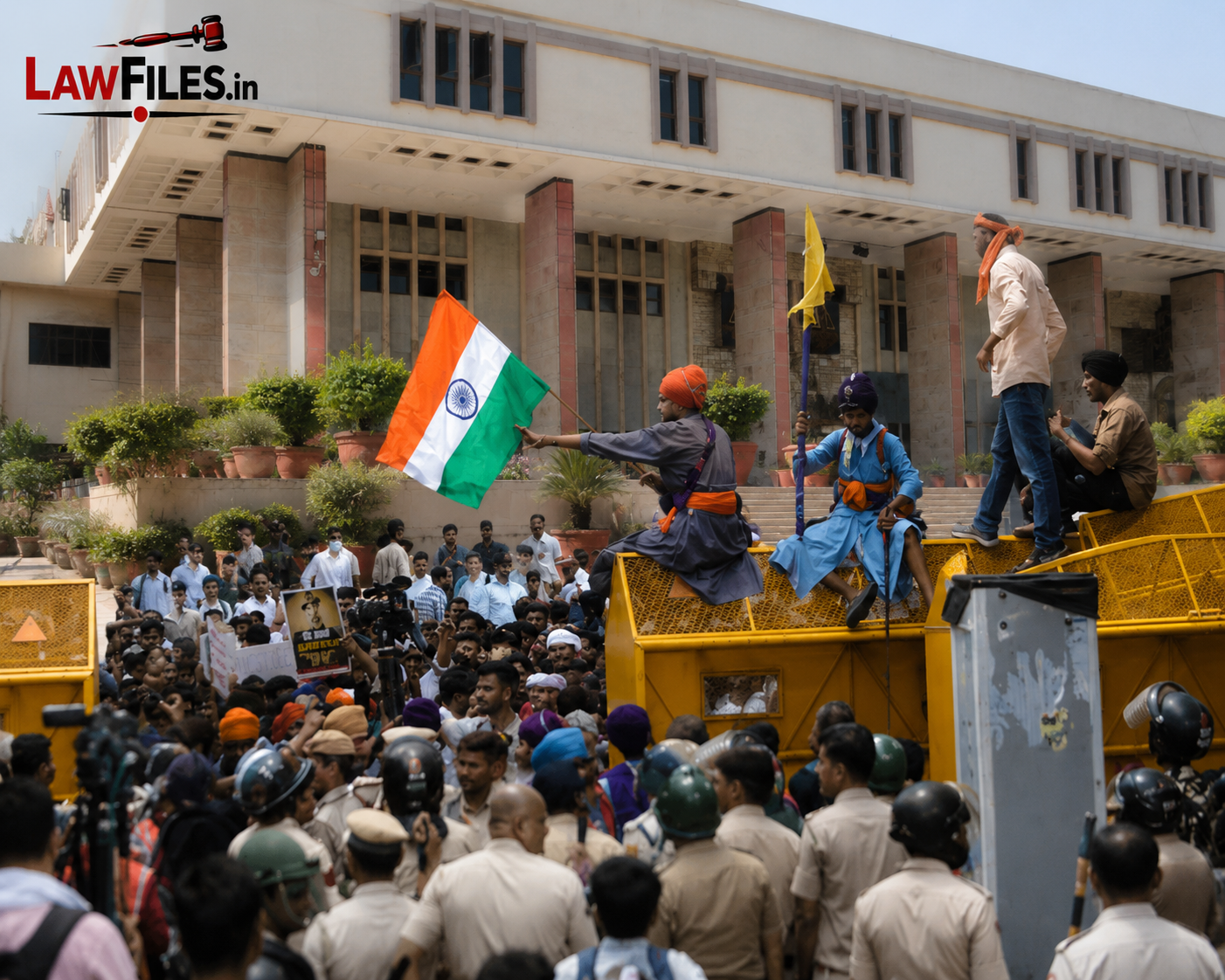
The constitutional validity of internet shutdowns has once again come under judicial scrutiny, this time before the Delhi High Court, where a Public Interest Litigation (PIL) has challenged the Union Government’s decision to suspend mobile internet services in and around Jantar Mantar during the ongoing student protests over alleged irregularities in the NEET examination. The petition, filed by Software Freedom Law Center, India (SFLC.in), raises questions that extend far beyond a temporary disruption of mobile data services. It asks whether the executive can repeatedly suspend internet access merely by invoking broad expressions such as “public emergency” and “public safety” without disclosing any objective material demonstrating necessity, proportionality or compliance with statutory safeguards. Mentioned before a Division Bench comprising Chief Justice Devendra Kumar Upadhyaya and Justice Tejas Karia, the matter was permitted to be listed urgently, although the hearing could not immediately proceed because of procedural defects in the filing. Nevertheless, the petition has brought into focus one of the most significant constitutional questions confronting India’s digital democracy whether internet shutdowns have become an ordinary policing mechanism rather than an exceptional constitutional measure.
The challenge specifically targets a series of orders issued by the Union Ministry of Home Affairs on 17, 20, 22 and 23 July, directing telecom service providers to suspend mobile internet services within and around the Jantar Mantar area, where students have been protesting over examination irregularities and demanding accountability. According to the petitioner, the shutdown orders merely reproduce statutory expressions relating to “public emergency” and “public safety” without disclosing the factual foundation justifying such restrictions. The plea argues that the authorities failed to demonstrate why less restrictive alternatives were inadequate, why mobile internet had to be suspended across a broad geographical area, and why the orders themselves were not made publicly available before implementation. The petition therefore seeks not merely quashing of the impugned orders but also production of the original government records, including intelligence assessments, file notings and Review Committee proceedings, so that judicial scrutiny can meaningfully assess whether the statutory requirements were actually satisfied.
One of the central grievances raised before the High Court concerns the absence of transparency. The petitioner contends that affected citizens were deprived of any meaningful opportunity to challenge the shutdown because the suspension orders themselves were not contemporaneously published. This, according to the petition, directly undermines the principle laid down by the Supreme Court in Anuradha Bhasin v. Union of India, where the Court categorically held that internet suspension orders must be published to enable judicial review and public accountability. A secret or inaccessible restriction, however temporary, effectively immunises executive action from constitutional scrutiny and deprives citizens of the ability to question the legality of restrictions imposed upon their fundamental rights. The PIL therefore seeks a judicial direction requiring all future internet suspension orders to be published either before or simultaneously with their enforcement, thereby strengthening procedural transparency in executive decision-making.
The controversy arose amid heightened security arrangements in central Delhi, where authorities repeatedly suspended mobile internet services within a 1.5-kilometre radius of Jantar Mantar while student demonstrations continued. The restrictions reportedly affected not only the immediate protest site but also neighbouring areas extending towards Mandi House, disrupting ordinary residents, commuters, businesses and professionals who had no direct connection with the demonstrations. Commercial establishments in Connaught Place were also advised to close early on certain occasions as part of broader security measures. These developments transformed what initially appeared to be a law-and-order response into a larger constitutional debate concerning the permissible limits of executive power during public protests.
From a constitutional perspective, the litigation engages one of the most important developments in modern Indian jurisprudence—the recognition of internet access as an integral component of several fundamental rights. Although the Constitution does not expressly guarantee a right to internet connectivity, the Supreme Court has repeatedly recognised that the internet has become indispensable for the exercise of freedoms protected under Article 19(1)(a), including freedom of speech and expression, access to information, journalistic activity, commercial communication and participation in democratic discourse. Simultaneously, internet access today directly affects educational opportunities, business transactions, banking services, healthcare, emergency communication and access to public services. Consequently, any executive decision suspending internet services inevitably engages constitutional rights extending well beyond digital convenience.
The statutory framework governing such restrictions has itself undergone significant legislative change. The petition argues that the impugned orders fail to satisfy the requirements of Section 20(2)(b) of the Telecommunications Act, 2023, read with the Telecommunications (Temporary Suspension of Services) Rules, 2024, which require authorities to establish necessity and proportionality before directing suspension of telecommunication services. According to the petitioner, merely reproducing statutory phrases such as “public emergency” cannot substitute for an objective assessment demonstrating why internet suspension became unavoidable in the particular factual circumstances. This argument reflects an increasingly important principle of Indian administrative law that executive satisfaction must be supported by discernible material rather than formulaic statutory language.
At the heart of the controversy lies the constitutional doctrine of proportionality, which has emerged as one of the defining principles governing restrictions upon fundamental rights. Under this doctrine, every restriction imposed by the State must pursue a legitimate objective, bear a rational connection with that objective, constitute the least restrictive means available and maintain an appropriate balance between public interest and individual rights. Applied to internet shutdowns, proportionality requires authorities to demonstrate not merely that public order concerns exist, but also that complete suspension of mobile internet represents the minimum restriction necessary to address those concerns. The petitioner argues that the government failed to evaluate whether targeted surveillance, selective blocking of specific digital platforms, enhanced policing or other narrower alternatives could have achieved the same objective without disabling internet access across an entire locality.
The Supreme Court’s landmark judgment in Anuradha Bhasin v. Union of India (2020) inevitably occupies the centre of this constitutional debate. Decided in the context of prolonged internet restrictions in Jammu and Kashmir, the Court held that freedom of speech through the internet enjoys constitutional protection and that indefinite internet shutdowns are impermissible. It further held that every suspension order must satisfy the tests of legality, necessity and proportionality and must remain subject to periodic review by an independent Review Committee. Perhaps most importantly, the Court insisted that suspension orders must be published to facilitate judicial review. The present PIL relies heavily upon these principles, arguing that repeated shutdowns around Jantar Mantar fail to satisfy the procedural and substantive safeguards articulated by the Supreme Court.
The litigation also reflects a broader shift in constitutional jurisprudence concerning the relationship between digital rights and democratic participation. Modern public protests no longer occur solely in physical spaces. Communication with lawyers, journalists, emergency services, family members and civil society organisations increasingly depends upon uninterrupted digital connectivity. Protest organisers coordinate peaceful assemblies through digital platforms, journalists transmit information in real time, and ordinary citizens rely upon mobile internet for navigation, emergency assistance and public communication. Consequently, suspending internet services today affects not only political expression but also numerous aspects of ordinary civic life.
The executive, however, advances an equally important constitutional concern. Governments possess a legitimate obligation under the Constitution to maintain public order and prevent violence. Authorities frequently argue that temporary internet suspension helps curb misinformation, prevents mobilisation of violent groups and restricts the rapid circulation of inflammatory content capable of aggravating volatile situations. The constitutional issue therefore is not whether the government possesses the power to suspend internet services—it undoubtedly does under appropriate statutory conditions but whether the exercise of that power satisfies constitutional standards of necessity, proportionality and accountability. The present litigation therefore concerns the manner of exercising executive power rather than its existence.
Another noteworthy aspect of the petition concerns the demand for production of the original administrative records, including intelligence inputs and Review Committee proceedings. This request reflects the growing judicial insistence upon evidence-based governance. Constitutional courts increasingly require executive authorities to demonstrate the factual basis underlying restrictions upon fundamental rights rather than relying solely upon broad assertions of public interest. Such scrutiny strengthens democratic accountability while preserving judicial deference to genuine security assessments supported by objective material.
The outcome of the proceedings may carry implications extending well beyond the present protests. Internet shutdowns have increasingly been employed across different States during public demonstrations, examinations, communal tensions and law-and-order situations. Judicial clarification regarding the scope of executive power under the Telecommunications Act, 2023 may therefore influence future governmental responses to public emergencies throughout the country. Equally, a reaffirmation of the principles laid down in Anuradha Bhasin would further consolidate India’s emerging jurisprudence concerning digital civil liberties in the constitutional era.
Ultimately, the Delhi High Court is not merely being asked to determine whether a particular internet shutdown was lawful. It is being invited to define the constitutional limits of executive authority in an increasingly digital society where access to the internet has become inseparable from the exercise of numerous fundamental rights. The case therefore transcends the immediate controversy surrounding the Jantar Mantar protests. It raises enduring questions regarding the relationship between security and liberty, executive discretion and judicial review, public order and democratic participation. As India continues to navigate the constitutional challenges of the digital age, the High Court’s consideration of this PIL may become another important milestone in shaping the jurisprudence governing internet shutdowns, digital freedoms and the evolving meaning of constitutional liberty in the twenty-first century.
