


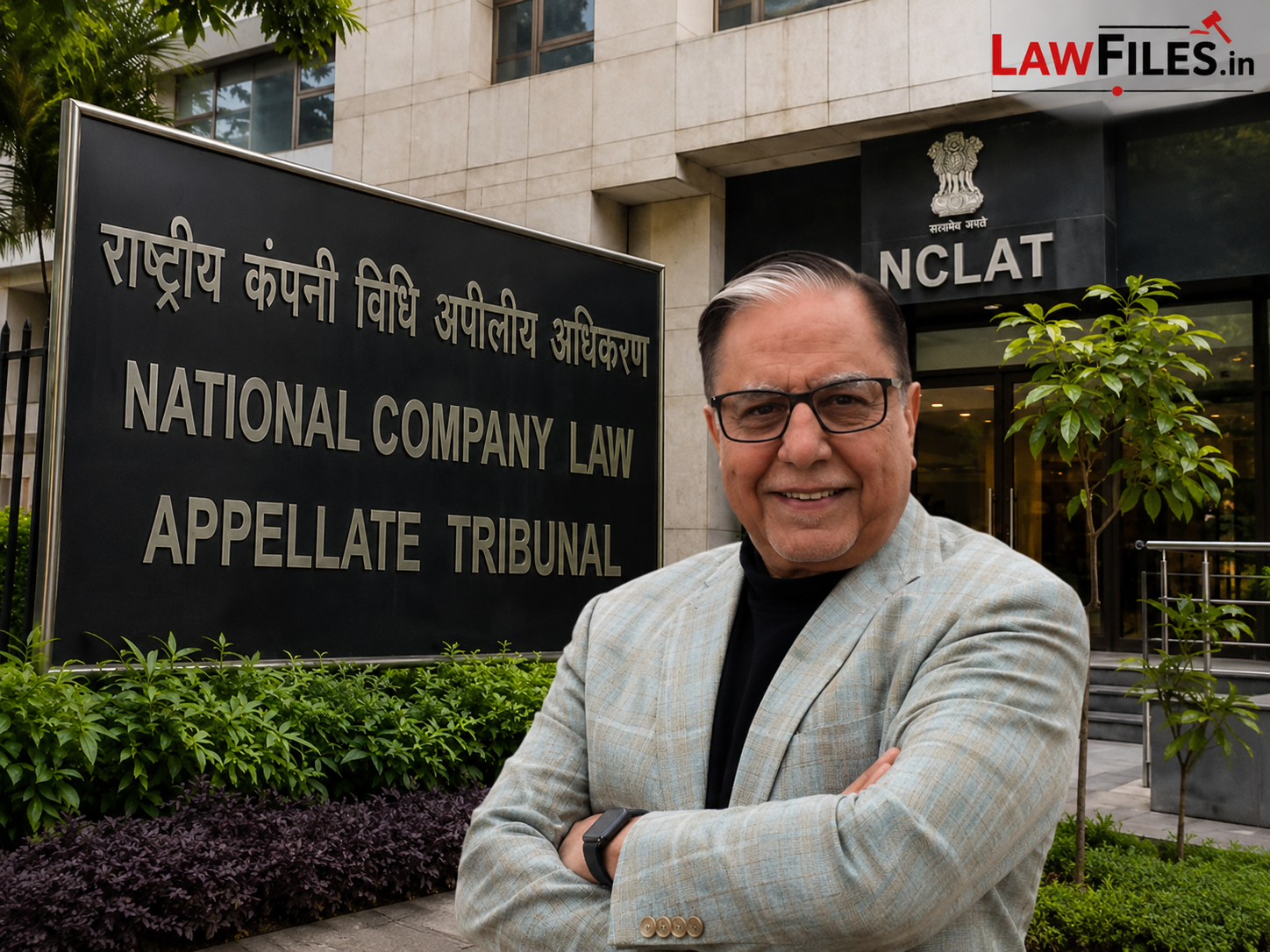
The insolvency proceedings concerning Essel Group founder Subhash Chandra have entered a new procedural phase before the National Company Law Appellate Tribunal, with Chandra questioning the very constitution of the five-member National Company Law Tribunal Bench that has now taken over consideration of his personal insolvency case. During the hearing, his counsel argued that Chandra had been publicly portrayed as having secured a settlement of merely ₹6.5 crore against creditor claims exceeding ₹22,000 crore, despite there being no operative final order approving such a repayment plan at the time the controversy intensified. The proceedings before the NCLAT therefore brought into focus not only the extraordinarily low proposed recovery but also the more fundamental question of how a tribunal should proceed when its members have expressed conflicting opinions on a matter and whether the statutory mechanism for resolving such disagreement permits constitution of a larger Bench.
The controversy arises from personal insolvency proceedings initiated against Chandra in relation to personal guarantees furnished by him for borrowings of companies associated with the Essel Group. The proceedings were initiated under Section 95 of the Insolvency and Bankruptcy Code, 2016, and concern the extent to which creditors can recover against a personal guarantor when the underlying corporate borrowers have defaulted. It is important to distinguish this proceeding from insolvency proceedings against Zee Entertainment itself. The present dispute concerns Chandra’s personal liability arising from guarantees and the repayment proposal submitted in those proceedings, rather than being a direct insolvency resolution process concerning Zee Entertainment.
The scale of the numbers nevertheless explains the intensity of the controversy. The repayment proposal contemplated payment of approximately ₹6.25 crore to creditors, with another ₹25 lakh earmarked towards insolvency-process expenses, against admitted claims stated at approximately ₹22,006.57 crore. The proposed recovery therefore represented only a tiny fraction of the admitted claims. Several creditors strongly objected to the proposal, arguing that such a recovery could not reasonably be accepted without a more searching examination of Chandra’s financial position, assets and the circumstances in which the guarantees had been furnished.
Yet the legal issue before the tribunal is not simply whether a recovery of ₹6.5 crore against claims exceeding ₹22,000 crore appears commercially fair. Insolvency law is not a mathematical exercise in which every rupee of admitted debt must necessarily produce an equivalent rupee of recovery. A repayment plan has to be assessed within the statutory framework, including the debtor’s actual asset position, the voting mechanism prescribed by the IBC, the interests of creditors and the consequences of alternative courses. The central controversy is consequently whether the statutory conditions for approval were satisfied and whether the decision-making process leading to the proposed plan was legally sound.
The case had already produced sharply divergent opinions within the NCLT. An initial two-member Bench comprising Judicial Member Ashok Kumar Bhardwaj and Technical Member Reena Sinha Puri did not arrive at a common conclusion. Bhardwaj was inclined to approve the repayment plan, but proposed that its operation should be confined to creditors who had voted in favour of it, leaving dissenting creditors to pursue other remedies available in law. Technical Member Puri, on the other hand, rejected the proposal, raising concerns concerning irregularities in the process by which certain claims had been admitted and the voting structure that ultimately supported the plan.
The disagreement subsequently went before a third member, Judicial Member Nilesh Sharma, pursuant to the statutory mechanism for resolving differences between members. On August 25, 2026, Sharma favoured approval of the repayment plan. His order, however, did not simply reproduce the earlier opinions. He dealt independently with questions concerning eligibility, disputed creditor claims and the legal effect of the plan. Among other directions, he excluded certain claims representing groups of individuals whose claims had been admitted without adequate supporting material and directed consequential redistribution of the amount earmarked for those claims.
The third member further held that once approved under the applicable provisions of the IBC, the repayment plan would bind creditors, including those who had opposed it. This was one of the principal points on which the legal consequences of the plan became contentious. The earlier Judicial Member had contemplated a narrower effect, whereas the third member considered the statutory framework sufficient to make the approved plan binding on the entire creditor body.
When the matter returned to the original Bench, however, the tribunal found that the third member’s opinion had not resulted in a clear majority capable of being implemented as a final determination. The result was an unusual procedural situation: there were effectively three views, but no legally coherent majority view. It was against this background that the NCLT President constituted a five-member special Bench to hear the matter afresh.
That development has now itself become the subject of challenge before the NCLAT. Appearing for Chandra, Advocate Sasmit Patra argued that Section 419(5) of the Companies Act, 2013, which governs situations where members of a tribunal differ in opinion, has a limited procedural purpose. According to the submission, the provision permits a matter involving a difference of opinion to be placed before another member or members so that the disagreement can be resolved, but it does not confer an unrestricted power upon the NCLT to constitute a five-member Bench and effectively reopen the entire controversy.
The argument is significant because tribunal procedure is ultimately controlled by statute. The NCLT is a creature of legislation and its jurisdiction and powers must be located within the framework created by the Companies Act and the IBC. The question, therefore, is not simply whether a five-member Bench may be institutionally convenient or whether the case is sufficiently important to justify a larger Bench. The question is whether the governing legislation authorises such a constitution in the particular procedural circumstances that have arisen.
Chandra’s counsel also questioned the basis upon which the five-member Bench stayed the August 25 opinion of the third member. The submission was that the third member’s decision had itself never matured into a final and enforceable NCLT order because the original Bench had subsequently found that there was no majority view. If there was no operative final order, counsel argued, the question naturally arose as to what exactly the newly constituted Bench was empowered to stay.
This is more than a technical objection. The distinction between an opinion, a majority decision and an executable judicial or tribunal order is fundamental to adjudicatory procedure. A tribunal exercises coercive authority through orders that have a defined legal status. If different members have delivered opinions which do not combine into a majority, identifying the operative decision becomes essential before appellate or supervisory jurisdiction can meaningfully be exercised. The procedural confusion in the present case illustrates why statutory mechanisms for resolving differences between members have to be applied with precision.
The NCLAT, however, did not decide the validity of the five-member Bench during the hearing. The appellate tribunal observed that the constitution of that Bench was not directly under challenge in the appeals filed by the dissenting lenders. Chandra was therefore left at liberty to independently challenge the September 1 order if he was aggrieved by the constitution or functioning of the larger Bench. The NCLAT consequently refrained from prematurely deciding an issue that had not been properly placed before it.
This judicial restraint is significant. Appellate tribunals cannot ordinarily transform every hearing into an omnibus examination of every procedural development in the proceedings below. The NCLAT was seized of appeals filed by lenders against the August 25 opinion, while the five-member Bench was a subsequent development before the NCLT. Keeping the two questions procedurally separate avoids a situation in which an appellate court decides an issue without the benefit of a properly framed challenge and the complete record.
The lenders, represented by Solicitor General Tushar Mehta, also attempted to address the procedural consequences of the five-member Bench’s intervention. Initially, the Solicitor General indicated that the lenders might withdraw their appeals with liberty to revive them depending upon what happened before the NCLT. His argument was understandable: if the August 25 opinion had been stayed and the entire matter was to be reheard by a larger Bench, the immediate necessity of an appellate challenge to that opinion could arguably diminish.
Chandra’s counsel opposed such a course. He argued that the appeals themselves were defective or premature because the August 25 opinion had never crystallised into a final order capable of being challenged as such. The NCLAT ultimately did not accept the proposal to withdraw the appeals with liberty to revive them. The appeals have instead remained pending and have been listed for October 7.
The courtroom exchange concerning Chandra’s alleged public vilification adds another layer to the proceedings. His counsel submitted that for approximately two weeks the businessman had been publicly portrayed as having obtained a ₹6.5-crore settlement against liabilities of more than ₹22,000 crore, despite the fact that there was no final operative order approving the plan at the relevant time. Counsel characterised the resulting coverage as a media trial that had damaged Chandra’s reputation.
The Solicitor General objected to the submission, cautioning that the NCLAT proceedings should not become a platform for statements intended principally for public dissemination. The appellate tribunal did not adjudicate upon the allegation of media vilification and indicated that Chandra could raise his grievance before the NCLT where the insolvency proceedings were pending. This is a useful reminder of the distinction between judicial proceedings and public advocacy. A tribunal’s primary function is adjudication, not reputation management, and allegations concerning media coverage must ordinarily remain separate from the legal determination of creditor claims and insolvency rights.
At the same time, Chandra’s complaint raises an important issue about the public consequences of interim or fragmented tribunal proceedings. High-profile insolvency litigation often generates headlines before the judicial process has reached finality. A judicial opinion, a dissenting view, a third-member opinion and a final order are not legally interchangeable. Public reporting that compresses these distinct procedural stages into a single conclusion can create an impression of finality where none exists. In complex insolvency litigation, precision in describing the procedural status of an order is therefore particularly important.
The underlying creditor dispute also raises broader questions about the personal-guarantee regime under the IBC. Personal guarantees were designed to provide creditors with an additional layer of security by permitting recourse against guarantors when corporate borrowers default. The Supreme Court has recognised the validity of insolvency proceedings against personal guarantors to corporate debtors, thereby confirming that the insolvency framework can operate against the guarantor independently of the corporate debtor’s own resolution process.
The practical effectiveness of that framework, however, depends substantially on the guarantor’s actual assets and the integrity of the insolvency process used to identify them. If a guarantor with substantial recoverable assets enters insolvency, creditors may reasonably expect the resolution process to examine those assets rigorously. Conversely, if the guarantor genuinely has very limited realizable assets, insolvency law cannot manufacture value that does not exist merely to satisfy the face value of admitted claims. The difficult question in the present case is therefore whether Chandra’s declared financial position accurately reflects the recoverable value available to creditors.
That issue has become contentious because creditors have pointed to the dramatic decline in the net-worth figures associated with Chandra over the years. Lenders have questioned whether the reduction in declared wealth was adequately examined and whether a comprehensive asset-tracing or forensic exercise was necessary before accepting the repayment proposal. Chandra, for his part, has maintained that he does not personally possess the assets attributed to him by some of the creditors and has emphasised the distinction between the liabilities of the underlying corporate borrowers and his own obligations as a guarantor.
The distinction between corporate debt and personal guarantee liability is legally crucial. A personal guarantor does not necessarily become the primary borrower merely because he has guaranteed the borrower’s obligations. His liability arises from the terms of the guarantee and the applicable law. At the same time, once the guarantee is invoked and the statutory insolvency process is triggered, the guarantor cannot avoid examination of his own estate simply by pointing to the fact that the original borrowing was undertaken by corporate entities.
The voting pattern concerning the repayment proposal has also become an important part of the controversy. Creditors representing approximately 80.814 per cent of the voting share had supported the plan. Chandra’s side has therefore relied upon the statutory voting threshold and argued that the plan could not be rejected merely because a minority of creditors strongly disagreed with the proposed recovery. Dissenting lenders, however, have questioned the composition of the voting body and the admission of certain claims, arguing that the legitimacy of the voting percentage itself cannot be separated from the process through which the creditors were admitted.
This presents one of the central tensions within collective insolvency law. The IBC deliberately gives substantial importance to the commercial decision-making of creditors. Tribunals are not expected to substitute their own commercial preferences for decisions validly taken by the requisite majority. But the commercial wisdom of creditors can operate only within a legally valid process. If voting rights are based on disputed or improperly admitted claims, the numerical majority may itself become questionable. Thus, the present litigation involves not merely the percentage of creditors who supported the plan, but whether that percentage was generated through a procedurally sound process.
The five-member Bench’s decision to stay the earlier opinion and rehear the matter consequently serves an interim protective function. The restraint against Chandra alienating his assets directly or indirectly was sought by the dissenting lenders to ensure that the subject matter of the insolvency proceedings does not disappear while the tribunal examines the competing positions. Such an injunction does not determine liability. Its purpose is preservation: if assets were transferred during the pendency of a dispute over the repayment plan, a later decision in favour of creditors could become practically ineffective.
This principle is particularly important in insolvency proceedings, where the value of the process lies not merely in determining legal rights but in ensuring that recoverable assets remain available for distribution. An asset-preservation order therefore reflects the tribunal’s concern with maintaining the substratum of the dispute. It is not, by itself, a finding that Chandra has attempted or intends to dissipate assets.
The five-member Bench is now required to examine the entire controversy afresh, including the competing opinions already delivered, the statutory framework governing repayment plans, the objections of dissenting creditors and the questions surrounding the admission and voting of claims. The exercise will also have to clarify the legal consequences of a third-member opinion where the original members’ views do not produce a coherent majority.
The case has therefore developed into an important test of tribunal procedure as much as an insolvency dispute involving a prominent businessman. The outcome will potentially clarify how NCLT Benches should proceed when members disagree, how Section 419(5) of the Companies Act interacts with the tribunal’s broader procedural powers, and whether a larger Bench can be constituted to resolve a deadlock of the kind that has arisen here.
There is also a larger policy question that the proceedings bring into sharp focus: whether the personal-guarantor insolvency regime can maintain credibility when the difference between admitted claims and proposed recovery is extraordinarily large. Insolvency law is intended to facilitate resolution, maximise value and provide a structured mechanism for dealing with financial failure. It is not intended to punish insolvency, but neither should it become a mechanism through which creditors are compelled to accept negligible recovery without adequate scrutiny of the debtor’s financial position.
The present proceedings should therefore not be reduced to the headline figure of ₹6.5 crore against ₹22,006 crore. The legally significant questions lie underneath that striking numerical contrast. Was the repayment plan validly constituted? Were the creditor claims properly admitted? Was the voting process legally sound? Does the statutory scheme permit the proposed plan to bind dissenting creditors? Was the third member’s opinion capable of producing an operative decision? And, critically, was the constitution of the five-member Bench authorised by law?
Until these questions are conclusively determined, describing the matter as a final settlement would be legally inaccurate. The August 25 opinion has been stayed, Chandra has been restrained from alienating his assets, the NCLAT appeals remain pending and the matter is now headed for a fresh consideration before the larger NCLT Bench. The litigation therefore remains very much alive.
The proceedings before the NCLAT ultimately demonstrate why insolvency adjudication cannot be understood solely through the lens of commercial recovery. Procedure is not a technical afterthought in insolvency law; it determines the legitimacy of the collective process through which creditors’ rights are decided. A repayment plan supported by a statutory majority can acquire binding force only if the voting process, adjudication and statutory requirements leading to its approval are themselves legally sustainable. Equally, a debtor challenging the tribunal’s procedure must establish the precise statutory basis for the challenge rather than merely object to an outcome that is commercially inconvenient.
For Subhash Chandra, the immediate controversy has therefore shifted from whether a ₹6.5-crore repayment proposal should be accepted to whether the tribunal was legally entitled to reconsider the proposal through a five-member Bench in the first place. For the creditors, the central concern remains whether the insolvency framework can produce meaningful recovery from a personal guarantor whose disclosed assets are said to be substantially lower than historical wealth figures. For insolvency jurisprudence, the case presents a potentially important examination of the relationship between statutory voting mechanisms, tribunal procedure, dissenting creditor rights and the scope of adjudicatory powers under the IBC and Companies Act.
The next hearing before the NCLAT on October 7 may therefore provide further clarity, but the decisive questions are likely to remain before the NCLT’s five-member Bench. Until that process concludes, the ₹6.5-crore figure should be understood as the amount proposed under a disputed repayment plan—not as a finally adjudicated settlement of more than ₹22,000 crore in claims. The distinction is not merely semantic; it goes to the heart of fair reporting, procedural accuracy and the credibility of India’s emerging personal insolvency jurisprudence.
