


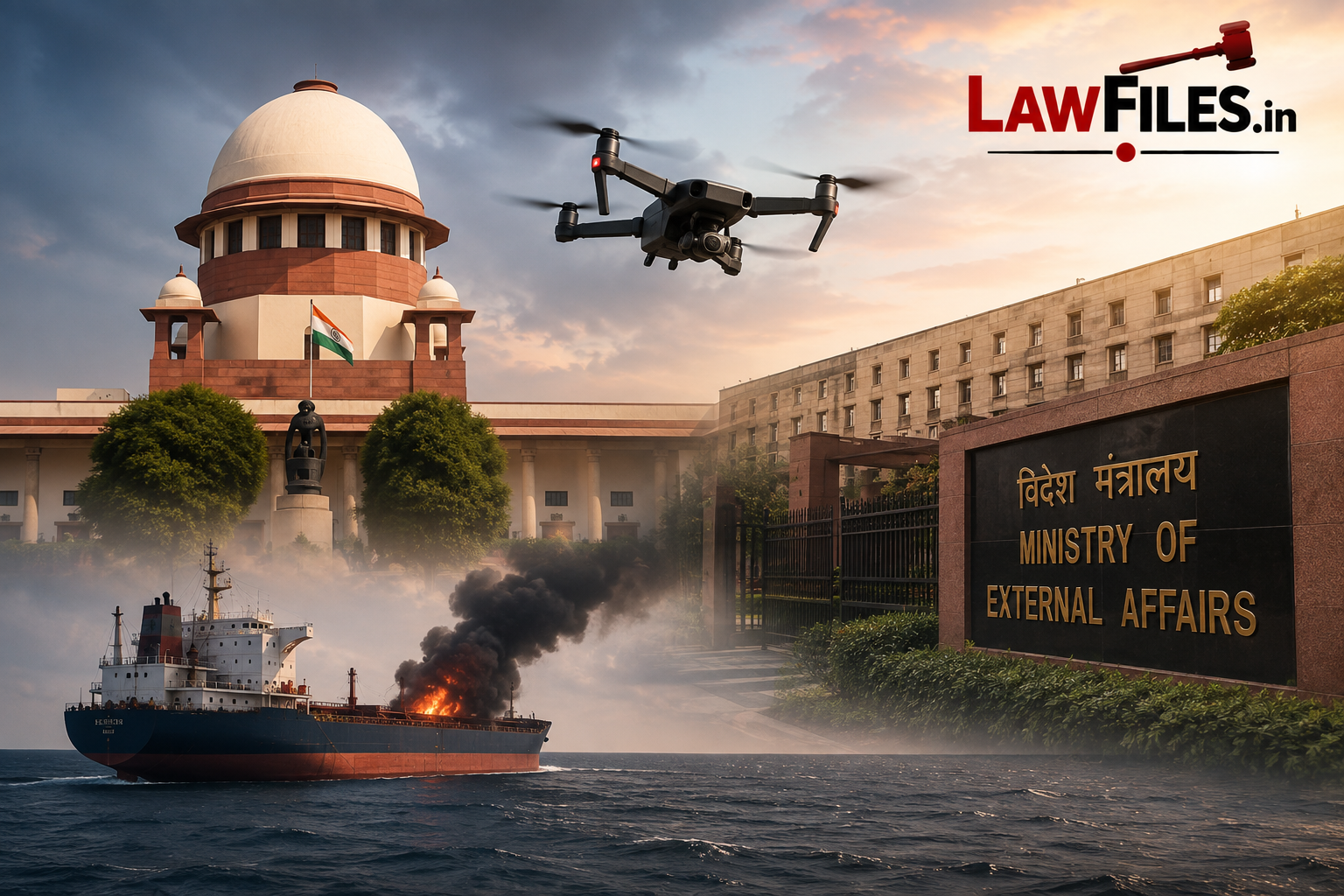
In a significant humanitarian intervention carrying important constitutional and diplomatic implications, the Supreme Court of India directed the Ministry of External Affairs (MEA) to take immediate and coordinated steps to trace an Indian seafarer reported missing after a merchant vessel came under a drone attack near the Ukrainian coast. The Court instructed the MEA, along with the Embassies of India in Ukraine and Romania, to actively coordinate with local authorities and international agencies to ascertain the whereabouts of the missing crew member and keep the family informed of all developments. Although the proceedings arose from an individual petition seeking urgent relief, the Court’s observations extend far beyond the immediate facts of the case. They reaffirm a constitutional principle that the Indian State’s concern for the life and safety of its citizens does not end at the nation’s geographical frontiers, particularly when Indian nationals become victims of armed conflict while engaged in lawful commercial employment abroad.
The matter reached the Supreme Court after the family of an Indian seafarer approached the Court expressing grave concern over the disappearance of their relative following a drone strike on a commercial cargo vessel operating near Ukraine’s Black Sea region, an area that has witnessed repeated attacks on civilian shipping amid the ongoing Russia–Ukraine conflict. According to submissions before the Court, communication with the missing seafarer had ceased after the attack, creating deep anxiety regarding his safety and prompting the family to seek judicial intervention for immediate diplomatic assistance. The petition highlighted that despite the seriousness of the incident, the whereabouts of the missing Indian crew member had not yet been conclusively established.
During the hearing, the Supreme Court treated the matter with evident urgency. The Bench directed the Ministry of External Affairs to immediately activate all available diplomatic channels and coordinate with the Indian missions concerned to ascertain the status of the missing seafarer. The Court emphasised that where Indian citizens become trapped in conflict situations beyond national territory, governmental authorities must respond with promptness, sensitivity and institutional coordination. The directions were not confined merely to tracing the individual but also contemplated continuous engagement with the affected family, ensuring that they receive timely information regarding search efforts and diplomatic developments.
The proceedings assume considerable significance because they revisit an increasingly important constitutional question—to what extent does the Indian State owe legal and constitutional responsibilities towards its citizens working abroad, particularly in conflict zones? While the Constitution primarily operates within the territory of India, constitutional courts have consistently recognised that the Union Government possesses a continuing obligation to extend diplomatic protection and consular assistance to Indian nationals facing extraordinary situations overseas. Although such obligations often arise through executive policy and international law rather than enforceable statutory rights, the Supreme Court’s intervention demonstrates that constitutional courts remain willing to ensure that executive authorities discharge these responsibilities diligently where human life is at stake.
The case also highlights the growing vulnerability of Indian seafarers, who constitute one of the largest maritime workforces in the world. India supplies a substantial proportion of skilled merchant navy personnel serving on vessels registered under numerous foreign flags and operating across international shipping routes. These seafarers frequently navigate regions affected by armed conflict, piracy, geopolitical instability and maritime hostilities. While they serve aboard privately owned commercial vessels, their safety often depends upon effective diplomatic coordination whenever emergencies arise. The present proceedings therefore underscore that maritime employment has become inseparably connected with questions of international humanitarian protection and consular responsibility.
The incident itself occurred against the backdrop of escalating attacks on commercial shipping operating near Ukraine’s ports, particularly around the Odesa region, where civilian merchant vessels have increasingly found themselves exposed to drone and missile strikes despite not being parties to the armed conflict. India has repeatedly expressed concern over attacks on commercial shipping and has consistently maintained that civilian vessels, merchant seafarers and international maritime commerce must remain insulated from military hostilities. In recent weeks, the MEA confirmed that it was already coordinating with Ukrainian authorities regarding Indian seafarers affected by attacks in the Black Sea and reiterated India’s call for protection of civilian maritime navigation.
From a legal perspective, the proceedings also illuminate the interface between constitutional law and international maritime law. Merchant vessels navigating international waters are governed by an intricate network of legal regimes comprising the United Nations Convention on the Law of the Sea (UNCLOS), international humanitarian law, International Maritime Organization (IMO) conventions and various safety regulations governing commercial navigation. Although the Supreme Court does not exercise jurisdiction over the armed conflict itself, it can require Indian authorities to fully utilise available diplomatic mechanisms, treaty obligations and international cooperation frameworks to protect Indian nationals who become victims of such conflicts.
Another important aspect of the hearing concerns the positive obligations of the executive under Article 21. Over the years, Indian constitutional jurisprudence has progressively expanded the scope of Article 21 beyond protection against unlawful State action to include affirmative obligations requiring governmental authorities to take reasonable measures for preservation of life. While Article 21 cannot compel foreign governments or belligerent parties to act in a particular manner, it unquestionably obliges Indian authorities to exhaust all reasonable diplomatic and administrative avenues available for protecting Indian citizens whenever feasible. The Court’s directions to the MEA are consistent with this evolving understanding of constitutional responsibility.
The proceedings also reflect the judiciary’s increasing recognition of the importance of consular diplomacy. Traditionally, questions relating to foreign affairs have been regarded as matters falling primarily within the executive domain. However, where individual life and liberty become directly implicated, constitutional courts have not hesitated to require the executive to demonstrate that adequate efforts are being undertaken. The present case illustrates this limited yet significant form of judicial oversight. The Court did not attempt to dictate foreign policy or interfere with diplomatic strategy. Instead, it required the executive to actively pursue available diplomatic channels with the urgency warranted by the circumstances.
The matter further highlights the distinction between judicial intervention and executive implementation. The Supreme Court itself cannot physically trace missing persons located in foreign jurisdictions or conduct international rescue operations. Those responsibilities necessarily rest with the Ministry of External Affairs, Indian diplomatic missions and foreign authorities exercising territorial jurisdiction. Judicial intervention therefore operates primarily by ensuring institutional accountability and expeditious governmental response rather than substituting the executive’s operational role.
The case also acquires significance in light of the recent series of attacks on Indian seafarers serving aboard merchant vessels in conflict-affected maritime regions. Only weeks earlier, India strongly condemned attacks on commercial ships near Ukraine after several Indian sailors lost their lives and others went missing. Those incidents prompted diplomatic protests, coordination with Ukrainian authorities and renewed calls for safeguarding international shipping corridors. The present proceedings therefore form part of a broader pattern of judicial and diplomatic engagement concerning the safety of Indian maritime workers employed in high-risk international waters.
From the standpoint of labour rights, the petition also reminds policymakers of the unique legal vulnerabilities confronting merchant navy personnel. Unlike military personnel, merchant seafarers operate under private contractual arrangements while frequently entering zones affected by armed conflict. Questions concerning evacuation, emergency communication, insurance, compensation, repatriation and diplomatic assistance therefore assume considerable importance. The Supreme Court’s intervention may encourage closer coordination between the Ministry of External Affairs, the Directorate General of Shipping, shipping companies and international maritime organisations in responding to future emergencies involving Indian crew members abroad.
Another noteworthy feature of the proceedings is the Court’s concern for the families of missing seafarers. Judicial directions requiring authorities to maintain regular communication with affected families reflect an increasingly humane dimension of constitutional adjudication. During prolonged search operations, uncertainty itself often becomes a significant source of suffering. By emphasising regular information-sharing and coordinated governmental response, the Court recognised that procedural transparency constitutes an important component of humanitarian relief.
The case also raises broader questions regarding the evolving nature of State responsibility in an era of globalised employment. Millions of Indian citizens today work outside the country’s territorial boundaries in shipping, aviation, construction, healthcare and various international industries. As overseas employment expands, constitutional institutions increasingly confront situations where citizens require governmental assistance in foreign jurisdictions. The present proceedings demonstrate that constitutional governance must adapt to these changing realities by ensuring effective institutional mechanisms capable of responding rapidly to transnational humanitarian emergencies.
Importantly, the Supreme Court’s order should not be understood as attributing legal responsibility for the drone attack itself. Questions concerning the conduct of hostilities, attribution under international law and responsibility of parties to the armed conflict remain outside the scope of the present proceedings. The Court’s focus remained firmly upon the immediate humanitarian objective of locating the missing Indian citizen and ensuring that every available diplomatic effort is undertaken for his safety.
Ultimately, the Supreme Court’s intervention represents a powerful affirmation that citizenship carries with it not merely rights within national borders but also a legitimate expectation of governmental protection when life is imperilled abroad. The Court’s directions to the Ministry of External Affairs underscore that constitutional governance does not become irrelevant simply because danger arises outside India’s territorial limits. By requiring immediate diplomatic engagement, institutional coordination and continued communication with the affected family, the Court has reaffirmed that the State’s constitutional commitment to protecting life extends beyond geography and into the broader realm of humanitarian responsibility. In an era where Indian professionals increasingly serve across the world’s most volatile regions, the judgment serves as an important reminder that the constitutional bond between citizen and State does not end at the nation’s coastline it travels wherever Indian lives require the protection of law, diplomacy and the institutions of the Republic.
