


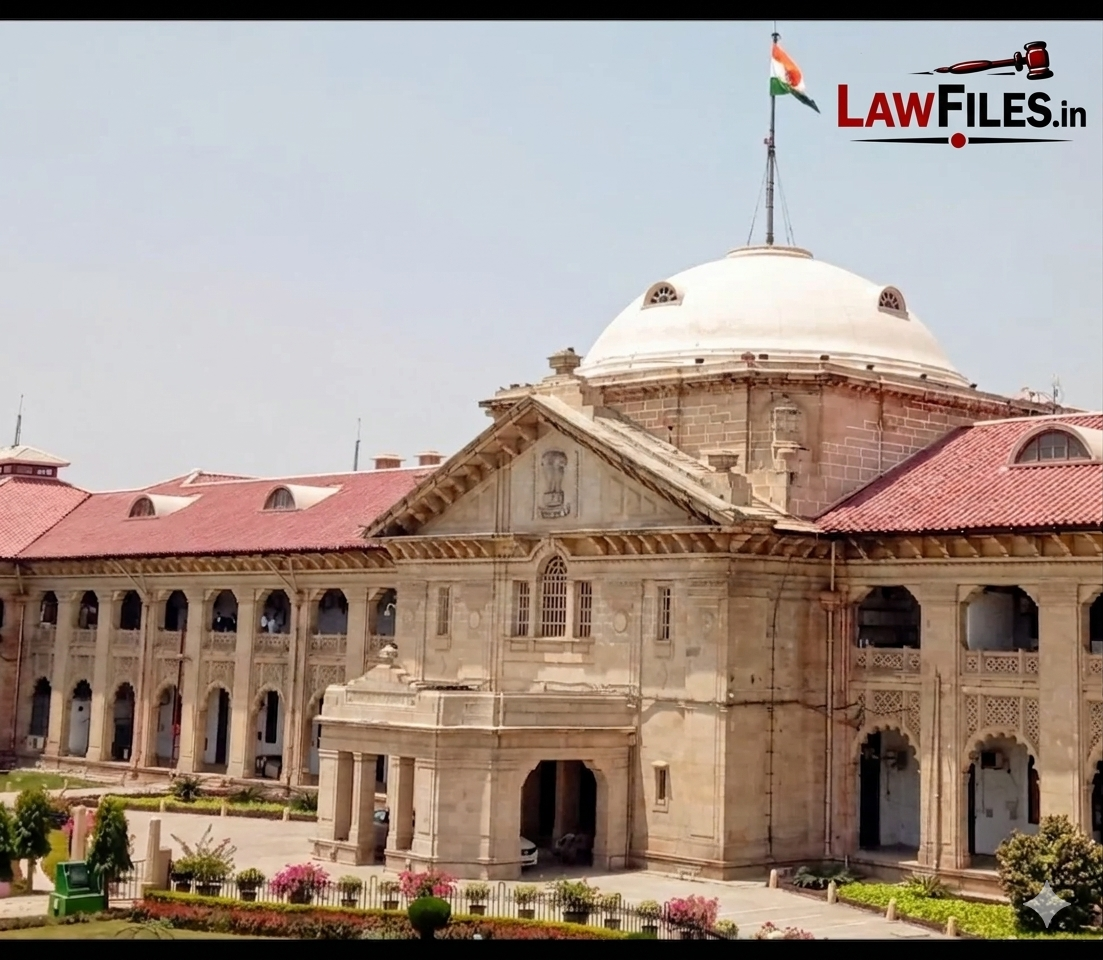
In a development that has once again placed Uttar Pradesh’s anti-conversion framework under judicial scrutiny, the Allahabad High Court has disposed of a petition filed by a Muslim man who voluntarily converted to Hinduism after the Prayagraj administration finally approved his long-pending conversion application. The decision came only after the High Court sharply questioned the conduct of local authorities for repeatedly reopening inquiries into a conversion that earlier investigations had already found to be voluntary.
The case concerned Anil Pandit, formerly known as Mohammad Ahashan, an Assistant Professor associated with an institution under the University of Allahabad. According to records placed before the Court, he embraced Sanatan Dharma in 2022 and sought formal recognition of his conversion under the procedure prescribed by the Uttar Pradesh Prohibition of Unlawful Conversion of Religion Act, 2021. Despite multiple inquiries reportedly concluding that the conversion was voluntary, his application remained entangled in administrative scrutiny for years before eventually being rejected in August 2024.
The rejection became the subject of challenge before a Division Bench comprising Justice Ajit Kumar and Justice Indrajeet Shukla. Earlier this month, the Bench strongly criticised the conduct of the Prayagraj administration for initiating fresh police inquiries despite previous investigations already addressing the central question—whether the conversion was voluntary. The Court questioned why administrative authorities continued to revisit the issue when the statutory inquiry process had effectively been completed.
Following the Court’s intervention, the Additional District Magistrate (Administration), Prayagraj, passed an order on May 14 formally approving the conversion application. Taking note of this development, the High Court disposed of the writ petition, recording that the relief sought by the petitioner had effectively been granted.
On its face, the dispute appears to concern a single administrative order. In reality, however, the litigation touches upon one of the most contested constitutional questions in contemporary India: the relationship between individual freedom of conscience and state regulation of religious conversion.
The petitioner’s case acquired additional complexity because it intersected with an interfaith marriage. Reports indicate that he is married to a Hindu woman and that the marriage was solemnised according to Hindu rites and customs. The controversy intensified after objections reportedly emerged from the woman’s family, leading to criminal proceedings and renewed scrutiny of the conversion process. It was this chain of events that ultimately resulted in repeated police verification exercises and prolonged administrative hesitation.
The High Court’s intervention is significant because it appears to reaffirm a principle often overshadowed in public debates surrounding anti-conversion legislation: the law regulates unlawful conversion, not voluntary change of faith itself. The Uttar Pradesh Prohibition of Unlawful Conversion of Religion Act, 2021 criminalises conversions obtained through force, fraud, coercion, misrepresentation, undue influence, or allurement. Yet the statute simultaneously presupposes the existence of lawful and voluntary religious conversion, which remains protected under Article 25 of the Constitution.
This distinction lies at the centre of the present controversy. The Court’s earlier criticism suggests concern that administrative authorities may have shifted their focus from verifying voluntariness to repeatedly re-investigating a matter that had already been examined. If conversion is found to be voluntary after due inquiry, continued administrative resistance risks transforming regulatory oversight into an obstacle to the exercise of constitutional freedom.
The judgment arrives amid an evolving body of Allahabad High Court jurisprudence on religious conversion and interfaith relationships. In recent years, the Court has delivered several significant rulings concerning the legal consequences of conversion, the validity of interfaith marriages, and the operation of Uttar Pradesh’s anti-conversion legislation. In some cases, the Court has taken a strict view against conversions found to be fraudulent or procedurally defective, holding that marriages based upon invalid conversions cannot receive legal recognition.
At the same time, the Court has repeatedly emphasised that constitutional protections remain available where conversion is voluntary and genuine. Earlier this year, another Bench observed that Article 25 guarantees every individual the freedom to profess, practise, and propagate religion, while clarifying that the Constitution protects voluntary faith and not coercive conversion.
The present case therefore highlights a growing tension within anti-conversion governance. While the State possesses a legitimate interest in preventing fraudulent or coercive religious conversions, that regulatory authority cannot become so expansive that it effectively subjects personal belief to indefinite administrative approval. Religious identity, unlike licensing or regulatory compliance, ultimately concerns an individual’s conscience a sphere where constitutional protections are at their strongest.
The High Court’s observations also raise broader concerns regarding procedural fairness. The petitioner reportedly underwent multiple inquiries over several years. Earlier reports had already found his conversion voluntary, yet fresh investigations were initiated after subsequent complaints emerged. The Court’s criticism appears rooted in the concern that repeated inquiries may create uncertainty even after statutory requirements have been satisfied.
From a constitutional perspective, the case illustrates a recurring challenge in the implementation of anti-conversion laws across India. Such laws are often defended as mechanisms to prevent exploitation and protect vulnerable individuals from coercive religious practices. Critics, however, argue that vague standards and broad investigative powers can result in intrusive scrutiny of personal relationships, particularly interfaith marriages. The Allahabad High Court’s intervention may therefore be viewed as an attempt to ensure that enforcement remains tethered to evidence rather than suspicion.
Another noteworthy aspect is the Court’s implicit emphasis on administrative accountability. The eventual approval of the conversion application came only after judicial intervention. This sequence of events reinforces the role constitutional courts increasingly play as supervisory institutions ensuring that executive authorities exercise statutory powers within reasonable limits. Courts are often reluctant to interfere in administrative processes, but they intervene where procedural discretion appears to drift toward arbitrariness.
The case also reflects a broader transformation in conversion-related litigation. Earlier legal disputes often focused on allegations of mass conversions, organised religious campaigns, or questions of public order. Increasingly, however, courts are being asked to adjudicate deeply personal disputes involving individual faith choices, interfaith relationships, and family opposition. This shift places constitutional values such as autonomy, dignity, and freedom of conscience at the centre of judicial analysis.
Ultimately, the Allahabad High Court’s disposal of the petition is important not because it creates a new legal principle, but because it reinforces an existing one: the State may regulate unlawful conversion, but it cannot indefinitely obstruct a voluntary exercise of faith once statutory requirements have been satisfied. The decision serves as a reminder that anti-conversion laws operate within constitutional boundaries and that administrative power must remain subordinate to individual liberty.
In a legal landscape increasingly shaped by debates over identity, religion, and personal autonomy, the case of Anil Pandit may come to represent a broader constitutional question whether the State’s role is to verify voluntariness or to determine legitimacy of belief itself. The Allahabad High Court’s intervention suggests that the answer, at least for now, remains firmly anchored in the constitutional promise of freedom of conscience.
