


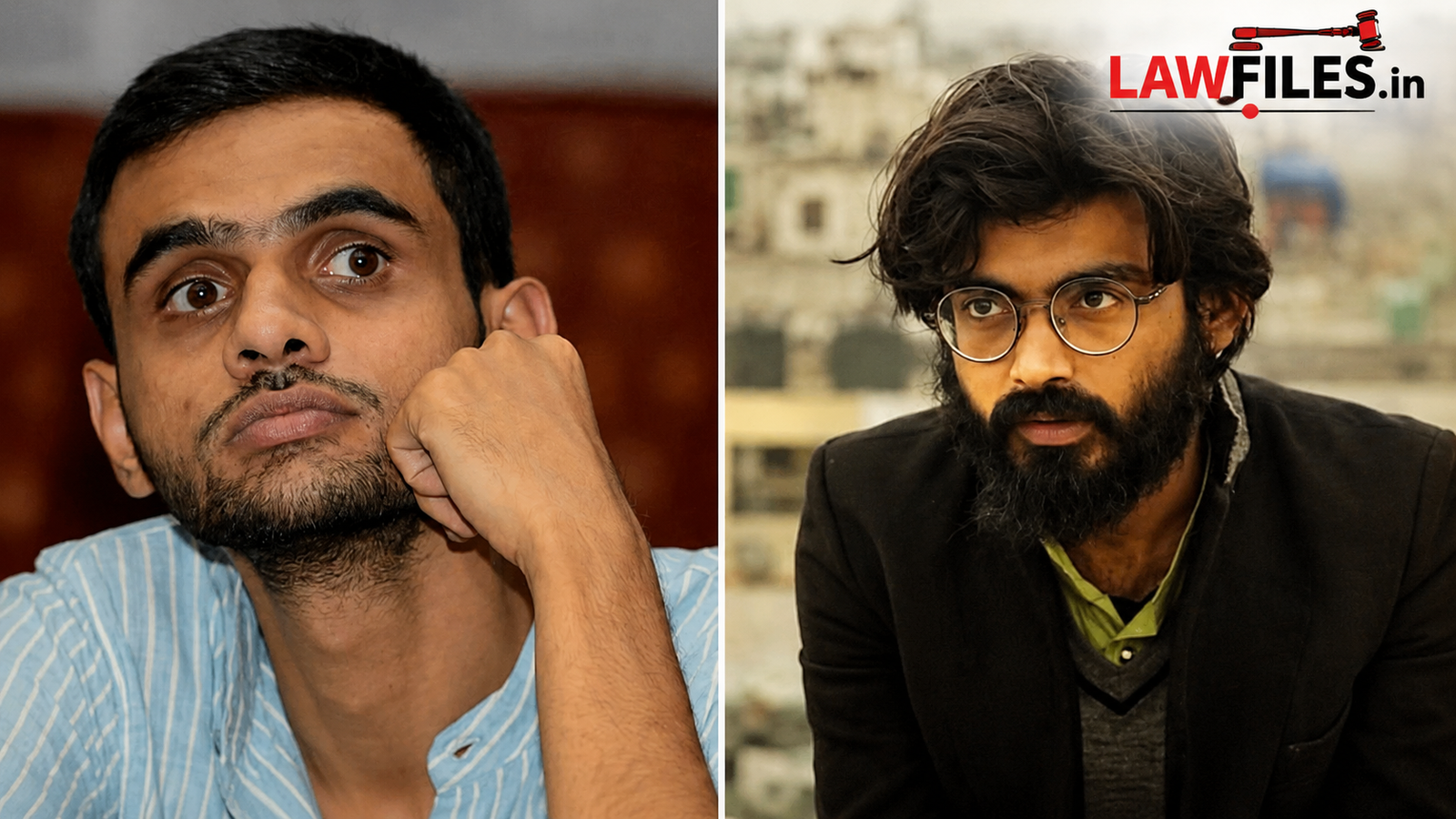
A Delhi Court has once again declined to grant bail to former student leader Umar Khalid and researcher Sharjeel Imam in the alleged larger conspiracy case arising out of the 2020 North-East Delhi riots, holding that it remains bound by the Supreme Court’s earlier judgment refusing them bail under the Unlawful Activities (Prevention) Act, 1967 (UAPA). The order, passed by Additional Sessions Judge Sameer Bajpai of the Karkardooma Courts, underscores the stringent statutory framework governing bail under anti-terror legislation and reiterates the constitutional principle that subordinate courts cannot depart from binding precedents laid down by the Supreme Court. While the applicants sought fresh consideration of their liberty on the strength of subsequent legal developments, the trial court concluded that until the Supreme Court settles the issue through an authoritative pronouncement, it had no jurisdiction to take a contrary view.
The proceedings arose from fresh bail applications filed by Umar Khalid and Sharjeel Imam in FIR 59 of 2020, one of the principal prosecutions relating to the alleged “larger conspiracy” behind the communal violence that erupted in North-East Delhi in February 2020. The prosecution alleges that the violence was not a spontaneous outbreak but the culmination of a coordinated conspiracy linked to protests against the Citizenship (Amendment) Act. Both accused have consistently denied the allegations and maintain that they have been falsely implicated for their participation in constitutionally protected protest activities. The case has attracted sustained legal and constitutional attention because it invokes the stringent provisions of the UAPA alongside offences under the Indian Penal Code, raising recurring questions concerning preventive detention, prolonged incarceration and the threshold for grant of bail in terrorism-related prosecutions.
During the hearing, the defence relied upon subsequent developments in the litigation, particularly the Supreme Court’s decision granting bail to five co-accused earlier this year and its observations concerning prolonged incarceration and the progress of the trial. It was argued that these subsequent developments warranted a fresh examination of the applicants’ entitlement to bail. The prosecution, however, contended that the Supreme Court had already distinguished the alleged role attributed to Umar Khalid and Sharjeel Imam from that of other co-accused and had specifically declined to extend similar relief to them. According to the prosecution, the allegations against the present applicants relate to the alleged conceptualisation, planning and coordination of the conspiracy itself rather than participation in isolated or peripheral acts.
Accepting the prosecution’s submissions, the Sessions Court observed that it was judicially bound by the Supreme Court’s judgment dated 5 January 2026, which had specifically rejected the bail pleas of Umar Khalid and Sharjeel Imam while simultaneously granting conditional bail to certain other accused. The Court noted that the Supreme Court had consciously drawn a distinction between the applicants and the co-accused who were enlarged on bail, holding that the allegations against Khalid and Imam stood on a “qualitatively different footing.” In view of that binding declaration, the trial court held that it had “no option” but to follow the law declared by the apex court under Article 141 of the Constitution.
The trial court also referred to another important procedural development. It noted that the Supreme Court has referred the correctness of its decision in *Gulfisha Fatima* and *Syed Iftikhar Andrabi* concerning interpretation of the bail restrictions under the UAPA to a larger Bench. Until that legal issue is conclusively determined, the Sessions Court held that it could not independently revisit questions already decided by the Supreme Court in relation to the present applicants. The order therefore reflects not merely a rejection on merits but adherence to the constitutional doctrine of precedent and judicial discipline.
The decision assumes significance because it once again illustrates the rigorous statutory standard governing bail under Section 43D(5) of the UAPA. Unlike ordinary criminal law, where bail is generally governed by considerations such as the possibility of absconding, tampering with evidence or influencing witnesses, Section 43D(5) substantially curtails judicial discretion. The provision prohibits release on bail where the court, upon a prima facie assessment of the case diary or charge-sheet, finds reasonable grounds for believing that the accusations are prima facie true. This statutory threshold has consistently been interpreted by the Supreme Court as requiring courts to undertake only a limited evaluation of the prosecution material at the bail stage rather than a detailed appreciation of evidence.
The present order must also be viewed against the backdrop of the Supreme Court’s earlier judgment delivered in January 2026, where the apex court differentiated between the alleged roles attributed to different accused persons in the conspiracy case. While granting bail to five co-accused, the Supreme Court observed that their alleged involvement appeared limited or ancillary in nature. In contrast, it held that the prosecution material, if accepted at face value for the limited purpose of deciding bail, attributed to Umar Khalid and Sharjeel Imam a central and formative role in the alleged conspiracy behind the riots. That distinction became the decisive basis for refusing them bail notwithstanding the grant of relief to other accused in the same prosecution.
From a jurisprudential perspective, the order demonstrates the complex interaction between personal liberty under Article 21 of the Constitution and Parliament’s legislative policy underlying anti-terror legislation. Indian constitutional jurisprudence has consistently recognised that “bail is the rule and jail is the exception” in ordinary criminal law. However, statutes such as the UAPA consciously modify that principle by prescribing a more restrictive statutory framework in cases involving allegations affecting national security or terrorist activities. Courts are therefore required to balance two competing constitutional imperatives: safeguarding individual liberty while simultaneously respecting the legislative judgment embodied in special criminal statutes.
The order also reaffirms the constitutional importance of judicial hierarchy. Trial courts are not at liberty to disregard or reinterpret binding decisions of the Supreme Court merely because subsequent legal developments appear to raise fresh questions. Where the apex court has already determined the legal position in relation to particular parties and the underlying principle continues to hold the field, subordinate courts remain duty-bound to follow that precedent. This institutional discipline, rooted in Article 141, preserves consistency and certainty within the judicial system and prevents conflicting decisions across different forums.
The broader significance of the proceedings extends beyond the immediate controversy surrounding the 2020 Delhi riots. The litigation has become one of the principal judicial forums through which Indian courts continue to shape the contours of bail jurisprudence under the UAPA. Questions relating to prolonged pre-trial incarceration, the meaning of “prima facie true” under Section 43D(5), the evidentiary threshold at the bail stage and the constitutional balance between liberty and national security remain subjects of continuing judicial development. The reference of certain legal questions to a larger Bench of the Supreme Court indicates that important aspects of this jurisprudence may yet undergo further clarification.
For the present, however, the legal position remains unchanged. By refusing fresh bail to Umar Khalid and Sharjeel Imam, the Delhi Court has reaffirmed that until the Supreme Court revisits or modifies its earlier determination, subordinate courts are constitutionally obligated to apply the existing precedent. The order therefore serves as a reminder that in India’s constitutional framework, the doctrine of precedent is not merely a procedural convention but an institutional guarantee ensuring coherence, consistency and predictability in the administration of criminal justice.
