


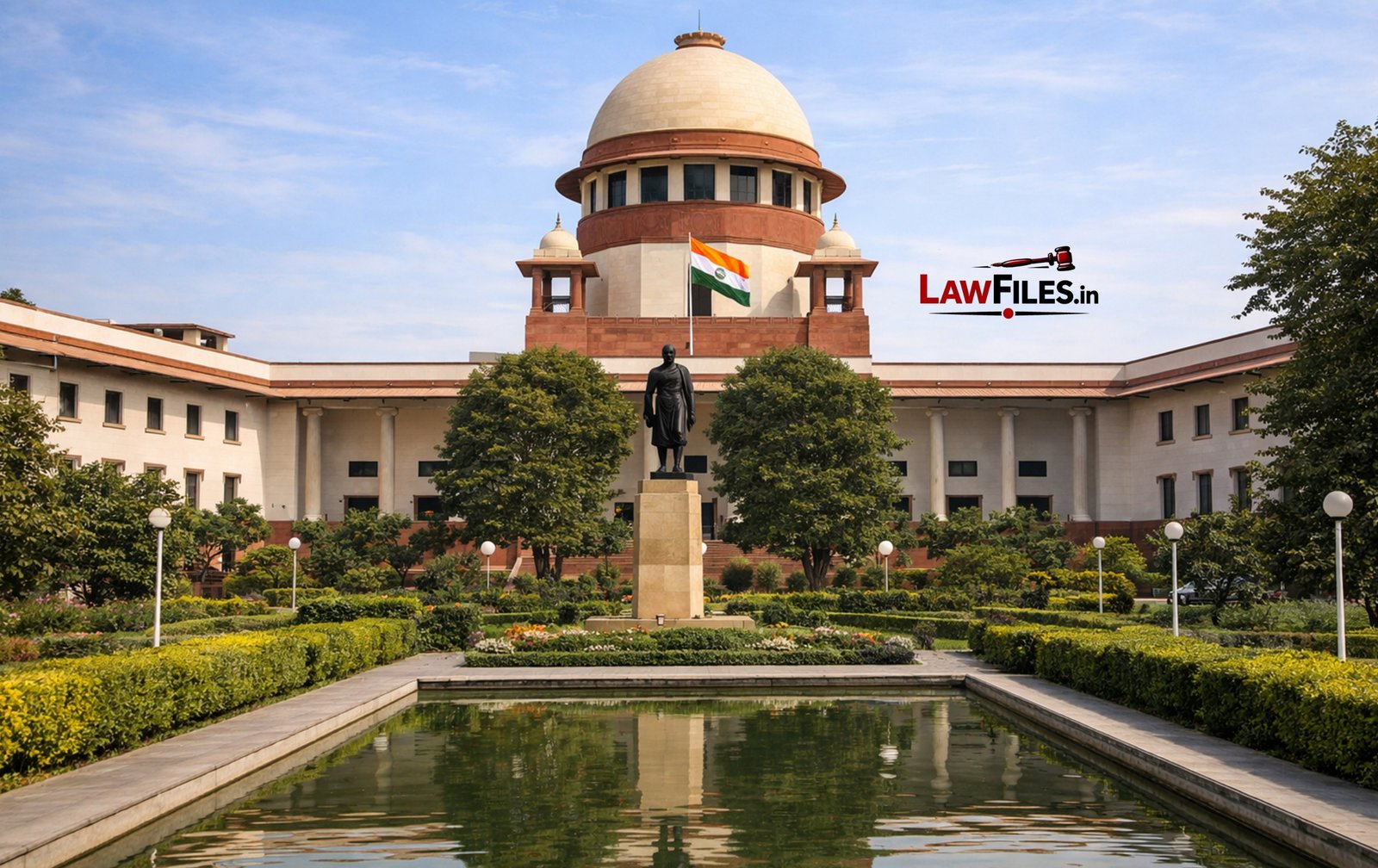
In a significant ruling arising out of the Haldwani (Banbhoolpura) riots case, the Supreme Court of India has set aside the grant of default bail to certain accused, holding that the benefit of statutory bail cannot be sustained where the accused failed to promptly challenge the extension of time granted for investigation. The decision marks an important clarification of the procedural discipline required under Section 167(2) of the Code of Criminal Procedure (CrPC), particularly in complex criminal investigations.
The controversy stemmed from the grant of default bail by the Uttarakhand High Court, which had held that the accused were entitled to statutory bail due to the alleged failure of the prosecution to complete investigation within the prescribed time. However, the Supreme Court found this conclusion to be legally flawed, emphasizing that the extension of time granted to investigating authorities had not been timely or effectively challenged by the accused.
Default bail, often described as an “indefeasible right,” arises when the investigating agency fails to file a chargesheet within the statutory period. Yet, the Court underscored that this right is not absolute in a vacuum; it is contingent upon the procedural posture of the case. Where an extension of time has been granted by a competent court, the accused must contest such extension at the earliest opportunity. A failure to do so, the Court held, weakens the foundation of a subsequent claim to default bail.
The ruling thus pivots on the principle of procedural vigilance. The Court reasoned that allowing accused persons to remain passive during the grant of extension and later invoke default bail would undermine the integrity of judicial orders and encourage tactical litigation. In this case, the accused had not promptly assailed the extension orders, thereby allowing them to attain finality. Consequently, the later invocation of default bail was held to be unsustainable.
Importantly, the Court also criticised the High Court’s approach, characterising it as a serious error in both fact and law. It held that the High Court failed to adequately consider the procedural history and the legal effect of unchallenged extension orders. This observation signals a broader judicial concern regarding the mechanical application of default bail principles without due regard to the surrounding procedural context.
From a doctrinal standpoint, the judgment recalibrates the balance between individual liberty and the interests of effective criminal investigation. While the jurisprudence on default bail has traditionally leaned in favour of safeguarding personal liberty, the present ruling introduces a countervailing emphasis on procedural responsibility. It suggests that the right to default bail cannot be invoked as a mere technicality divorced from the conduct of the accused during the investigation process.
The decision also has wider implications for cases involving serious offences such as riots, organised violence, and public disorder, where investigations are often complex and time-intensive. By upholding the validity of extensions that go unchallenged, the Court has provided investigative agencies a degree of procedural protection, while simultaneously imposing a duty on the defence to act with diligence and promptness.
At a systemic level, the ruling contributes to an evolving jurisprudence that seeks to prevent the misuse of procedural safeguards. It reinforces the idea that criminal procedure is not merely a set of technical entitlements but a structured process requiring active participation and timely assertion of rights.
In conclusion, the Supreme Court’s intervention in the Haldwani riots case serves as a reminder that the right to default bail, though fundamental to personal liberty, operates within a framework of procedural accountability. By denying relief to accused who failed to promptly challenge the extension of investigation time, the Court has strengthened the principle that legal rights must be exercised with vigilance, not retrospectively invoked as a strategic afterthought.
