


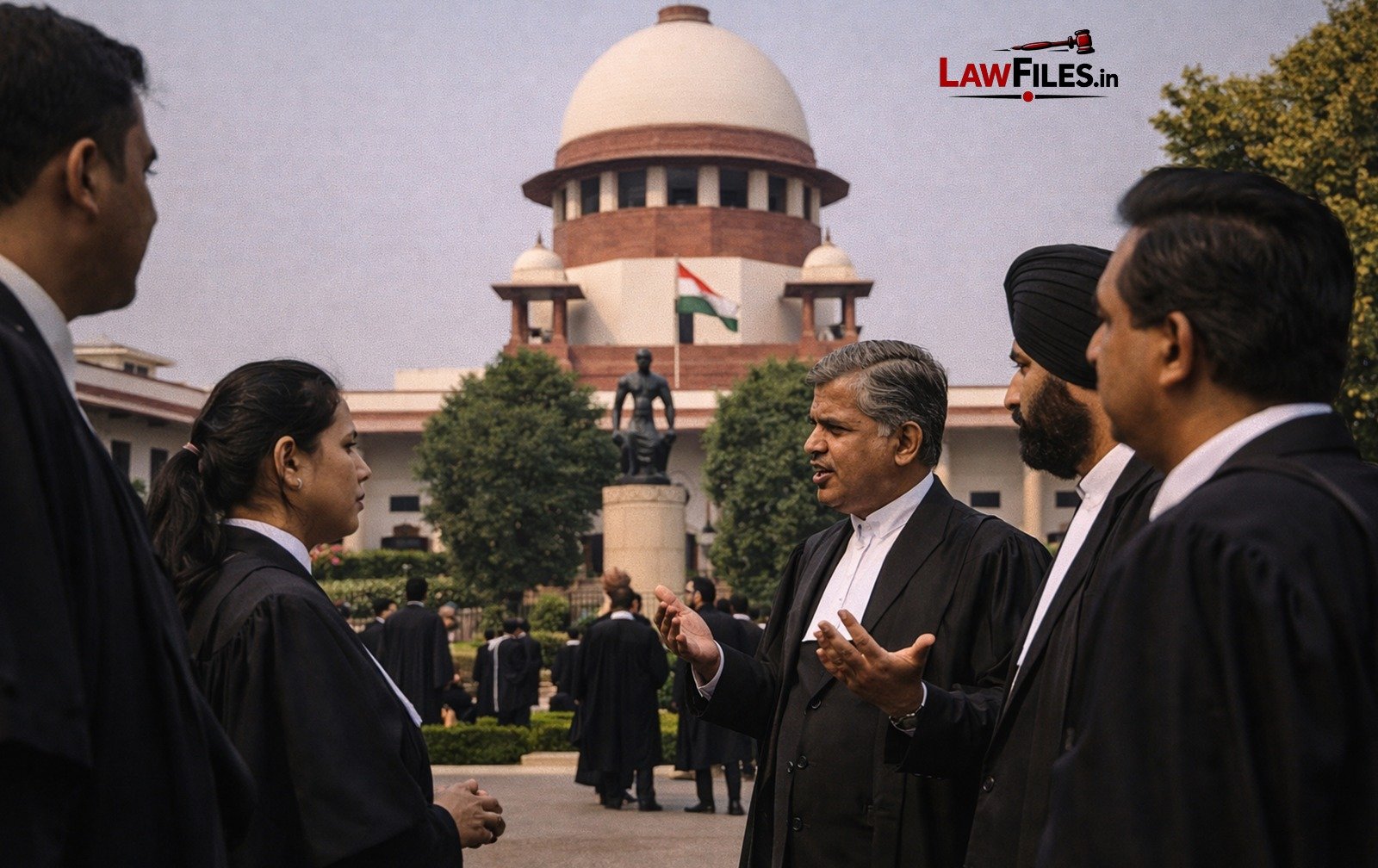
In a significant hearing underscoring the constitutional relationship between judicial authority and executive accountability, the Supreme Court expressed strong displeasure over the Union Government’s continued delay in implementing judicial directions to confer the President’s Gallantry Award upon former Madhya Pradesh police officer Vivek Singh Chouhan, who was recommended for the honour following a successful anti-dacoity operation more than two decades ago. Questioning why the Government was unwilling to comply with the binding judicial mandate while simultaneously pursuing a review petition, the Court observed that compliance with an existing order cannot ordinarily be withheld merely because the Government disagrees with its legal basis. The hearing therefore transcended the issue of one gallantry medal and evolved into a broader constitutional discussion on the obligation of the executive to respect judicial decisions, the limits of executive discretion in implementing court orders, and the sanctity of the rule of law.
The matter came before a Bench comprising Justice Vikram Nath, Justice Sandeep Mehta and Justice R. Mahadevan, which was considering an application filed by Union Home Secretary Govind Mohan seeking additional time to comply with earlier judicial directions relating to the conferment of the President’s Gallantry Award. The litigation traces its origins to proceedings before the Madhya Pradesh High Court, where former police officer Vivek Singh Chouhan challenged the denial of the gallantry decoration despite his role in an anti-dacoity operation in which two dreaded dacoits were neutralised. After examining the material on record, the High Court directed the Union Government to confer the President’s Gallantry Medal upon the officer. The Supreme Court had subsequently affirmed that direction, thereby rendering the obligation judicially binding.
However, instead of implementing the direction in the precise manner contemplated by the courts, the controversy deepened when the Union Government approved the conferment of a lower Gallantry Medal (GM) rather than the President’s Gallantry Medal specifically directed by the High Court. The Madhya Pradesh High Court viewed this action as an attempt to circumvent its earlier judgment and observed that the Government had effectively “overreached” the judicial order. Holding the Union Home Secretary prima facie liable for contempt, the High Court granted one final opportunity for compliance while warning that failure to implement the order before the next hearing would result in the Home Secretary being deemed to have committed contempt of court.
When the matter reached the Supreme Court once again, the Union Government, represented by Solicitor General Tushar Mehta, informed the Bench that a review petition had already been filed challenging the Supreme Court’s earlier order affirming the High Court’s judgment. The Solicitor General clarified that the Government’s objection was “in principle” and not directed against the individual officer. According to the Union, the concern was whether courts could issue a writ of mandamus compelling the conferment of a specific gallantry award, a matter traditionally falling within executive discretion. The Government suggested that if the review petition were ultimately allowed, implementation at this stage could create avoidable complications.
The Bench, however, was unconvinced by this reasoning. Justice Vikram Nath directly questioned why the Government could not comply with the subsisting judicial order while simultaneously pursuing its review petition. When the Solicitor General argued that a successful review could later require withdrawal of the award, the Court responded that such a possibility did not justify withholding compliance with an operative judicial direction. The Bench repeatedly asked why the Government had chosen to make the issue one of institutional principle instead of simply obeying the judgment presently holding the field. The exchange reflected the Court’s clear concern that filing a review petition does not automatically suspend the enforceability of an existing judgment unless an appropriate stay has been granted.
The proceedings raise an important constitutional issue concerning the relationship between executive discretion and judicial review. Gallantry awards such as the President’s Police Medal for Gallantry ordinarily fall within the executive domain. Recommendations are evaluated through administrative procedures involving State Governments, police authorities and the Ministry of Home Affairs before final approval by the President. Courts generally exercise considerable restraint while reviewing such decisions because assessment of bravery, operational circumstances and comparative merit ordinarily involves specialised administrative evaluation. Yet the present litigation demonstrates that executive discretion is not absolute. Once a constitutional court concludes that administrative action is arbitrary, discriminatory or legally unsustainable and issues binding directions, continued executive resistance may attract judicial scrutiny.
The hearing also illustrates the constitutional significance of Article 141 of the Constitution, under which the law declared by the Supreme Court becomes binding upon all courts and authorities throughout India. Equally relevant is the broader constitutional principle flowing from Articles 129 and 142, under which the Supreme Court possesses inherent authority to ensure obedience to its judgments and to do complete justice in matters before it. These constitutional provisions collectively reinforce the proposition that judicial decisions cannot remain advisory in character; they must ultimately be implemented by executive authorities unless modified or stayed by a competent court.
From the standpoint of administrative law, the controversy reflects the doctrine that public authorities cannot indirectly defeat judicial directions through administrative innovation. If a court specifically directs conferment of a particular benefit, compliance ordinarily requires implementation in the form directed rather than substitution with an alternative administrative arrangement. The Madhya Pradesh High Court’s observation that the Government had “overreached” its earlier order reflects this well-established principle. Administrative authorities undoubtedly retain discretion within the sphere left open by judicial directions, but they cannot substantially alter the very relief granted by the court.
The proceedings also highlight the limited legal effect of a review petition. Under the Supreme Court Rules and settled judicial precedent, the filing of a review petition does not by itself suspend the operation of the judgment sought to be reviewed. Unless the reviewing court grants an express stay, the original judgment continues to bind the parties. This principle serves an important constitutional purpose. Were it otherwise, every unsuccessful litigant could indefinitely postpone compliance merely by filing successive review or curative petitions. The Bench’s insistence that the Government first comply and thereafter pursue its review reflects this settled procedural doctrine.
Another significant aspect concerns the law of civil contempt. The Contempt of Courts Act, 1971 defines civil contempt as wilful disobedience of any judgment, decree, direction, order, writ or other process of a court. Courts have consistently emphasised that contempt jurisdiction exists not to vindicate judicial prestige but to preserve the authority of the legal system and ensure effective administration of justice. Where executive authorities fail to implement binding judicial directions without sufficient legal justification, contempt proceedings may become necessary to uphold the rule of law. The Madhya Pradesh High Court’s warning to the Union Home Secretary must therefore be understood within this broader constitutional framework.
At the same time, the case raises an interesting institutional question regarding the extent of judicial review over State honours and decorations. Traditionally, conferment of civilian and gallantry awards has been regarded as a matter of executive policy involving subjective evaluation. Courts ordinarily refrain from substituting their own assessment for that of specialised administrative authorities. However, judicial intervention becomes possible where the challenge concerns procedural illegality, arbitrariness, unequal treatment or failure to consider relevant material rather than the intrinsic merits of comparative gallantry. The present dispute appears to fall within this narrower category, with the litigation focusing less upon comparative evaluation and more upon the Government’s obligation to faithfully implement an existing judicial determination.
Beyond the legal doctrines involved, the case also carries a broader institutional message. Gallantry awards perform a symbolic constitutional function. They recognise extraordinary courage displayed by members of the armed forces and police in protecting society under dangerous circumstances. Delayed recognition, particularly after prolonged litigation spanning decades, raises questions not merely of administrative efficiency but of institutional fairness towards public servants whose service has already been judicially acknowledged. At the same time, preservation of a credible honours system requires consistency, transparency and adherence to established legal processes.
The Supreme Court’s observations ultimately reinforce a foundational constitutional principle: the executive may disagree with a judicial decision, but disagreement cannot become a substitute for compliance. Constitutional governance provides lawful mechanisms—appeals, reviews and curative petitions for challenging judgments. Until those mechanisms alter the legal position, however, binding judicial orders remain enforceable. This principle is central to the doctrine of separation of powers because it preserves institutional respect between coordinate branches of government while ensuring that no authority becomes a judge in its own cause.
As the review petition remains pending, the larger legal question regarding the extent of judicial power to direct conferment of specific gallantry awards may still receive detailed examination. Yet the hearing has already reaffirmed an equally significant proposition. The authority of constitutional courts derives not merely from the power to pronounce judgments but from the expectation that those judgments will be implemented in good faith by every public authority. In reminding the Union Government that compliance cannot ordinarily await the uncertain outcome of a review petition, the Supreme Court has reiterated that the rule of law rests not upon institutional convenience but upon faithful obedience to binding judicial mandates.
