


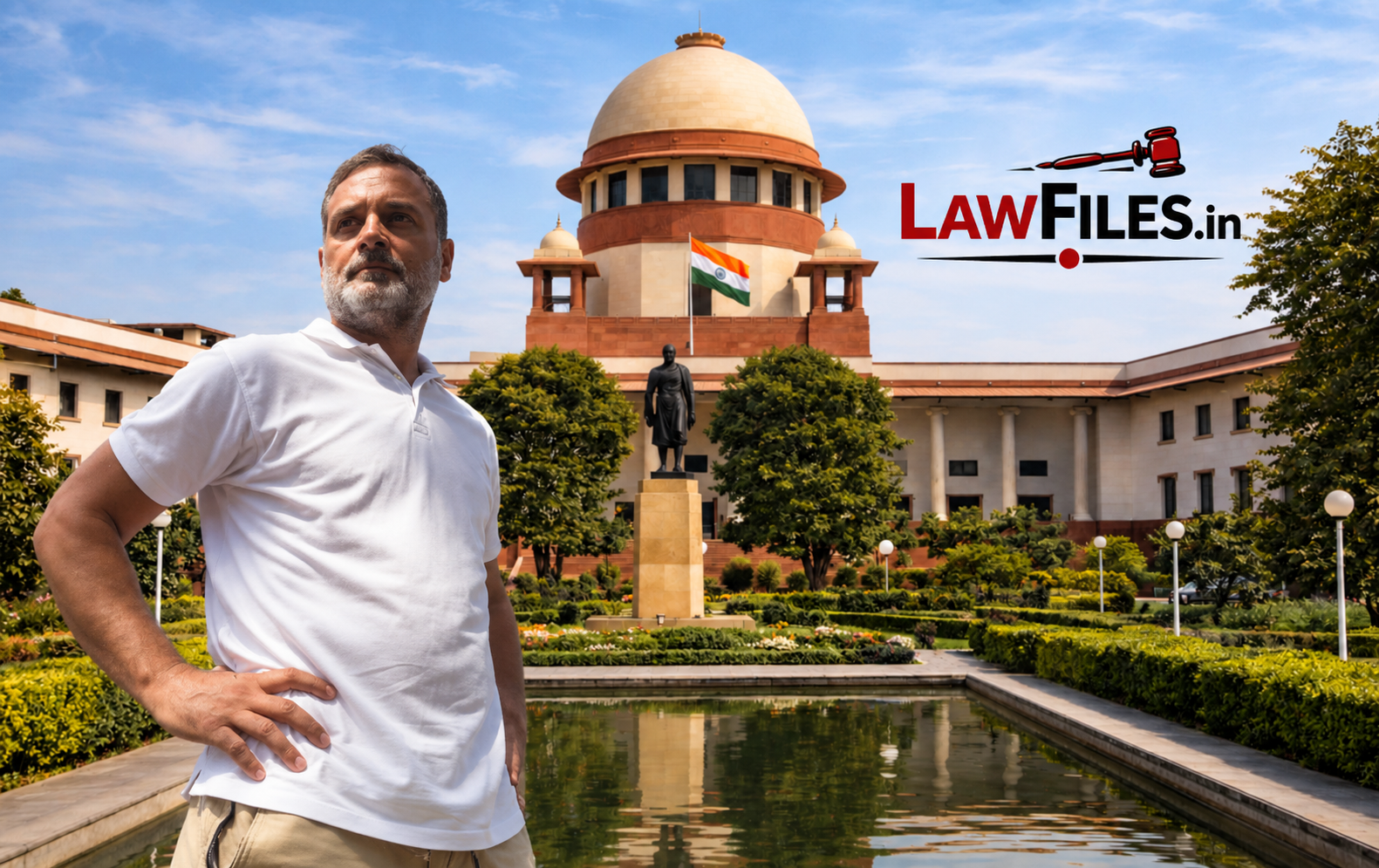
The Supreme Court on October 13, 2026, stayed further proceedings before the trial court in the criminal defamation case against Congress leader and Leader of the Opposition in the Lok Sabha Rahul Gandhi over his remarks describing Prime Minister Narendra Modi as “Choron Ke Sardar” and “Commander-in-Thief”. A Bench comprising Justice Vikram Nath and Justice Aparesh Kumar Singh issued notice, returnable in four weeks, on Gandhi’s challenge to the Bombay High Court’s September 8 order refusing to quash the criminal defamation proceedings. The Bench ordered that further proceedings before the trial court would remain stayed in the meantime. Senior Advocate Abhishek Manu Singhvi appeared for Gandhi. The interim order temporarily suspends the trial while the Supreme Court examines the challenge; it does not decide whether the remarks constitute criminal defamation or whether the complaint is legally maintainable.
The proceedings arise from remarks Gandhi made during a public rally in Rajasthan in September 2018 while criticising the Narendra Modi government over the Rafale fighter aircraft deal. The complainant, Mahesh Shrishrimal, a Bharatiya Janata Party worker, alleged that Gandhi’s statements were defamatory towards the Prime Minister and, by extension, the BJP and its members. According to the complaint, the remarks lowered the reputation of the Prime Minister and subjected him to ridicule across news channels and social media platforms. Shrishrimal contended that the language used by Gandhi was not merely criticism of a government decision but carried an imputation of dishonesty that extended beyond an individual political office-holder to the party and its members. Gandhi has contested the maintainability of the complaint, arguing that he had not named the BJP or any clearly identifiable class of persons in the impugned remarks.
The Metropolitan Magistrate at Girgaum, Mumbai, issued process against Gandhi on August 28, 2019, taking cognisance of the complaint and requiring him to face the criminal proceedings. Gandhi challenged the summoning order before the Bombay High Court, contending that the complaint did not satisfy the legal requirements for prosecuting him for defamation. The High Court, in its order dated September 8, 2026, declined to interfere with the Magistrate’s decision. It reasoned, at the preliminary stage, that the complainant’s contention that the remarks extended to the BJP and its members could not be rejected outright. The High Court observed that the imputation could not necessarily be understood as being confined to the party’s senior leadership and that its substance and impact on party members would have to be considered at trial. Gandhi then approached the Supreme Court.
The principal legal question is whether an individual who claims to be a member or supporter of a political party can maintain a criminal defamation complaint over remarks directed at a prominent leader when the complainant was not personally named and the alleged imputation was not expressly directed at a clearly defined group. Gandhi’s challenge rests on the proposition that a criminal defamation prosecution cannot be sustained merely because a complainant interprets a political statement as indirectly insulting a broader political organisation. The law requires a legally cognisable connection between the alleged imputation, the person or class said to have been defamed and the complainant’s entitlement to initiate proceedings. The issue is therefore not simply whether the words were offensive or politically intemperate, but whether the complaint satisfies the statutory requirements governing criminal defamation.
Under Section 499 of the Indian Penal Code, 1860, which governs the alleged conduct dating from 2018, defamation involves making or publishing an imputation concerning a person with the requisite intention, knowledge or reason to believe that the imputation will harm that person’s reputation, subject to the statutory exceptions. Section 500 prescribes punishment for the offence. Explanation 2 to Section 499 extends the concept of defamation to imputations concerning a company, an association or a collection of persons as such. This provision is particularly relevant where a complainant alleges that a statement about an individual has also defamed an identifiable organisation or group. However, the statutory language does not mean that every person who belongs to, supports or sympathises with an organisation automatically acquires an independent right to prosecute whenever that organisation is criticised.
The requirement that the allegedly defamed group be identifiable is central to this dispute. A political party may be an identifiable organisation, but the legal question is whether the particular statement can reasonably be understood as imputing something defamatory to the party or a sufficiently definite collection of persons, rather than merely attacking an individual leader or criticising a political administration. The distinction matters because the law protects reputation, not a general entitlement to be shielded from criticism or ridicule. If every disparaging remark about a political leader could be converted into a criminal complaint by any party member, the potential reach of criminal defamation would become exceptionally broad. Conversely, where an imputation genuinely targets an identifiable body or collection of persons, the fact that every member is not individually named may not, by itself, defeat a complaint. The legal inquiry must turn on the meaning, context and identifiable target of the statement.
The Bombay High Court declined to terminate the proceedings at the threshold because it considered the complainant’s argument about the reach of the remarks to be a matter requiring examination. The High Court did not finally determine, after a completed trial, that every BJP member had been defamed. Rather, it concluded that the complaint could not be rejected at that preliminary stage merely on the ground that Gandhi had not expressly named the party or its members. The Supreme Court must now consider whether this approach correctly applies the law governing group defamation and the right to initiate criminal proceedings. Its scrutiny will be particularly important because the complainant’s personal grievance and the alleged injury to the reputation of a larger political organisation are related but legally distinct questions.
Criminal defamation is not ordinarily prosecuted by the State in the same manner as every other criminal offence. Section 199 of the Code of Criminal Procedure, 1973, generally requires a complaint by a person aggrieved by the alleged offence, subject to specified exceptions, including special procedures for certain public servants and constitutional functionaries in relation to conduct connected with public duties. The provision seeks to ensure that the criminal process is not routinely invoked by persons who have no legally recognised grievance. In the present case, the complainant’s entitlement to proceed depends in part on whether he can establish that the alleged imputation concerned him or an identifiable collection of persons of which he forms part, in a manner recognised by the law of defamation. Membership of a political party, standing alone, cannot conclusively resolve that question.
The legal principles concerning group defamation require courts to distinguish between criticism of a collective entity and an imputation against every individual associated with it. A statement that attacks the policies or performance of a political party does not automatically mean that each of its members has been personally defamed. Equally, the absence of individual names does not invariably prevent a complaint where the words unmistakably refer to a defined group. The size and composition of the alleged group, the language used, the circumstances in which the statement was made and the connection between the imputation and the complainant all become relevant. The law must avoid both extremes: allowing a loosely connected individual to prosecute every political insult and making it impossible to seek a remedy when a genuinely identifiable group has been targeted by a defamatory imputation.
The distinction between a political leader and a political party is particularly important in democratic debate. A Prime Minister occupies a constitutional office and is also the leader of a political formation, but those roles do not merge every criticism of the office-holder into an allegation against every party member. Political speeches often use rhetorical language to challenge the integrity, competence or policy choices of the government. Whether a particular statement crosses the legal line into defamation depends on its substance and the applicable statutory elements. A court must therefore examine what was actually communicated, who was reasonably understood to be the target and whether the complaint identifies a legally cognisable injury. The mere fact that a political statement attracted public attention or triggered controversy does not independently establish criminal liability.
At the same time, political speech is not entirely beyond the reach of defamation law. Article 19(1)(a) of the Constitution protects freedom of speech and expression, including robust criticism of government and public officials. Article 19(2), however, permits reasonable restrictions on that freedom in the interests of specified constitutional objectives, including defamation. The constitutional framework therefore recognises both the democratic necessity of political criticism and the legitimate interest in protecting reputation. The challenge for courts is to apply the criminal law in a manner that preserves meaningful space for forceful public debate without denying remedies where the legal ingredients of defamation are established.
The Supreme Court’s decision in Subramanian Swamy v. Union of India, (2016) 7 SCC 221, is an important part of this constitutional background. The Court upheld the constitutional validity of criminal defamation provisions under Sections 499 and 500 of the IPC, recognising reputation as an aspect of the interests protected by law and rejecting the argument that criminal defamation was inherently incompatible with freedom of speech. The decision does not, however, mean that every allegation of reputational injury must proceed to trial. The existence of a valid criminal defamation statute does not dispense with the requirement that a particular complaint satisfy its ingredients. The present case concerns the application of those requirements to a political statement and the maintainability of a complaint by a person who says that an imputation directed at a leader also affected the reputation of the party and its members.
Another relevant principle emerges from the Supreme Court’s broader jurisprudence on criminal complaints and the protection of free expression. In S. Khushboo v. Kanniammal, (2010) 5 SCC 600, the Court cautioned against allowing criminal proceedings to be initiated by persons who do not qualify as aggrieved under the law and emphasised the importance of protecting public discussion from unwarranted criminal prosecution. The judgment arose in a different factual and legal setting, but its underlying concern is pertinent: criminal law should not become a mechanism through which individuals seek to punish expression merely because they find it offensive or contrary to their beliefs. This principle does not confer blanket immunity on political speakers. It requires courts to scrutinise whether the complainant has the legally required standing and whether the alleged conduct actually falls within the offence invoked.
The timing and setting of Gandhi’s remarks also matter to the legal analysis. The speech was delivered during political criticism of the Rafale aircraft deal, a subject that had become a major point of dispute between the government and opposition parties. Political debate about government procurement, public expenditure and alleged irregularities is central to democratic accountability. Opposition leaders must be able to question governmental decisions and demand explanations, including in forceful terms. Yet the political context does not automatically immunise an imputation that otherwise meets the statutory definition of defamation. A court must assess whether the statement was an expression of opinion, political hyperbole or criticism of public policy, or whether it conveyed a factual imputation capable of attracting criminal liability. That determination cannot be made solely by labelling the words either political rhetoric or an insult.
The Supreme Court’s present order is procedural rather than a final pronouncement on these substantive questions. By issuing notice and staying further trial proceedings, the Bench has given the parties an opportunity to address the legal challenge without allowing the trial to continue while the issue remains under consideration. The stay prevents the trial court from proceeding further for the time being, but it does not quash the complaint, discharge Gandhi or determine that the alleged remarks are protected speech. Nor does the order affirm the Bombay High Court’s reasoning. The questions concerning the complainant’s standing, the identification of the alleged target group and the applicability of the law of criminal defamation remain open.
The case must also be distinguished from the separate criminal defamation proceedings arising from Gandhi’s 2019 remarks about the Modi surname at an election rally in Karnataka. That earlier matter concerned a different statement, a different complainant and a separate legal record. In 2023, the Supreme Court stayed Gandhi’s conviction in that case, examining, among other matters, the reasons for imposing the maximum two-year sentence and the consequential disqualification from Parliament. The present proceedings concern remarks made in 2018 about the Rafale deal and a complaint filed by BJP worker Mahesh Shrishrimal in Mumbai. Treating the two cases as one would obscure the different factual allegations and legal questions involved.
The broader institutional concern is the potential chilling effect of criminal defamation proceedings on political debate. When public figures face criminal prosecution over speeches criticising government decisions, courts must ensure that the law is not applied so expansively that legitimate political criticism becomes legally hazardous. Repeated criminal proceedings can impose significant costs in time, resources and personal liberty even before guilt is established. That practical burden is one reason why courts scrutinise complaints at the threshold where the legal requirements of the offence or the complainant’s entitlement to prosecute are in question. At the same time, a public figure’s prominence does not extinguish the right to reputation, and the law cannot simply disregard an allegation because the statement arose in a political contest.
The proper legal balance lies in a disciplined application of the statutory ingredients. The court must determine whether the words complained of were published, whether they carried a defamatory imputation, whether the imputation concerned the complainant or an identifiable group recognised by law, and whether the requisite mental element is present, subject to the statutory exceptions. Where the complaint rests on an alleged injury to a group, the connection between that group and the complainant must be legally sufficient rather than merely asserted. These are not technical obstacles designed to defeat every complaint; they are safeguards against using criminal process to police disagreement or punish speech without satisfying the law.
The next stage will require the Maharashtra government and the complainant to respond to Gandhi’s challenge. The Supreme Court will then have to consider whether the Bombay High Court correctly refused to quash the complaint and whether the criminal proceedings can lawfully continue on the basis of the allegations made. Until that determination, the trial remains stayed, and no conclusion should be drawn about Gandhi’s criminal liability or the ultimate merits of the complainant’s case.
The significance of the proceedings extends beyond the personalities involved. In a constitutional democracy, political speech must remain capable of challenging powerful institutions and public officials, particularly on matters involving public expenditure and government accountability. But freedom of expression and protection of reputation are both recognised interests within the constitutional order. The law must preserve room for robust criticism while requiring anyone invoking criminal defamation to establish a genuine, legally recognised grievance. The Supreme Court’s examination of this complaint may therefore clarify an important boundary: when does criticism of a political leader remain political expression, and when can it lawfully be treated as an imputation against an identifiable group? The answer will depend on the statutory text, the actual words used, their context and the complainant’s legal standing not merely on the political consequences of the speech.
