


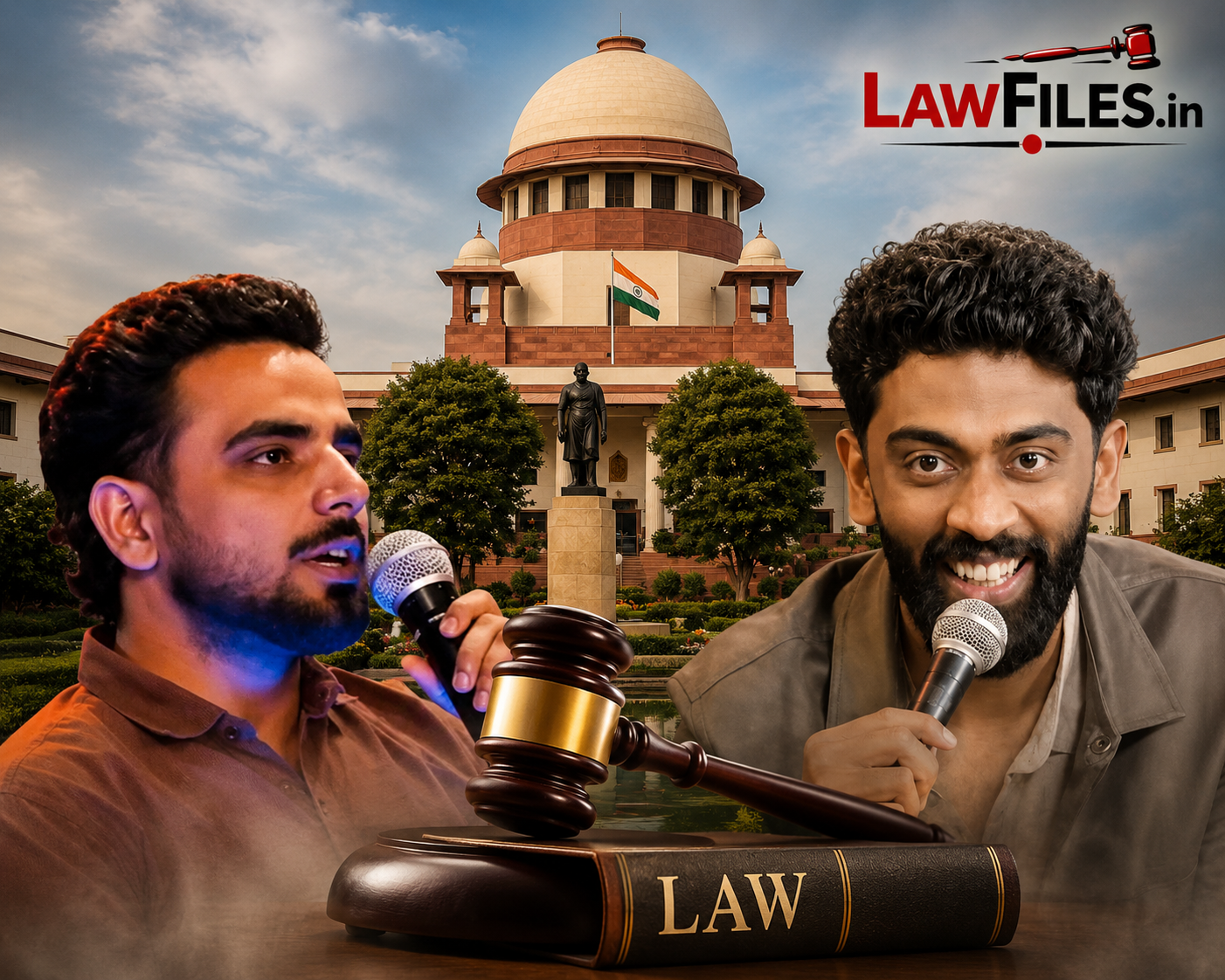
The Supreme Court has been approached through a Public Interest Litigation seeking the formulation of a comprehensive statutory and regulatory framework governing stand-up comedy, podcasts, live-streaming platforms, social media ecosystems and other forms of user-generated digital content. Filed under Article 32 of the Constitution by Advocate Vishal Tiwari, the petition contends that India’s existing legal architecture has failed to keep pace with the unprecedented speed at which digital platforms amplify information, misinformation and controversial content. Significantly, the plea does not seek criminal prosecution of individual comedians or content creators. Instead, it argues that recent controversies including the widely discussed “Rs. 370 Biryani” episode, the dissemination of misleading narratives concerning the All India Judges’ Badminton Championship, and other viral incidents involving digital creators demonstrate an urgent constitutional need for institutional safeguards capable of balancing freedom of speech with public accountability in the algorithm-driven digital age.
At the heart of the petition lies an important constitutional distinction. The petitioner expressly clarifies that the issue before the Supreme Court is not whether humour, satire or artistic liberty ought to be curtailed. Rather, the concern is whether digital platforms, through algorithmic amplification, transform isolated remarks into nationwide public discourse without any corresponding legal framework to address the consequences. According to the plea, a statement that may originally emerge during an improvised stand-up performance or casual online interaction can, within hours, reach millions of users across the country, influencing perceptions on issues involving women’s dignity, consent, constitutional institutions and public morality. The petition therefore argues that while individual speech enjoys constitutional protection under Article 19(1)(a), the architecture through which such speech is algorithmically amplified deserves independent legal examination.
The proceedings arise against the backdrop of the controversy surrounding comedian Pranit More’s stand-up performance, during which an audience member narrated an incident claiming entitlement to sexual favours after spending ₹370 on a plate of biryani during a date. The exchange, initially occurring during a crowd-interaction segment, rapidly spread across multiple digital platforms, triggering widespread public criticism concerning misogyny, consent and gender sensitivity. The petitioner, however, consciously distances the litigation from demands for criminal prosecution of either the comedian or the audience participant. Instead, the plea submits that the controversy demonstrates the extraordinary capacity of social media algorithms to convert an isolated statement into a permanent national conversation capable of shaping public attitudes far beyond the original context in which the remarks were made.
The petition further places considerable emphasis upon recent instances involving dissemination of allegedly misleading content concerning constitutional institutions. It refers to photographs and videos relating to the All India Judges’ Badminton Championship held at Thyagaraj Stadium in New Delhi in November 2025, which were allegedly circulated online with misleading captions suggesting that the event had taken place in a foreign country and had involved expenditure of public funds abroad by the Chief Justice of India, Supreme Court judges and constitutional functionaries. According to the petitioner, these narratives achieved extraordinary circulation before official clarifications could effectively reach the public, thereby generating widespread speculation regarding judicial independence and institutional propriety. The plea argues that such incidents illustrate how misinformation affecting constitutional institutions often acquires irreversible public traction long before corrective information is disseminated.
One of the central legal propositions advanced in the petition is that India’s present regulatory framework remains overwhelmingly reactive. Existing mechanisms generally become operational only after misleading information has already attained mass circulation. By the time fact-checks, official clarifications or legal proceedings commence, millions of users may already have consumed, shared and acted upon inaccurate or misleading narratives. The petitioner therefore argues that traditional legal remedies such as criminal prosecution, defamation proceedings or intermediary takedown mechanisms under the Information Technology Act and associated Rules are often incapable of effectively addressing the speed, scale and permanence of algorithmically amplified misinformation.
To address this perceived regulatory gap, the petition seeks several institutional reforms. Among the principal reliefs sought is the constitution of an Expert Committee to inquire into the dissemination of misleading material relating to the All India Judges’ Badminton Championship. It further seeks the establishment of an Independent Judicial Commission headed by a retired Supreme Court judge to examine the broader problem of manipulated digital narratives, institutional safeguards, unrestricted social media exposure among children below sixteen years of age, age-verification mechanisms, digital literacy initiatives and child-protection standards for online platforms. Most significantly, the petitioner requests directions to the Union Government to formulate a comprehensive statutory framework governing stand-up comedy, podcasts, user-generated digital content, live-streaming platforms, artificial intelligence-generated content and algorithm-driven social media systems in a manner consistent with Articles 14, 19 and 21 of the Constitution.
The litigation raises several complex constitutional questions concerning the permissible limits of State regulation over online expression. Article 19(1)(a) guarantees freedom of speech and expression, while Article 19(2) permits only narrowly tailored restrictions in the interests of sovereignty, security, public order, decency, morality, defamation and other constitutionally recognised grounds. Indian constitutional jurisprudence has consistently treated prior restraints upon speech with considerable suspicion, recognising that open political discourse, satire, artistic expression and criticism form essential components of democratic governance. Consequently, any statutory framework emerging from judicial or legislative intervention would necessarily be required to satisfy the constitutional tests of proportionality, necessity and reasonableness repeatedly articulated by the Supreme Court in its free speech jurisprudence.
At the same time, the petition highlights an increasingly recognised constitutional challenge the role played by private digital platforms in shaping public discourse. Unlike traditional publishers or broadcasters, algorithm-driven platforms actively prioritise, recommend and amplify content based upon engagement metrics rather than public interest considerations. This technological architecture often rewards controversy, outrage and sensationalism, enabling inaccurate or misleading content to spread exponentially before institutional correction becomes possible. The petitioner therefore seeks to shift the legal conversation from regulation of individual speakers towards examination of the systemic mechanisms through which digital platforms influence information consumption.
The proceedings also intersect with the rapidly evolving jurisprudence surrounding artificial intelligence and online intermediaries. Recent developments before the Supreme Court—including concerns regarding AI-generated fake judicial precedents and deepfake technologies—have already demonstrated judicial awareness that technological innovation presents novel regulatory challenges extending beyond conventional legal categories. The present petition broadens that debate by focusing upon algorithmic amplification itself rather than merely the content being amplified. It raises the question whether constitutional law should increasingly engage not only with speech but also with the digital infrastructure that determines the reach and visibility of such speech.
Another noteworthy aspect of the petition is its emphasis upon vulnerable sections of society, particularly children and adolescents. The petitioner argues that India’s exceptionally high level of digital exposure, combined with unrestricted access to algorithmically curated short-form content, necessitates stronger institutional safeguards regarding age verification, digital literacy and responsible online engagement. The plea therefore situates misinformation not merely as an issue of false information but as a broader constitutional concern involving mental well-being, civic discourse, democratic participation and protection of vulnerable users within rapidly evolving digital ecosystems.
From a jurisprudential perspective, the litigation reflects the continuing evolution of constitutional law in response to technological transformation. Earlier constitutional debates concerning freedom of speech largely centred upon governmental censorship or criminal restrictions upon expression. The present petition instead focuses upon private technological ecosystems that possess unprecedented capacity to shape public opinion through algorithmic recommendation systems operating beyond traditional editorial control. Whether constitutional regulation should extend into this domain without impermissibly chilling free expression remains one of the most difficult questions confronting modern constitutional democracies.
Ultimately, the Supreme Court’s consideration of the petition may extend well beyond the immediate controversies that prompted its filing. The proceedings have the potential to define the constitutional contours of digital governance, intermediary accountability and algorithmic responsibility in India. The challenge before the Court will be to reconcile two equally compelling constitutional imperatives: preserving robust freedom of expression in a democratic society while ensuring that technological systems capable of amplifying misinformation, degrading public discourse and undermining confidence in constitutional institutions operate within a framework consistent with the rule of law. Whatever the eventual outcome, the petition signals that the next frontier of constitutional adjudication may no longer concern speech alone, but the increasingly powerful digital architecture through which speech reaches society.
