


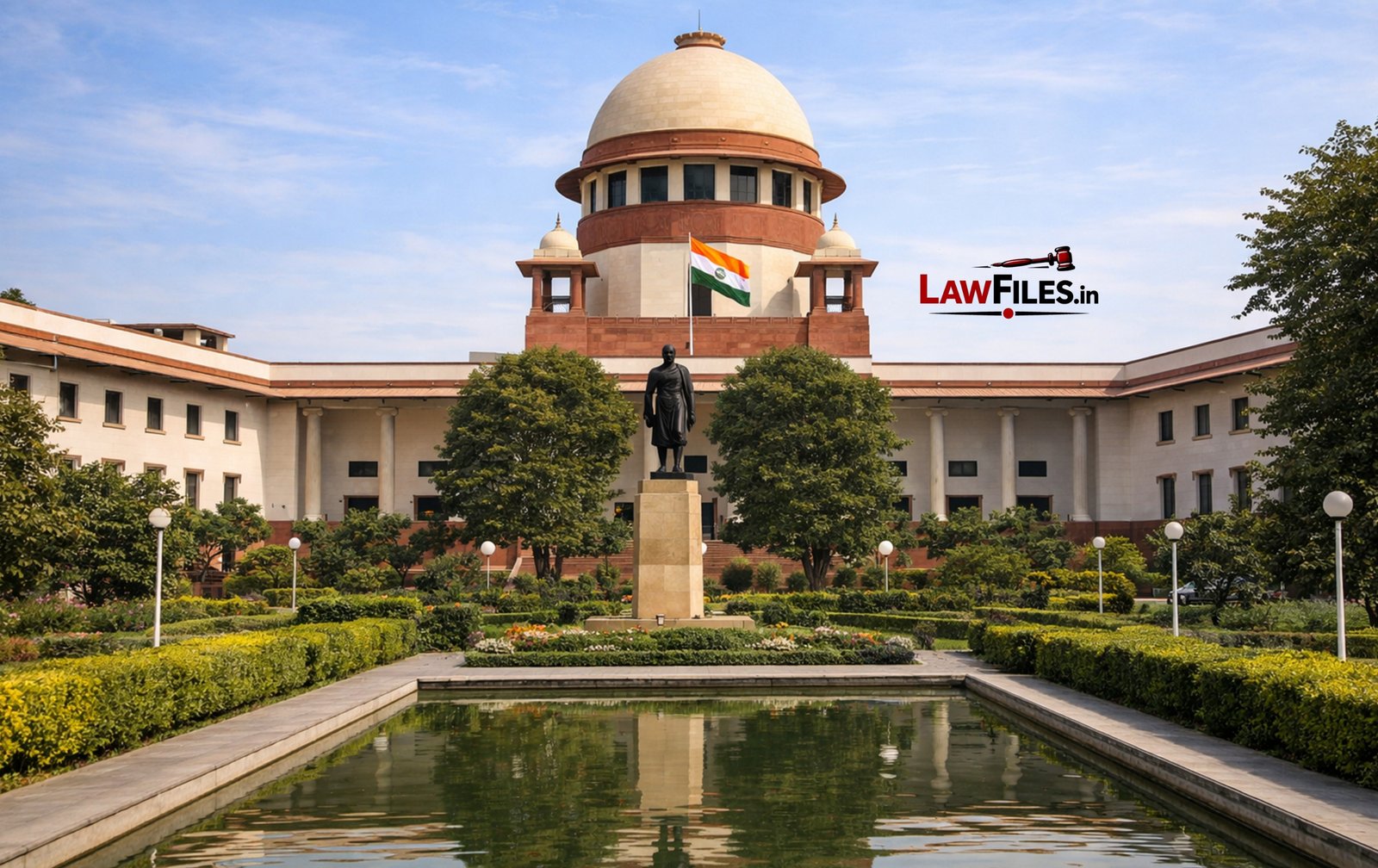
The Supreme Court has declined to grant urgent listing to a Public Interest Litigation seeking immediate judicial intervention against alleged derogatory remarks made by a social media influencer concerning Prophet Muhammad, holding that the petitioner must first exhaust the remedies available under the ordinary criminal justice system. Refusing to entertain the plea at the threshold, a Vacation Bench comprising Justice Ahsanuddin Amanullah and Justice Sheel Nagu underscored that the Supreme Court cannot become the first forum for every grievance merely because it involves a matter of public sensitivity. Advising the petitioner to “have faith in the system,” the Bench observed that the constitutional framework envisages a structured hierarchy of legal remedies beginning with the police authorities and subordinate courts before invoking the extraordinary jurisdiction of the apex court. The observations reaffirm the Court’s consistent jurisprudence that constitutional remedies under Article 32 are extraordinary in nature and cannot ordinarily be invoked by bypassing statutory mechanisms specifically designed to investigate alleged criminal offences.
The matter arose when an Advocate-on-Record sought urgent listing of a PIL alleging that certain comments made by influencer Nazia Elahi Khan during a podcast had the potential to disturb communal harmony and hurt the religious sentiments of members of the Muslim community. During oral mentioning, counsel submitted that the issue required immediate intervention because the remarks had circulated widely on social media and could aggravate public tensions. The petitioner requested the Supreme Court to urgently hear the matter in view of its alleged impact on public order and communal peace. However, the Bench declined to entertain the request at the stage of mentioning, observing that the petitioner had not first approached the police authorities or invoked the remedies available under criminal law.
Justice Amanullah, while interacting with counsel, questioned the growing tendency of litigants to approach the Supreme Court directly without first utilising the statutory institutions entrusted with law enforcement. The Court remarked that the Supreme Court forms part of the same judicial system and cannot function as the first point of contact for every alleged offence. Stressing the importance of institutional confidence, the Bench observed that if every grievance were to be brought directly before the apex court, the ordinary criminal justice machinery would become redundant and the carefully designed hierarchy of courts would be rendered ineffective. The Court further cautioned against “sensationalising sensitive matters,” noting that issues capable of affecting communal harmony should be addressed through lawful investigative mechanisms rather than by seeking immediate constitutional intervention.
The order is significant not because the Supreme Court examined the merits of the allegations—it consciously refrained from doing so—but because it reiterates an important constitutional principle governing the exercise of writ jurisdiction. Article 32 undoubtedly guarantees the right to approach the Supreme Court for enforcement of fundamental rights, a remedy famously described by Dr. B.R. Ambedkar as the “heart and soul” of the Constitution. Nevertheless, constitutional courts have consistently maintained that where an effective statutory remedy exists, particularly in matters requiring factual investigation, litigants should ordinarily approach the competent authorities before invoking the extraordinary jurisdiction of the apex court. The present case illustrates this doctrine in operation, with the Court emphasising procedural discipline over immediate judicial intervention.
The decision also reflects the distinction between judicial review and criminal investigation. Allegations that particular statements amount to hate speech, promote enmity or outrage religious feelings generally require factual examination, assessment of context, collection of digital evidence and investigation by the police. Such exercises fall within the statutory functions assigned to investigating agencies under the Bharatiya Nagarik Suraksha Sanhita, 2023. Constitutional courts ordinarily avoid undertaking these investigative functions directly unless there is demonstrable failure of statutory authorities or exceptional circumstances warranting immediate intervention. By directing the petitioner to first approach the police, the Supreme Court reaffirmed this institutional division of responsibilities.
The proceedings acquire additional legal significance because Indian criminal law already contains several statutory provisions addressing speech that allegedly threatens communal harmony or intentionally insults religious beliefs. Depending upon the factual matrix of a particular case, authorities may examine the applicability of provisions such as Sections 196, 299 and other relevant provisions of the Bharatiya Nyaya Sanhita, 2023 dealing with promotion of enmity, deliberate acts intended to outrage religious feelings and related offences. Whether these provisions are ultimately attracted in any given case remains a matter of investigation and judicial determination based upon evidence rather than public perception. The Supreme Court’s refusal to intervene at the threshold therefore reinforces the principle that criminal liability must be determined through established legal processes rather than through preliminary constitutional proceedings.
From a constitutional perspective, the matter sits at the intersection of two competing guarantees. Article 19(1)(a) protects freedom of speech and expression, while Article 19(2) authorises the State to impose reasonable restrictions in the interests of public order, decency, morality and other constitutionally recognised grounds. Simultaneously, Articles 25 and 26 safeguard freedom of religion and the right of religious denominations to practise and profess their faith. Courts have consistently recognised that disputes involving allegedly offensive speech concerning religion require careful balancing between these constitutional guarantees. Neither unrestricted speech nor unrestricted censorship finds absolute protection under the constitutional framework; instead, judicial scrutiny focuses upon the statutory standards enacted by Parliament and the factual circumstances surrounding the alleged expression.
The Supreme Court’s observations also resonate with its broader jurisprudence discouraging direct recourse to Public Interest Litigation where ordinary legal remedies remain available. Over the years, the Court has repeatedly emphasised that PIL jurisdiction was conceived to address structural injustice and protect disadvantaged sections of society, not to replace the statutory processes governing investigation of individual criminal complaints. While constitutional courts undoubtedly possess the power to intervene in exceptional cases involving systemic failure, litigants are generally expected to first invoke remedies before police authorities, Magistrates and jurisdictionally competent courts before seeking relief under Article 32.
Equally important is what the Court did not decide. The Bench expressed no opinion on the correctness, legality or criminality of the alleged remarks attributed to the influencer. Nor did it examine whether any offence under the Bharatiya Nyaya Sanhita had in fact been committed. Its refusal was confined to the procedural question of urgent listing, leaving the substantive allegations to be examined, if necessary, through the ordinary investigative process. This restraint reflects the long-established judicial principle that constitutional courts should avoid prejudging factual controversies before the competent statutory authorities have undertaken investigation.
The case also highlights the evolving challenge posed by digital platforms in contemporary constitutional adjudication. Statements made during podcasts, live-streams and social media broadcasts now acquire nationwide circulation within minutes, frequently generating demands for immediate judicial intervention. However, the Supreme Court’s response indicates that technological speed cannot justify abandonment of procedural safeguards embedded within the criminal justice system. Even where online speech gives rise to allegations of communal disharmony, constitutional adjudication continues to operate through established legal processes rather than instantaneous judicial supervision.
Ultimately, the Supreme Court’s refusal to accord urgent listing reinforces a foundational principle of constitutional governance that the rule of law depends not only upon the availability of judicial remedies but also upon adherence to institutional processes. By directing the petitioner to first approach the police and “have faith in the system,” the Court reaffirmed that the effectiveness of constitutional justice lies in the proper functioning of every level of the legal system, from local law enforcement to the nation’s highest court. The order therefore serves as an important reminder that while the Supreme Court remains the ultimate constitutional guardian, its extraordinary jurisdiction is designed to complement not supplant the statutory mechanisms through which criminal law is ordinarily administered.
