


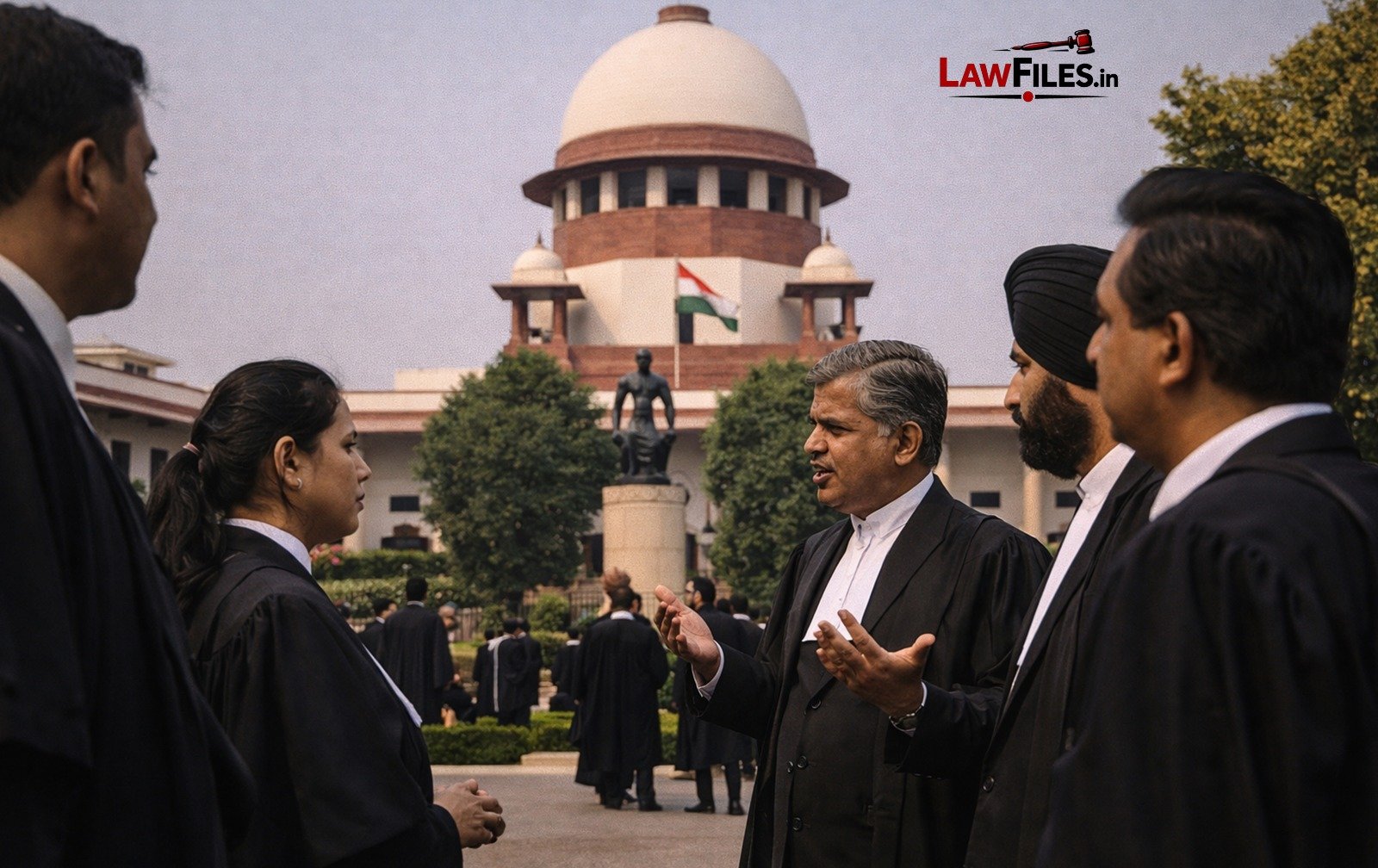
The Supreme Court has declined a proposed interaction between its sitting judges and the Joint Parliamentary Committee examining the constitutional framework for simultaneous elections, bringing into sharp focus an important institutional question that goes beyond the political debate surrounding “One Nation, One Election”: how should the legislature and judiciary interact when Parliament is examining a constitutional amendment that may ultimately come before the Court for judicial review?
The proposed interaction was scheduled for October 6 and had been described in the committee’s circulated programme as an “informal discussion” with the Chief Justice of India and other Supreme Court judges on simultaneous elections. The Supreme Court administration subsequently conveyed that the proposed interaction would not take place. The communication followed consideration of the proposal by senior judges, who took the view that such an interaction was neither “expedient nor desirable”, particularly given the possibility that the proposed constitutional amendments could subsequently become the subject of judicial review.
The development is constitutionally significant because the parliamentary committee is not examining an ordinary legislative amendment. It is scrutinising the Constitution (129th Amendment) Bill, 2024 and the Union Territories Laws (Amendment) Bill, 2024, legislation designed to establish a constitutional and statutory framework for synchronising elections to the Lok Sabha and State Legislative Assemblies. The proposed framework involves questions concerning the tenure of elected Houses, premature dissolution, federalism, electoral administration and the distribution of constitutional power.
The controversy began after the Joint Parliamentary Committee, chaired by P.P. Chaudhary, proposed a visit to the Supreme Court as part of its consultation process. The committee has been undertaking consultations with political parties, legislators, constitutional experts, civil society representatives and other stakeholders. It has also consulted former Chief Justices and retired Supreme Court judges on the constitutional implications of simultaneous elections. The distinction between those consultations and a meeting with sitting judges is central to the institutional issue now arising.
The Supreme Court’s decision should therefore not be read as a judicial pronouncement on the merits of simultaneous elections. No constitutional question concerning the validity of the proposed Bills has been adjudicated by the Court. Rather, the development concerns the propriety of an informal interaction between the legislative branch and judges who may, at a later stage, be required to adjudicate challenges to the very constitutional amendments presently under parliamentary consideration.
The proposed interaction and why it became controversial
The committee’s proposed October 6 programme was described as a “Local Study Visit”, with the circulated agenda referring to an informal discussion with the Chief Justice and other judges concerning simultaneous elections. Committee Chairman P.P. Chaudhary subsequently maintained that the proposed visit was primarily intended to familiarise members with the Supreme Court, including its library, and was not intended to discuss the merits of the Bills with the judges. He also indicated that the programme had been postponed because of scheduling issues.
The Supreme Court’s administrative response, however, gave a different institutional reason for declining the interaction. According to reports, the Secretary General’s Office communicated that senior judges had considered the proposal and concluded that discussing the issue on the administrative side was not expedient or desirable because the proposed constitutional amendments could become the subject of judicial review.
That reasoning is important. The Court did not say that Parliament is constitutionally prohibited from consulting judges generally. Nor did it question the legitimacy of parliamentary committees seeking expert information. Its concern was more narrowly directed towards sitting judges discussing a legislative proposal that may subsequently come before them in litigation.
This distinction between an institutional consultation and an interaction capable of touching upon the merits of pending or prospective legislation is fundamental to judicial ethics and constitutional structure.
Senior Advocate Kapil Sibal had publicly objected to the proposed meeting earlier on the same day, describing such a pre-legislative interaction with sitting judges as unprecedented and raising separation-of-powers concerns. He pointed out that Parliament is constitutionally responsible for making laws, while the judiciary determines their validity when challenged. His concern was that the same judges who might later be called upon to test the constitutional validity of the amendments should not first participate in a discussion concerning their substance.
The objection therefore was not that Parliament cannot seek legal expertise. It was that the source and identity of the expertise matter when the proposed legislation may later become the subject of adjudication.
Separation of powers is not institutional isolation
The episode provides an opportunity to understand separation of powers more precisely.
The Indian Constitution does not establish the kind of rigid institutional separation in which the legislature, executive and judiciary can never communicate with each other. Constitutional governance necessarily requires institutional interaction. Courts depend upon legislative frameworks; Parliament responds to judicial decisions; executive authorities implement judicial orders; and parliamentary committees routinely examine legal and constitutional questions with assistance from experts.
Separation of powers therefore does not mean that the three branches must operate in complete isolation.
Its more important function is to ensure that one constitutional institution does not compromise the independent exercise of another institution’s assigned function.
In the present context, Parliament is entitled to deliberate upon the constitutional desirability and legal mechanics of simultaneous elections. A parliamentary committee can call constitutional scholars, former judges, election administrators and other experts. But sitting judges occupy a different position because their constitutional role includes adjudicating disputes concerning legislation enacted by Parliament.
A judge who participates in a substantive discussion about a proposed amendment may later face a situation in which the same issue comes before the Court. Even if the judge approaches the eventual case with complete impartiality, the appearance of prior institutional involvement could itself become a source of controversy.
Judicial independence therefore includes not only actual impartiality but institutional conditions that preserve public confidence in impartial adjudication.
Why consultation with former judges is different
The parliamentary committee has already consulted former Chief Justices of India and retired Supreme Court judges. Those consultations have produced views on the constitutional viability of simultaneous elections. The committee has stated publicly that these consultations form part of its broader stakeholder engagement.
There is an obvious legal distinction between a retired judge and a sitting judge.
A retired judge who expresses an opinion about a proposed constitutional amendment does not ordinarily face the institutional possibility of later hearing a constitutional challenge to that amendment in the Supreme Court. A sitting judge does.
This does not mean that the views of retired judges are legally binding or that they predetermine the constitutional position. They are expert opinions available to Parliament as part of the legislative process. The same would apply to constitutional academics or practising lawyers consulted by the committee.
But the judicial office imposes additional obligations of restraint upon those who may subsequently be called upon to adjudicate.
The Supreme Court’s decision to decline the interaction can therefore be understood as an attempt to preserve a firewall between legislative consultation and future adjudication, rather than as a declaration that Parliament and the judiciary cannot communicate.
The constitutional amendments under examination
The underlying Bills themselves involve substantial constitutional changes.
The Constitution (129th Amendment) Bill, 2024 proposes the insertion of a new Article 82A to establish a framework for simultaneous elections to the Lok Sabha and State Legislative Assemblies. It also proposes consequential changes to Articles 83, 172 and 327. The Union Territories Laws (Amendment) Bill, 2024 contains corresponding changes for Union Territories.
The proposed model seeks to establish a common electoral cycle. Broadly, legislatures elected after an appointed date would have their terms aligned with the Lok Sabha’s electoral cycle. Where a House is dissolved prematurely, the newly elected House would serve only the unexpired portion of the existing cycle rather than receiving a fresh full five-year term.
That feature raises an important constitutional question of its own.
In a parliamentary system, the life of a government depends upon its ability to retain the confidence of the House. Governments may fall because they lose majority support, because coalition arrangements collapse or because other constitutional circumstances arise. If elections are synchronised through a constitutional amendment, the consequences of premature dissolution would necessarily have to be addressed through constitutional design.
The Bill attempts to address this by limiting the tenure of a newly elected House after premature dissolution to the remainder of the existing cycle. But that solution creates a further question: what happens to democratic accountability when voters elect a legislature whose full constitutional term has already been predetermined to end earlier than five years?
These are precisely the types of questions that Parliament is entitled to debate before legislation is enacted.
Federalism and the State Assemblies
The proposal also raises federal questions because State Assemblies are not merely administrative bodies subordinate to the Union.
India’s constitutional structure distributes legislative and executive powers between the Union and States. State governments derive democratic legitimacy from elections to their respective Legislative Assemblies. Aligning their electoral cycle with that of the Lok Sabha necessarily affects the timing and duration of State political mandates.
This is one reason why the proposed amendments have generated debate over federalism.
Supporters of simultaneous elections have argued that repeated elections impose financial and administrative costs, repeatedly activate the Model Code of Conduct and divert governmental machinery towards election management. The parliamentary committee has stated that it is examining mechanisms to preserve government stability and maintain the common election cycle in circumstances such as premature dissolution.
Opponents have raised different constitutional concerns, including the possibility that synchronisation could reduce the political autonomy of State governments or require elected Assemblies to have their terms curtailed or extended to achieve electoral alignment.
These competing arguments are ultimately matters for Parliament to consider at the legislative stage. If the Bills become law, constitutional objections may then be tested through the judicial process.
It is precisely because these stages are constitutionally distinct that the Supreme Court’s refusal to participate in the proposed discussion assumes importance.
The Basic Structure question
Any constitutional amendment affecting the electoral and federal architecture of the Constitution would inevitably invite consideration of the basic structure doctrine.
The Supreme Court’s decision in Kesavananda Bharati v. State of Kerala established that Parliament’s power to amend the Constitution under Article 368, though broad, is not unlimited. The basic structure doctrine subsequently developed through cases examining judicial review, democracy, federalism, separation of powers and other foundational constitutional principles.
That does not mean that simultaneous elections are inherently unconstitutional. Nor does the existence of a basic structure challenge establish that the proposed amendments would fail constitutional scrutiny.
The proper legal question would be whether the specific provisions, once enacted, alter or damage any feature protected by the basic structure doctrine.
Indeed, several former Chief Justices who have appeared before the parliamentary committee have reportedly taken the view that simultaneous elections as a concept are not necessarily inconsistent with the basic structure, while also identifying provisions that may raise constitutional concerns, particularly concerning the powers proposed for the Election Commission and the handling of premature dissolution.
This distinction is crucial. Constitutional feasibility of a concept is different from constitutional validity of every mechanism chosen to implement that concept. A constitutional amendment may pursue a permissible objective but still contain a particular provision that creates constitutional difficulty.
One of the more significant questions identified during consultations concerns the role of the Election Commission of India. A synchronised election cycle would require an institutional mechanism capable of coordinating elections to the Lok Sabha and all State Assemblies. The proposed constitutional and statutory changes consequently contemplate a stronger role for the Election Commission in determining and managing the electoral cycle.
Former Chief Justices who appeared before the parliamentary committee have reportedly indicated that the concept of simultaneous elections could pass constitutional scrutiny but expressed concerns regarding the extent of powers proposed to be vested in the Election Commission.
That concern is doctrinally significant because Article 324 already grants the Election Commission wide constitutional authority over the superintendence, direction and control of elections to Parliament and State Legislatures. Expanding its role in a synchronised electoral framework would require careful consideration of the relationship between Article 324 and the constitutional autonomy of State legislatures.
The question is not simply whether the Election Commission can conduct simultaneous elections. It is whether the constitutional framework would confer upon an electoral body powers that indirectly determine the duration, continuation or electoral timing of elected legislatures.
That issue could eventually become relevant to judicial review. The practical difficulty of synchronisation becomes particularly visible when a government loses its majority before the common electoral date.
Under the present parliamentary system, the fall of a government does not necessarily require immediate dissolution of the House. An alternative government may be formed if another leader can command majority support. But if no government can be formed, dissolution and fresh elections may follow. Under a simultaneous-election model, however, an early election would disturb the common cycle.
The proposed constitutional framework attempts to solve this by limiting the tenure of the newly elected House to the remainder of the common cycle. That preserves synchronisation but creates a novel constitutional arrangement in which an election may produce a government whose tenure is constitutionally predetermined to be shorter than five years.
Such an arrangement would need to be examined not merely from the standpoint of administrative efficiency but also from the perspective of democratic accountability and the constitutional relationship between the electorate and its elected representatives. The committee has reportedly been examining mechanisms including constructive votes of no-confidence and anti-defection safeguards to preserve stability after synchronisation. These proposals demonstrate that “One Nation, One Election” is not merely a question of changing election dates. It potentially requires a broader redesign of the constitutional consequences of political instability.
The judiciary should not become a participant in constitutional drafting
The Supreme Court’s refusal to participate in the proposed interaction can also be understood through another constitutional principle: the judiciary interprets the Constitution; it does not ordinarily participate in drafting constitutional amendments that it may later be required to adjudicate.
Parliamentary committees are specifically designed to scrutinise Bills, gather evidence, receive representations and consider possible modifications before legislation reaches the final stage of parliamentary approval.
The Court’s institutional role is different. It may later be called upon to determine whether Parliament’s constitutional amendment power has been exercised within the limits of Article 368 and the basic structure doctrine.
If sitting judges participate in substantive pre-legislative discussions and express views on the design of a constitutional amendment, litigants challenging that amendment could potentially seek recusal or raise questions concerning institutional impartiality.
The Supreme Court has therefore avoided creating a situation in which the adjudicator becomes an informal consultant to the law-making body on a matter that may later require adjudication. That is a prudent institutional boundary even though there is no suggestion that the parliamentary committee intended to compromise judicial independence. At the same time, it would be inaccurate to treat the Court’s response as hostility towards parliamentary scrutiny or constitutional dialogue.
The committee has undertaken extensive consultations across States and with different categories of stakeholders. The Government has also maintained that the process is intended to gather views before the committee submits its report to Parliament. The committee’s consultations have included legal experts, academics, legislators, government officials, civil society representatives and former members of the higher judiciary. There is considerable constitutional value in such consultation. A constitutional amendment of this magnitude should be informed by evidence concerning electoral administration, federal relations, legislative stability, financial costs, voter behaviour, constitutional history and comparative electoral systems.
The institutional boundary becomes important only when consultation crosses into substantive engagement with judges who may later have to determine the legality of the resulting legislation. The Supreme Court’s response preserves that distinction.
The timing of the proposed interaction was especially significant
The timing also matters. The Bills remain under parliamentary scrutiny. The Joint Committee has not yet completed its work, and the legislative process has not reached its final stage. The proposed meeting therefore would have taken place before Parliament had formally decided the final text of the constitutional amendments.
This is materially different from a situation in which judges appear before Parliament in a purely educational or historical capacity concerning settled constitutional doctrine. Here, the very legislation being examined could eventually generate constitutional litigation.
The Court’s reasoning that the issue might become the subject of judicial review therefore reflects a forward-looking institutional caution. The judiciary need not wait until a case is actually filed to avoid an avoidable appearance of prior participation in the legislative design of the measure.
Former judges can speak; sitting judges must exercise restraint
The development also highlights an important distinction within the legal profession.
Former judges are free, subject to applicable legal and ethical considerations, to participate in public discussions concerning constitutional questions. Their experience can provide valuable institutional insight. Parliament’s consultation with retired Chief Justices is therefore not inherently problematic. Sitting judges, however, occupy a different constitutional position. Their decisions are subject to judicial discipline, precedent and constitutional adjudication. Their public statements concerning matters that may come before the Court are correspondingly constrained.
Judicial independence is therefore not merely the absence of executive interference. It also requires judges to maintain sufficient institutional distance from political and legislative controversies so that litigants can approach the Court without a reasonable apprehension that the adjudicating institution has already participated in shaping the contested law. The Supreme Court’s present decision can thus be seen as an exercise in institutional restraint rather than institutional disengagement.
A constitutional lesson for all three branches
The episode also offers a broader lesson concerning constitutional democracy. Parliament has the authority and responsibility to debate whether simultaneous elections are desirable, workable and constitutionally appropriate. The executive may place policy proposals before Parliament and assist in their implementation if enacted. The Election Commission can provide technical and electoral expertise. Experts, academics, former judges and civil society organisations can contribute their perspectives. The judiciary’s role begins differently: it must remain available to determine whether the constitutional limits governing the legislative process and the substance of the resulting law have been respected. Keeping these functions distinct does not weaken constitutional dialogue. It makes the dialogue more credible.
A parliamentary committee can receive the strongest constitutional criticism without asking sitting judges to validate its proposals. Similarly, the Supreme Court can later adjudicate the validity of legislation without having participated in its formulation.
The issue of “One Nation, One Election” remains open
The Supreme Court’s decision not to meet the parliamentary committee should not be mistaken for a judicial position either supporting or opposing simultaneous elections. The Court has made no finding that the proposed amendments are unconstitutional. Nor has it endorsed the proposal. The legislative process remains with Parliament, and the committee is expected to continue examining the Bills and stakeholder submissions.
The committee’s chairman has maintained that the proposed visit was not intended to discuss the Bills with judges and that the visit was primarily an orientation to the Supreme Court premises. The committee’s broader consultation exercise therefore remains unaffected by the cancellation of this particular interaction.
The institutional question, however, has been answered clearly enough for the present: sitting judges should not participate in an informal discussion about proposed constitutional amendments where those amendments may subsequently come before the Supreme Court for adjudication. That approach preserves the constitutional sequence in which Parliament debates and enacts the law, while the judiciary remains available to review its validity if a proper case subsequently arises.
The deeper significance of the episode is therefore not whether “One Nation, One Election” is ultimately adopted. It lies in the constitutional discipline governing how institutions should behave when a proposed change reaches the intersection of legislative policy and judicial review. In a constitutional democracy, Parliament must have room to legislate and consult widely, while courts must retain sufficient distance from the legislative process to adjudicate later without the burden of having previously participated in the very debate.
The proposed meeting may therefore have been cancelled, but it has nevertheless generated a valuable constitutional discussion: institutional dialogue is essential to constitutional governance, but institutional roles must remain sufficiently distinct to preserve the credibility of the eventual decision-making process.
