


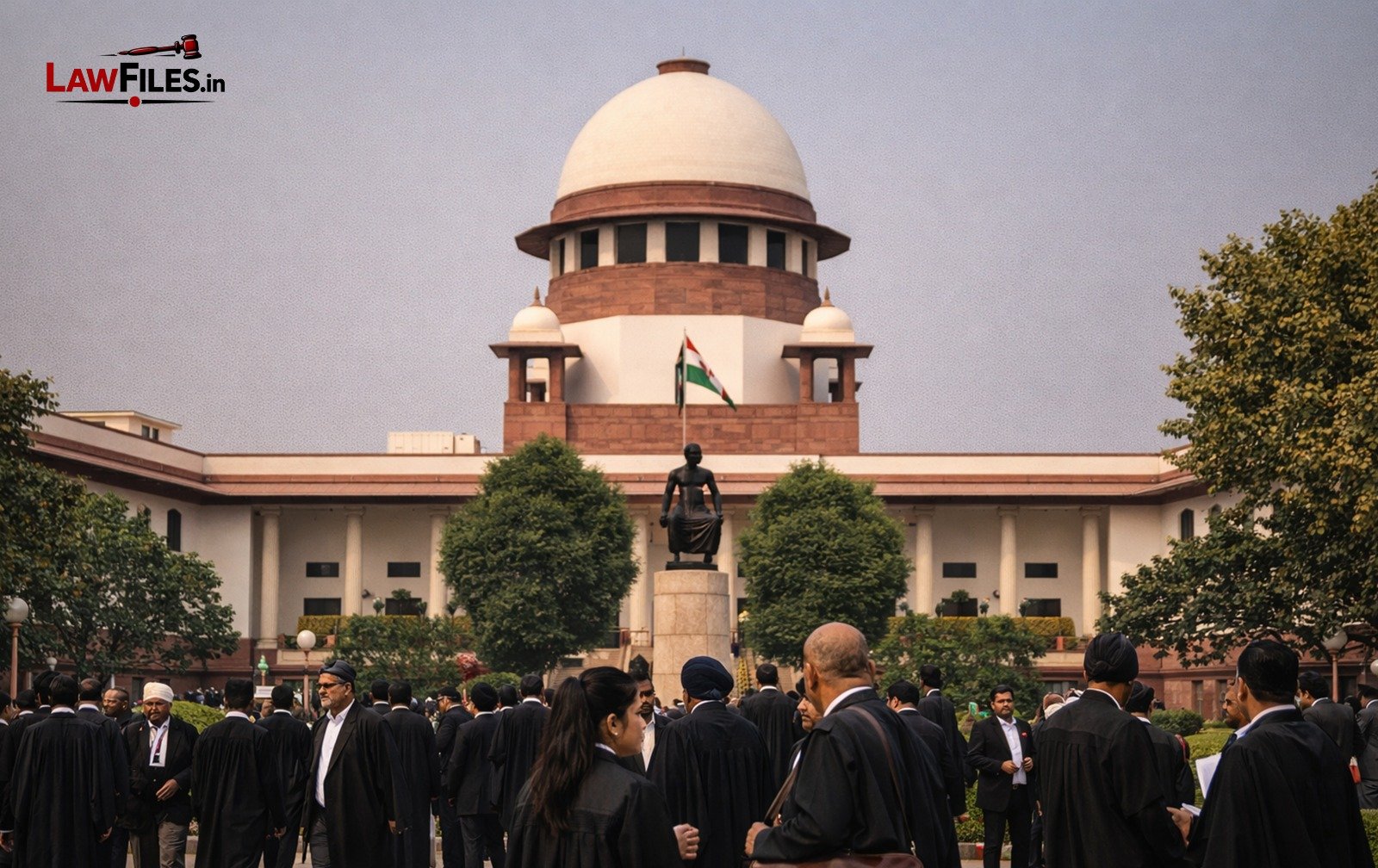
The Supreme Court on October 13, 2026, declined to entertain a writ petition filed directly under Article 32 of the Constitution by Waiz Khan, who alleged that personnel of the Uttar Pradesh Anti-Terrorism Squad (ATS) entered his residence without wearing proper uniforms or displaying identification, despite there being no criminal proceedings pending against him. A Bench comprising Chief Justice of India Surya Kant and Justices Joymalya Bagchi and V. Mohana held that the petitioner had not first approached the Allahabad High Court and granted him liberty to pursue the available remedy before that Court. The petition was accordingly dismissed at the threshold. The order is significant not because the Supreme Court adjudicated the legality of the alleged police entry, but because it reiterated an important principle of constitutional litigation: although Article 32 guarantees access to the Supreme Court for enforcement of fundamental rights, the existence of that remedy does not invariably require the Court to entertain every petition in the first instance when the jurisdiction of a High Court under Article 226 is equally available. The allegations concerning the ATS personnel remain unadjudicated, and the dismissal should not be understood as a judicial endorsement of the conduct complained of.
The matter, titled Waiz Khan v. State of Uttar Pradesh and Others, was registered as Diary No. 42099 of 2026. During the hearing, counsel for the petitioner questioned why the Supreme Court could decline to examine an allegation involving the violation of fundamental rights when Article 32 itself guarantees a constitutional remedy. The counsel maintained that the Supreme Court could not avoid its constitutional responsibility merely because the petitioner had not approached the High Court first. The argument raised a substantial constitutional issue concerning the relationship between Articles 32 and 226: whether a litigant who alleges an infringement of fundamental rights may insist on an immediate hearing before the Supreme Court, or whether the Court can require the litigant to approach the jurisdictional High Court in the first instance.
Justice Joymalya Bagchi addressed this issue by observing that Articles 32 and 226 overlap in their jurisdiction concerning the enforcement of fundamental rights. He indicated that the Court would ordinarily prefer the court of first instance to examine an alleged violation before the matter was brought directly before the Supreme Court. When counsel emphasised that Parliament had provided jurisdiction to both constitutional courts, Justice Bagchi acknowledged the point but stressed that the petitioner also had a responsibility to pursue the available means of enforcing his rights. The exchange brought out an important distinction in constitutional law: the existence of jurisdiction and the discretionary manner in which that jurisdiction is exercised are separate questions. A court may possess the power to hear a matter without being obliged to exercise that power immediately in every case.
The Chief Justice similarly questioned why the petitioner could not approach the Allahabad High Court. Counsel persisted that a violation of fundamental rights was, in substance, a violation of the Constitution and that Article 32 could not be suspended. The Bench did not dispute the constitutional importance of the remedy. Instead, it declined to entertain the petition in the circumstances presented, recording that no case for exercising its jurisdiction had been made out and expressly preserving the petitioner’s liberty to approach the High Court. The distinction is important: the Court did not hold that an allegation of unlawful entry by police personnel falls outside the protection of fundamental rights. It held only that the petitioner should pursue the matter before the jurisdictional High Court rather than seek first-instance adjudication directly from the Supreme Court.
The petitioner relied on the Supreme Court’s decision in D.K. Basu v. State of West Bengal, (1997) 1 SCC 416, which established safeguards intended to prevent custodial abuse and make police arrest and detention procedures transparent and accountable. During the hearing, counsel invoked the judgment in support of the contention that police action must comply with established safeguards. Justice Bagchi responded by referring to the availability of a remedy before the High Court in cases involving alleged illegal arrest. The exchange was not a finding that the safeguards in D.K. Basu were irrelevant to the allegations. Rather, it reflected the Bench’s view that the petitioner could seek appropriate constitutional relief before the High Court, which could examine the facts, the nature of the alleged police action and the legal provisions governing it.
The underlying allegation raises questions that extend beyond the formal issue of which court should hear the petition first. According to the plea, ATS personnel entered the petitioner’s residence without proper uniforms or visible identification, even though no criminal proceedings were pending against him. The petitioner’s concern was that the entry lacked an identifiable legal basis and that the absence of clear identification made it difficult to determine the authority under which the personnel had acted. Such allegations, if established, could raise issues concerning personal liberty, the privacy and security of the home, the limits of police power and the accountability of specialised law-enforcement units. At the same time, the absence of a pending criminal case does not, by itself, conclusively establish that every police visit or entry is unlawful. The legality of the conduct would depend on the circumstances, the authority invoked, any applicable warrant or statutory power, the urgency of the situation and compliance with the relevant safeguards.
Article 21 of the Constitution provides that no person shall be deprived of life or personal liberty except according to procedure established by law. Its protection extends beyond formal arrest and incarceration. State action affecting an individual’s liberty, security and dignity must have a lawful basis and satisfy the applicable constitutional requirements. An entry into a person’s home by law-enforcement personnel may therefore raise questions under Article 21 depending on the circumstances in which it occurs. The constitutional concern becomes particularly acute where the person affected cannot readily identify the officers, ascertain the purpose of their visit or determine the legal authority under which they are acting. However, the precise application of Article 21 cannot be decided merely from the allegation that officers were not wearing uniforms. The court examining the matter would need to establish what occurred and whether the conduct was authorised by law.
Article 14 may also become relevant if the alleged conduct reflects arbitrary or discriminatory exercise of State power. Police authority is not an unrestricted discretion to enter private premises or interfere with personal liberty according to an officer’s unrecorded preference. It must be exercised for a legally permissible purpose, within the limits of the applicable law and subject to safeguards that allow subsequent scrutiny. Where a citizen alleges that officers entered a home without identifiable authority, the questions are not limited to whether the officers behaved discourteously. They include whether the action was legally authorised, whether the officers complied with prescribed procedures and whether there is a reliable record of the operation. These matters require evidence and cannot be resolved solely by the description of the officers’ appearance.
The question of identification is particularly important in operations conducted by specialised units such as the ATS. Such units may undertake sensitive assignments involving intelligence gathering, counter-terrorism investigations and the prevention of serious offences. The operational nature of their work may sometimes justify specific security arrangements, but it does not place their personnel outside the law. The need for operational confidentiality must coexist with accountability for the exercise of coercive powers. Where officers enter private premises, the ability to establish who acted, under whose authority and for what purpose can become crucial to determining whether the operation was lawful. Identification requirements, written authorisations where applicable, contemporaneous records and the preservation of relevant electronic evidence can protect both citizens and officers by enabling disputed events to be independently verified.
The allegation that no criminal proceedings were pending against the petitioner also requires careful legal treatment. Police powers are not confined exclusively to situations in which a person has already been formally charged or summoned by a court. Depending on the applicable statute and facts, officers may be authorised to investigate suspected offences, gather intelligence, execute lawful warrants or take preventive action in specified circumstances. Nevertheless, such powers cannot be exercised without legal limits. A claim that no case was pending may be relevant to assessing the justification for the alleged entry, but the decisive inquiry would include whether any investigation, warrant, statutory authorisation or other lawful basis existed. The High Court, if approached, would be able to call for the relevant records and determine whether the ATS personnel acted within the authority conferred upon them.
The constitutional distinction between Articles 32 and 226 lies at the centre of the Supreme Court’s decision. Article 32 guarantees the right to move the Supreme Court for enforcement of fundamental rights and empowers it to issue appropriate writs, directions and orders. Dr. B.R. Ambedkar famously described Article 32 as the Constitution’s most important guarantee because a right without an effective remedy risks becoming merely declaratory. The provision is therefore not an ordinary statutory appeal or a discretionary concession granted by the State; it is itself a fundamental right. Yet the Supreme Court has developed a practice of directing litigants to the appropriate High Court in suitable cases, particularly where factual issues require examination and the High Court can provide effective relief under Article 226.
Article 226 confers a broader writ jurisdiction on High Courts. Unlike Article 32, which is specifically directed towards the enforcement of fundamental rights, Article 226 permits High Courts to issue writs for the enforcement of fundamental rights and for other legal purposes. This wider jurisdiction often makes the High Court a suitable forum for examining disputes involving State authorities, especially where the relevant events occurred within its territorial jurisdiction and the factual record must be developed. In the present case, the Allahabad High Court is the natural constitutional forum for examining the alleged conduct of Uttar Pradesh ATS personnel, subject to the ordinary requirements of jurisdiction and maintainability.
The Supreme Court’s approach is consistent with the principle that the existence of an alternative constitutional remedy may influence the exercise of its jurisdiction without extinguishing the right guaranteed by Article 32. The Court’s refusal to entertain a petition directly does not necessarily mean that the petitioner lacks a remedy, nor does it diminish the fundamental right alleged to have been infringed. Instead, it reflects a judicial assessment of the appropriate forum and the sequence in which the dispute should be considered. By granting liberty to approach the Allahabad High Court, the Bench preserved the petitioner’s ability to seek constitutional relief rather than deciding the substantive allegations without examining the underlying facts.
This approach must nevertheless be distinguished from a rule that Article 32 petitions can never be entertained where a High Court has not been approached. The Constitution does not make prior recourse to a High Court an absolute jurisdictional prerequisite for every Article 32 petition. The Supreme Court retains its constitutional authority to intervene where the circumstances warrant it. The relevant distinction is between the existence of that authority and the Court’s decision to exercise it in a particular case. The present order indicates that the Bench considered the available High Court remedy appropriate in the circumstances; it does not establish a categorical bar against direct recourse to Article 32 in future cases involving police misconduct or alleged violations of personal liberty.
The decision also demonstrates the practical importance of the High Court’s fact-finding role. Allegations concerning entry into private premises may require examination of police station records, duty rosters, deployment orders, written authorisations, CCTV footage, witness accounts and any communication explaining the purpose of the operation. The court may need to determine whether the personnel were identifiable, whether the entry was consensual or compelled, whether any legal authority was invoked and whether the petitioner suffered a continuing threat or interference with his rights. A constitutional court cannot properly assess these issues by treating every allegation as proved, but neither should the availability of an alternative forum be understood as a determination that the allegations lack substance. The appropriate forum must examine the evidence and apply the law to the facts established.
The reliance on D.K. Basu also highlights the distinction between safeguards governing arrest and the wider legality of police conduct. The judgment laid down procedural requirements intended to prevent arbitrary arrest and custodial abuse, including identification of arresting officers, preparation of arrest documentation, communication of information to a nominated person and medical examination in the circumstances specified by the safeguards. These protections have an important accountability function. However, whether each requirement applies to the alleged entry into Khan’s home depends on the legal character of the police action. If the personnel merely entered premises without arresting or detaining him, the applicable legal questions may differ from those arising from a formal arrest. If the operation involved restraint of liberty or an arrest in substance, the relevant safeguards would need to be assessed accordingly. The legal analysis must therefore focus on the actual conduct rather than assume that every police visit attracts precisely the same procedural requirements.
The broader public importance of the dispute lies in maintaining a balance between effective law enforcement and the protection of private life. Specialised agencies may need to operate in sensitive circumstances, but the seriousness of their functions cannot justify unreviewable discretion. A citizen must be able to seek an explanation where State personnel enter a home or exercise coercive authority, while officers must be able to demonstrate that their actions were undertaken pursuant to lawful duties. The existence of a clear record is particularly important when an operation is disputed because it allows the court to assess the competing accounts on evidence rather than speculation. The legal system’s response to such allegations must be firm about accountability without presuming misconduct before the facts are established.
The immediate consequence of the Supreme Court’s order is that Waiz Khan may approach the Allahabad High Court to seek relief concerning the alleged entry by ATS personnel. The High Court will have to consider the petition in accordance with the applicable law and the material placed before it. The Supreme Court has not determined whether the alleged entry was unlawful, whether the personnel were required to wear a particular uniform in the circumstances, or whether any fundamental right was actually infringed. Nor has it held that the petitioner is disentitled to constitutional protection. Its decision is confined to declining to entertain the Article 32 petition at that stage while preserving the alternative remedy.
Ultimately, the ruling reinforces a procedural principle with substantive consequences: the enforcement of fundamental rights depends not only on the rights guaranteed by the Constitution but also on the effective use of the constitutional institutions established to protect them. Article 32 remains a vital safeguard against State action that violates fundamental rights, while Article 226 gives High Courts broad authority to examine the legality of State conduct and grant appropriate relief. The Supreme Court’s decision directs the petitioner to use that High Court jurisdiction first, without foreclosing a determination on the merits of his allegations. The essential constitutional question whether the ATS personnel acted within the law remains unanswered and must be resolved, if pursued, through a factual and legal examination before the appropriate forum.
