


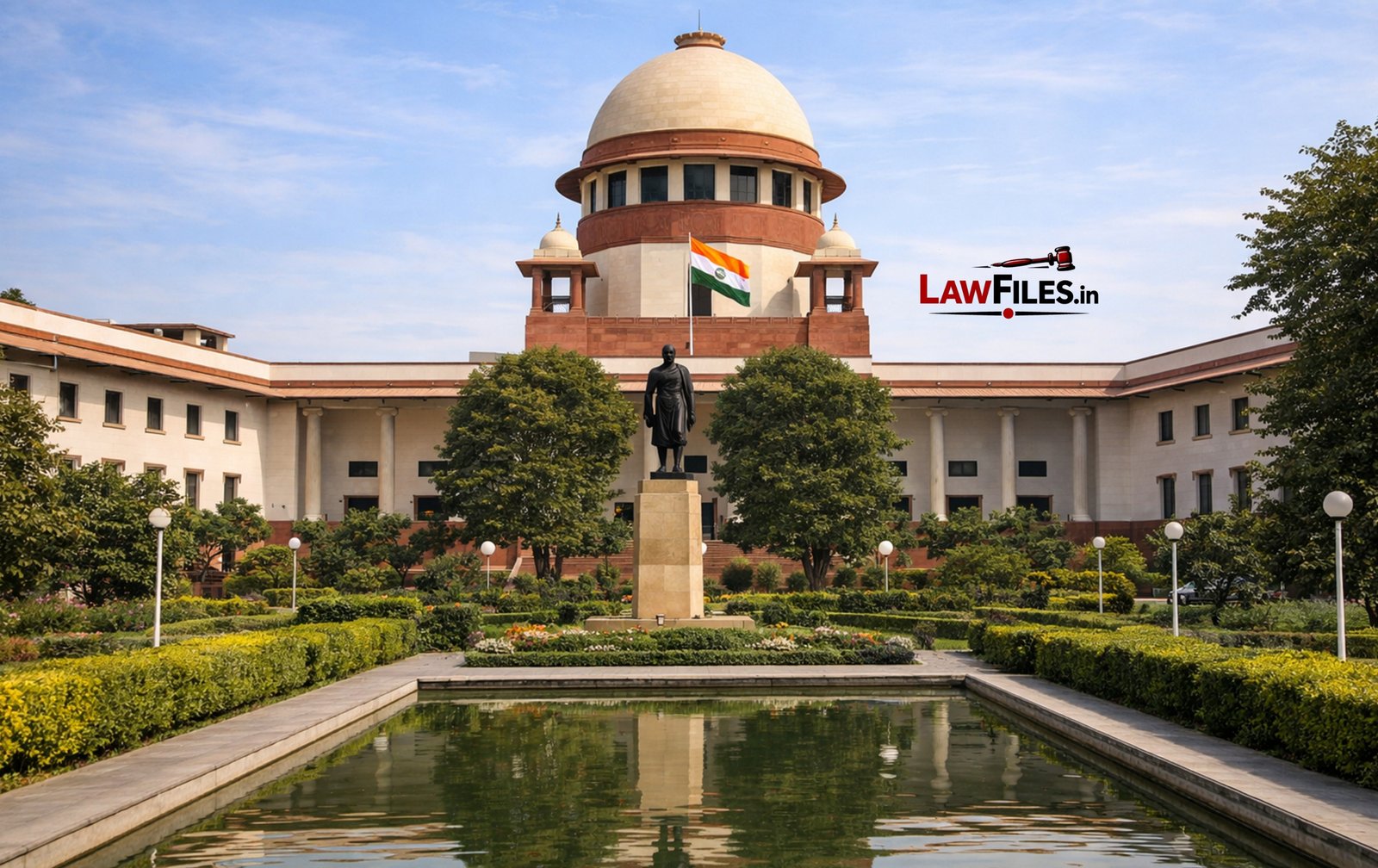
The Supreme Court on October 12, 2026, clarified that it has neither approved nor rejected the modified Form 6 declaration introduced by the Election Commission of India (ECI) in connection with the Special Intensive Revision (SIR) of electoral rolls. The Bench, comprising Chief Justice of India Surya Kant and Justices Joymalya Bagchi and V. Mohana, explained that its earlier judgment upholding the Election Commission’s authority to conduct the Bihar SIR did not adjudicate upon the validity of the particular modified declaration now under challenge, because that version was not in existence when the judgment was delivered. The clarification came during the hearing of a writ petition filed by Priya Mishra concerning the functioning of the Election Commission and the legality of decisions allegedly taken without the concurrence of its other members. The Court agreed to issue notice and listed the matter for October 27, along with connected proceedings concerning Chief Election Commissioner Gyanesh Kumar. The immediate significance of the hearing lies in the Court’s insistence that its earlier judgment cannot be cited as judicial approval of a measure whose legality was never directly examined.
The exchange arose after advocate Narendra Mishra, appearing for the petitioner, referred to the controversy surrounding the ECI’s public position that the Supreme Court had upheld the declaration attached to Form 6 during the Bihar SIR proceedings. He submitted that the Court had already clarified that the modified form had not been approved, and sought to press the issue in the pending petition. Justice Bagchi explained that the Court had made no adjudication on the new Form 6, adding that the earlier observation merely meant that the modified declaration did not exist when the Bihar SIR judgment was delivered. The Chief Justice cautioned counsel against isolating particular words from the Court’s observations and using them to suggest a conclusion broader than the Bench had actually reached. The Court’s clarification was therefore carefully framed: the absence of an earlier judicial ruling is not equivalent to a judicial declaration that the form is invalid, just as the ECI cannot rely on the earlier judgment as a final determination that the new declaration is lawful.
The controversy has developed around an additional declaration incorporated into the online Form 6 process, the statutory application ordinarily used by eligible citizens seeking inclusion in electoral rolls. Under the modified process, applicants are required to provide information about whether they or specified family members were included or mapped in an earlier Special Intensive Revision. The additional requirement has raised questions about whether a declaration of this nature can lawfully be added to the existing registration process through an administrative or technological change, or whether formal amendment of the applicable electoral rules is necessary. The dispute is not merely about the design of an online form. It concerns the legal authority under which the Election Commission collects information from prospective voters, the permissible scope of its constitutional powers and the procedural safeguards that must govern the registration of citizens as electors.
The Election Commission has defended the broader SIR framework by relying on its constitutional responsibility to maintain accurate electoral rolls and its statutory powers to revise them. The present controversy, however, requires a distinction between the authority to conduct an intensive revision and the authority to prescribe every additional condition or declaration that may be attached to an application for voter registration. An institution may possess jurisdiction to undertake a particular exercise without necessarily having unrestricted power to alter the statutory instruments governing that exercise. The legal validity of the additional declaration must therefore be assessed by identifying the source of the power relied upon, the scope of the relevant statutory rules and the connection between the additional information demanded and the legitimate purpose of the revision.
The distinction is especially important because the Supreme Court’s judgment of May 27, 2026, in the Bihar SIR proceedings did recognise that the Election Commission possesses a degree of residual authority to devise a suitable documentation framework for an intensive revision. The Court acknowledged that Form 6, as prescribed under the Registration of Electors Rules, 1960, was designed for the ordinary process of revision and could not necessarily be applied literally to every aspect of an SIR exercise. It nevertheless emphasised that the Commission’s residual authority was not unbounded and that any departure from the prescribed framework had to maintain a rational connection with the objectives of the revision. That judgment upheld the Commission’s power to conduct the Bihar exercise within the legal framework considered by the Court; it did not automatically validate every subsequent modification made to the online registration process.
This distinction between a general legal power and a particular exercise of that power lies at the heart of administrative law. Constitutional and statutory authorities must act within the limits of their jurisdiction, and the existence of a broad mandate does not remove the obligation to comply with specific procedural requirements. If the Registration of Electors Rules prescribe a particular form and procedure, the question is whether the additional declaration is legally authorised as part of the SIR framework or whether it amounts to a substantive modification that requires the prescribed rule-making process. The answer cannot be reached merely by describing the alteration as a technical addition to an online form. Its legal character depends on what information is being demanded, the purpose for which it is required, the consequences of non-compliance and the authority under which the requirement has been introduced.
The controversy also illustrates why judicial observations must be read in their proper factual and procedural context. A judgment may recognise a legal principle without deciding every future question that could arise under it. The May 2026 ruling addressed the Election Commission’s authority to conduct the Bihar SIR and the documentation framework then before the Court. The modified Form 6 declaration now challenged was introduced subsequently. It would therefore be legally incorrect to treat the earlier ruling as a blanket endorsement of a later administrative measure merely because the two arise from the same broader electoral exercise. Equally, the fact that the Court did not consider the modified declaration in May does not predetermine the outcome of the present challenge. The declaration must be tested against the governing law and the limits identified in the earlier judgment.
The matter is further complicated by allegations concerning collective decision-making within the Election Commission itself. The writ petition filed by Priya Mishra, along with former Madhya Pradesh Law Minister P.C. Sharma, alleges that approximately 14 decisions were taken over a period of around ten months without the concurrence of the other two Election Commissioners. The petition questions whether decisions and official communications concerning electoral processes were issued in accordance with the applicable requirements governing a three-member constitutional body. It seeks the production of records, including minutes of meetings, agendas, voting records, dissenting notes and relevant correspondence, so that the circumstances in which the decisions were taken can be examined.
The petitioners contend that the Election Commission cannot be treated as a single office-holder acting independently of the institution’s prescribed decision-making framework. Article 324 of the Constitution vests the superintendence, direction and control of elections in the Election Commission, while the statutory framework governing the appointment and functioning of the Chief Election Commissioner and other Election Commissioners provides for a multi-member body. Where a decision is required to be taken collectively or in accordance with the applicable majority procedure, the question of whether that procedure was followed becomes legally significant. The allegations of unilateral decision-making, however, remain to be established. The Court’s decision to issue notice does not amount to a finding that the Chief Election Commissioner acted unlawfully, nor does it establish that any particular decision is invalid.
The link between the two controversies is institutional rather than merely procedural. The legality of the modified Form 6 declaration depends in part on whether the measure was introduced under a valid exercise of the Election Commission’s authority and through the legally prescribed process. If the relevant decision was taken without following a mandatory procedure, that could affect its validity independently of the substantive question of whether the additional declaration serves a legitimate electoral purpose. Conversely, a decision properly taken by the Commission would still need to comply with the applicable statutes and rules. Institutional authorisation and substantive legality are separate requirements; satisfying one does not automatically satisfy the other.
The statutory framework is particularly important because voter registration is governed by legislation rather than administrative convenience alone. The Representation of the People Act, 1950, and the Registration of Electors Rules, 1960, prescribe the legal structure for preparing and revising electoral rolls and for applications seeking inclusion. Form 6 operates within that framework. While the Election Commission must retain sufficient operational flexibility to maintain accurate rolls, such flexibility cannot be assumed to displace every requirement imposed by Parliament or the rules made under the Act. If a modification effectively changes the information that an applicant must provide or introduces a new condition affecting registration, the Court may need to determine whether the change falls within the Commission’s existing powers or requires a formal amendment to the governing rules.
There is also a substantive question about the relevance and proportionality of the additional declaration. The purpose of electoral-roll revision is to ensure that eligible citizens are included and that ineligible entries are identified in accordance with law. Information linking an applicant or their family to an earlier electoral roll may assist the Commission in verifying identity, residence or continuity of electoral records. But the collection of such information must have a clear legal basis and a rational relationship with the statutory objective. A requirement that is administratively convenient does not necessarily become legally permissible merely because it may simplify verification. The authority must be able to explain why the information is relevant, how it will be used and whether the requirement risks imposing an additional burden on eligible applicants who cannot readily access older records.
The consequences of an additional declaration are therefore as important as its wording. If the declaration is merely an evidentiary aid and does not alter the substantive eligibility criteria for registration, that may be relevant to assessing its legality. If, however, it operates in practice as a new threshold condition, or if applicants are effectively disadvantaged because they cannot establish a historical linkage that the governing law does not require, the legal analysis becomes more demanding. The right to be registered as an elector is subject to the eligibility conditions prescribed by law, but administrative verification must remain consistent with those conditions. The process cannot lawfully create an additional substantive qualification through an online interface if the governing statutory framework does not authorise it.
At the same time, it would be premature to conclude that every additional declaration connected with an SIR is impermissible. The Supreme Court’s Bihar judgment expressly recognised a limited residual authority in the Election Commission to formulate an appropriate documentation framework for intensive revision. The decisive question is where that authority ends. A form designed to facilitate verification may be permissible within the statutory framework, while a form that changes legal eligibility conditions or bypasses a mandatory rule-making procedure may not be. The present proceedings will require the Court to distinguish between these possibilities on the basis of the precise declaration, the manner in which it was introduced and the consequences it produces for applicants.
The Election Commission’s public communication about the May 2026 judgment has added a further dimension to the dispute. The Commission had issued a statement suggesting that the declaration attached to Form 6 for the SIR had been upheld by the Supreme Court. The current clarification makes clear that the Court had not adjudicated upon the later modified version now under challenge. The issue is not whether a public authority may explain a judgment or defend its interpretation of a statutory provision; it plainly may. The concern arises when a public statement is understood as representing that a court has approved a specific measure when the measure was not before it. Accurate communication of judicial decisions is important because statements attributed to the Supreme Court may influence how officials implement a policy and how citizens understand their legal obligations.
The Court’s caution against extracting isolated words from its observations is relevant beyond the immediate controversy. Judicial orders must be read as a whole, with attention to the issues framed, the material considered and the relief actually granted. A finding that an institution possesses a particular power does not necessarily determine whether every subsequent exercise of that power is lawful. Likewise, a court’s decision not to invalidate a framework does not amount to affirmative approval of every operational detail associated with it. In constitutional litigation, the difference between a principle recognised and a question actually decided can determine whether a government measure has judicial support or remains open to challenge.
The pending petition will also require the Court to consider what records are necessary to establish how the declaration was introduced. If the issue turns on whether the alteration was authorised through a valid institutional decision, the minutes, file notings, communications between Election Commissioners and technical records concerning the online form may be relevant. If the issue turns on statutory competence, the applicable rules, orders and notifications will need to be examined. A transparent record is particularly important where the legality of an action by an independent constitutional body is questioned. Institutional independence protects the Commission from improper external interference; it does not exempt the Commission from compliance with the law or from judicial review where a credible legal challenge is raised.
The wider public significance of the dispute lies in the relationship between electoral integrity and inclusive participation. Accurate electoral rolls are essential to free and fair elections, and the Election Commission has a constitutional responsibility to correct errors and prevent ineligible entries. But the integrity of the electoral process depends equally on ensuring that eligible citizens are not excluded through requirements unsupported by law or through procedures they cannot reasonably satisfy. The legitimacy of an intensive revision exercise therefore depends not only on the accuracy of its final list, but also on the legality, transparency and fairness of the process through which that list is prepared. Verification should protect the electoral system without creating arbitrary barriers to participation.
The Supreme Court’s decision to issue notice and list the matter with connected petitions keeps the central legal questions open. It has not held the modified Form 6 declaration unconstitutional, nor has it approved the declaration. It has clarified only that the May 2026 Bihar SIR judgment did not adjudicate upon the new version because that version did not exist at the relevant time. The allegations of unilateral decision-making within the Election Commission likewise remain unresolved. The next stage will require the Court to examine the relevant records, the statutory basis for the modification and the procedure through which it was introduced.
Ultimately, the case is about more than a declaration attached to a voter-registration form. It concerns the limits of administrative discretion, the distinction between constitutional authority and the lawful exercise of that authority, and the responsibility of an independent election-management institution to act through transparent and legally prescribed procedures. The Supreme Court’s clarification prevents an earlier judgment from being used as a substitute for adjudication on a later measure. The constitutional task now is to determine whether the modified declaration falls within the Election Commission’s residual authority or crosses the boundary imposed by the statutory framework. That determination will be important not only for the present SIR exercise but also for preserving public confidence that electoral verification is conducted under law, with due regard to both the accuracy of the rolls and the rights of eligible voters.
