


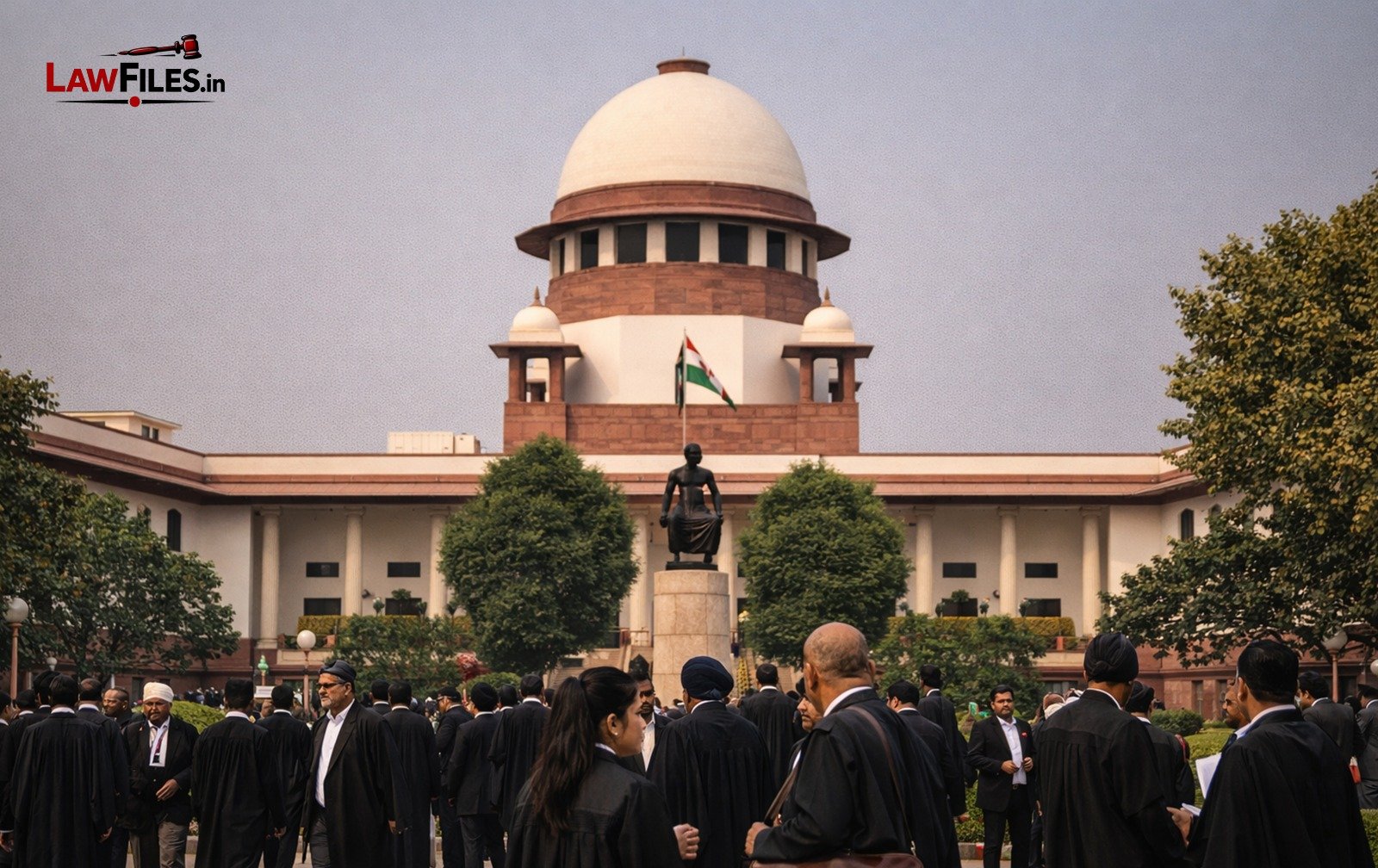
The Supreme Court on Monday agreed to list a plea seeking directions to the Delhi Police to permit peaceful demonstrations at Jantar Mantar, at a time when protests are taking place in the national capital demanding the resignation of Chief Election Commissioner Gyanesh Kumar. The matter was mentioned before a Bench headed by Chief Justice of India Surya Kant, where the Court indicated that it would first examine the nature of the petition, the identity of the petitioner and whether any similar proceedings were already pending before the Court before deciding the manner in which the matter should proceed. The Court’s response is significant because the immediate dispute over permission to protest places a much larger constitutional question before the judiciary: how far can the executive regulate public demonstrations in the name of public order without effectively extinguishing the citizen’s constitutional right to dissent.
During the brief mentioning, counsel submitted that Delhi Police were not permitting peaceful protests and that the restrictions were affecting students, ordinary citizens, political party office-bearers and even Members of Parliament. The submission was that the petition was intended to secure directions ensuring that peaceful demonstrations could be held in accordance with law. Chief Justice Surya Kant asked what precisely was being sought and whether the matter was being presented as a Public Interest Litigation. Rather than immediately granting any interim permission, the Court indicated that it would examine the issue and, if appropriate, list the matter for detailed hearing. The exchange is important in understanding what the Supreme Court has actually done: the Court has agreed to consider the plea; it has not, at this stage, declared that the Delhi Police’s restrictions are unconstitutional or directed that any particular protest be permitted.
The petition has arisen against the backdrop of a widening confrontation between protesters and the authorities over the functioning of the Election Commission and the Special Intensive Revision exercise of electoral rolls. Demonstrations in Delhi during the past several days have witnessed the deployment of additional police personnel, barricading and detention of protesters. Reports indicate that around 120 persons were detained during a demonstration on October 4, while police had earlier registered FIRs in connection with attempts to reach the designated protest area. The police action followed refusals of permission for proposed demonstrations at Jantar Mantar.
The immediate controversy therefore cannot be viewed in isolation from the constitutional position of public protest in India. The right to assemble peacefully is expressly recognised under Article 19(1)(b) of the Constitution, while political expression and communication of grievances are protected under Article 19(1)(a). A demonstration is often the practical intersection of these two freedoms. Citizens who believe that an institution or public authority has acted improperly may communicate that disagreement through speeches, placards, marches and peaceful gatherings. In a representative democracy, such activities are not merely tolerated acts of public inconvenience; they are among the recognised constitutional means through which citizens participate in public affairs.
At the same time, neither Article 19(1)(a) nor Article 19(1)(b) creates an unrestricted entitlement to occupy any public space at any time or in any manner. The Constitution itself permits reasonable restrictions in the interests of sovereignty and integrity of India, security of the State, public order and other constitutionally recognised grounds. The legal problem therefore is not whether the State may regulate protests. It undoubtedly can. The more difficult question is whether the restriction is genuinely regulatory and proportionate, or whether regulation is being used as a disguised prohibition.
That distinction assumes particular importance in Delhi because Jantar Mantar has historically functioned as one of the principal locations for political demonstrations. The Supreme Court has previously dealt extensively with the competing claims surrounding demonstrations at Jantar Mantar. In Mazdoor Kisan Shakti Sangathan v. Union of India, the Court examined restrictions on protests in the area after concerns were raised about noise, congestion, pollution and prolonged occupation of public space. The Court recognised that the right to protest is constitutionally protected but also emphasised that the rights of residents, commuters and other members of the public cannot simply be disregarded. The constitutional solution, therefore, was not to place either side absolutely above the other, but to require a regulatory mechanism capable of balancing competing rights.
The importance of that jurisprudence lies in the word “balance”. A constitutional right cannot ordinarily be reduced to a permission that is granted only when the administration considers the protest convenient. At the same time, a protest cannot become a licence to block roads indefinitely, prevent access to public institutions, create serious safety risks or impose disproportionate burdens on persons who are not participating in the demonstration. The administration is consequently entitled, and in some circumstances constitutionally obliged, to prescribe location, duration, crowd limits, traffic arrangements, sound restrictions and security conditions. What it cannot ordinarily do is move from regulation to an indiscriminate denial without demonstrating why the proposed restrictions are inadequate.
The recent litigation before the Delhi High Court provides an illustration of precisely this tension. The Indian Youth Congress has separately challenged the refusal of permission for a proposed Jantar Mantar demonstration against the CEC. According to the petition, the organisation had sought permission for a peaceful gathering of approximately 100 to 150 persons and had undertaken to comply with conditions relating to security, traffic and public order. The challenge contends that the police cannot convert their regulatory power into an absolute power of prohibition without making an individualised and proportionate assessment of the proposed demonstration. The plea invokes Articles 14, 19(1)(a) and 19(1)(b), thereby bringing equality and proportionality into the discussion alongside the freedoms of speech and assembly.
The Supreme Court has repeatedly made clear that the right to protest does not disappear merely because the subject matter of the protest is politically contentious. In Amit Sahni v. Commissioner of Police, dealing with the Shaheen Bagh protests, the Court recognised that persons aggrieved by legislation retain the right to protest even while the validity of that legislation is under judicial consideration. At the same time, the Court drew a distinction between the existence of the right and the manner in which it is exercised, particularly where public roads and the rights of other citizens are affected. The principle is therefore neither “every protest must be permitted everywhere” nor “public order automatically defeats protest”; the constitutional exercise lies in finding a proportionate accommodation between the two.
The present controversy adds another dimension because the protest concerns the Election Commission itself. The Election Commission occupies a constitutionally significant position under Article 324, entrusted with the superintendence, direction and control of elections. Public criticism of the Commission, including demands for the resignation of the Chief Election Commissioner, cannot by itself be treated as an attack on constitutional authority that loses protection merely because the institution being criticised is constitutionally important. Indeed, democratic institutions acquire legitimacy not only through their formal constitutional status but also through their ability to withstand scrutiny, criticism and peaceful public disagreement.
The allegations surrounding the Special Intensive Revision exercise have intensified the political environment. Protesters have alleged that electoral-roll revisions could result in eligible voters being excluded, while the Election Commission has maintained that the exercise is intended to remove duplicate, deceased and otherwise ineligible entries and preserve the integrity of electoral rolls. Those competing claims remain part of the public and legal controversy. The question presently before the Court, however, is narrower and constitutionally distinct: regardless of whether the protesters’ substantive allegations concerning electoral rolls ultimately succeed, do they retain the right to express those allegations through peaceful assembly, subject to reasonable regulation?
That distinction is fundamental. The State cannot ordinarily make the legality of a protest dependent upon the correctness of the political opinion being expressed. Constitutional protection of speech would become illusory if citizens first had to establish before the administration that their criticism of a public institution was factually correct. Conversely, the protection of political speech does not immunise unlawful conduct committed during a protest. If a gathering becomes violent, obstructs lawful police action, damages property or violates a valid and proportionate restriction, the participants may face consequences under the applicable law. The legal system must therefore separate the message from the manner in which the message is communicated.
The recent registration of FIRs following attempts to reach Jantar Mantar demonstrates why that distinction matters. Delhi Police have reportedly registered three FIRs in connection with the October 2 protest attempts, invoking provisions concerning disobedience of an order issued by a public servant, obstruction of public servants, use of criminal force and acts allegedly committed by several persons in furtherance of a common intention. Registration of those FIRs does not itself establish guilt, just as participation in a political demonstration does not itself establish criminality. Each allegation must ultimately be tested against the evidence and the precise legal ingredients of the offences invoked.
The Supreme Court’s intervention is therefore likely to require a closer examination of the distinction between “permission” and “regulation”. In constitutional terms, an administrative permission regime should not operate as an unstructured discretion by which the police can allow demonstrations that are politically convenient while denying those that are politically uncomfortable. The existence of reasonable restrictions is not the difficulty; the difficulty arises when restrictions are imposed without transparent criteria, consistent standards or a demonstrable connection with public-order concerns.
Article 14 becomes relevant at precisely this point. If similarly situated groups are treated differently, or if permission is refused on broad and unexplained grounds, the administrative decision can potentially attract scrutiny not merely under Articles 19(1)(a) and 19(1)(b), but also under the guarantee against arbitrary State action. Administrative discretion affecting fundamental rights must remain structured by law. The police may have legitimate security concerns, but those concerns must be capable of being articulated and, where challenged, judicially examined.
There is also a practical constitutional solution that courts have repeatedly preferred: controlled facilitation rather than blanket prohibition. A designated protest site, fixed participant limits, prior intimation, specified timings, traffic diversions, restrictions on loudspeakers, emergency access routes and undertakings against violence can often protect public order without eliminating public dissent. Indeed, a regulatory framework that enables peaceful protests may serve public order better than an absolute prohibition, because forcing demonstrations outside designated channels can itself increase confrontation between protesters and law enforcement.
A 2026 Karnataka High Court decision concerning regulation of demonstrations at Jantar Mantar has similarly recognised the need for a mechanism permitting limited use of the area for peaceful public meetings and demonstrations while protecting residents and offices from disturbance. Though the precise factual context is different, the broader constitutional idea is instructive: regulation should be designed to facilitate lawful democratic participation while preventing unreasonable interference with the rights of others.
The present Supreme Court proceedings may consequently become important beyond the immediate controversy involving the Chief Election Commissioner. If the Court eventually examines the issue on merits, it could clarify the standards governing denial of permission for demonstrations in the national capital, particularly where the proposed protest concerns a constitutional authority. Such clarification would be valuable because Delhi has repeatedly witnessed disputes concerning the right to assemble, the use of public spaces and the police’s discretion to impose restrictions.
The Court will also have to remain conscious of the institutional limits of judicial intervention. The judiciary cannot be expected to grant advance permission for every political demonstration in the capital. Nor can constitutional courts become the first forum for deciding operational questions concerning every gathering. Their role becomes necessary when executive restrictions appear arbitrary, disproportionate or inconsistent with fundamental rights. A constitutional court should neither administer protests nor permit the administration to administer away the right to protest.
The timing of the plea is also noteworthy. The controversy surrounding the Election Commission has already generated separate proceedings before the Supreme Court challenging aspects of the functioning of the Commission and decisions associated with the Special Intensive Revision exercise. A petition concerning the right to protest therefore exists alongside substantive litigation concerning the electoral process itself. The two issues must nevertheless remain analytically separate. A court considering whether citizens can peacefully demonstrate is not thereby deciding whether the allegations made by those demonstrators against the Election Commission are correct.
Ultimately, the constitutional value at stake is larger than the particular demand for the removal of CEC Gyanesh Kumar. A democracy does not protect only popular or institutionally comfortable speech. The real test of Article 19 is often presented by speech that is inconvenient, critical or directed against those exercising public power. Equally, democratic dissent survives only when protesters recognise that constitutional freedom carries corresponding duties towards public safety, other citizens and the rule of law.
The Supreme Court has, for the moment, taken only the first procedural step by agreeing to list the plea. The Court has not declared the restrictions illegal, has not granted an unrestricted right to demonstrate at Jantar Mantar and has not expressed an opinion on the merits of the allegations against the Election Commission. But the decision to examine the plea places an important constitutional question back before the country’s highest court: whether the State’s duty to maintain public order can be discharged by preventing assemblies altogether, or whether constitutional governance requires the State to facilitate peaceful dissent while regulating only those aspects of a demonstration that genuinely threaten the rights and safety of others.
That question goes to the heart of democratic constitutionalism. Public order is unquestionably a legitimate governmental concern, but public order cannot be understood as the absence of disagreement. A constitutional democracy is expected to manage disagreement, not eliminate it. If peaceful citizens can be given a regulated space to voice opposition, the State preserves both order and liberty. If every politically inconvenient gathering is denied permission on broad grounds, the resulting peace may be administrative silence rather than constitutional order. The Supreme Court’s forthcoming consideration of the plea therefore has the potential to reaffirm the principle that the right to protest is neither absolute nor ornamental: it is a constitutional freedom whose exercise may be regulated, but whose existence cannot be left entirely at the discretion of the executive.
