


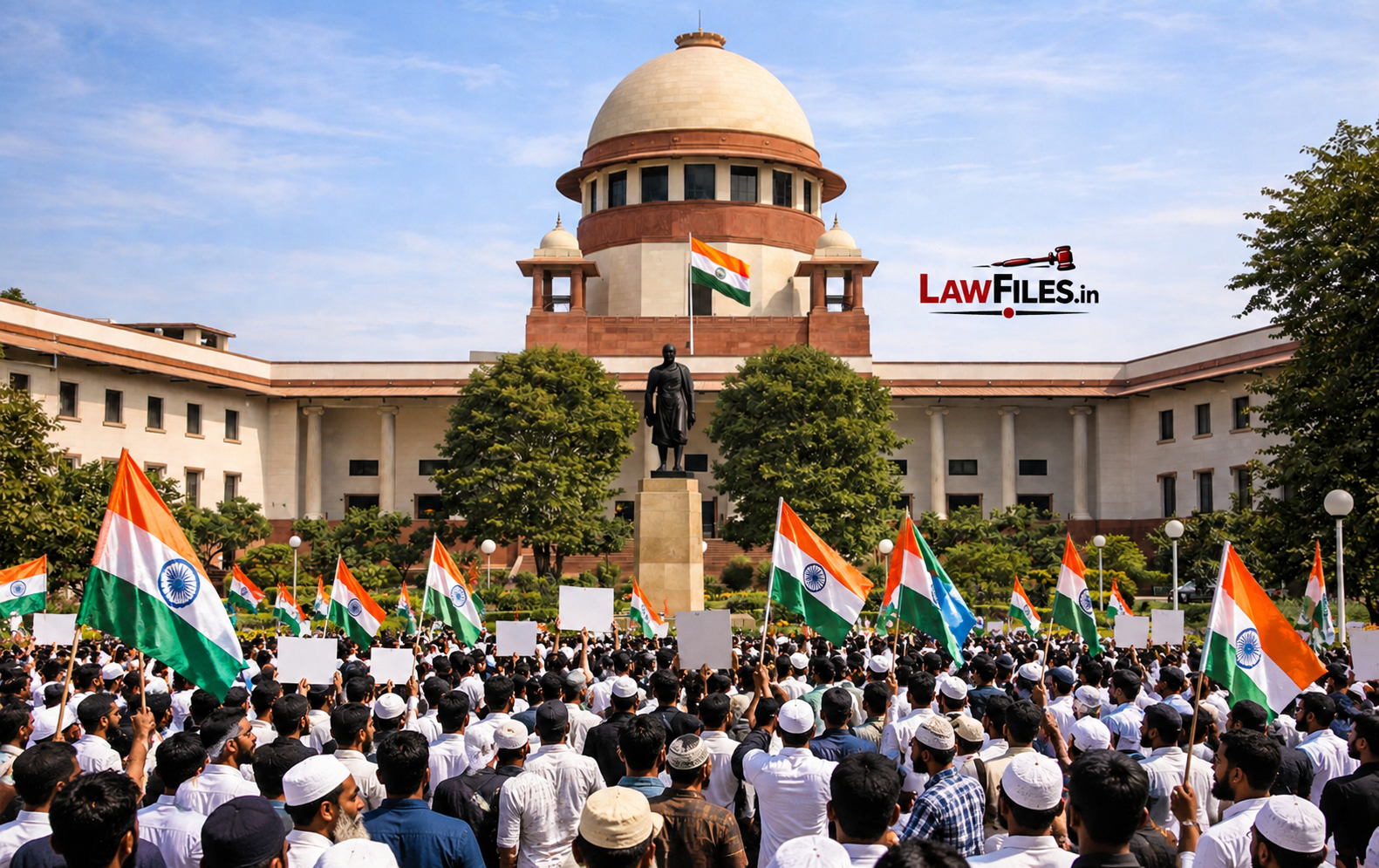
The Supreme Court on October 13, 2026, adjourned to October 15 the batch of petitions arising from the protests in Delhi against Chief Election Commissioner Gyanesh Kumar and the Election Commission’s Special Intensive Revision (SIR) of electoral rolls, after Justice V. Mohana was reported to be unwell. The matters were listed before a Bench comprising Chief Justice of India Surya Kant, Justice Joymalya Bagchi and Justice Mohana. With the parties expressing no objection to the adjournment, the Court deferred the hearing and extended the time for the Union and the other authorities to submit their compliance report in relation to its earlier directions. The proceedings concern allegations of illegal detention, excessive police force, restrictions on public movement and transport, and interference with the professional duties of lawyers and journalists during the demonstrations. The adjournment was procedural and does not amount to a decision on the allegations or the legal questions raised in the connected petitions.
The Court also took up the broader question of police accountability during public demonstrations. It sought the presence of a senior Delhi Police officer to respond to allegations by women journalists that they had been assaulted while covering the protests. The Solicitor General, Tushar Mehta, sought additional time to file the compliance report required under the Court’s October 9 directions and responses to the contempt petition filed by advocate Shailendra Mani Tripathi and the petition moved by Senior Advocate Menaka Guruswamy. The extension of time gives the authorities an opportunity to place their account before the Court, but it does not displace the existing interim directions. The next hearing will therefore be important in determining whether the authorities have adequately explained the steps taken to implement the Court’s orders and how the allegations of police excesses are to be examined.
The dispute originated in the restrictions imposed by the Delhi authorities ahead of demonstrations against the Chief Election Commissioner and the Election Commission’s electoral-roll revision exercise. On October 9, the Supreme Court, while hearing a matter initiated by CPI(M) General Secretary M.A. Baby and others, considered communications directing the closure of 57 Metro stations and the cancellation or suspension of certain railway services in anticipation of the planned protests. The Court expressed concern that the measures appeared to impose an excessive restriction on essential public transport. It held that Metro and railway services could be regulated to address genuine public-order concerns, but that a complete shutdown required a justification consistent with constitutional standards. The Court directed the authorities to ensure that public transport operated normally unless restrictions were necessary to address disturbances to public order, and required the relevant authorities to file a compliance report.
The October 9 order was significant because it placed the proportionality of preventive restrictions at the centre of the dispute. Authorities responsible for public safety are entitled to assess credible threats, regulate traffic and take preventive measures in accordance with law. However, the existence of a proposed demonstration does not automatically justify imposing extensive restrictions on ordinary commuters, workers, students, patients, lawyers and other members of the public who are not participating in the protest. A restriction must be supported by the circumstances and tailored to the risk sought to be addressed. The Court’s intervention reflected the principle that preventive policing should not become a general suspension of ordinary civic life merely because a public gathering is anticipated.
The controversy escalated after allegations that restrictions on transport and movement continued despite the Supreme Court’s directions. Advocate Shailendra Mani Tripathi filed a contempt petition alleging that the closure of Metro stations and restrictions on railway services were inconsistent with the October 9 order. The petition sought action against Union Home Secretary Govind Mohan, Delhi Police Commissioner Anurag Kumar and Delhi Metro Rail Corporation Chairperson D. Thara. The allegation is that the authorities failed to comply with the Court’s directions and thereby interfered with the public’s ability to move freely through the capital. Whether this conduct amounts to contempt depends on the precise terms of the judicial order, the actions taken by each authority and the evidence concerning knowledge, implementation and compliance. The mere filing of a contempt petition does not establish wilful disobedience.
On October 11, the Supreme Court convened a special sitting to address the urgent allegations arising from the protests. A Bench of Justice Joymalya Bagchi and Justice V. Mohana issued directions requiring that no person be detained except in accordance with the procedure established by law, particularly where peaceful and unarmed assemblies were taking place outside the area covered by prohibitory orders under Section 163 of the Bharatiya Nagarik Suraksha Sanhita, 2023. The Court also directed that the notice board referring to the imposition of Section 163 restrictions in and around the Supreme Court premises be removed, if it had not already been taken down, so that lawyers, litigants and members of the public would not be deterred from accessing the Court or other courts.
The same order addressed movement, transport and internet access. The Court directed that Metro and railway services should function normally unless restrictions were required to address disturbances to public order within the constitutional framework. It also directed that movement within Delhi be ensured subject to traffic regulations and legitimate law-and-order requirements, that barricades be reviewed promptly, and that internet services remain undisturbed. Lawyers, journalists and other professionals were not to be hindered in discharging their professional duties. These directions were designed to prevent public-order measures from unnecessarily interfering with the functioning of courts, access to public transport and the exercise of constitutional freedoms.
The Bench also found that the petitioners had made out a prima facie case warranting responses from the authorities in the contempt proceedings. That procedural assessment is important but must not be overstated. A prima facie case means that the material placed before the Court warrants further examination; it does not establish that contempt has been conclusively proved. Under the law of contempt, the Court must ultimately determine whether a clear and binding judicial direction was wilfully disobeyed. Authorities may explain the operational circumstances, the steps taken to comply and any difficulties encountered, but they cannot treat a judicial order as optional simply because its implementation presents administrative challenges. The October 13 adjournment gives the authorities additional time to file the required material before the Court examines compliance.
The connected petitions allege that the police response extended beyond restrictions on public transport. Senior Advocate Menaka Guruswamy’s petition concerns the alleged detention of political leaders, including former Delhi Chief Minister Arvind Kejriwal, former West Bengal Chief Minister Mamata Banerjee, former Kerala Chief Minister Pinarayi Vijayan and former Tripura Chief Minister Manik Sarkar. The plea alleges that some leaders were taken from their residences or moved to undisclosed locations before they could reach the protest site. Other petitions, including one filed by Rajya Sabha MP Manoj Jha, allege disproportionate use of force, illegal detention, house restrictions, interference with protesters and students, and mistreatment of women demonstrators. The petitioners have also raised concerns about internet restrictions, road closures, phone jammers and disruptions to transport.
These allegations concern distinct incidents and cannot be treated as a single established factual narrative merely because they arose during the same period of protest. Each alleged detention must be examined in light of the applicable legal authority, the circumstances in which the person was restrained, the duration of the restraint and whether required procedural safeguards were followed. Similarly, allegations of assault must be assessed against medical records, witness statements, video footage and other relevant evidence. The Court’s decision to hear connected petitions together may allow it to consider systemic questions about policing and compliance, but individual allegations will still require evidentiary scrutiny.
The claims concerning lawyers and journalists raise a particularly serious concern because their professional functions are closely connected with access to justice and public accountability. Several lawyers’ bodies have approached the Supreme Court alleging that advocates were intercepted, manhandled or taken away by police during the protests. The Supreme Court Advocates-on-Record Association and the Supreme Court Bar Association have sought details of the legal basis and duration of the alleged detentions, identification of the officers involved, preservation of records and accountability for any unlawful conduct. The petitions also raise concerns about barricades and restrictions that allegedly obstructed lawyers and litigants from reaching the Supreme Court and other courts.
A separate petition by the Free Speech Collective alleges that journalists covering the demonstrations were subjected to unlawful detention, physical assault, intimidation or obstruction despite the Court’s direction that their professional duties should not be impeded. The allegation by women journalists that they were assaulted while reporting the protests prompted the Court to seek the presence of a senior police officer. This request reflects the need for a direct response from the police hierarchy rather than a general statement that public order was being maintained. The authorities will need to address the specific circumstances alleged, including whether the journalists were identifiable as media personnel, whether they were performing professional duties and what legal basis existed for any restraint or use of force.
The legal position is not that journalists or lawyers enjoy immunity from all generally applicable laws. Journalists remain subject to lawful restrictions, and lawyers participating in a demonstration do not acquire an unrestricted right to disregard valid prohibitory orders. But neither professional status nor participation in a public gathering can be used as a substitute for examining the legality of a particular police action. A journalist covering an event may need to move through a restricted area to report on it, while a lawyer may need to access a court to represent a client or attend proceedings. Where authorities interfere with such activity, the justification must be grounded in law and proportionate to the actual circumstances. The Court’s directions are therefore concerned not with creating privileged classes of citizens, but with ensuring that the exercise of legitimate public functions is not arbitrarily obstructed.
The role of Section 163 of the BNSS is central to the legality of the restrictions. The provision enables an Executive Magistrate or other competent authority, subject to statutory conditions, to issue urgent orders in cases of nuisance or apprehended danger. Such orders may restrict certain activities where immediate preventive action is necessary. However, the existence of a prohibitory order does not automatically authorise every subsequent detention or every form of force used to enforce it. The scope of the order, the area to which it applies, the persons affected and the legal basis for the particular action must be examined. The Supreme Court’s direction concerning peaceful and unarmed assemblies beyond the area covered by prohibitory orders underscores that preventive powers cannot be exercised without regard to territorial and legal limits.
The constitutional framework also requires a careful balance between Article 19 freedoms and the State’s obligation to maintain public order. Article 19(1)(a) protects speech and expression, while Article 19(1)(b) protects the right to assemble peaceably and without arms. These freedoms are subject to constitutionally permitted restrictions, including those imposed in the interests of public order. Article 19(1)(d), which protects movement throughout the territory of India, is likewise subject to the restrictions authorised by Article 19(5). The State may regulate the manner and location of demonstrations, but restrictions must be legally authorised and reasonable. The question is not whether public order matters—it plainly does—but whether the measures adopted are necessary and proportionate to the threat identified.
The Court’s approach to Metro and railway services illustrates how proportionality operates in practice. A temporary regulation of services around a sensitive location may be justified where supported by a genuine risk. A sweeping shutdown that imposes widespread hardship on people who have no connection with the protest requires a much stronger justification. The same reasoning applies to barricades, road closures and restrictions on internet access. Preventive action should address the actual risk rather than impose unnecessary burdens on the population at large. A court examining such measures must assess both the legitimacy of the objective and the relationship between the objective and the restriction adopted.
The connected proceedings also include a fresh challenge by the Association for Democratic Reforms to Section 16 of the Chief Election Commissioners and Other Election Commissioners Act, 2023. The provision concerns protection from legal proceedings in respect of certain acts done or words spoken in the discharge of official duties. The Supreme Court issued notice on the petition on October 13. The challenge raises a separate constitutional issue concerning the scope of legal protection afforded to members of the Election Commission. The question is whether the statutory immunity, in its wording and operation, is consistent with constitutional principles of accountability and judicial review. The issuance of notice means that the Court has agreed to seek a response; it does not mean that the provision has been declared unconstitutional or that the petitioners’ arguments have been accepted.
The challenge to Section 16 must also be distinguished from the petitions concerning police conduct during the protests. The former concerns the statutory protection available to election officials for specified acts connected with official duties; the latter concern the legality of preventive restrictions, alleged detentions, force and compliance with judicial orders. Although both arise against the wider backdrop of public controversy involving the Election Commission, they involve different respondents, legal standards and remedies. The Court’s decision to issue notice on the immunity challenge brings an additional constitutional question into the proceedings, but the merits of that question will require independent consideration.
The political context is the dispute over the Election Commission’s Special Intensive Revision of electoral rolls. Opposition parties have questioned aspects of the exercise and alleged that the revision risks excluding eligible voters, while the Election Commission’s work falls within its constitutional responsibility to supervise and conduct elections. The legal challenge to SIR must be decided on the applicable constitutional and statutory framework, the evidence concerning the revision process and the remedies sought by the petitioners. The protests surrounding the issue have generated a parallel set of questions about public order and civil liberties. It is important not to confuse the legality of the electoral revision with the legality of the police response to demonstrations: even if an electoral process is ultimately upheld, that would not automatically validate every restriction imposed during protests; equally, allegations of police excess do not themselves determine whether the electoral revision is lawful.
The adjournment to October 15 gives the authorities additional time to submit their compliance report and responses to the connected petitions. The Court is expected to examine whether its earlier directions concerning transport, movement, internet access and protection against unlawful detention have been implemented, and how the allegations of assault and interference with professional duties should be addressed. The responses may assist the Court in determining whether further directions are necessary, whether an independent inquiry is warranted in any of the matters, and whether the contempt allegations require further proceedings. No final finding of contempt, illegal detention or custodial abuse should be inferred from the present procedural stage.
The broader significance of the proceedings lies in the constitutional limits of preventive policing. A democratic State must be capable of maintaining public order, protecting sensitive locations and ensuring that demonstrations do not endanger others. But preventive powers are not a licence to impose indiscriminate restrictions, detain people without lawful authority or obstruct access to courts. Equally, the right to protest must be exercised within the law and cannot be used to justify violence or disregard of valid restrictions. The Supreme Court’s task is to ensure that both principles remain effective: public order must be protected, and the means used to protect it must themselves comply with constitutional standards.
The October 15 hearing will therefore be significant not merely because the Court has deferred the matters, but because the authorities are required to account for their actions against a clear set of interim directions. The central question is whether the response to the protests remained within the bounds of lawful and proportionate policing, and whether the Court’s orders were implemented in substance rather than only in form. The outcome may shape how future demonstrations are regulated in the national capital, particularly where restrictions affect transport, lawyers, journalists and access to judicial institutions. Until the Court considers the compliance reports and the evidence placed before it, the allegations must remain allegations. What is already clear, however, is that the Constitution requires both protesters and public authorities to operate within the law and places a special obligation on the State to ensure that coercive power remains accountable, proportionate and open to judicial scrutiny.
