


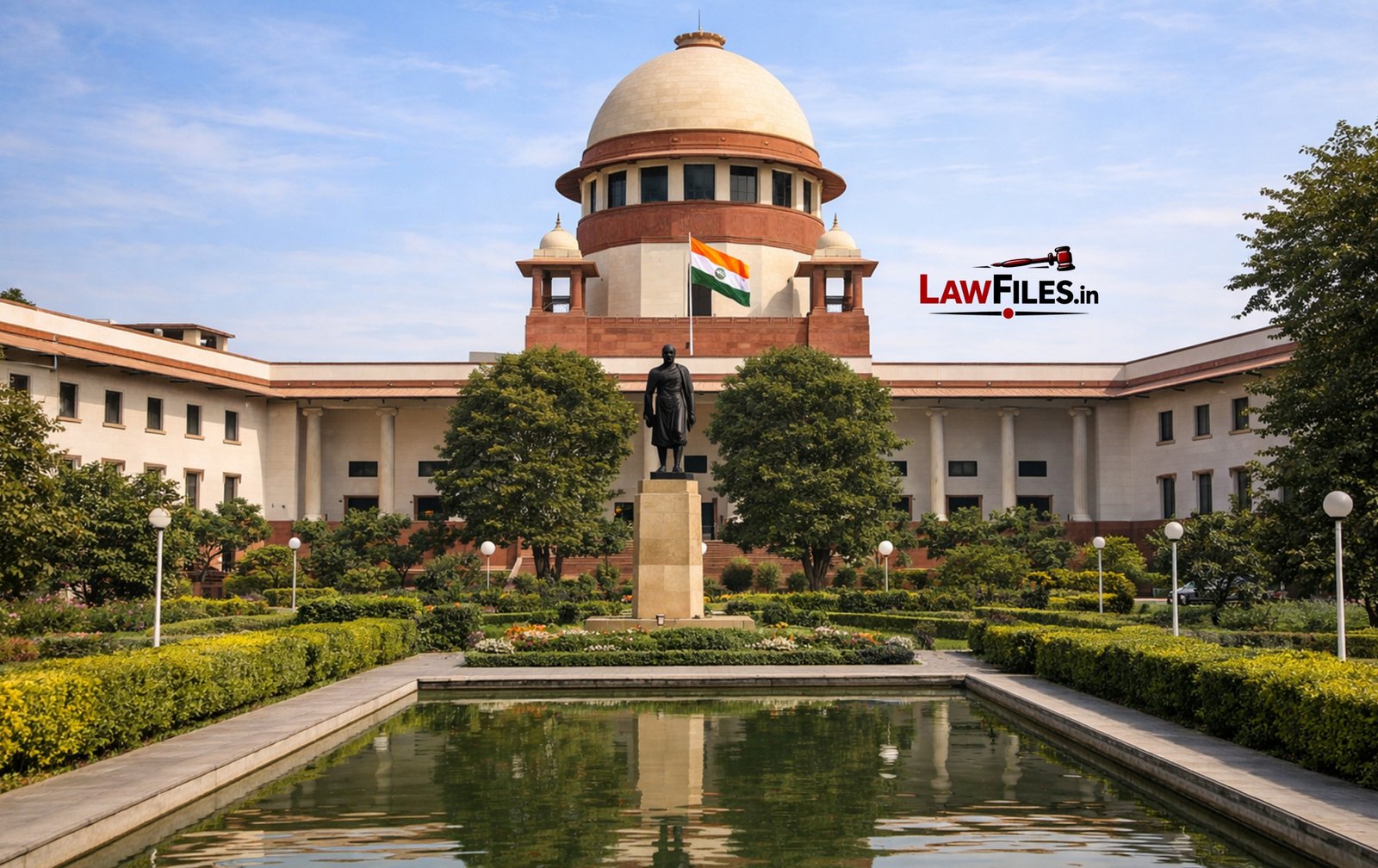
The Supreme Court has opened another significant constitutional dimension in the long-running Shiv Sena split dispute, questioning whether the Election Commission of India’s decision to recognise the Eknath Shinde faction as the Shiv Sena and allot it the party’s reserved “bow and arrow” symbol can continue to stand if the Court ultimately concludes that the Maharashtra Legislative Assembly Speaker was wrong in refusing to disqualify the rebel MLAs under the Tenth Schedule. The question, raised by Justice Joymalya Bagchi during Tuesday’s hearing, goes to the heart of the relationship between two constitutionally significant adjudicatory processes: the Speaker’s determination of defection and the Election Commission’s determination under Paragraph 15 of the Election Symbols (Reservation and Allotment) Order, 1968. The Bench comprising Chief Justice Surya Kant, Justice Joymalya Bagchi and Justice V. Mohana did not decide the issue but subjected the Shinde faction’s position to searching scrutiny.
The immediate proceedings arise from the challenges led by Uddhav Thackeray’s faction to the Election Commission’s February 17, 2023 decision recognising the Shinde faction as the “real” Shiv Sena and allowing it to use the reserved bow-and-arrow symbol. The challenge is being heard alongside the dispute concerning the Speaker’s January 2024 decision rejecting the disqualification petitions filed against members of the rival factions. The Court is consequently examining not two isolated orders but the constitutional chain connecting the alleged defection, the Speaker’s adjudication, the Election Commission’s determination of party identity and the continuing political entitlement associated with the party’s name and symbol.
The question posed by Justice Bagchi became particularly pointed when Senior Advocate Neeraj Kishan Kaul, appearing for the Shinde faction, relied upon the Constitution Bench’s 2023 judgment in Subhash Desai v. Principal Secretary, Governor of Maharashtra. Kaul’s submission was that proceedings under Paragraph 15 of the Symbols Order and proceedings under the Tenth Schedule occupy different legal fields and operate independently. The Election Commission decides which rival faction constitutes the political party for the purposes of the Symbols Order, while the Speaker determines whether a member has incurred disqualification from the House. On that understanding, a subsequent disqualification should not retrospectively invalidate an earlier Election Commission determination.
The difficulty identified by Justice Bagchi arises from the fact that the consequences of those supposedly separate determinations can nevertheless converge upon the same political reality. If the Supreme Court ultimately holds that the Speaker wrongly refused to disqualify the Shinde-faction MLAs, the question would arise whether the Election Commission’s earlier recognition of that faction as the political party can remain untouched. Justice Bagchi asked, in substance, whether the Court could allow a reserved symbol to continue with a faction whose legislative strength—and potentially the very basis upon which its claim to represent the party was sustained—was subsequently found to have been affected by an erroneous disqualification decision.
The problem becomes particularly acute because a reserved election symbol is not simply a graphic mark used on a ballot paper for one election. It has continuing political significance. The Court specifically noted that enjoyment of the symbol is a continuing right and questioned whether a later judicial determination that the Speaker’s decision was wrong could therefore become relevant to the continued operation of the Election Commission’s symbol order. This introduces an important temporal dimension into the dispute. If an ECI decision operates prospectively, as the Constitution Bench has held, what happens when a subsequent judicial determination changes the legal foundation upon which the political identity recognised by the ECI rests?
The Constitution Bench’s judgment in Subhash Desai is central to understanding this apparent tension. The Court had held that the Speaker’s decision under the Tenth Schedule and the ECI’s decision under the Symbols Order are based upon different considerations and serve different purposes. It expressly held that the ECI’s decision is prospective. The Constitution Bench also contemplated a situation in which members of a faction that had received the reserved symbol were subsequently disqualified from the House. In such a situation, the members remaining in the House would have to follow the procedure under the Symbols Order and other applicable laws for allotment of a fresh symbol.
At first sight, that principle appears to support the Shinde faction’s argument that a later disqualification cannot retrospectively erase the ECI’s earlier decision. But another part of the same Constitution Bench judgment has now become the focus of the Supreme Court’s questioning. The judgment recognised that if the faction that had secured a majority in the House and had consequently been recognised as the political party were subsequently disqualified, the consequences of that disqualification could not simply be ignored. Justice Bagchi therefore drew attention to the possibility that the foundation of the ECI’s declaration could itself require reconsideration if the Speaker’s decision is eventually found to have been legally erroneous.
This is not a minor procedural issue. It raises the deeper constitutional question of whether two institutions can independently make legally valid determinations which, when placed together, produce a result that neither institution could have intended. The Speaker may determine that legislators have not incurred disqualification; the ECI may then recognise the faction commanding those legislators as the political party and grant it the reserved symbol. If the Supreme Court later reverses the Speaker’s determination, the legal position of the same legislators changes. The question is whether the second institutional determination must consequently be revisited even though it was valid when made.
The Shinde faction’s answer is that the two proceedings should not be collapsed into each other. Kaul argued that disqualification operates prospectively and removes a legislator from the House but does not automatically expel that person from the political party. In other words, a person can lose legislative membership because of defection without the law automatically transforming that person into a non-member of the political organisation. He also argued that subsequent disqualification cannot retrospectively invalidate votes already cast or decisions already made on the basis of the legal position existing at the relevant time.
The Court’s concern, however, appears to be directed towards the continuing nature of the symbol rather than the retrospective validity of past elections. Justice Bagchi specifically distinguished between an earlier election being invalidated and the continuing entitlement to use the reserved symbol. Even if votes already cast cannot be disturbed merely because a later disqualification takes place, the continued possession of the symbol could raise a different question. If the factual or legal basis for the ECI’s recognition subsequently disappears, does the principle of prospective operation necessarily protect the symbol indefinitely? That is the conceptual problem the Bench is now examining.
The question also brings into focus the unusual character of election symbols under Indian law. In Sadiq Ali v. Election Commission of India, the Supreme Court explained that an election symbol cannot simply be treated as divisible property belonging jointly to rival factions. Where a recognised political party splits and competing groups claim the symbol, Paragraph 15 requires the Election Commission to determine which group is, for the purposes of the Symbols Order, the political party entitled to the reserved symbol. The Court upheld the relevance of numerical strength and majority in that context, particularly because the organisation in question was democratic and the Commission needed a workable method of determining which faction substantially constituted the party.
Sadiq Ali is therefore an important part of the Shinde faction’s defence. Kaul relied upon that precedent to contend that legislative strength is a relevant and legitimate consideration under Paragraph 15. The ECI, according to this argument, is not constitutionally confined to examining the party constitution or organisational hierarchy. It can consider the circumstances of the split and determine which faction substantially represents the political party. The 1971 Supreme Court judgment specifically recognised numerical strength as a valuable and relevant consideration in determining which rival group constituted the political party in the circumstances of that case.
The Thackeray faction, however, has challenged the manner in which that principle was applied in the present case. The difficulty lies in treating the strength of legislators as an uncomplicated indicator of party identity when the very conduct that produced that legislative majority is alleged to constitute defection. If legislators elected on the ticket of one political party subsequently shift allegiance and form a rival faction, counting their numerical strength as evidence that the rival faction is the original party can create a circularity: the act allegedly constituting the constitutional violation becomes part of the evidence used to establish the faction’s claim to the political party itself.
This concern has been visible in the Supreme Court’s earlier hearings. In September, the Bench questioned why the Election Commission, if it found the available tests inadequate or uncertain, did not adopt a neutral course and allow the rival factions to contest elections on separate symbols rather than awarding the established party name and symbol to one side. The Court also questioned whether legislative majority should carry decisive weight while disqualification petitions were still pending. Those observations indicated that the Bench was examining not merely whether the ECI possessed jurisdiction, but whether the method it chose was consistent with the constitutional structure governing political parties and defections.
The present hearing takes that inquiry one step further. If legislative majority is accepted as a relevant factor under Paragraph 15, what happens when the legal status of that majority itself is subsequently altered by a judicial finding on defection? This is precisely why the relationship between the ECI and Speaker proceedings cannot be understood purely in terms of institutional independence. Independence of jurisdiction does not necessarily mean independence of consequences. Two bodies may decide different questions, yet their findings can materially affect the factual foundation upon which the other decision rests.
The Constitution Bench in Subhash Desai had itself recognised this distinction. It held that the Speaker should not rely upon an ECI decision rendered after the alleged act of defection because doing so could give the ECI decision impermissible retrospective effect. The constitutional sequence matters because at the time of the alleged defection there was only one political party, and the Speaker must determine the relevant political affiliation at the time of the prohibited conduct. A subsequent ECI recognition cannot rewrite the legal identity of the party at the moment when the alleged defection occurred.
That principle creates a fascinating inversion in the present case. The Speaker’s decision came after the ECI’s recognition, but the Supreme Court is now reviewing both. If the Speaker’s decision is found erroneous, the Court must determine whether that finding merely affects legislative membership prospectively or whether it also undermines the continuing political consequences flowing from the ECI’s recognition. The answer could have implications well beyond the Shiv Sena dispute because the same institutional problem can arise whenever a party split, defection proceedings and symbol recognition overlap in time.
The Court’s reference to the “constitutional sin” of defection must also be understood in its doctrinal context. The Tenth Schedule was introduced precisely because repeated defections had destabilised representative government and enabled legislators to change political allegiance without facing an immediate constitutional consequence. The anti-defection framework therefore seeks to preserve a degree of political accountability between elected representatives and the party on whose ticket they entered the legislature. The constitutional question in the present case is whether the benefits associated with the original party’s electoral identity including its established symbol can continue to flow to legislators whose conduct is ultimately found to have violated that constitutional framework.
This does not mean that the anti-defection law automatically determines ownership or entitlement to a party symbol. The two legal regimes remain distinct. But the Court appears to be asking whether the distinction can be carried so far that a finding of unconstitutional defection becomes practically irrelevant to the continued political benefit of the symbol. That would raise a question about the coherence of the constitutional scheme: if the law treats defection as constitutionally prohibited conduct, should the consequences of that conduct have no bearing whatsoever upon the political identity and electoral advantage enjoyed by the defecting faction?
Kaul’s answer is that such an approach would lead to an “endless exercise.” Political factions can change, legislators can be disqualified, vacancies can arise and subsequent elections can alter numerical strength. If every later development were allowed to reopen an earlier Paragraph 15 determination, the ECI’s symbol adjudications could become permanently unstable. This is a legitimate institutional concern. Electoral law requires certainty because political parties need to know under which name and symbol they will contest elections, and voters need to know which political organisation that symbol represents. A symbol that can be continuously reopened every time the composition of a legislative party changes would lose much of its practical value.
The counterargument, however, is equally significant: certainty cannot be purchased at the cost of preserving an outcome founded upon an erroneous constitutional determination. If the Supreme Court ultimately finds that the Speaker failed to apply the Tenth Schedule correctly, the question cannot be dismissed merely by saying that the ECI order was already made. The Court is therefore confronting the difficult line between finality and correction. Election law values certainty, but constitutional adjudication also values legality. The challenge is to design a remedy that corrects an unlawful institutional outcome without destabilising every subsequent electoral consequence.
Another important aspect of the hearing concerns the meaning of “political party” under the Symbols Order. The Shinde faction has argued that the ECI is entitled to consider legislative majority alongside organisational strength and other indicators. The Thackeray faction’s challenge has focused more fundamentally on the distinction between the political party and its legislature party. The Constitution Bench in Subhash Desai emphasised that these are not interchangeable concepts, particularly in the context of appointment of a whip under the Tenth Schedule. The political party remains the organisational entity from which the relevant authority flows; the legislature party cannot simply be treated as the party itself.
That distinction matters because the ballot box is fundamentally an instrument of party identification as much as individual candidate selection. A voter does not merely choose an individual MLA in isolation. In a party-based electoral system, the candidate’s party affiliation, manifesto, leadership and symbol form part of the information through which the voter understands the choice presented on the ballot. This is why the Court earlier questioned whether legislative majority alone could adequately determine the identity of the political party when voters had voted for candidates under a particular party identity.
The reserved symbol therefore has a constitutional and democratic value that extends beyond convenience. It represents continuity of political identity. Sadiq Ali recognised that the symbol is not ordinary property, yet it also acknowledged the enormous practical importance of the symbol in an electoral democracy. When voters associate a particular symbol with a party over decades, awarding that symbol to one faction can confer a significant electoral advantage. That is precisely why Paragraph 15 adjudication cannot be reduced to a simple dispute over an emblem. It determines which political organisation inherits the electoral identity recognised by voters.
The Supreme Court’s questioning consequently exposes a structural weakness in the existing legal architecture. The Symbols Order gives the ECI a mechanism to determine which rival faction constitutes the recognised political party, while the Tenth Schedule gives the Speaker the initial adjudicatory role over defection. The Constitution Bench has already held that these proceedings are distinct. But the Shiv Sena litigation demonstrates that “distinct” does not mean “unrelated.” A determination under one regime can alter the factual and political landscape relevant to the other. The law must therefore explain how the two outcomes interact when they point in different directions.
The Court is not yet answering that question. It is testing the competing interpretations through the submissions of counsel. Justice Bagchi’s questions should therefore not be read as a finding that the ECI’s symbol order is invalid or that the Shinde faction is disqualified. Nor has the Court directed the Election Commission to immediately take the symbol away. The Court is considering what legal consequences would follow if, at the conclusion of the hearing, the Speaker’s refusal to disqualify the MLAs is found to be erroneous. The distinction between judicial questioning and judicial determination is particularly important in a politically charged case of this nature.
If the Court eventually adopts the view that the ECI’s order must be revisited, the practical consequences could be substantial. It could require the Election Commission to reassess which faction constitutes the Shiv Sena for the purposes of the Symbols Order in light of the final judicial determination on disqualification. It may also require the Commission to consider whether the existing symbol should continue with one faction, whether a fresh adjudication is necessary or whether another legally neutral arrangement is appropriate. The exact remedy, however, cannot be predicted from the questions raised during the hearing.
If, on the other hand, the Supreme Court upholds the Speaker’s decision, the immediate foundation for Justice Bagchi’s hypothetical concern would disappear. The ECI’s determination would continue to operate independently within the framework recognised by Subhash Desai. This is why the Court itself observed that if the Speaker’s refusal to disqualify is sustained, there would be no corresponding difficulty. The constitutional tension arises principally if the Speaker’s decision is ultimately found to have been legally wrong.
The dispute therefore presents the Court with a question that goes beyond the personalities of Uddhav Thackeray and Eknath Shinde. It concerns the constitutional consequences of political realignment after an election. In a parliamentary democracy, elected representatives necessarily possess political agency, but that agency is subject to constitutional constraints. At the same time, political parties are not static legal entities. They have internal constitutions, organisational structures, legislative wings and changing leadership. The law must accommodate political change without allowing constitutional restrictions on defection to become meaningless.
The larger significance of the hearing lies in the Court’s attempt to prevent compartmentalisation of constitutional questions. A Speaker’s order cannot be examined entirely in isolation from its consequences for party identity, just as an ECI symbol order cannot be understood without considering the constitutional circumstances in which a rival faction emerged. The institutional separation between the Speaker and the Election Commission remains important, but the consequences of their decisions may need to be viewed as part of one constitutional ecosystem.
The Court’s scrutiny also reinforces the principle that electoral symbols belong to the regulatory framework of elections rather than to individual political leaders. No faction can claim a symbol merely because it has historically been associated with a particular personality. The legal entitlement flows from the determination under the Symbols Order. At the same time, because the symbol carries the accumulated political identity of a party, the process by which it is awarded must be capable of surviving constitutional scrutiny. A legally erroneous foundation cannot necessarily be insulated forever merely because the resulting symbol order has acquired political momentum.
For now, the Supreme Court has left the central questions open. The Shinde faction continues to defend the ECI’s approach by relying on Sadiq Ali, the absence of a rigid statutory test under Paragraph 15 and the distinction between legislative defection proceedings and symbol adjudication. The Thackeray side continues to challenge the ECI’s recognition and the constitutional consequences of treating legislative majority as decisive. The Court, meanwhile, is examining whether the two legal tracks can remain completely insulated when a later judicial determination concerning defection may alter the factual basis for the continued enjoyment of the party’s reserved symbol.
The eventual ruling could consequently become one of the most consequential judgments on Indian electoral law since Subhash Desai. It may clarify whether an ECI determination under Paragraph 15 can remain untouched when the legislative majority relied upon in that determination is subsequently affected by a finding of unconstitutional defection; whether the continuing use of a reserved symbol creates a distinct legal consequence from the validity of past elections; and how the principles of finality, prospective operation, party identity and anti-defection law are to be reconciled. More fundamentally, the Court may have to answer a question at the centre of representative democracy: when elected legislators change sides, does the political identity they carry with them continue to represent the party chosen by voters, or can constitutional law require that the electoral identity remain with those who did not abandon that political affiliation? The answer will determine not merely the fate of the bow-and-arrow symbol, but the legal architecture governing party splits and electoral identity in India.
