


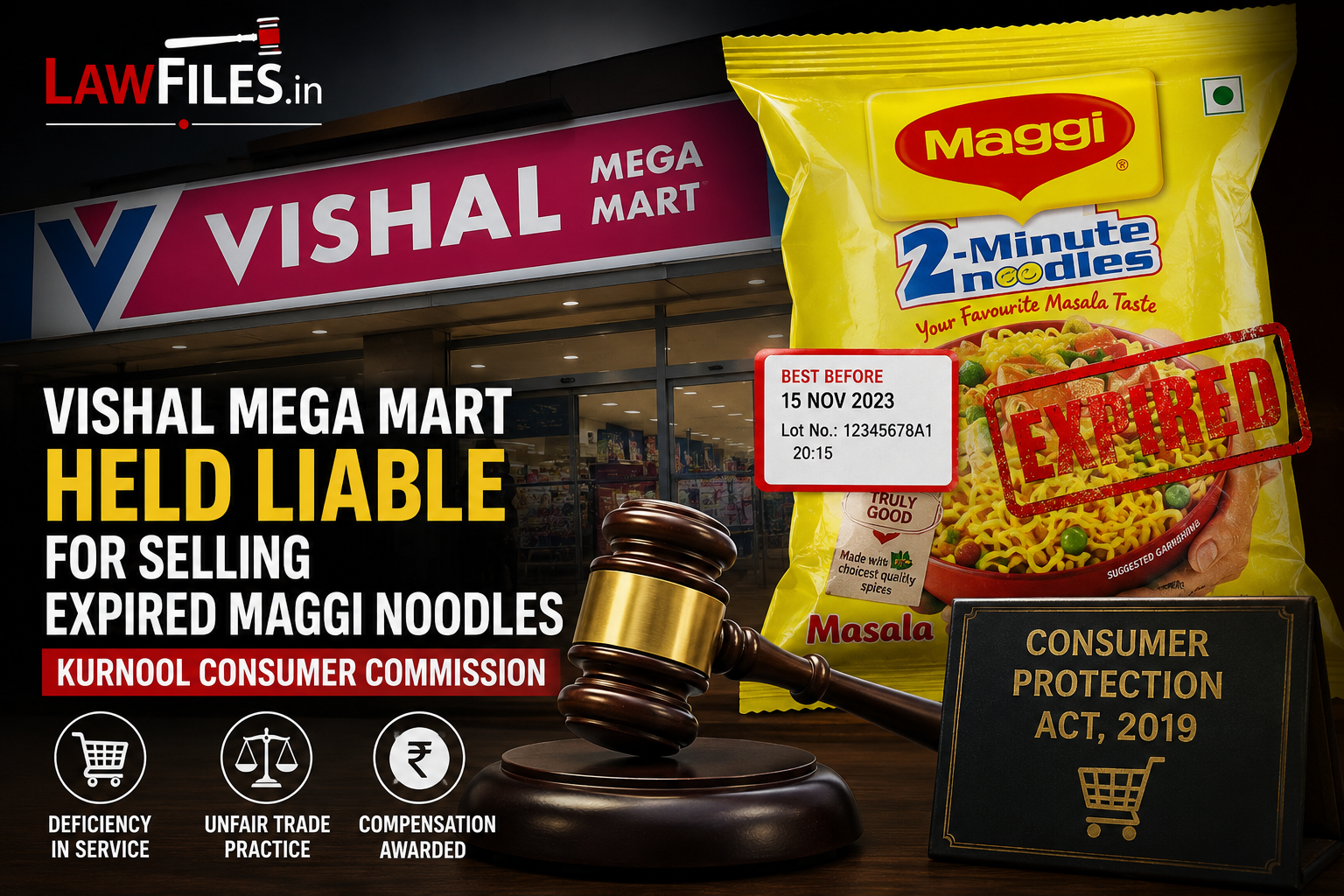
In a significant ruling reinforcing consumer rights and retailer accountability, the District Consumer Disputes Redressal Commission, Kurnool, has held Vishal Mega Mart (Airplaza Retail Holding Private Limited) liable for selling an expired packet of Maggi Atta Instant Noodles, observing that the sale of expired food products constitutes not merely a deficiency in service but a serious threat to public health. The Commission’s decision goes beyond awarding compensation to an aggrieved consumer; it reiterates an important legal principle that retailers cannot escape liability by treating expiry dates as the consumer’s responsibility. In an era where organised retail chains command significant consumer trust, the ruling underscores that every retailer owes a statutory duty to ensure that products displayed on store shelves are safe, fit for consumption and compliant with food safety regulations. The judgment is therefore likely to have implications extending beyond the individual dispute, particularly for supermarkets, retail chains and food distributors operating under India’s evolving consumer protection framework.
The dispute arose after P. Sravan Kumar, a resident of Yemmiganur in Andhra Pradesh’s Kurnool district, purchased two packets of Maggi Atta Instant Noodles from a Vishal Mega Mart outlet on 20 March 2025. According to the complaint, after consuming the noodles on the same evening, he developed fever, vomiting and severe stomach pain and was subsequently diagnosed with food poisoning at a nearby hospital. Upon inspecting the remaining packet, he allegedly discovered that the product had already expired two days prior to its sale, with the expiry date printed as 18 March 2025. Alleging that the retailer had negligently sold an expired food product, thereby endangering his health and exposing consumers to unnecessary risk, the complainant approached the Consumer Commission seeking compensation for medical expenses, mental agony and punitive damages. Despite being served with notice, Vishal Mega Mart neither appeared before the Commission nor filed its written statement, resulting in the proceedings being conducted ex parte against the retailer.
After examining the documentary evidence, including the purchase invoice, photographs of the product and medical records produced by the complainant, the Commission concluded that the retailer had sold a food product after its expiry date. It further noted that the complainant’s medical records corroborated his claim that he suffered food poisoning immediately after consuming the product. In the absence of any rebuttal or explanation from the retailer, the Commission held that there was no reason to disbelieve the complainant’s version. More importantly, the Commission observed that selling expired food products reflects gross negligence, constitutes deficiency in service as well as an unfair trade practice, and poses a significant danger to public health. The Bench comprising President Karanam Kishore Kumar and Member S. Nazima Kausar remarked that such incidents cannot be viewed as isolated commercial errors because they create a legitimate apprehension that similar expired products may also have been sold to unsuspecting consumers. Accordingly, the Commission directed Vishal Mega Mart to pay ₹25,000 as compensation, ₹5,000 towards litigation costs, and further imposed punitive damages of ₹2.5 lakh to be deposited in the Andhra Pradesh Chief Minister’s Relief Fund, failing which interest at nine per cent per annum would become payable.
The legal significance of the decision lies in its reaffirmation of the statutory obligations imposed upon retailers under the Consumer Protection Act, 2019 and the Food Safety and Standards Act, 2006. Consumer law no longer treats retailers as passive intermediaries merely stocking products manufactured by third parties. Every retailer who offers food products for sale owes an independent duty of care towards consumers. Sections 2(11) and 2(47) of the Consumer Protection Act recognise “deficiency” and “unfair trade practice” in sufficiently broad terms to encompass negligent sale of expired food items. Simultaneously, the Food Safety and Standards Act places statutory obligations upon food business operators to ensure that unsafe food does not enter the market. Once a retailer displays expired food on its shelves and completes the sale, liability cannot ordinarily be avoided by shifting responsibility exclusively to the manufacturer or distributor. The retailer becomes the final commercial interface between the product and the consumer and is therefore expected to maintain adequate inventory control and periodic stock verification.
The Commission’s reasoning also reflects the gradual shift in consumer jurisprudence from the traditional common law doctrine of caveat emptor (“let the buyer beware”) to the modern doctrine of caveat venditor (“let the seller beware”). This transition is particularly significant in cases involving food safety. Modern consumer markets operate through organised retail chains where consumers legitimately rely upon sellers to ensure that products displayed for sale comply with statutory safety requirements. Expecting every customer to carefully inspect expiry dates on every packaged food item before purchase would substantially dilute the retailer’s statutory obligations and undermine the protective philosophy of consumer legislation. Similar reasoning has recently been adopted by consumer commissions in other cases involving the sale of expired food products, where retailers were held liable despite contending that consumers should have examined the packaging before purchase. These decisions collectively indicate that Indian consumer law increasingly places primary responsibility upon sellers rather than consumers for ensuring food safety.
The ruling further illustrates the growing willingness of consumer fora to award punitive damages in appropriate cases. Traditionally, compensation under consumer law primarily focused upon reimbursing financial loss or mental agony suffered by individual consumers. However, where the conduct complained of affects public health or demonstrates systemic negligence, consumer commissions have increasingly recognised the deterrent function of punitive damages. The Kurnool Commission expressly observed that sale of expired food products could not be viewed merely as a private dispute between one retailer and one consumer because such conduct potentially endangers numerous unsuspecting customers. By directing deposit of ₹2.5 lakh into the Chief Minister’s Relief Fund, the Commission emphasised that organised retailers cannot treat food safety violations as routine commercial risks. The order therefore reflects a broader regulatory philosophy that consumer law must not only compensate victims but also discourage negligent business practices capable of affecting public welfare.
The decision also assumes importance from the perspective of corporate governance and compliance within organised retail. Large supermarket chains today rely upon sophisticated inventory management systems capable of electronically tracking expiry dates and stock movement. Consequently, the presence of expired food items on retail shelves may indicate failures extending beyond individual employee negligence to broader deficiencies in inventory management, internal audits and quality assurance mechanisms. Retailers increasingly operating on nationwide supply chains must therefore strengthen compliance protocols by introducing automated expiry alerts, periodic physical verification of stock and prompt removal of expired goods from display shelves. Such preventive mechanisms are not merely matters of operational efficiency but increasingly constitute legal obligations flowing from consumer protection and food safety legislation.
Another noteworthy aspect of the ruling is its implicit recognition that food safety litigation need not await widespread harm before attracting legal consequences. Consumer protection law functions preventively as much as remedially. Even a single instance of sale of expired food undermines public confidence in organised retail because consumers reasonably assume that products displayed in established retail outlets have undergone adequate quality checks. Judicial insistence upon strict compliance with food safety norms therefore serves a broader regulatory objective of maintaining confidence in India’s retail supply chain.
The Kurnool Commission’s decision also reflects an emerging trend within consumer jurisprudence where courts and tribunals are adopting a stricter approach towards retail negligence involving consumable products. Recent decisions against major retail chains for selling expired food products demonstrate that consumer fora are increasingly unwilling to accept technical defences based upon manufacturer liability or consumer negligence. Instead, they have consistently emphasised that protection of consumer health occupies a central position within the statutory framework. This jurisprudential evolution aligns with the constitutional commitment to public health and reinforces the principle that commercial convenience cannot override consumer safety.
Ultimately, the Kurnool Consumer Commission’s ruling transcends the facts of one complaint concerning an expired packet of noodles. It sends a clear legal message that organised retailers cannot treat statutory food safety obligations as matters of internal business discretion. The sale of expired food is not a trivial inventory oversight; it represents a breach of statutory duty capable of endangering public health and attracting both compensatory and punitive consequences. As India’s organised retail sector continues to expand, decisions such as this are likely to shape higher standards of corporate compliance and reinforce consumer confidence that the law will hold commercial establishments accountable whenever public health is compromised for commercial convenience.
