


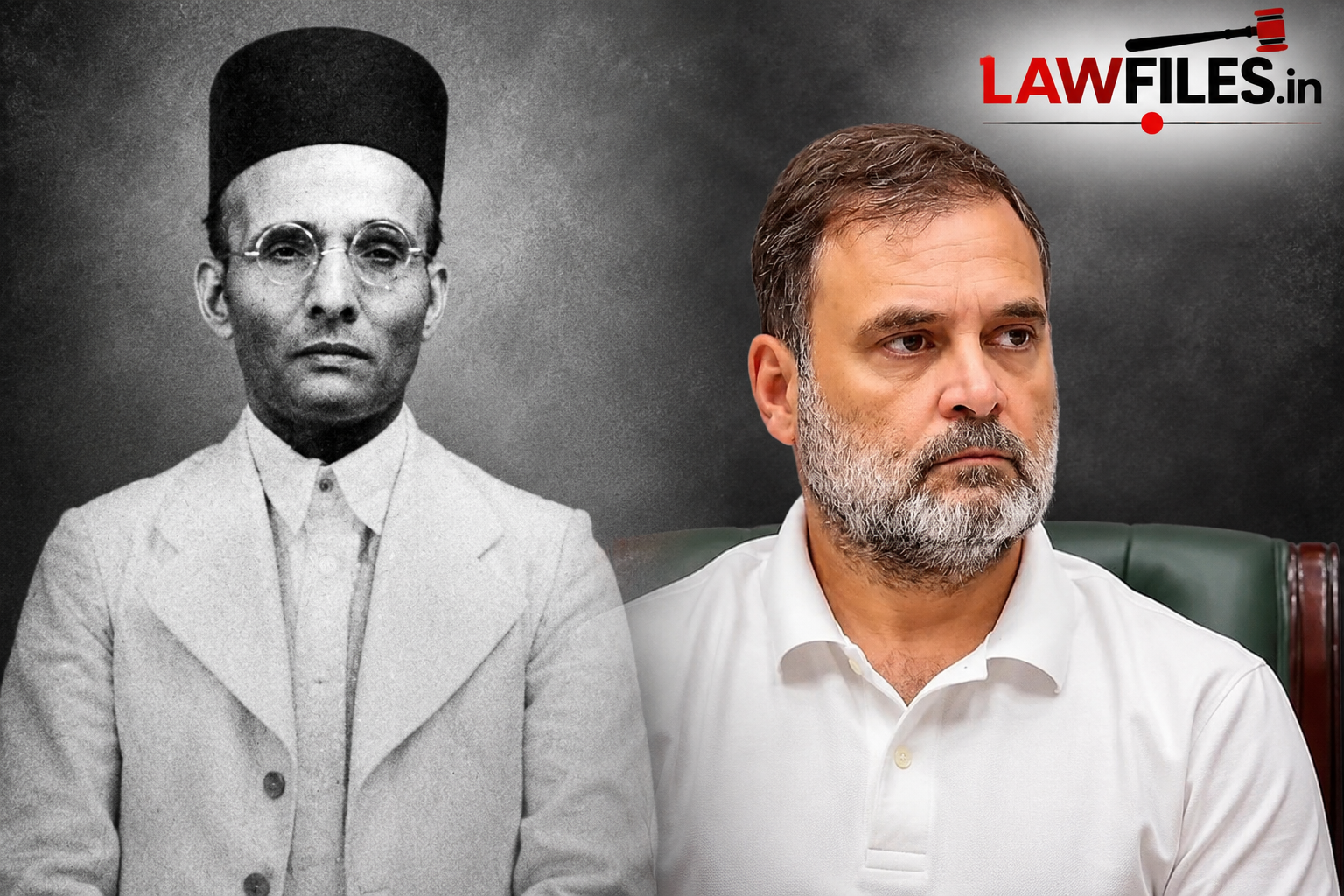
A criminal defamation proceeding pending before a Pune court has once again brought one of India’s most enduring historical debates into the judicial arena, as the grandnephew of Vinayak Damodar Savarkar deposed before the trial court regarding the controversial characterisation of the freedom fighter’s mercy petitions addressed to the British colonial administration. The witness, during the course of cross-examination, stated that he could not conclusively say whether Savarkar should be described as a “Mahaveer” or as a “British agent” merely because he had submitted mercy petitions during his incarceration in the Cellular Jail. The testimony assumes significance not because it resolves the long-standing historical controversy surrounding Savarkar, but because it illustrates the evidentiary challenges courts encounter when criminal defamation proceedings intersect with competing interpretations of history, political discourse and constitutional free speech. Importantly, the observations recorded before the trial court constitute witness testimony and not judicial findings on Savarkar’s legacy or the historical accuracy of competing narratives.
The proceedings arise from a criminal defamation complaint instituted against Congress leader Rahul Gandhi over remarks allegedly made during a public speech concerning Vinayak Damodar Savarkar. The complaint has been filed by Satyaki Savarkar, the grandnephew of the late freedom fighter, who contends that the statements made by Gandhi were false, defamatory and intended to tarnish the reputation of Savarkar by portraying him as someone who repeatedly apologised to the British Government in exchange for his release from imprisonment. The complainant maintains that the remarks exceeded the limits of permissible political criticism and amounted to criminal defamation punishable under Sections 499 and 500 of the Indian Penal Code, provisions which now find corresponding place in the Bharatiya Nyaya Sanhita, 2023. The trial before the Pune court is presently at the stage of recording evidence.
During cross-examination, defence counsel questioned the complainant regarding the historical implications of the mercy petitions submitted by Savarkar while lodged in the Cellular Jail in the Andaman and Nicobar Islands. Responding to questions put during the proceedings, the witness stated that he was unable to definitively conclude whether the filing of mercy petitions, by itself, justified describing Savarkar either as a heroic freedom fighter or as an agent of the British Government. The answer assumes evidentiary significance because it reflects the witness’s acknowledgement that the historical interpretation of those documents cannot be reduced to simplistic legal characterisations. The testimony, however, forms only one part of the evidentiary record and will ultimately be assessed by the trial court in conjunction with documentary evidence, historical material and the legal ingredients required to establish the offence of criminal defamation.
The controversy surrounding Savarkar’s mercy petitions has remained a subject of historical and political debate for several decades. It is an undisputed historical fact that Savarkar, after being sentenced to transportation for life following his conviction in 1911, submitted multiple mercy petitions to the British colonial authorities during his incarceration in the Cellular Jail. These petitions are preserved in official archival records and have been extensively discussed by historians across the ideological spectrum. However, the legal and historical significance attributed to those petitions remains sharply contested. One school of thought characterises them as strategic legal representations intended to secure release so that the struggle for India’s independence could continue outside prison, while another interprets them as evidence of compromise with colonial authorities. Courts adjudicating defamation disputes are ordinarily not called upon to conclusively resolve such historical controversies; rather, they examine whether the impugned statements satisfy the statutory ingredients of defamation in light of the available evidence.
The proceedings also highlight the limited institutional role of criminal courts in adjudicating historical controversies. Judicial determination in a defamation case does not amount to an authoritative rewriting of history. Instead, the court’s inquiry remains confined to whether the impugned statement lowered the complainant’s reputation within the meaning of criminal defamation law, whether the statement falls within any of the statutory exceptions contained in Section 499 of the Indian Penal Code (or the corresponding provision under the Bharatiya Nyaya Sanhita), and whether the accused acted with the requisite legal intent. Historical truth, public good, fair comment and good-faith criticism continue to occupy an important place within the statutory exceptions recognised by Indian defamation law.
From a constitutional perspective, the litigation once again illustrates the continuing tension between the right to freedom of speech under Article 19(1)(a) and the right to reputation recognised as an integral component of Article 21. The Supreme Court, in Subramanian Swamy v. Union of India (2016), upheld the constitutional validity of criminal defamation by recognising that while political speech occupies a preferred constitutional position, the protection of individual reputation equally constitutes a legitimate constitutional interest. The Court held that freedom of expression, though fundamental, is not absolute and remains subject to the reasonable restrictions contemplated under Article 19(2), including defamation. Consequently, political criticism enjoys broad constitutional protection, but where such criticism allegedly crosses into false factual assertions damaging another’s reputation, courts may be called upon to determine whether the statutory threshold for criminal defamation has been crossed.
The present proceedings also underscore the distinction between historical interpretation and legal adjudication. Historians routinely disagree regarding the motives underlying archival documents, speeches and political decisions. Such disagreements are ordinarily resolved through academic research rather than judicial determination. Criminal courts, by contrast, operate on evidentiary standards prescribed by law and determine whether specific legal ingredients of an offence have been established beyond reasonable doubt. Thus, while historical debates may inform the factual background of a defamation case, the ultimate judicial inquiry remains confined to the statutory framework governing criminal liability rather than competing schools of historical interpretation.
Another noteworthy aspect concerns the evidentiary value of witness testimony. Under the Indian Evidence Act and its successor legislation, the Bharatiya Sakshya Adhiniyam, the testimony of a witness constitutes one component of the evidentiary record rather than conclusive proof of disputed historical facts. The complainant’s acknowledgment during cross-examination regarding the complexity of interpreting Savarkar’s mercy petitions neither determines the legal merits of the prosecution nor resolves the broader historical debate. Instead, it forms part of the factual matrix that the trial court will evaluate alongside documentary records, contextual evidence and legal submissions advanced by both parties.
The proceedings further illustrate the increasingly common phenomenon of constitutional courts and criminal courts becoming forums for politically significant historical disputes. In recent years, litigation concerning historical personalities, freedom fighters and national icons has frequently reached courts through actions alleging defamation, hate speech or protection of personality rights. Such cases require judges to maintain careful institutional restraint by focusing upon the legal issues before them without transforming judicial proceedings into adjudications of history itself. This distinction preserves both judicial neutrality and the autonomy of historical scholarship.
Ultimately, the Pune court proceedings are not a judicial referendum on Vinayak Damodar Savarkar’s place in India’s freedom movement. Rather, they represent the adjudication of a narrowly framed criminal complaint requiring the court to determine whether the impugned statements satisfy the legal requirements of criminal defamation. The testimony recorded during cross-examination nevertheless serves as a reminder that historical personalities often continue to generate competing narratives long after the events themselves have passed into history. The role of the criminal court is not to endorse one historical interpretation over another, but to ensure that legal liability, if any, is determined strictly in accordance with constitutional principles, statutory requirements and the evidence placed on record. In doing so, the proceedings reaffirm an important constitutional principle: while history may remain open to debate, criminal responsibility must always rest upon proof established through the rule of law rather than political or ideological contestation.
