


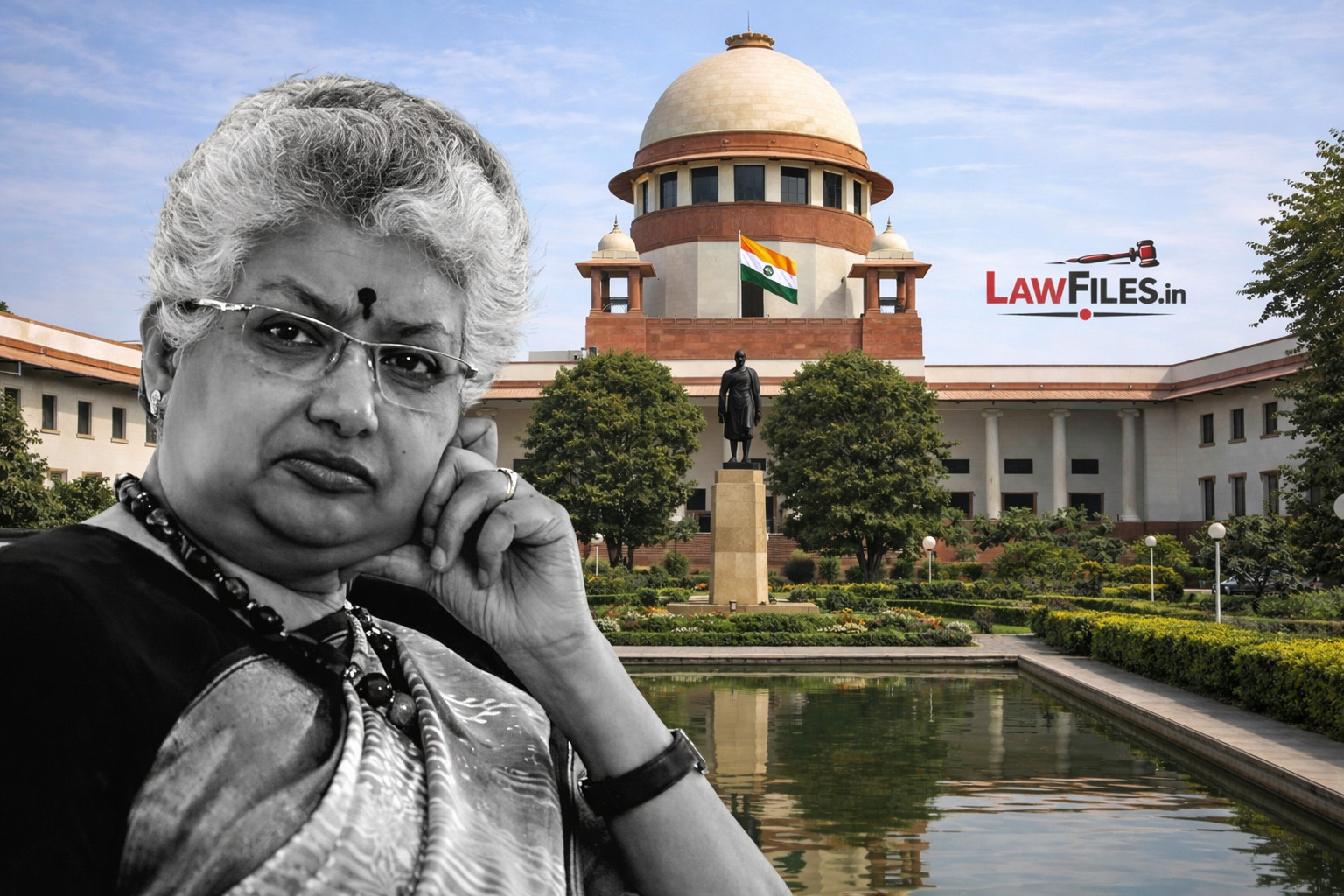
In a significant institutional development for India’s legal aid framework, the Chief Justice of India has nominated Supreme Court Judge Justice B.V. Nagarathna as the Chairperson of the Supreme Court Legal Services Committee (SCLSC) with effect from June 29, 2026. The appointment follows the retirement of Justice J.K. Maheshwari, who previously headed the Committee, and is in accordance with the long-standing convention that the third senior-most judge of the Supreme Court assumes charge of the SCLSC. While the notification may appear to be an administrative appointment, it carries considerable constitutional significance because the Committee functions as the apex institution responsible for ensuring that financial incapacity does not become a barrier to accessing justice before the Supreme Court of India.
The Supreme Court Legal Services Committee has been constituted under Section 3A of the Legal Services Authorities Act, 1987, a landmark welfare legislation enacted to operationalise Article 39A of the Constitution. Article 39A, inserted through the Forty-Second Constitutional Amendment, obligates the State to secure equal justice and provide free legal aid so that opportunities for securing justice are not denied to any citizen by reason of economic or other disabilities. The SCLSC represents the highest institutional expression of that constitutional mandate by extending legal representation to eligible litigants whose cases fall within the jurisdiction of the Supreme Court. Its responsibilities include scrutinising legal aid applications, determining eligibility under the statutory framework, appointing competent advocates-on-record and panel counsel, and ensuring effective legal representation for beneficiaries appearing before the apex court.
Although the appointment itself was administrative, it assumes wider significance because access to justice has increasingly emerged as one of the defining constitutional priorities of the Supreme Court. Over the last several decades, the Court has consistently recognised that the right to legal representation is not merely a statutory concession but an integral component of fair procedure under Article 21 of the Constitution. Beginning with landmark decisions such as Hussainara Khatoon v. State of Bihar, Khatri (II) v. State of Bihar, and Suk Das v. Union Territory of Arunachal Pradesh, the Supreme Court transformed free legal aid from a policy objective into an enforceable constitutional obligation, holding that the denial of competent legal assistance to an indigent person may itself amount to a violation of the guarantee of life and personal liberty. The functioning of the SCLSC is therefore not confined to administrative coordination; it forms an essential institutional mechanism through which constitutional guarantees are translated into practical legal remedies.
Justice Nagarathna’s appointment also carries particular institutional importance in light of her long-standing engagement with access-to-justice initiatives even before her elevation to the Supreme Court. During her years at the Karnataka High Court, she represented the Karnataka State Legal Services Authority as a practising advocate and later served in judicial capacities connected with legal services and mediation. Her judicial career has consistently reflected a strong emphasis on constitutional governance, procedural fairness, gender justice and the protection of individual rights. After her elevation to the Supreme Court in August 2021, she has authored several notable judgments across constitutional, administrative and commercial law, often emphasising the importance of institutional accountability, due process and citizen-centric governance.
The appointment further assumes symbolic significance because Justice Nagarathna is widely expected to become India’s first woman Chief Justice of India in 2027, albeit for a brief tenure under the existing seniority convention. Her elevation to the chairmanship of the Supreme Court Legal Services Committee therefore places one of the judiciary’s most significant welfare institutions under the stewardship of a judge who has consistently advocated an expansive understanding of constitutional rights and access to justice. While the chairmanship itself is distinct from the office of the Chief Justice, it provides an important platform for strengthening legal aid administration at the highest judicial level.
The importance of the Supreme Court Legal Services Committee has grown considerably in recent years as litigation before the apex court has become increasingly specialised and procedurally complex. Appeals involving constitutional rights, criminal convictions, labour disputes, service matters, family law, environmental litigation, consumer disputes and compensation claims frequently reach the Supreme Court through economically weaker litigants who lack the financial capacity to engage experienced counsel. The Committee bridges this structural imbalance by maintaining panels of advocates qualified to appear before the Supreme Court and by ensuring that deserving litigants receive competent legal representation irrespective of their economic status. In many cases, the SCLSC becomes the only avenue through which indigent litigants can effectively exercise their statutory right of appeal or invoke the Court’s constitutional jurisdiction.
The Committee’s role extends beyond merely appointing advocates. It functions as an institutional filter that evaluates the legal viability of claims, facilitates filing of petitions, coordinates procedural compliance and monitors the quality of legal assistance rendered to beneficiaries. This makes the SCLSC an integral component of India’s broader legal aid ecosystem headed by the National Legal Services Authority (NALSA), State Legal Services Authorities, High Court Legal Services Committees and District Legal Services Authorities established under the Legal Services Authorities Act. The multi-tiered framework seeks to create a continuum of legal assistance from the district judiciary to the Supreme Court, ensuring that constitutional promises are supported by institutional mechanisms rather than remaining abstract declarations.
From a constitutional perspective, the appointment also highlights the continuing evolution of access to justice as a substantive constitutional value rather than a mere procedural entitlement. Indian constitutional jurisprudence has progressively expanded the scope of Article 21 to include legal aid, speedy trial, fair investigation, effective legal representation and meaningful access to courts. Consequently, institutions like the SCLSC have become indispensable to the functioning of constitutional democracy because they ensure that the ability to approach the country’s highest court is not determined solely by financial resources. The Committee’s work reinforces the egalitarian philosophy embedded in the Directive Principles of State Policy by reducing structural inequalities within the justice delivery system.
Justice Nagarathna’s appointment comes at a time when the Supreme Court itself is witnessing rapid institutional transformation through digitisation, virtual hearings, artificial intelligence-assisted administrative systems and increasing emphasis on procedural efficiency. These developments present both opportunities and challenges for legal aid institutions. While technology has improved accessibility for litigants across geographical boundaries, it has also created new barriers for economically and digitally disadvantaged individuals. The Supreme Court Legal Services Committee is therefore likely to play an increasingly significant role in ensuring that technological modernisation does not inadvertently widen inequalities in access to justice. Strengthening legal aid in the digital era requires not merely appointment of counsel but also facilitation of electronic filing, digital communication, translation assistance and procedural guidance for vulnerable litigants.
Another important dimension concerns public confidence in the justice delivery system. Access to justice is measured not merely by the existence of courts but by the practical ability of ordinary citizens to invoke judicial remedies. The Legal Services Authorities Act was enacted precisely to address the economic imbalance that often prevents weaker sections of society from effectively enforcing their legal rights. Every appointment to the leadership of the SCLSC therefore assumes institutional importance because it directly influences the quality, efficiency and credibility of legal aid administered at the country’s highest judicial forum.
The nomination of Justice B.V. Nagarathna thus represents far more than a routine administrative reshuffle. It reinforces the judiciary’s continuing commitment to the constitutional vision embodied in Article 39A that justice must remain accessible irrespective of economic status. As the legal landscape grows increasingly complex and litigation before constitutional courts becomes more specialised, institutions like the Supreme Court Legal Services Committee will play an even more pivotal role in preserving equality before law. Under Justice Nagarathna’s leadership, the Committee is expected to continue advancing the constitutional objective that the doors of the Supreme Court remain open not only to those who can afford justice, but equally to those for whom legal aid is the only pathway to vindicating their rights.
