


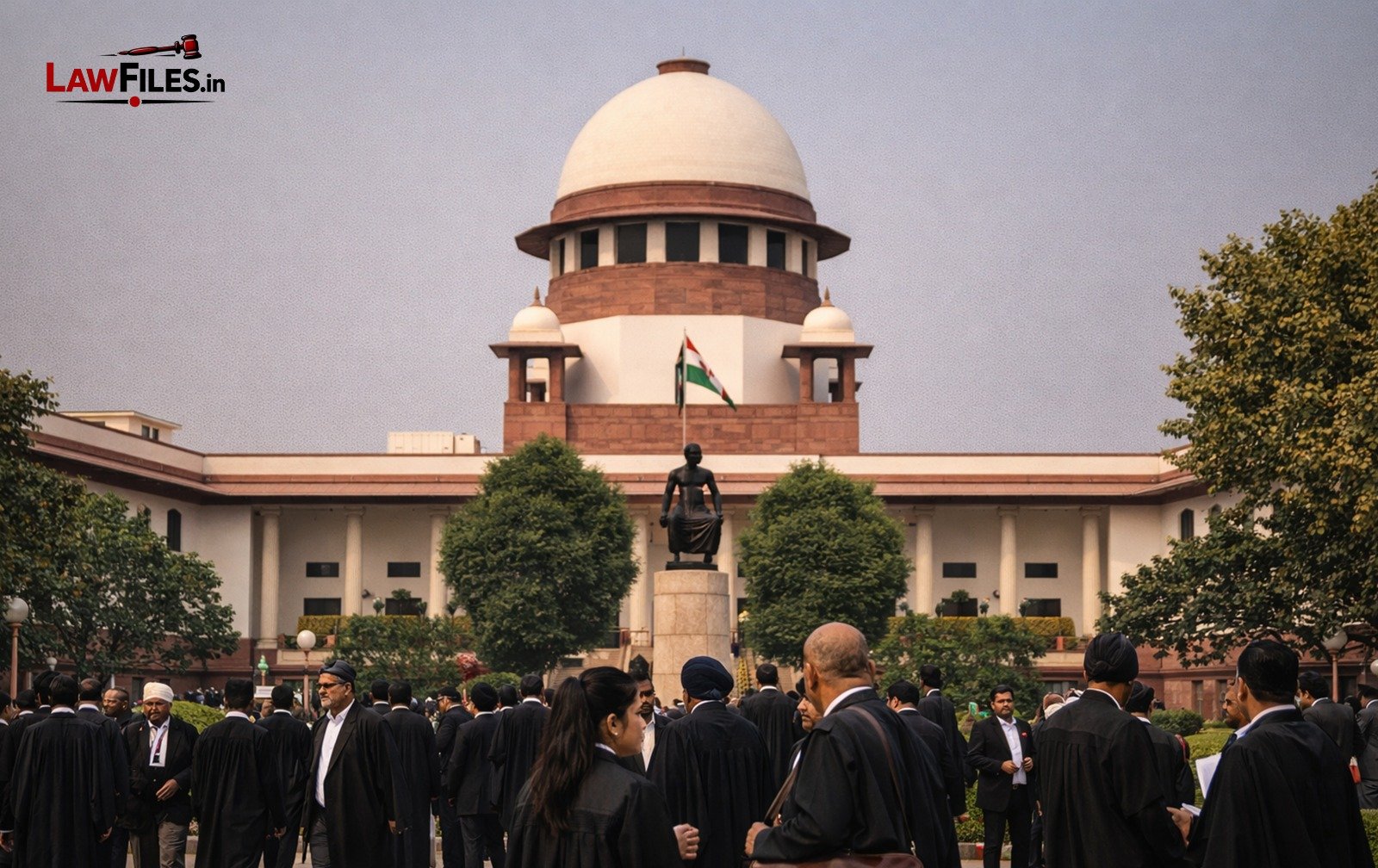
In a significant ruling reaffirming the humane and welfare-oriented spirit of motor accident compensation law, the Supreme Court of India enhanced compensation to ₹56.83 lakh for a 14-year-old boy who suffered 100% permanent disability in a road accident, holding that the compensation awarded by the Motor Accident Claims Tribunal (MACT) and later by the Rajasthan High Court was grossly inadequate considering the lifelong consequences of the injuries. The judgment reflects the Court’s continuing effort to move beyond narrow arithmetic in compensation cases and toward a more realistic understanding of lifelong disability, dependency, and dignity.
The case arose from a 2016 accident in Rajasthan in which the minor victim, Hansraj, was travelling as a pillion rider on a motorcycle that collided with the rear side of a tractor trolley. The accident caused catastrophic injuries to his neck, spine, and head, leaving him permanently disabled. He reportedly remained hospitalised for nearly 203 days and thereafter required continuous assistance for basic daily functioning.
Initially, the MACT awarded compensation of approximately ₹7.76 lakh. The Rajasthan High Court later enhanced the amount to around ₹12.17 lakh. However, the claimant approached the Supreme Court arguing that the compensation failed to reflect the extent of permanent disability, future dependency, attendant costs, and complete loss of normal life opportunities. The Supreme Court accepted this contention and substantially recalculated the compensation under multiple heads.
A Bench comprising Justice J.K. Maheshwari and Justice Atul S. Chandurkar held that the High Court had erred in adopting an unrealistically low notional income of ₹30,000 annually. The Court observed that in cases involving minors, particularly those suffering total permanent disability, notional income cannot be assessed mechanically or symbolically. Instead, it should reflect the prevailing minimum wages applicable to skilled workers in the concerned State. On that basis, the Court fixed the monthly notional income at ₹5,800 and added 40% future prospects while applying the multiplier method to compute loss of earning capacity.
One of the most important aspects of the judgment is the Court’s recognition of lifelong attendant care as a central component of “just compensation.” Observing that the victim would require two attendants round the clock for the rest of his life, the Court awarded ₹21.60 lakh under attendant charges alone, relying on its earlier precedent in Kajal v. Jagdish Chand. This approach reflects an evolving judicial understanding that disability compensation cannot be confined merely to medical bills or loss of income, but must also account for the practical realities of survival and assisted living.
The Court also enhanced compensation under non-pecuniary heads, awarding ₹10 lakh for pain, suffering, and loss of amenities of life. Additionally, it granted compensation toward future medical expenses, transportation, special diet, and even loss of marriage prospects an acknowledgement of the social and emotional consequences of severe disability in Indian society.
From a jurisprudential perspective, the ruling is significant because it reinforces the principle that compensation under the Motor Vehicles Act must be restorative rather than merely tokenistic. Indian courts have increasingly recognized that in cases involving children or young persons rendered permanently disabled, the loss is not limited to earning potential but extends to autonomy, mobility, education, social participation, and dignity itself. The judgment thus reflects a broader constitutional commitment to substantive justice and human dignity under Article 21.
Critically, the decision also exposes longstanding inconsistencies in the approach of tribunals and High Courts toward disability compensation. Lower adjudicatory forums have often relied on outdated notional income figures, resulting in awards that fail to meet even basic care requirements. By correcting the assessment methodology, the Supreme Court has signaled that compensation jurisprudence must evolve in tune with economic realities and the actual cost of long-term disability care.
Another notable feature of the ruling is the Court’s concern for future financial security. It directed that a substantial portion of the amount awarded toward attendant charges be placed in fixed deposit, ensuring sustained availability of funds for the claimant’s long-term care. This demonstrates a welfare-oriented judicial approach aimed not merely at awarding compensation, but at structuring it in a manner that protects vulnerable victims from future financial instability.
The judgment may also have wider implications for motor accident claims involving minors and persons with severe disabilities. By emphasizing realistic income assessment, future prospects, and permanent caregiving needs, the Court has laid down principles likely to influence compensation calculations in similar cases across the country.
In conclusion, the Supreme Court’s decision in Hansraj v. Mukesh Nath & Ors. represents a humane and constitutionally grounded interpretation of “just compensation.” By substantially enhancing the award for a child rendered 100% disabled, the Court has reaffirmed that compensation law is not merely about financial calculation but about recognizing the lifelong human cost of catastrophic injury. The ruling stands as an important reminder that the justice system must respond to disability not with symbolic relief, but with meaningful rehabilitation-oriented compensation capable of preserving dignity and survival.
