


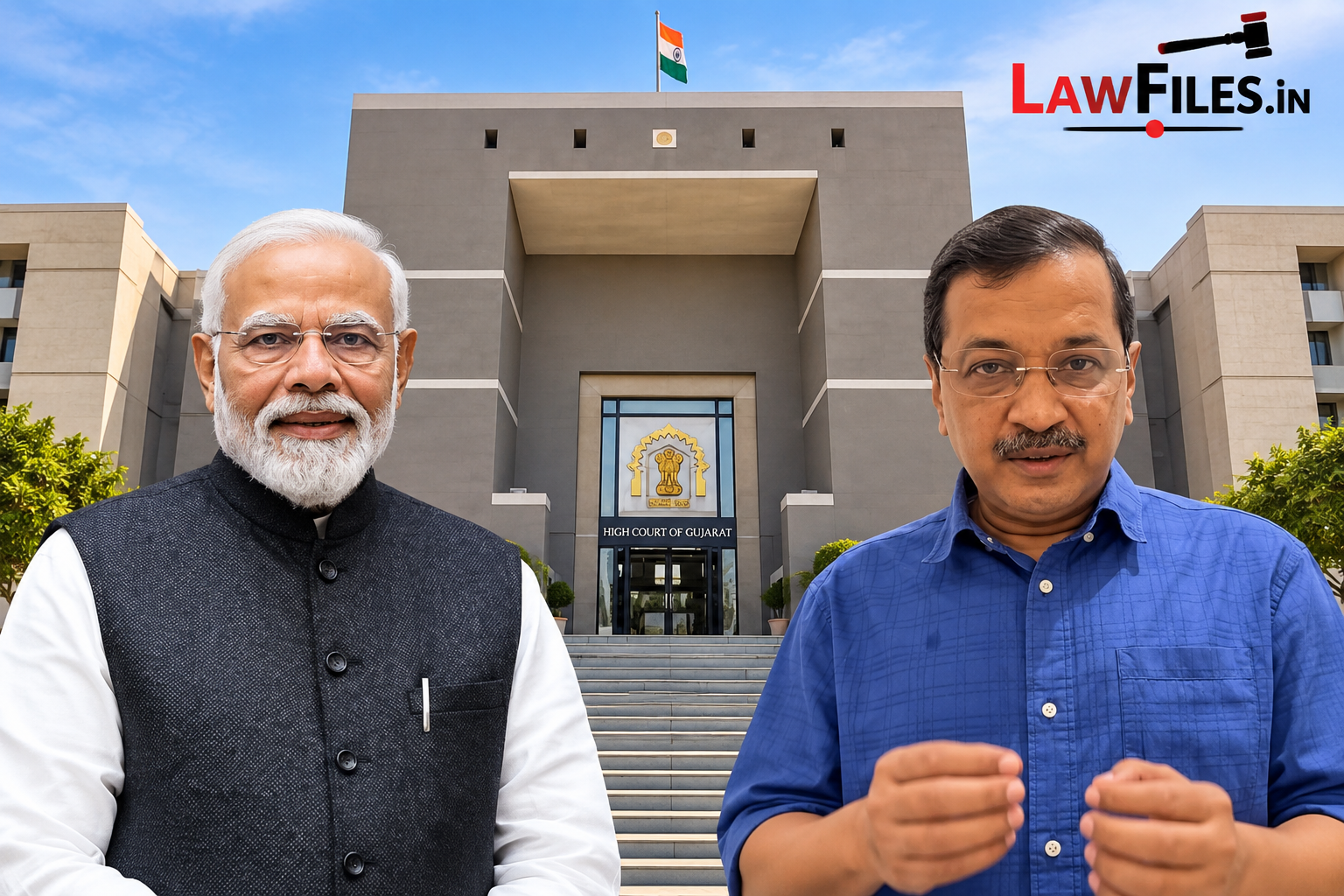
The Gujarat High Court has once again brought into focus the delicate boundary between the citizen’s right to know and an individual’s right to privacy, holding that the educational records of Prime Minister Narendra Modi cannot be sought under the Right to Information Act merely because he occupies the country’s highest elected constitutional office. A Division Bench comprising Chief Justice Sunita Agarwal and Justice D.N. Ray dismissed Arvind Kejriwal’s appeal against the March 2023 judgment of the Single Judge, thereby leaving intact the quashing of a Central Information Commission direction concerning disclosure of information relating to the Prime Minister’s educational degrees as well as the ₹25,000 cost imposed upon Kejriwal.
The judgment is important not because it creates a special privacy rule for a Prime Minister, but because it examines a recurring problem under the RTI regime: whether information becomes a matter of “public interest” merely because the person to whom it relates is a public figure. The Court answered that proposition in the negative. The fact that information concerns a person occupying constitutional office does not, by itself, displace the statutory exemptions protecting personal information. In the Court’s reasoning, the decisive question is not whether the public may be interested in the information, but whether disclosure serves a legally demonstrable public interest capable of outweighing the applicable privacy protection.
The litigation itself has a rather unusual procedural history. The controversy originated in proceedings before the Central Information Commission in 2016. The CIC was dealing with an issue concerning Kejriwal’s electoral photo identity card when Kejriwal made a request relating to Prime Minister Modi’s educational qualifications. The Commission treated that request as sufficient basis to direct the Prime Minister’s Office to provide specific identifying details concerning the degrees and to facilitate the search of records with Delhi University and Gujarat University. Gujarat University challenged that direction before the High Court.
The Single Judge, Justice Biren Vaishnav, in March 2023 set aside the CIC’s direction. The Court found that educational records such as degrees and marksheets constitute personal information and that the universities and examining bodies hold such records in a fiduciary relationship with their students. The Court further concluded that the necessary element of larger public interest required to justify disclosure of otherwise protected information had not been established. It also imposed ₹25,000 in costs on Kejriwal. The present appeal arose from that order.
The Division Bench has now found no sufficient ground to interfere with that conclusion. The Bench’s reasoning proceeds from an important conceptual distinction in RTI jurisprudence: “information in which the public is interested” is not necessarily “information disclosed in public interest.” A subject may generate extensive public discussion, political controversy or media attention and yet remain legally protected personal information. Public curiosity, by itself, cannot become the statutory test for overriding privacy.
That distinction is central to the architecture of Section 8 of the RTI Act. The right to information is deliberately broad, but it is not absolute. Section 8 contains a series of exemptions designed to protect interests such as national security, commercial confidence, fiduciary relationships and personal privacy. The exemptions concerning fiduciary information and personal information are particularly relevant when records held by universities are sought by persons other than the student concerned.
The Court considered Section 8(1)(e), which protects information available to a public authority in a fiduciary relationship, and Section 8(1)(j), concerning personal information. The Court noted that educational qualification documents fall within the category of personal information and that universities hold such records in a relationship of trust with their students. Consequently, disclosure requires the statutory public-interest threshold to be crossed rather than merely a demonstration that the information concerns an important public figure.
The Bench also found fault with the reasoning adopted by the CIC while directing disclosure. According to the High Court, the Commission had not adequately explained why disclosure was necessary in the larger public interest despite the applicability of the statutory exemptions. The Court particularly disapproved of the broad proposition that information concerning a public authority, public servant or political leader occupying a constitutional position automatically falls outside the protection of Section 8.
That approach has wider significance. If holding public office were by itself sufficient to transform personal records into publicly disclosable material, the privacy protections under the RTI Act could progressively become weaker as an individual’s public responsibilities increased. Such a principle would potentially expose not merely degrees but medical records, financial information, family details, correspondence and other personal records of public functionaries to disclosure merely because the individual happens to occupy public office.
The High Court therefore approached privacy not as an exception available only to private citizens, but as a constitutional interest that continues to operate in the case of public officials unless there is a sufficiently strong public-interest justification for disclosure. The Court relied upon the Supreme Court’s jurisprudence on informational privacy, including K.S. Puttaswamy v. Union of India and the Constitution Bench judgment in Central Public Information Officer, Supreme Court of India v. Subhash Chandra Agarwal.
The reference to Puttaswamy is particularly significant because the Supreme Court recognised privacy as a constitutionally protected facet of dignity and personal liberty under Article 21. Privacy, however, is not an absolute shield against every form of disclosure. The constitutional framework requires balancing privacy against legitimate public purposes. The RTI Act itself incorporates such balancing through its public-interest exceptions. The present judgment therefore operates within a broader constitutional principle rather than treating privacy and transparency as mutually exclusive absolutes.
The Supreme Court’s decision in Subhash Chandra Agarwal also provides an important doctrinal framework. The Constitution Bench examined the relationship between transparency and privacy and emphasised that the public-interest test must be applied carefully, particularly where information otherwise falls within a statutory exemption. The Gujarat High Court’s present reasoning is consistent with that approach: the person seeking disclosure cannot stop at establishing that the information relates to a public functionary; there must be a legally sustainable explanation as to why disclosure serves a public purpose that outweighs the protected interest.
The Court’s reasoning also gains significance when viewed alongside the Delhi High Court’s 2025 ruling concerning a separate RTI proceeding relating to Prime Minister Modi’s educational records. In that case too, the Delhi High Court held that degree certificates, marksheets and academic records constitute personal information and cannot be disclosed merely because the individual concerned is a public figure. The Court stressed that public office does not automatically extinguish confidentiality over personal data unrelated to the discharge of public duties.
The convergence of these decisions is legally noteworthy. The issue is no longer confined to the factual controversy surrounding one individual’s educational qualifications. Courts are increasingly required to determine where the line should be drawn between transparency concerning the exercise of public power and the protection of information that remains personal notwithstanding the individual’s public position.
At the same time, the judgment should not be read as establishing that information concerning public officials can never be disclosed under the RTI Act. Such a proposition would be inconsistent with the statutory structure itself. The crucial distinction lies in the nature of the information and its relationship to public duties. Information concerning the exercise of public authority, expenditure of public money, decision-making processes, official conduct or statutory compliance can engage powerful transparency considerations. Personal educational records stand on a different footing unless their disclosure has a demonstrable connection with a legally relevant public issue.
This distinction becomes particularly important when educational qualifications are discussed in the context of eligibility for public office. The Court noted that the Constitution does not prescribe a minimum educational qualification for a person to become Prime Minister. Article 75 governs the appointment of the Prime Minister and Council of Ministers, but educational attainment is not prescribed as a constitutional qualification for holding the office. Therefore, the Court found no automatic nexus between disclosure of the Prime Minister’s educational records and eligibility to occupy the office.
That aspect of the reasoning also explains why the Court rejected an argument based merely on the constitutional importance of the office. If the law itself does not prescribe a particular degree as a condition for becoming Prime Minister, the educational certificate cannot automatically be treated as an official eligibility document whose disclosure is necessary to verify a statutory qualification. The public-interest inquiry consequently cannot be reduced to the proposition that citizens are entitled to know everything about a person holding high office.
The Court’s approach also carries a broader warning for the use of the RTI mechanism. The RTI Act was enacted as a transparency statute designed to facilitate informed participation, accountability and scrutiny of governmental functioning. It was not intended to become a general mechanism for compelling disclosure of every piece of information concerning a public personality. A robust RTI regime depends not only upon the willingness of public authorities to disclose information, but also upon principled recognition of the boundaries expressly built into the statute.
The ₹25,000 cost imposed upon Kejriwal is therefore a separate but connected aspect of the case. The Single Judge had criticised the manner in which the request concerning the Prime Minister’s degree was pursued and observed that the degree information was already available in the public domain. The Division Bench has now declined to interfere with that part of the order and dismissed the appeal without imposing any additional costs.
The costs should nevertheless be understood carefully. A monetary cost imposed in litigation does not itself establish that a party acted unlawfully in seeking information. Courts may impose costs where they find proceedings unnecessarily pursued, procedurally inappropriate or lacking sufficient legal foundation. But the substantive legal principle remains distinct: an unsuccessful RTI request does not automatically become an abuse of process. The application of costs depends upon the facts and conduct in the particular litigation.
There is another important dimension to the case: the distinction between verification and disclosure. A citizen may have a legitimate interest in knowing whether a public representative has made a particular qualification claim. That does not necessarily mean that the citizen has an unrestricted right to obtain the underlying university record through RTI. Verification may be possible through publicly disclosed information, statutory election records or other legally available sources without compelling disclosure of confidential academic records. The law therefore need not choose between complete secrecy and unrestricted disclosure; the nature and source of the information matter.
The judgment also illustrates why the phrase “public interest” cannot be treated as a rhetorical formula. If every politically contentious matter is described as being in the public interest, the statutory exemption would lose much of its meaning. Conversely, if privacy is invoked mechanically whenever personal information is involved, the transparency objective of the RTI Act would also be undermined. The correct exercise is one of structured balancing, supported by reasons and connected to the statutory purpose.
From a constitutional perspective, the case demonstrates that public accountability and individual privacy are not opposing constitutional camps. Transparency is indispensable to democratic government, but democracy does not require the elimination of personal spheres merely because an individual enters public life. Public office subjects a person to legitimate scrutiny in relation to public functions; it does not necessarily surrender every aspect of personal identity to public inspection.
The judgment also assumes significance in the era of digital information, where personal records can quickly travel beyond the purpose for which they were originally collected. Academic documents held by universities were created primarily to record educational attainment and maintain institutional records. Once disclosed, however, such records can be replicated indefinitely and detached from their original context. The privacy question is consequently no longer limited to whether a document can physically be inspected; it concerns the consequences of placing personal information permanently into the public domain.
Ultimately, the Gujarat High Court’s ruling reinforces a relatively precise legal proposition: the constitutional status of the person concerned does not, by itself, determine the disclosure status of the information sought. What matters is the character of the information, the statutory exemption applicable to it, the relationship in which the information is held and whether a demonstrable public interest justifies overriding the protection.
The decision therefore takes the debate beyond the political controversy surrounding Prime Minister Modi’s educational qualifications and places it within the more enduring jurisprudence of transparency, privacy and responsible use of the RTI mechanism. For citizens, information commissions and public authorities alike, the central lesson is that public interest must be established, not presumed; privacy must be respected, but not treated as absolute; and the RTI Act must be interpreted as a transparency law with carefully defined constitutional and statutory limits. The Gujarat High Court’s refusal to treat public curiosity as a substitute for the statutory public-interest test is consequently the more enduring legal significance of the judgment.
