

Close Menu
LawFilesLawFiles

    Subscribe to Updates

    Get the latest creative news from FooBar about art, design and business.

    What's Hot

    Supreme Court Reaffirms Finality of CoC-Approved Resolution Plans: Why This Judgment Matters for Future Insolvency Professionals

    June 1, 2026

    Supreme Court Reaffirms Finality of CoC-Approved Resolution Plans: Why This Judgment Matters for Future Insolvency Professionals

    June 1, 2026

    NUSRL Ranchi Invites Submissions for “Kautilya’s Take” Policy Blog: A Valuable Opportunity for Law Students and Young Researchers

    June 1, 2026
    Facebook X (Twitter) Instagram Threads
    Monday, June 1
    LawFilesLawFiles
    Facebook X (Twitter)
    • Home
      • Who We Are
      • Our Mission
      • Advisory board
      • Contact US
    • Supreme Court
    • High Courts
      • Gujarat High Court
      • Jharkhand High Court
      • Rajasthan High Court
      • Karnataka High Court
      • Andhra Pradesh High Court
      • Allahabad High Court
      • Himachal Pradesh High Court
      • Chhattisgarh High Court
      • Jammu & Kashmir and Ladakh High Court
      • Kerala High Court
      • Punjab and Haryana High Court
      • Patna High Court
      • Madhya Pradesh High Court
      • Madras High Court
      • Bombay High Court
      • Orissa High Court
      • Calcutta High Court
      • Meghalaya High Court
      • Delhi High Court
      • Manipur High Court
      • Gauhati High Court
    • Corporate
    • Taxation Laws
      • Income Tax
      • GST
      • Customs & Excise
    • Global Affairs
    • Articles
      • Sitting Judge’s’ Views
      • Senior Advocate
      • Policy Analysis
      • Tax Expert
    • PILS
      • Free/Affordable Legal Aid
      • PIL Cell
      • Law student Volunteer Cell (research & Drafting)
      • NGO & Legal services Authority Tie-ups
      • Online Legal Formats
      • Online Legal Help Form
    Subscribe Premium
    LawFilesLawFiles
    Home»Political News»“From Courtroom to Caricature: Supreme Court Questions ‘Rats Ate Bribe Money’ Claim, Exposes Evidentiary Collapse”
    Political News

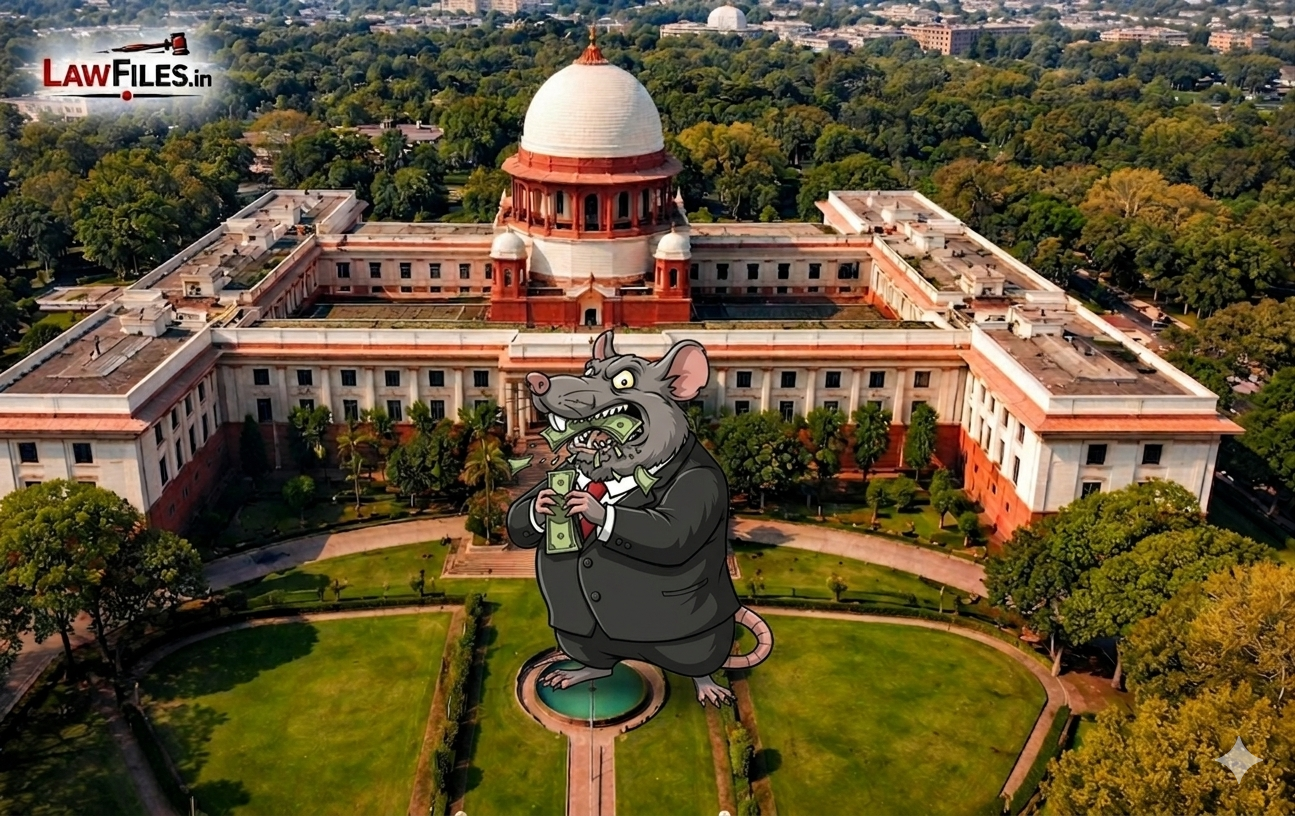
    “From Courtroom to Caricature: Supreme Court Questions ‘Rats Ate Bribe Money’ Claim, Exposes Evidentiary Collapse”

    Anvita DwivediBy Anvita DwivediApril 25, 2026No Comments3 Mins Read
    WhatsApp Facebook Twitter Copy Link
    Share
    Facebook Twitter Pinterest Copy Link WhatsApp

    In a striking case that underscores both the fragility of evidence handling and the complexities of corruption prosecutions, the Supreme Court of India granted bail to a woman convicted under the Prevention of Corruption Act, 1988, while expressing serious concern over an unusual factual claim recorded by the High Court that seized bribe money in the case had allegedly been destroyed by rodents.

    The matter came before a Bench comprising Justices J.B. Pardiwala and K.V. Viswanathan, which suspended the sentence of the convicted woman pending appeal. While granting relief, the Court did not merely focus on the individual circumstances of the accused but highlighted a deeper systemic issue: the handling and preservation of crucial material evidence in corruption cases. The Bench expressed surprise at the explanation that currency notes central to the prosecution’s case had been destroyed by rats, remarking that such a situation pointed to a serious institutional lapse.

    At one level, the explanation borders on the improbable; at another, it reveals a troubling reality. What often appears in popular culture as an exaggerated defence where incriminating material mysteriously disappears has, in this instance, found mention in judicial records themselves. The transition of such narratives from fiction to courtrooms raises uncomfortable questions about the credibility of custodial mechanisms and evidentiary discipline.

    At the doctrinal level, the case brings into focus the evidentiary framework under corruption law. Offences under the Prevention of Corruption Act are typically built on proof of demand, acceptance, and recovery of illegal gratification. The recovery of tainted currency often plays a pivotal role in corroborating the prosecution’s case. Where such evidence is compromised, the integrity of the prosecution itself may come into question.

    Analytically, the case highlights a critical tension between conviction based on procedural compliance and conviction grounded in evidentiary certainty. The disappearance or destruction of primary physical evidence particularly without a credible and verifiable explanation undermines the evidentiary chain and introduces reasonable doubt into the prosecution’s narrative.

    The Court’s decision to grant bail must also be viewed in light of appellate principles. Suspension of sentence pending appeal reflects a judicial assessment that continued incarceration may not be justified where serious questions arise regarding evidentiary integrity. In such circumstances, courts are compelled to ensure that conviction does not rest on a compromised foundation.

    Beyond the immediate facts, the case raises broader institutional concerns. The alleged destruction of seized currency by rodents points to deficiencies in evidence storage, chain of custody, and accountability. When physical evidence becomes vulnerable to such lapses, the problem is not merely factual  it is systemic.

    From a policy perspective, the incident underscores the need for modernisation of evidence management systems. Secure storage, digital documentation, and strict audit trails are no longer optional they are essential safeguards. Without them, even strong cases risk erosion, not because the offence did not occur, but because the system failed to preserve proof of it.

    In conclusion, the Supreme Court’s observations transform what might appear as an unusual factual claim into a deeper commentary on the state of criminal justice administration. The case serves as a reminder that in corruption prosecutions, the strength of the law is only as good as the integrity of its evidence. When that foundation weakens, even the most serious allegations risk being reduced to uncertainty blurring the line between accountability and doubt.


    Exposes Evidentiary Collapse” From Courtroom to Caricature Supreme Court Questions ‘Rats Ate Bribe Money’ Claim
    Share. WhatsApp Facebook Twitter Pinterest Email
    Anvita Dwivedi

    Related Posts

    Supreme Court Reaffirms Finality of CoC-Approved Resolution Plans: Why This Judgment Matters for Future Insolvency Professionals

    June 1, 2026

    Supreme Court Reaffirms Finality of CoC-Approved Resolution Plans: Why This Judgment Matters for Future Insolvency Professionals

    June 1, 2026

    NUSRL Ranchi Invites Submissions for “Kautilya’s Take” Policy Blog: A Valuable Opportunity for Law Students and Young Researchers

    June 1, 2026
    Add A Comment
    Leave A Reply Cancel Reply

    Demo
    Top Posts

    Wrongful Claim Rejection Amounts to Deficiency in Service: Delhi Consumer Commission Holds Star Health Liable

    March 16, 202667 Views

    Bombay High Court Quashes POCSO Case, Directs Accused to Fund MacBook for Victim’s Education

    February 28, 202650 Views

    Siyahat Meri Syahi Se: A Journey That Transforms Travel into Thought and Entrepreneurship

    March 18, 202643 Views

    Banking Negligence and Consumer Accountability: Supreme Court Reinforces Duty of Care in Cheque Handling

    April 16, 202635 Views
    Don't Miss

    Supreme Court Reaffirms Finality of CoC-Approved Resolution Plans: Why This Judgment Matters for Future Insolvency Professionals

    By Anvita DwivediJune 1, 2026

    In a significant ruling under the Insolvency and Bankruptcy Code, 2016 (IBC), the Supreme Court…

    Supreme Court Reaffirms Finality of CoC-Approved Resolution Plans: Why This Judgment Matters for Future Insolvency Professionals

    June 1, 2026

    NUSRL Ranchi Invites Submissions for “Kautilya’s Take” Policy Blog: A Valuable Opportunity for Law Students and Young Researchers

    June 1, 2026

    Allahabad High Court’s Intervention in Conversion Plea Rekindles Debate on Religious Freedom, Administrative Power, and UP’s Anti-Conversion Law

    June 1, 2026
    Stay In Touch
    • Facebook
    • Twitter

    Subscribe to Updates

    Get the latest creative news from SmartMag about art & design.

    Top Posts

    Wrongful Claim Rejection Amounts to Deficiency in Service: Delhi Consumer Commission Holds Star Health Liable

    March 16, 202667 Views

    Bombay High Court Quashes POCSO Case, Directs Accused to Fund MacBook for Victim’s Education

    February 28, 202650 Views

    Siyahat Meri Syahi Se: A Journey That Transforms Travel into Thought and Entrepreneurship

    March 18, 202643 Views
    Don't Miss

    Supreme Court Reaffirms Finality of CoC-Approved Resolution Plans: Why This Judgment Matters for Future Insolvency Professionals

    By Anvita DwivediJune 1, 2026

    In a significant ruling under the Insolvency and Bankruptcy Code, 2016 (IBC), the Supreme Court…

    Supreme Court Reaffirms Finality of CoC-Approved Resolution Plans: Why This Judgment Matters for Future Insolvency Professionals

    June 1, 2026

    NUSRL Ranchi Invites Submissions for “Kautilya’s Take” Policy Blog: A Valuable Opportunity for Law Students and Young Researchers

    June 1, 2026

    Allahabad High Court’s Intervention in Conversion Plea Rekindles Debate on Religious Freedom, Administrative Power, and UP’s Anti-Conversion Law

    June 1, 2026
    Stay In Touch
    • Facebook
    • YouTube
    • TikTok
    • Instagram
    Top Trending
    About Us
    About Us

    LawFiles.in is a comprehensive legal news platform delivering real-time updates from the Supreme Court, High Courts, Tribunals, Corporate and Tax law, Regulators, Politics, Crime, Consumer cases, and Global Affairs.

    Email Us: lawfilesoffical@gmail.com
    Contact: +91 8800026066

    Contact Us:
    India International Centre
    40, Max Mueller Marg
    Lodhi Estate, New Delhi-110003

    Facebook X (Twitter)
    Our Picks

    Supreme Court Reaffirms Finality of CoC-Approved Resolution Plans: Why This Judgment Matters for Future Insolvency Professionals

    June 1, 2026

    Supreme Court Reaffirms Finality of CoC-Approved Resolution Plans: Why This Judgment Matters for Future Insolvency Professionals

    June 1, 2026

    NUSRL Ranchi Invites Submissions for “Kautilya’s Take” Policy Blog: A Valuable Opportunity for Law Students and Young Researchers

    June 1, 2026

    Allahabad High Court’s Intervention in Conversion Plea Rekindles Debate on Religious Freedom, Administrative Power, and UP’s Anti-Conversion Law

    June 1, 2026

    Supreme Court Rejects Demolition of Navi Mumbai Mall, Signals Shift from Punitive Urban Governance to Proportional Justice

    June 1, 2026
    Most Popular

    ED Can Arrest Even If FIRs Are Added to ECIR Later: Punjab & Haryana High Court

    January 30, 20260 Views

    Custodial Death and State Liability : A Critical Analysis of the Allahabad High Court’s ₹10 Lakh Compensation Judgment

    February 22, 20260 Views

    Gujarat High Court Commutes Death Sentence in Child Rape-Murder; Reinforces Capital Sentencing Standards in Light of MP High Court Precedent

    February 23, 20260 Views

    Delhi Family Court Rules Against Enforcement of Australian Property Orders in Shikhar Dhawan Matrimonial Dispute

    February 25, 20260 Views

    Supreme Court Stays Criminal Proceedings Against Jharkhand CM Hemant Soren Over Alleged ED Summons Defiance

    February 25, 20260 Views
    © 2026 LawFiles. Owned by Varta24 Media.
    • Articles
    • Careers
    • Corporate
    • Global Affairs
    • Law Firms & Lawyers
    • PILS
    • Regulatory

    Type above and press Enter to search. Press Esc to cancel.