

Close Menu
LawFilesLawFiles

    Subscribe to Updates

    Get the latest creative news from FooBar about art, design and business.

    What's Hot

    Advocacy Is Not Influencing, It Is a Public Trust: Bar Council of India Draws Ethical Boundaries for Lawyers in the Age of Social Media

    July 18, 2026

    ‘No Passenger Is Second-Class in a Constitutional Democracy’: Supreme Court Urges Railways to Curb Overcrowding, Reconsider Terminology and Strengthen Passenger Safety

    July 18, 2026

    Electoral Exclusion Is Not Citizenship Determination: Supreme Court Reaffirms Constitutional Limits on Election Commission’s Powers in West Bengal SIR Proceedings

    July 17, 2026
    Facebook X (Twitter) Instagram Threads
    Saturday, July 18
    LawFilesLawFiles
    Facebook X (Twitter)
    • Home
      • Who We Are
      • Our Mission
      • Advisory board
      • Contact US
    • Supreme Court
    • High Courts
      • Gujarat High Court
      • Jharkhand High Court
      • Rajasthan High Court
      • Karnataka High Court
      • Andhra Pradesh High Court
      • Allahabad High Court
      • Himachal Pradesh High Court
      • Chhattisgarh High Court
      • Jammu & Kashmir and Ladakh High Court
      • Kerala High Court
      • Punjab and Haryana High Court
      • Patna High Court
      • Madhya Pradesh High Court
      • Madras High Court
      • Bombay High Court
      • Orissa High Court
      • Calcutta High Court
      • Meghalaya High Court
      • Delhi High Court
      • Manipur High Court
      • Gauhati High Court
    • Corporate
    • Taxation Laws
      • Income Tax
      • GST
      • Customs & Excise
    • Global Affairs
    • Articles
      • Sitting Judge’s’ Views
      • Senior Advocate
      • Policy Analysis
      • Tax Expert
    • PILS
      • Free/Affordable Legal Aid
      • PIL Cell
      • Law student Volunteer Cell (research & Drafting)
      • NGO & Legal services Authority Tie-ups
      • Online Legal Formats
      • Online Legal Help Form
    Subscribe Premium
    LawFilesLawFiles
    Home»High Courts»ECI’s Transfer Powers Cannot Be Second-Guessed”: Calcutta High Court Rejects PIL, Says Bengal Not Singled Out in Officer Reshuffle
    High Courts

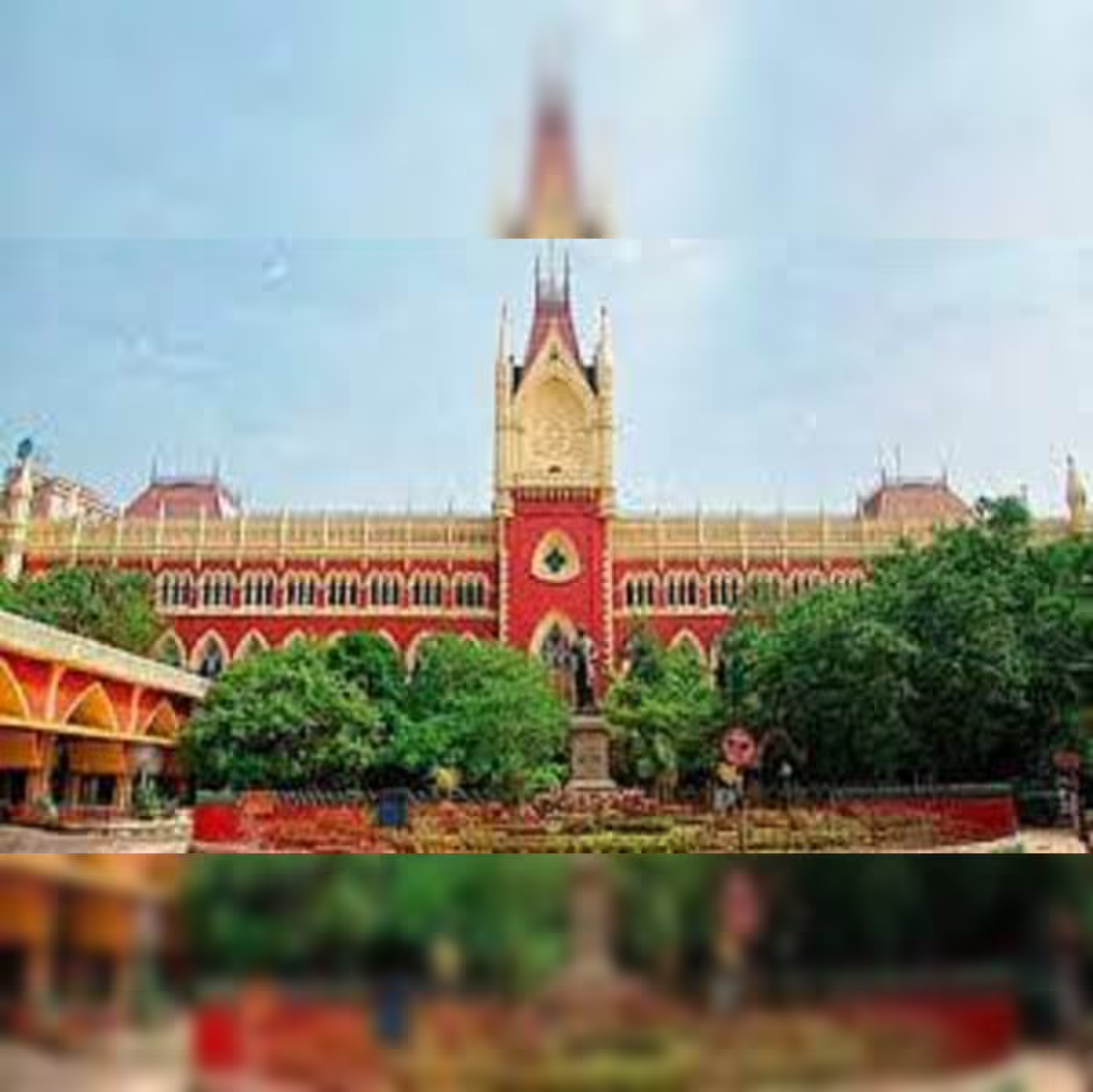
    ECI’s Transfer Powers Cannot Be Second-Guessed”: Calcutta High Court Rejects PIL, Says Bengal Not Singled Out in Officer Reshuffle

    Anvita DwivediBy Anvita DwivediApril 1, 2026No Comments4 Mins Read
    WhatsApp Facebook Twitter Copy Link
    Share
    Facebook Twitter Pinterest Copy Link WhatsApp

    In a significant ruling reinforcing the constitutional autonomy of the Election Commission, the Calcutta High Court has dismissed a Public Interest Litigation challenging the large-scale transfer of IAS and IPS officers in West Bengal ahead of the Assembly elections, holding that such administrative decisions fall squarely within the domain of the Election Commission of India (ECI).

    The Division Bench of Chief Justice Sujoy Paul and Justice Partha Sarathi Sen made it clear that courts cannot sit in appeal over the administrative wisdom of the Election Commission, unless clear arbitrariness or mala fide intent is established.

    The PIL, filed by advocate Arka Kumar Nag, challenged the ECI’s decision to transfer a large number of senior bureaucrats and police officials following the announcement of elections on March 15, 2026.

    The petitioner argued that the transfers were “unprecedented” and excessive. They disrupted the functioning of the State administration. The exercise amounted to a misuse of power under Article 324 of the Constitution. It was also contended that such large-scale reshuffling created an administrative vacuum, impairing governance during a crucial electoral period.

    Rejecting the petition, the High Court pointed out a fundamental flaw that the petitioner himself had not disputed the existence of ECI’s power to transfer officers during elections, thereby undermining his own challenge. The Court observed that the Election Commission has the authority to transfer and deploy officers after election notification. Such power is essential to ensure free and fair elections. Once the power is admitted, its exercise cannot be casually questioned without concrete evidence of illegality

    A key aspect of the judgment is the Court’s rejection of allegations of mala fide intent. The Bench held that “Mere assertions of mala fide without foundational facts cannot justify judicial interference.” It further clarified that the petitioner failed to provide any substantive material showing bias or improper motive. Judicial review cannot be invoked on the basis of speculation or political allegations

    One of the central claims in the PIL was that West Bengal had been disproportionately targeted. The Court rejected this contention, observing similar or even larger-scale transfers have taken place in other poll-bound states. Therefore, it cannot be said that West Bengal was uniquely or unfairly targeted This finding is crucial in neutralising claims of selective administrative action or political bias.

    Addressing concerns about governance disruption, the Court held that each transferred officer was immediately replaced by another officer. There was no “numb” or paralysed administrative condition in the State

    The Bench emphasised that temporary transfers during elections cannot be equated with breakdown of governance, especially when continuity mechanisms exist.

    The ruling strongly reiterates a foundational principle courts must exercise restraint in matters relating to election administration. The Court observed that election management is a specialized constitutional function. The ECI operates under Article 324, with wide supervisory powers. Judicial interference is warranted only in cases of clear arbitrariness, violation of statutory provisions, demonstrable mala fides

    The judgment is anchored in the interpretation of Article 324 of the Constitution, which vests the Election Commission with superintendence, direction, and control of elections, authority to take necessary administrative measures

    The Court’s approach aligns with landmark precedents such as Mohinder Singh Gill v. Chief Election Commissioner, where the Supreme Court recognized the wide powers of the ECI to ensure free and fair elections.

    The ruling reinforces that the Election Commission must be allowed operational autonomy during elections, free from excessive judicial scrutiny. Courts will not interfere with administrative decisions unless there is clear evidence of illegality or mala fide intent. The judgment sends a message that public interest litigation must be backed by concrete facts, not conjecture or political narratives.

    The decision comes amid heightened political tensions in West Bengal, where large-scale transfers of Chief Secretary, Director General of Police, District Magistrates and Superintendents of Police had triggered debate over federalism, administrative control, and electoral neutrality.

    The Court’s ruling effectively settles the legal question in favour of the ECI, affirming that ensuring free and fair elections may justify temporary administrative restructuring. The Calcutta High Court’s dismissal of the PIL marks a strong reaffirmation of the constitutional position that Election Commission’s administrative decisions, especially during elections, are entitled to judicial deference unless proven unlawful.

    By holding that West Bengal was not selectively targeted and that the transfers were part of a broader nationwide exercise, the Court has reinforced both institutional independence and procedural discipline in electoral governance.

    At a broader level, the ruling underscores a critical democratic principle: free and fair elections require not just neutrality but also the authority to enforce it effectively.


    Calcutta High Court Rejects PIL ECI’s Transfer Powers Cannot Be Second-Guessed” Says Bengal Not Singled Out in Officer Reshuffle
    Share. WhatsApp Facebook Twitter Pinterest Email
    Anvita Dwivedi

    Related Posts

    Advocacy Is Not Influencing, It Is a Public Trust: Bar Council of India Draws Ethical Boundaries for Lawyers in the Age of Social Media

    July 18, 2026

    ‘No Passenger Is Second-Class in a Constitutional Democracy’: Supreme Court Urges Railways to Curb Overcrowding, Reconsider Terminology and Strengthen Passenger Safety

    July 18, 2026

    Electoral Exclusion Is Not Citizenship Determination: Supreme Court Reaffirms Constitutional Limits on Election Commission’s Powers in West Bengal SIR Proceedings

    July 17, 2026
    Add A Comment
    Leave A Reply Cancel Reply

    Demo
    Top Posts

    Digital Forensics Fail to convince Supreme Court: Bail Denied to Gagan Khanna in BNS Assault Case

    June 15, 2026245 Views

    Wrongful Claim Rejection Amounts to Deficiency in Service: Delhi Consumer Commission Holds Star Health Liable

    March 16, 202673 Views

    Banking Negligence and Consumer Accountability: Supreme Court Reinforces Duty of Care in Cheque Handling

    April 16, 202668 Views

    Bombay High Court Quashes POCSO Case, Directs Accused to Fund MacBook for Victim’s Education

    February 28, 202662 Views
    Don't Miss

    Advocacy Is Not Influencing, It Is a Public Trust: Bar Council of India Draws Ethical Boundaries for Lawyers in the Age of Social Media

    By Anvita DwivediJuly 18, 2026

    In one of the most significant regulatory interventions concerning the legal profession in the digital…

    ‘No Passenger Is Second-Class in a Constitutional Democracy’: Supreme Court Urges Railways to Curb Overcrowding, Reconsider Terminology and Strengthen Passenger Safety

    July 18, 2026

    Electoral Exclusion Is Not Citizenship Determination: Supreme Court Reaffirms Constitutional Limits on Election Commission’s Powers in West Bengal SIR Proceedings

    July 17, 2026

    Witness Protection, Fair Trial and Investigative Neutrality: Supreme Court Records UP Police Report Clearing Ashish Mishra and Ajay Mishra in Separate Witness Intimidation Probe

    July 16, 2026
    Stay In Touch
    • Facebook
    • Twitter

    Subscribe to Updates

    Get the latest creative news from SmartMag about art & design.

    Top Posts

    Digital Forensics Fail to convince Supreme Court: Bail Denied to Gagan Khanna in BNS Assault Case

    June 15, 2026245 Views

    Wrongful Claim Rejection Amounts to Deficiency in Service: Delhi Consumer Commission Holds Star Health Liable

    March 16, 202673 Views

    Banking Negligence and Consumer Accountability: Supreme Court Reinforces Duty of Care in Cheque Handling

    April 16, 202668 Views
    Don't Miss

    Advocacy Is Not Influencing, It Is a Public Trust: Bar Council of India Draws Ethical Boundaries for Lawyers in the Age of Social Media

    By Anvita DwivediJuly 18, 2026

    In one of the most significant regulatory interventions concerning the legal profession in the digital…

    ‘No Passenger Is Second-Class in a Constitutional Democracy’: Supreme Court Urges Railways to Curb Overcrowding, Reconsider Terminology and Strengthen Passenger Safety

    July 18, 2026

    Electoral Exclusion Is Not Citizenship Determination: Supreme Court Reaffirms Constitutional Limits on Election Commission’s Powers in West Bengal SIR Proceedings

    July 17, 2026

    Witness Protection, Fair Trial and Investigative Neutrality: Supreme Court Records UP Police Report Clearing Ashish Mishra and Ajay Mishra in Separate Witness Intimidation Probe

    July 16, 2026
    Stay In Touch
    • Facebook
    • YouTube
    • TikTok
    • Instagram
    Top Trending
    About Us
    About Us

    LawFiles.in is a comprehensive legal news platform delivering real-time updates from the Supreme Court, High Courts, Tribunals, Corporate and Tax law, Regulators, Politics, Crime, Consumer cases, and Global Affairs.

    Email Us: lawfilesoffical@gmail.com
    Contact: +91 8800026066

    Contact Us:
    India International Centre
    40, Max Mueller Marg
    Lodhi Estate, New Delhi-110003

    Facebook X (Twitter)
    Our Picks

    Advocacy Is Not Influencing, It Is a Public Trust: Bar Council of India Draws Ethical Boundaries for Lawyers in the Age of Social Media

    July 18, 2026

    ‘No Passenger Is Second-Class in a Constitutional Democracy’: Supreme Court Urges Railways to Curb Overcrowding, Reconsider Terminology and Strengthen Passenger Safety

    July 18, 2026

    Electoral Exclusion Is Not Citizenship Determination: Supreme Court Reaffirms Constitutional Limits on Election Commission’s Powers in West Bengal SIR Proceedings

    July 17, 2026

    Witness Protection, Fair Trial and Investigative Neutrality: Supreme Court Records UP Police Report Clearing Ashish Mishra and Ajay Mishra in Separate Witness Intimidation Probe

    July 16, 2026

    Remission Is a Constitutional Process, Not an Automatic Right: Supreme Court Directs Odisha Government to Decide Dara Singh’s Premature Release Plea in Graham Staines Murder Case

    July 15, 2026
    Most Popular

    Supreme Court Rules Limitation Period Under CrPC Starts When Offender’s Identity Is Known, Not From First Complaint

    February 27, 20260 Views

    Maharashtra State Consumer Commission Slams HP Employees’ Co-operative Credit Society for Enforcing Undisclosed Restriction, Orders Refund with Interest and Compensation

    March 2, 20260 Views

    Repeated Vehicle Defects Amount to Deficiency in Service: Chandigarh Consumer Commission Awards ₹4 Lakh Compensation to Ford Owner

    March 9, 20260 Views

    Order VI Rule 17 Proviso Not Applicable to Pre-2002 Suits: Allahabad High Court Allows Amendment in 1997 Plaint

    March 9, 20260 Views

    India’s Tribunal Crisis: Supreme Court Questions Who Guards the Guardians

    March 10, 20260 Views
    © 2026 LawFiles. Owned by Varta24 Media.
    • Articles
    • Careers
    • Corporate
    • Global Affairs
    • Law Firms & Lawyers
    • PILS
    • Regulatory

    Type above and press Enter to search. Press Esc to cancel.