


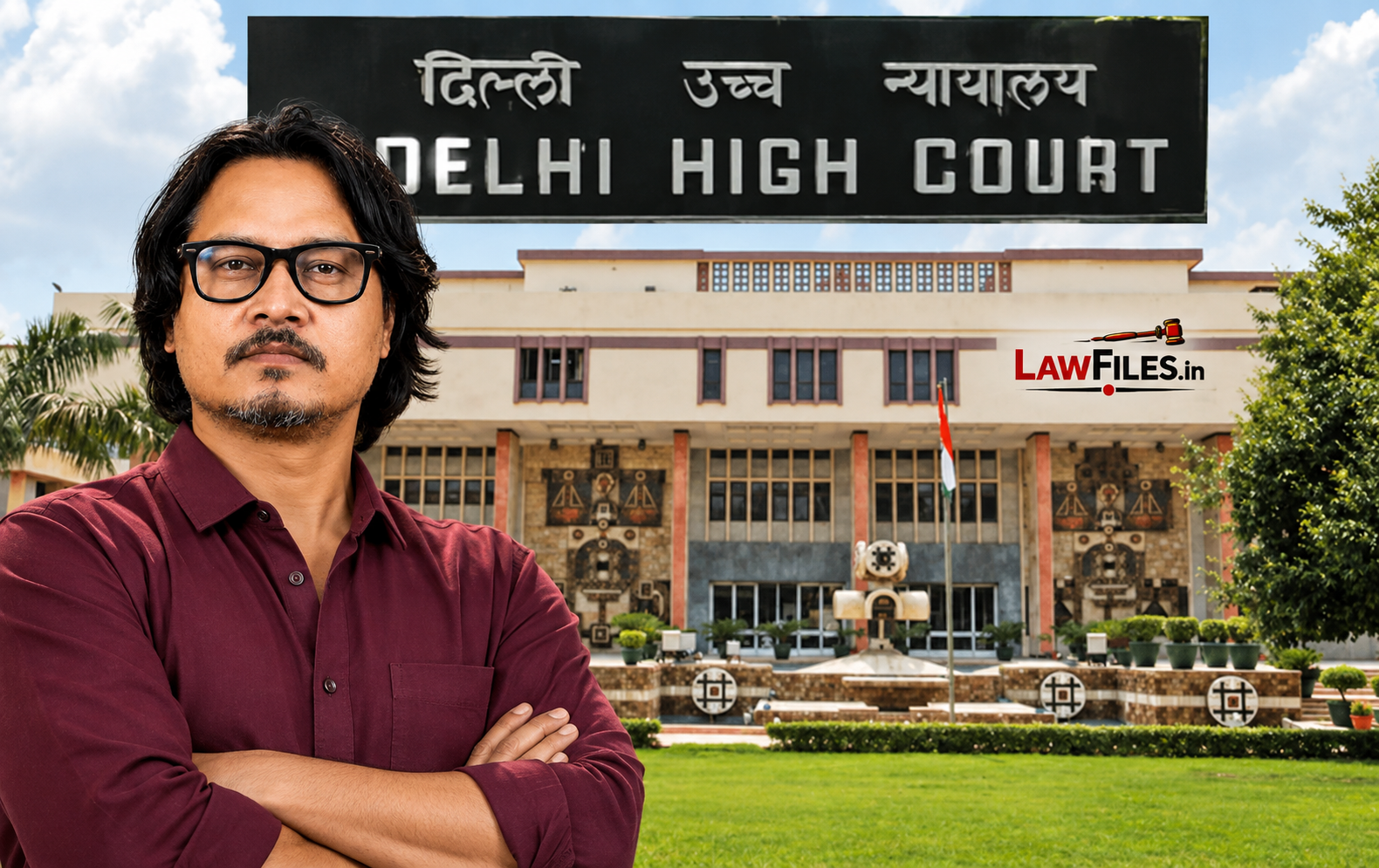
The Delhi High Court has refused to grant anticipatory bail to commentator and YouTuber Ajeet Bharti in a case arising from alleged caste-related and derogatory remarks concerning Nagina Member of Parliament Chandrashekhar Azad and members of the Scheduled Caste community. Justice Saurabh Banerjee dismissed the petition after holding that an offence under the Scheduled Castes and the Scheduled Tribes (Prevention of Atrocities) Act, 1989 was prima facie made out and that the statutory restriction on anticipatory bail consequently applied. The Court’s order presently available is limited to the bail question; a detailed order setting out the reasoning is awaited.
The decision is legally important because Section 18 of the SC/ST Act creates an exceptional departure from the ordinary framework governing anticipatory bail. Ordinarily, a person apprehending arrest may invoke Section 438 of the Code of Criminal Procedure, subject to the statutory requirements and judicial discretion. Under the SC/ST Act, however, Section 18 expressly excludes the operation of Section 438 in cases involving accusations under the special legislation. Section 18A subsequently reinforced that position by providing, among other things, that the statutory bar operates notwithstanding judicial directions and that no preliminary inquiry is required before registration of an FIR. The consequence is not that every allegation under the Act automatically defeats anticipatory bail; rather, the threshold question becomes whether the allegations, taken at their face value and tested at the limited bail stage, disclose a prima facie offence under the Act.
That distinction lies at the centre of the present case. The High Court did not merely say that an FIR contains an allegation under the SC/ST Act and therefore anticipatory bail is unavailable. The Court proceeded on the basis that an offence under the Act was prima facie disclosed. Once that threshold was crossed, the statutory bar became operative and the anticipatory-bail petition was treated as not maintainable. The legal architecture is therefore sequential: first determine whether the special statute is prima facie attracted; only thereafter does the statutory exclusion of anticipatory bail become relevant.
The FIR was registered at North Avenue Police Station in Delhi on August 23, according to reports, invoking provisions of the SC/ST Act along with Section 67 of the Information Technology Act and Sections 196(1)(c) and 351(3) of the Bharatiya Nyaya Sanhita. The complaint followed an episode of Bharti’s programme that was uploaded on his social-media and YouTube accounts on August 22. The prosecution alleges that the programme contained remarks concerning Chandrashekhar Azad, Dr B.R. Ambedkar and members of the Scheduled Caste community which were casteist, derogatory and humiliating. These remain allegations at the investigative stage and have not been adjudicated at trial.
The proceedings before the High Court had already revealed that the central legal controversy was not simply whether certain words were offensive. The Court was required to examine whether the material placed before it disclosed the statutory ingredients of the particular offences invoked under the SC/ST Act. Bharti’s counsel, Advocate Jai Anant Dehadrai, argued that Section 3(1)(r) requires an intentional insult or humiliation of a member of a Scheduled Caste or Scheduled Tribe on account of caste identity and that the impugned statements had to be examined in their complete context rather than by isolating individual expressions. Counsel also submitted that the remarks arose in the backdrop of comments allegedly made against Bharti’s sister on social media.
The Delhi Police opposed the plea and contended that the language used directly targeted a particular caste and was made on a public social-media platform rather than in a private conversation. Counsel representing the complainant also argued that the remarks were intentional and derogatory, referring to the allegedly large online audience and the repeated references to caste. These rival submissions illustrate why cases under Section 3(1)(r) cannot be decided merely by asking whether language was unpleasant or insulting in an ordinary sense. The statutory inquiry is narrower: whether the particular ingredients prescribed by Parliament are prima facie disclosed.
Section 3(1)(r) of the SC/ST Act penalises intentionally insulting or intimidating a member of a Scheduled Caste or Scheduled Tribe with intent to humiliate such person in any place within public view. Section 3(1)(s), separately, addresses intentional abuse by caste name in a place within public view. Thus, the statutory formulation contains more than a general prohibition on offensive speech. It requires attention to the identity of the person targeted, the nature and intention of the conduct, the connection with caste, and the requirement concerning public view. The precise factual application of those elements will ultimately depend upon the evidence.
The requirement of “public view” is particularly significant in the jurisprudence surrounding Sections 3(1)(r) and 3(1)(s). The Supreme Court has repeatedly treated it as a substantive ingredient rather than a decorative phrase. In recent decisions, the Court has explained that an incident occurring within a completely enclosed private space, without members of the public being present or capable of witnessing or hearing the alleged caste-based abuse, may fail to satisfy this statutory requirement. The expression is concerned with the public being capable of witnessing the act, not merely with the fact that the accused and victim happen to be outside their respective homes.
The present case has a different factual setting because the alleged remarks were made through a publicly accessible digital broadcast. That circumstance makes the question of public view substantially different from a private quarrel inside an enclosed room. Yet even in the digital environment, the statutory analysis cannot end with the fact that a video was uploaded online. The Court must still examine whether the alleged statement contains the requisite caste-related intent and whether the statutory ingredients are disclosed by the actual words, context and surrounding circumstances.
The trial court, while rejecting Bharti’s anticipatory-bail application on September 7, had taken the view that the material prima facie attracted Section 3(1)(r). According to the reported reasoning, the court considered references to caste hierarchy and marriageability, including the alleged suggestion that the concerned MP should make himself worthy of marrying an upper-caste woman, as material capable at the prima facie stage of demonstrating caste-based humiliation. The trial court also observed that the language invoked ideas of upper and lower caste hierarchy, purity and lineage.
The High Court’s subsequent proceedings indicate that it independently engaged with the context of the disputed video rather than mechanically adopting the FIR. During the September 16 hearing, Justice Saurabh Banerjee watched the impugned video and questioned the investigating agency about the investigation. The Court specifically asked why a notice had not yet been issued to Bharti and whether custodial interrogation was actually required. The police responded that the investigating officer had obtained Bharti’s address only shortly before and was then in a position to contact him.
That line of questioning is important from the perspective of anticipatory bail jurisprudence. The statutory bar under the SC/ST Act does not erase the broader principles governing arrest. Even where a person is not entitled to anticipatory bail because Section 18 applies, the investigating agency must still act within the law. A finding that anticipatory bail is statutorily barred is not equivalent to a judicial direction that arrest must necessarily follow, nor does it amount to a finding of guilt.
The Supreme Court’s Constitution Bench decision in Prathvi Raj Chauhan v. Union of India provides the governing framework. While upholding the statutory scheme concerning Sections 18 and 18A, the Court reaffirmed the earlier principle that where the complaint does not make out a prima facie offence under the SC/ST Act, the statutory bar on anticipatory bail cannot operate. The Court also explained the legislative rationale behind restricting pre-arrest protection in this category of cases, particularly against the historical vulnerability of members of Scheduled Castes and Scheduled Tribes and the possibility that unrestricted anticipatory bail could affect victims and investigations.
At the same time, Prathvi Raj Chauhan preserves an important judicial checkpoint. The special statute does not create a legal universe in which the mere invocation of its provisions becomes conclusive. Courts retain the responsibility of examining whether the basic ingredients of the alleged offence are disclosed. If they are not, Section 18 cannot be used as a complete answer to a plea for pre-arrest protection. The present Delhi High Court decision therefore turns on the Court’s prima facie conclusion that the statutory ingredients were disclosed on the material before it.
The Supreme Court’s earlier decision in Vilas Pandurang Pawar v. State of Maharashtra similarly recognised that Section 18 creates a specific restriction on anticipatory bail, but emphasised that the court must first determine whether a prima facie offence under the SC/ST Act is made out. The inquiry at this stage is deliberately limited. It is not a mini-trial and does not permit the court to undertake an exhaustive assessment of the credibility of witnesses or conduct a final evaluation of competing evidence.
This limited nature of the bail inquiry is particularly relevant where the prosecution is based upon a recorded speech or video. The complete recording, transcript, surrounding remarks, manner of delivery, intended audience and circumstances in which the statement was made may all become relevant to determining whether the statutory requirement of intentional humiliation on account of caste is ultimately established. A court deciding anticipatory bail does not ordinarily resolve these issues with the finality expected at trial.
There is consequently a significant distinction between saying that Bharti’s alleged remarks are legally actionable and saying that he has been found guilty of a caste-based offence. The High Court has made a prima facie determination for the limited purpose of deciding the availability of anticipatory bail. The prosecution must still establish the ingredients of the charged offences in accordance with the criminal standard of proof. The denial of pre-arrest bail cannot be converted into a presumption of guilt.
The case also raises an increasingly important problem in the age of digital political and social commentary: how should criminal law distinguish between harsh criticism, offensive expression and speech that crosses a specific statutory threshold of caste-based humiliation? The constitutional protection of speech under Article 19(1)(a) is broad, but it is not absolute. At the same time, restrictions on speech must remain tethered to a lawfully defined offence. Courts therefore have to resist two opposite tendencies treating every offensive statement as criminal, or treating the medium of political commentary as an automatic immunity from criminal law.
The SC/ST Act adds another layer to this balance. Its provisions were enacted against a documented history of caste-based exclusion, humiliation, violence and social discrimination. The criminal law is therefore not merely regulating etiquette in public discourse; it is addressing conduct that Parliament considered sufficiently harmful to warrant special protection. But because the statute carries serious criminal consequences, its ingredients must nevertheless be applied according to their text and settled judicial interpretation.
The present matter is also illustrative of the tension between individual liberty and the protective purpose of special penal legislation. Anticipatory bail ordinarily functions as a safeguard against unnecessary or arbitrary arrest. Section 18 represents Parliament’s judgment that this safeguard should be substantially restricted where the statutory offence is prima facie disclosed. The judicial task is therefore not to balance the two considerations afresh in every case but to determine whether the statutory threshold triggering the restriction has actually been crossed.
This is why the phrase “prima facie” carries considerable legal weight in the High Court’s order. It does not mean that the Court has finally accepted the prosecution’s narrative. It means that, for the limited purpose of deciding whether the special statutory bar applies, the material is sufficient to disclose the ingredients of the offence at the threshold. The trial court will ultimately have to consider the evidence in a much more comprehensive manner.
The procedural posture of the case also deserves attention. Bharti first sought anticipatory bail before the Patiala House Court, which rejected the plea on September 7. He thereafter approached the High Court. During the High Court proceedings, the Court questioned the investigating agency on the necessity of custodial interrogation and the absence of notice. After hearing the parties and examining the impugned material, the High Court ultimately dismissed the petition on September 24 on the ground that the statutory bar applied.
The decision therefore should not be read as establishing a general proposition that anticipatory bail can never be considered in a case involving speech on caste issues. The statutory scheme, as interpreted by the Supreme Court, makes the prima facie existence of an SC/ST Act offence the decisive threshold. Where that threshold is not crossed, the bar cannot mechanically operate. Where it is crossed, Section 18 substantially restricts the court’s power to grant pre-arrest protection.
The case also highlights the importance of context in criminalising speech. Context is not a convenient defence by itself, just as the offensiveness of a statement is not by itself the complete statutory test. The court must ask what was said, about whom, in what setting, with what apparent intent, and whether the statutory ingredients are satisfied. This contextual inquiry is especially important in social-media cases, where short clips can circulate independently of the longer discussion in which they originally appeared.
There is a further constitutional dimension. The right to freedom of speech protects robust disagreement, criticism of public figures and even expression that may be unpopular or deeply offensive, subject to constitutionally permissible restrictions. But caste-based humiliation is regulated by a specialised statutory framework with its own ingredients. The challenge for courts is therefore to ensure that the special legislation is neither diluted through an overbroad conception of protected speech nor expanded beyond its statutory boundaries merely because the language under scrutiny is socially objectionable.
The High Court’s decision presently settles only the bail stage. Since the detailed judgment has not yet been released, the precise reasoning by which Justice Banerjee concluded that Sections 3(1)(r) and 3(1)(s), or the relevant provisions invoked in the FIR, were prima facie attracted will require closer examination once the complete order becomes available. The distinction matters because a reasoned order may clarify how the Court assessed the disputed video, the requirement of intentional humiliation, public view, the caste nexus and the relevance of the surrounding context.
What can presently be understood from the proceedings is that the Court did not treat Section 18 as an automatic consequence of the FIR alone. The statutory bar was applied after a prima facie assessment that an offence under the special enactment was disclosed. That approach is consistent with the Supreme Court’s interpretation of the SC/ST Act, under which the special restriction on anticipatory bail is powerful but not detached from judicial scrutiny.
The broader significance of the case lies in the way it brings three legal concerns into the same courtroom: protection against caste-based humiliation, freedom of expression in the digital public sphere, and the individual’s protection against arrest before trial. None of these interests can be reduced to a single proposition. The SC/ST Act requires meaningful protection against caste-based offences; Article 19 protects expression subject to lawful restrictions; and criminal procedure continues to presume that guilt must be established through trial rather than inferred from accusation.
Ultimately, the Delhi High Court’s ruling should be understood as a decision on the statutory availability of anticipatory bail, not as a final judicial pronouncement on the truth or criminality of the disputed statements. The Court has found, at the threshold, that the SC/ST Act is prima facie attracted and that the statutory bar consequently prevents pre-arrest protection. The remaining questions including the precise meaning and context of the alleged remarks, the prosecution’s ability to establish the necessary intent and caste nexus, and the evidentiary value of the digital material belong to the subsequent stages of the criminal process.
The case consequently demonstrates an important feature of special criminal legislation: the real judicial safeguard does not disappear when anticipatory bail is barred; it shifts to the threshold inquiry into whether the special offence is genuinely disclosed. That threshold is where statutory language, constitutional liberty, social-protection objectives and the realities of modern digital speech intersect. The detailed reasoning of the Delhi High Court, once available, will be important in understanding how that intersection is being worked out in contemporary Indian criminal jurisprudence.
