


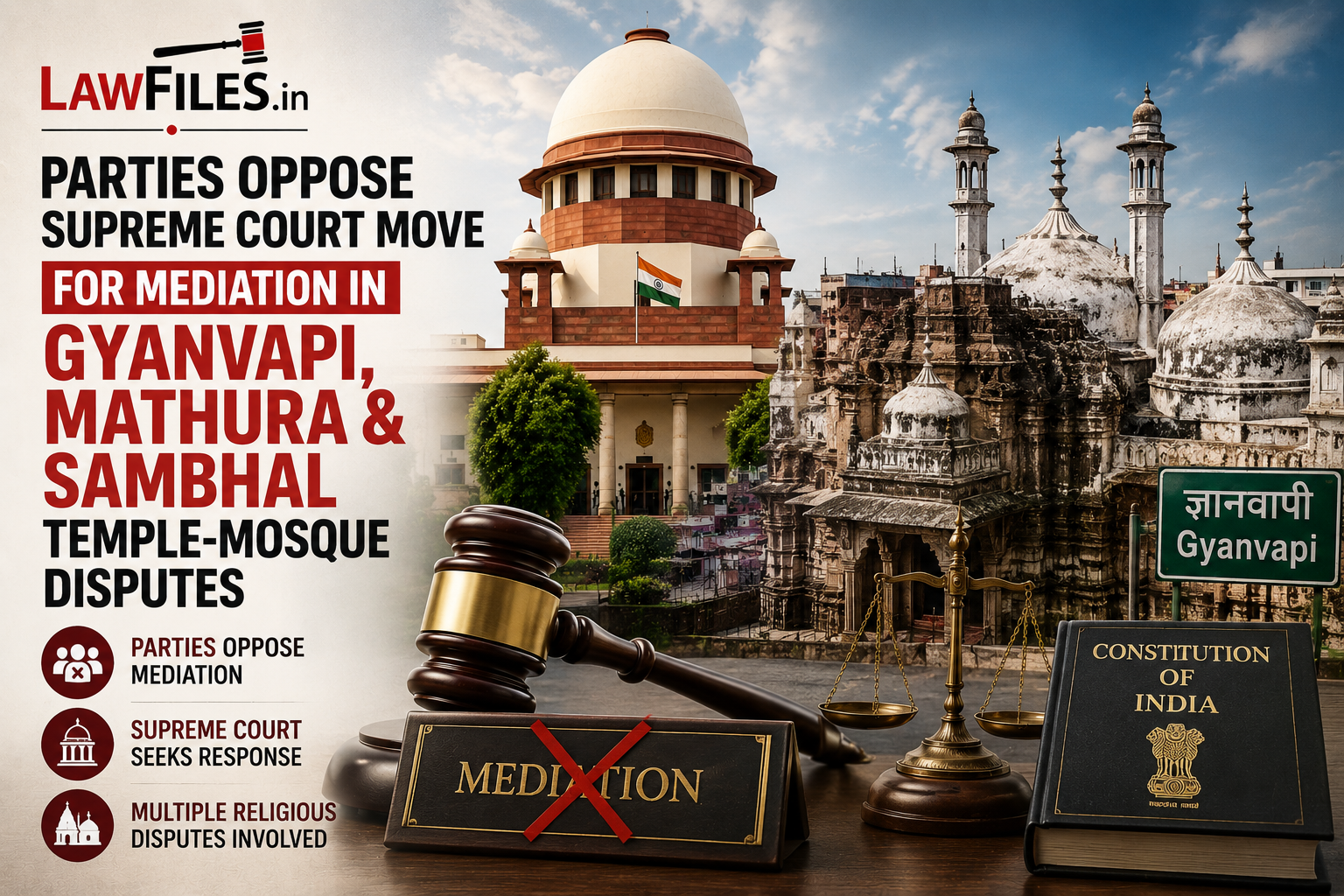
The Supreme Court’s recent attempt to explore the possibility of an amicable settlement in three of the country’s most closely watched religious site disputes the Gyanvapi Mosque-Kashi Vishwanath dispute in Varanasi, the Sri Krishna Janmabhoomi-Shahi Idgah dispute in Mathura, and the Shahi Jama Masjid dispute in Sambhal has triggered an important constitutional conversation on the limits of mediation in public law litigation. During the proceedings, the Court proposed referring the matters to the “Samadhan Samaroh”, a special Lok Adalat and mediation initiative scheduled to be held within the Supreme Court premises from 21 to 23 August, with the objective of exploring whether decades-old litigation involving competing religious claims could be resolved through dialogue rather than prolonged adjudication. However, in a development that underscores the complexity of these disputes, litigants representing both the Hindu and Muslim sides declined the proposal, expressing the view that the issues raised involve questions of title, statutory interpretation and constitutional rights which require authoritative judicial determination rather than negotiated settlement.
The proceedings did not involve adjudication on the merits of the disputes. Instead, the Bench explored whether the parties would be willing to participate in a structured mediation process before the matters continue through the ordinary course of litigation. During the hearing, the Court appears to have proceeded on the well-established judicial philosophy that consensual dispute resolution should always be explored wherever legally permissible, particularly in matters that have generated prolonged social, historical and legal contestation. Nevertheless, counsel appearing for the rival parties uniformly expressed reservations regarding mediation. According to submissions reported during the proceedings, both sides maintained that the disputes involve determination of legal rights over places of worship, interpretation of statutory provisions and questions carrying constitutional implications, making judicial adjudication the more appropriate institutional mechanism. Consequently, the proposal for mediation did not receive the consent necessary for referral under the consensual framework governing mediation proceedings.
The Court’s initiative is noteworthy because it reflects the Indian judiciary’s growing institutional preference for alternative dispute resolution (ADR) wherever possible. The Mediation Act, 2023, together with Section 89 of the Code of Civil Procedure, embodies Parliament’s recognition that consensual settlement often provides durable solutions while reducing adversarial litigation. The Supreme Court has, over the years, successfully encouraged mediation in numerous commercial, matrimonial, property and even certain public law disputes. However, the present proceedings expose an important limitation of mediation jurisprudence—its effectiveness depends fundamentally upon the willingness of all stakeholders to negotiate. Unlike adjudication, mediation cannot impose a legally binding outcome without the voluntary participation and consent of the disputing parties. The refusal by both sides therefore illustrates that while mediation remains a valuable judicial tool, it cannot replace adjudication where litigants seek definitive judicial pronouncement on questions involving constitutional rights, historical claims and statutory interpretation.
From a constitutional perspective, the reluctance of the parties is understandable given the nature of the legal questions involved. The disputes concerning Gyanvapi, Mathura and Sambhal are not confined to ordinary civil claims relating to ownership or possession. They intersect with broader issues concerning the Places of Worship (Special Provisions) Act, 1991, the extent of judicial review over historical religious claims, the maintainability of suits concerning religious structures and the constitutional guarantees of religious freedom under Articles 25 and 26. The 1991 Act was enacted with the express objective of preserving the religious character of places of worship as they existed on 15 August 1947, while expressly exempting only the Ayodhya dispute from its operation. Its constitutional validity and interpretation continue to have direct relevance to several pending religious site disputes across the country. Consequently, litigants appear to regard judicial adjudication as necessary not merely for resolving individual controversies but also for obtaining authoritative clarification on questions of constitutional and statutory interpretation.
The proceedings also revive an important debate regarding the distinction between private disputes and public disputes in mediation jurisprudence. Mediation traditionally succeeds where parties primarily seek resolution of personal or commercial interests capable of compromise. However, disputes involving constitutional identity, public religious institutions or competing claims concerning legal status often transcend individual interests. In such matters, parties frequently perceive themselves not merely as litigants but as representatives of larger communities or legal positions. This characteristic significantly reduces the scope for negotiated compromise because any settlement may be viewed as affecting rights extending beyond the immediate parties before the court. The present refusal to participate in mediation therefore reflects not merely disagreement between litigants but the structural limitations of consensual dispute resolution in cases involving questions of public importance.
Interestingly, the Supreme Court’s initiative also draws inevitable comparison with the mediation process undertaken during the Ayodhya title dispute. In M. Siddiq (D) through LRs v. Mahant Suresh Das (2019), the Supreme Court had constituted a mediation panel headed by former Justice F.M.I. Kalifulla, with spiritual leader Sri Sri Ravi Shankar and senior mediator Sriram Panchu as members. Although the mediation process did not culminate in a final settlement and the dispute ultimately required judicial adjudication, the Court nevertheless proceeded with the exercise in recognition of the possibility that consensual dialogue could reduce social friction even where complete settlement proved elusive. The present proceedings demonstrate that the Court continues to regard mediation as a valuable constitutional instrument for dispute resolution, even in cases involving profound historical and religious sensitivities. At the same time, the refusal by all parties reinforces that mediation remains an enabling process rather than a compulsory substitute for adjudication.
Another important legal implication concerns the institutional role of Lok Adalats in disputes of constitutional significance. Lok Adalats have traditionally been associated with settlement of motor accident claims, family disputes, labour matters and civil litigation involving compromise. Their success rests upon mutual consent and negotiated resolution. The proposal to include high-profile temple-mosque disputes within the framework of the Supreme Court’s Samadhan Samaroh represented an innovative attempt to expand the culture of consensual dispute resolution into areas historically characterised by prolonged adversarial litigation. Although the effort did not succeed in the present instance, it reflects the judiciary’s broader commitment to reducing litigation wherever legal and factual circumstances permit.
From a jurisprudential standpoint, the episode highlights the evolving philosophy of the Supreme Court in managing complex constitutional litigation. Modern constitutional courts increasingly recognise that their role extends beyond adjudicating rights; wherever possible, they also encourage institutional dialogue capable of preserving social harmony. Yet the present proceedings equally illustrate the constitutional limits of that philosophy. Certain disputes inevitably require judicial pronouncement because they involve interpretation of statutes, constitutional provisions or competing legal claims incapable of negotiated compromise. The refusal by both Hindu and Muslim litigants does not signify rejection of mediation as an institution; rather, it indicates their belief that the questions involved demand judicial determination through the ordinary adjudicatory process.
The developments also underscore the continuing importance of judicial neutrality in matters involving deeply contested religious claims. Notably, the Supreme Court’s proposal for mediation did not indicate any opinion on the merits of the pending disputes. Nor did the refusal by the parties affect the maintainability or substantive legal issues awaiting determination before the courts. The proceedings were confined exclusively to exploring whether consensual settlement remained possible. With mediation having been declined, the disputes will continue to be adjudicated in accordance with law through the ordinary judicial process, where questions relating to title, statutory interpretation, maintainability and constitutional validity will be examined on the basis of evidence and legal submissions.
Ultimately, the significance of the present proceedings extends well beyond the immediate outcome. They illustrate both the strength and the limits of mediation within India’s constitutional framework. The judiciary’s willingness to facilitate dialogue demonstrates an institutional commitment to peaceful resolution wherever feasible. Equally, the refusal of all parties reaffirms another constitutional principle that where disputes involve questions of public law, historical rights and statutory interpretation, litigants may legitimately seek a reasoned judicial verdict instead of negotiated compromise. In a constitutional democracy governed by the rule of law, both pathways consensual settlement and authoritative adjudication remain legitimate instruments of justice. The challenge for constitutional courts lies in identifying which mechanism best serves the interests of justice in the facts of each case, and the Supreme Court’s handling of these proceedings reflects precisely that careful institutional balance.
