


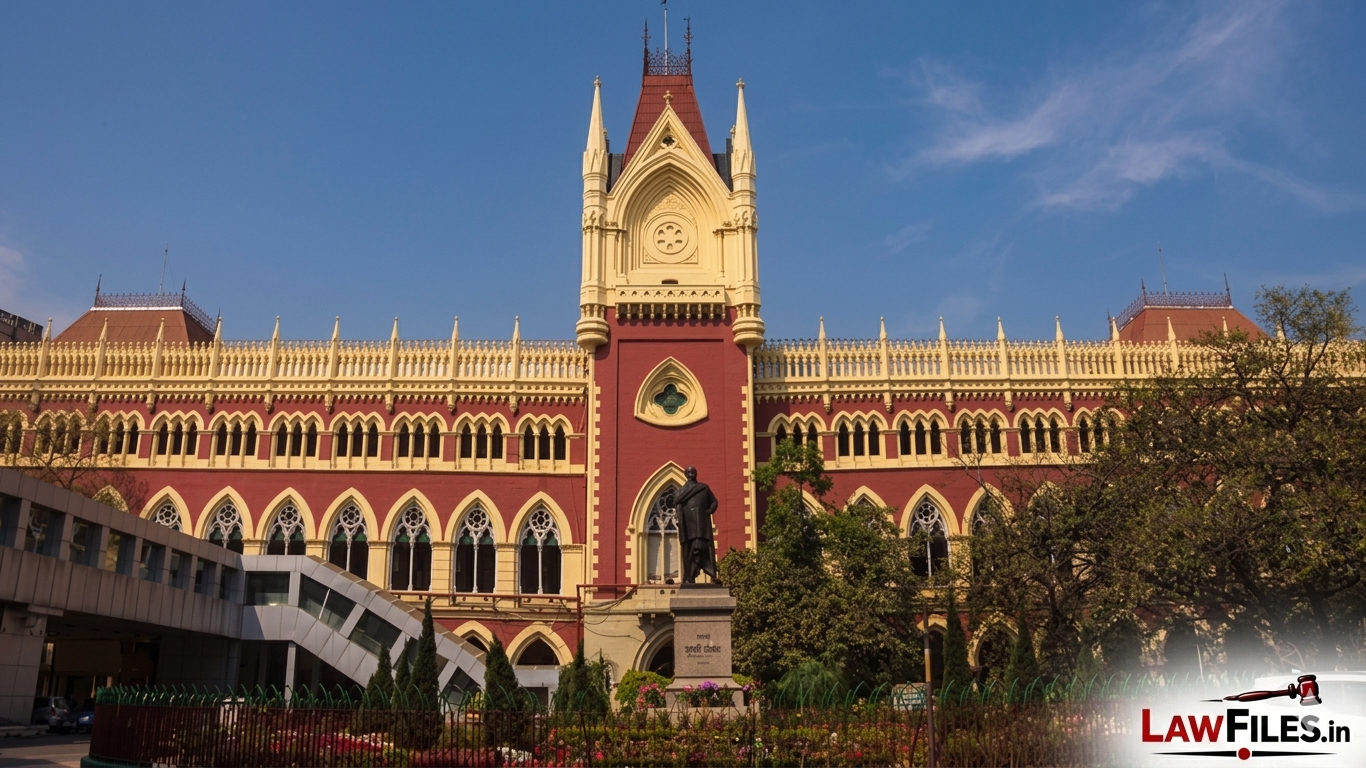
The Calcutta High Court’s recent direction seeking a response from the West Bengal Police regarding the existence of a Standard Operating Procedure (SOP) for handling social media posts targeting judges has opened a fresh constitutional debate over the limits of online free speech, judicial accountability and the growing challenge posed by digital disinformation surrounding court proceedings. In an era where judicial observations, pending cases and even individual judges increasingly become subjects of viral commentary and political contestation online, the Court’s intervention reflects rising institutional anxiety regarding the impact of unchecked digital narratives on public confidence in the justice system.
The matter came before Justice Jay Sengupta of the Calcutta High Court while hearing proceedings connected to Swami Pradiptananda, popularly known as Kartik Maharaj, a Hindu monk facing rape and intimidation allegations in a case registered at Nabagram Police Station in West Bengal. According to the prosecution, the complainant alleged that Maharaj repeatedly sexually assaulted her in 2013 after promising employment at an educational institution run under Bharat Sevashram Sangha. The allegations also included claims of forced abortion and criminal intimidation. The accused has consistently denied the charges and alleged political victimization.
During the hearing, the Court took serious note of several YouTube videos and online content allegedly making scandalous and defamatory remarks concerning judges of the Calcutta High Court in connection with the pending proceedings. The Court observed that certain videos attempted to create a false narrative suggesting that adverse judicial actions were being taken “behind closed doors” even on dates when the Bench had not assembled. Justice Sengupta recorded in the order that there were “wanton aspersions” cast upon the Bench and “defamatory and contumacious outbursts” directed not merely against the presiding judge but against judges of the High Court generally. The Court described some of the videos as “very disturbing indeed.”
Consequently, the Court directed the Director General of Police, West Bengal, to file a report clarifying whether any SOP presently exists for dealing with “grossly offensive, evidently false and contumacious” social media posts, including mechanisms for removal of such content. The Court granted four weeks for submission of the report and listed the matter for further hearing on June 22, 2026.
Although the order is presently procedural in nature, its constitutional implications are significant. The issue strikes at the heart of an increasingly difficult question confronting modern democracies: how to preserve judicial independence and institutional legitimacy without suppressing legitimate criticism and free expression in digital spaces.
Traditionally, Indian contempt jurisprudence developed in a media environment dominated by newspapers and broadcast television, where dissemination of potentially prejudicial or scandalous material could be more easily identified and regulated. Social media, however, has fundamentally altered that landscape. Today, judicial proceedings are instantly fragmented into clips, memes, opinion threads and algorithm-driven narratives capable of reaching millions within hours. This transformation has complicated the judiciary’s ability to distinguish between fair criticism, political commentary, misinformation and deliberate attempts to undermine institutional authority.
The Calcutta High Court’s concern appears rooted not merely in criticism of judicial functioning, but in allegations of deliberate falsehoods and fabricated narratives concerning ongoing proceedings. This distinction is legally crucial. Indian constitutional law protects criticism of courts and judicial reasoning under Article 19(1)(a), subject to reasonable restrictions including contempt of court. The Supreme Court has repeatedly recognised that fair criticism of judgments does not amount to contempt. However, courts have also maintained that deliberate attempts to scandalise the judiciary or interfere with administration of justice may justify contempt proceedings.
The present controversy therefore revives the long-standing constitutional tension between free speech and judicial dignity. On one side lies the principle that courts, as public institutions exercising sovereign power, must remain open to scrutiny and criticism. On the other lies the argument that systematic misinformation campaigns against judges can erode public confidence in the justice delivery system itself.
Importantly, the Court’s direction seeking an SOP from the police suggests a possible institutional shift from case-by-case contempt proceedings toward administrative regulation and coordinated digital response mechanisms. This raises several legal questions. Would such an SOP involve criminal prosecution, platform takedown requests, cyber monitoring or preventive surveillance? How would authorities distinguish between defamatory attacks and constitutionally protected criticism? Would political speech concerning judicial proceedings risk overregulation under vague standards such as “offensive” or “contumacious” content?
These concerns are not merely theoretical. Indian courts and police authorities have increasingly confronted controversies involving online commentary directed against judges, judicial orders and ongoing investigations. The judiciary’s growing engagement with digital speech regulation reflects a broader global trend where courts are struggling to adapt traditional contempt doctrines to decentralised online communication ecosystems.
The Calcutta High Court’s order also emerges against a politically sensitive background. West Bengal has witnessed repeated institutional confrontations involving courts, investigative agencies, political actors and media narratives. Judicial proceedings in politically charged matters frequently generate competing digital campaigns aimed at influencing public perception. In such environments, courts appear increasingly concerned about coordinated online narratives capable of affecting witness confidence, judicial credibility or the integrity of proceedings themselves.
At the same time, civil liberties advocates may view any move toward formalised policing of social media criticism with caution. India’s legal history already contains contentious experiences involving broad restrictions on online speech, including the now-struck down Section 66A of the Information Technology Act. The Supreme Court in Shreya Singhal v. Union of India strongly warned against vague and overbroad standards capable of chilling legitimate expression. Consequently, any SOP targeting social media commentary on courts would likely face constitutional scrutiny regarding proportionality, precision and safeguards against misuse.
The issue becomes even more complicated because public engagement with judicial proceedings has expanded dramatically in recent years. Live reporting, social media commentary and digital legal journalism have made courts more publicly visible than ever before. Judges today operate within an environment where every oral observation can rapidly become viral political content. This phenomenon has transformed not only public understanding of law but also the institutional vulnerability of courts to online amplification and narrative manipulation.
Another important aspect of the case concerns the distinction between criticism of judgments and attacks on individual judges. Democratic constitutional systems generally tolerate strong criticism of judicial decisions while treating direct intimidation, fabricated allegations or orchestrated personal vilification campaigns differently. The Calcutta High Court’s observations suggest concern that the online material crossed from criticism into targeted institutional delegitimisation.
The Court’s demand for an SOP also reflects broader anxieties regarding technological asymmetry. Judicial institutions remain structurally slow-moving and procedure-bound, whereas misinformation on digital platforms spreads instantly through decentralised networks. Courts therefore increasingly face pressure to evolve new mechanisms capable of responding to viral falsehoods without compromising constitutional liberties.
Interestingly, the order does not presently direct coercive action or immediate censorship. Instead, the Court has sought institutional clarification from the police regarding whether any framework exists at all for handling such situations. This indicates judicial recognition that existing enforcement mechanisms may be fragmented, inconsistent or legally inadequate in addressing digital attacks on judicial institutions.
The controversy additionally raises jurisprudential questions concerning whether contempt law itself remains suitable for regulating online ecosystems. Traditional contempt proceedings were designed around identifiable publications and deliberate interference with judicial administration. Social media environments involving anonymous accounts, algorithmic amplification and transnational platforms complicate both attribution and enforcement.
Ultimately, the Calcutta High Court’s intervention reflects a judiciary increasingly aware that threats to institutional legitimacy no longer emerge solely from political branches or direct defiance of judicial orders. In the digital age, sustained online campaigns, manipulated narratives and viral misinformation may also shape public confidence in courts and judicial processes.
Yet the constitutional challenge lies in ensuring that protection of judicial dignity does not gradually transform into insulation from criticism. Democracies require both an independent judiciary and a robust culture of public scrutiny. The real legal question therefore is not whether judges may be criticised online, but how constitutional systems distinguish legitimate democratic criticism from organised attempts to undermine administration of justice through deliberate falsehoods and targeted institutional attacks.
The Calcutta High Court proceedings may therefore evolve into an important test case in India’s developing digital constitutional jurisprudence one that could shape the future relationship between judicial authority, free speech and online accountability in the country’s rapidly transforming public sphere.
