


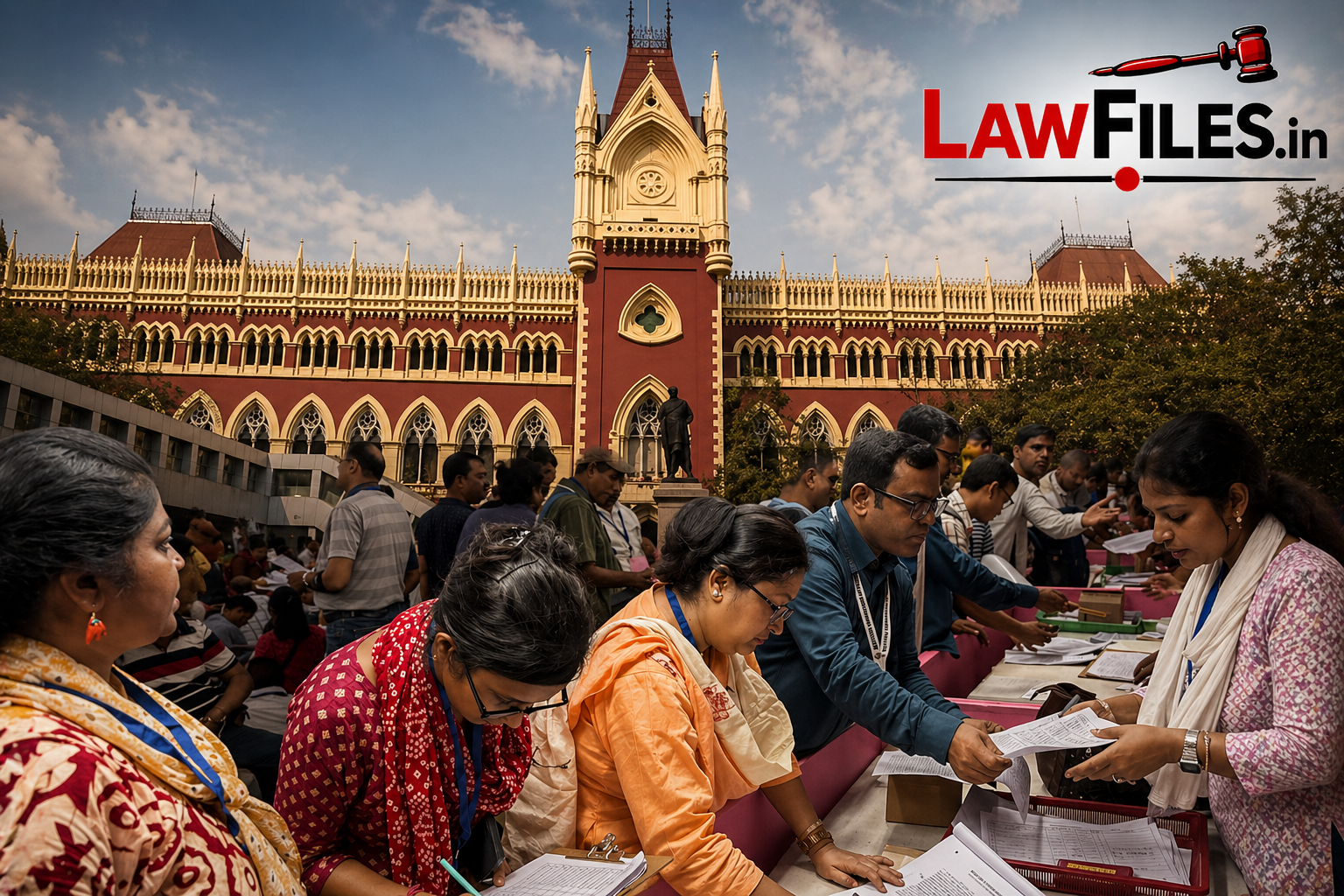
The Calcutta High Court has once again found itself at the centre of electoral governance debates, as it heard a challenge to the deployment of only central government and public sector undertaking (PSU) employees as counting supervisors in the ongoing West Bengal Assembly elections, 2026. The controversy, though administrative in appearance, raises deeper constitutional questions about electoral neutrality, federal balance, and institutional trust in the conduct of elections.
The plea before the Court challenges a recent directive issued by the Chief Electoral Officer mandating that at least one counting supervisor at each table must be drawn exclusively from central government or PSU personnel. Petitioners have argued that such a policy results in the systematic exclusion of state government employees, thereby potentially distorting the representative balance in the counting process. At its core, the petition frames the issue not merely as procedural irregularity, but as a structural deviation from principles of fairness and inclusivity in election administration.
During the hearing, the Court underscored a foundational principle governing electoral jurisprudence the presumption of bona fides in favour of the Election Commission of India. This presumption, rooted in Article 324 of the Constitution, acknowledges the Commission’s wide discretionary powers in ensuring free and fair elections. By invoking this principle, the Court signalled judicial restraint, emphasising that interference with election processes must be exercised sparingly and only upon clear demonstration of arbitrariness or mala fides.
However, the Court’s approach also reveals a subtle balancing act. While affirming institutional trust in the Election Commission, it did not summarily dismiss the concerns raised. Instead, the proceedings indicate a willingness to scrutinise whether such exclusivity in staffing decisions can withstand constitutional scrutiny—particularly under Articles 14 and 21, which guard against arbitrariness and ensure procedural fairness.
The timing of the litigation is equally significant. The West Bengal Assembly elections, conducted in two phases on April 23 and April 29, 2026, are at a critical juncture, with counting poised to determine the electoral outcome. Courts have traditionally exercised caution in intervening during active election cycles, wary of disrupting administrative continuity. Yet, as past precedents from the same High Court demonstrate—ranging from restrictions on preventive detention to modifications of Election Commission directives—the judiciary has not hesitated to intervene where fundamental rights or procedural integrity are at stake.
From a constitutional perspective, the controversy raises an important doctrinal question: does the centralisation of election personnel enhance neutrality, or does it risk undermining the federal character of India’s electoral framework? Proponents of the Commission’s approach argue that reliance on central staff ensures independence from local political pressures, particularly in states with a history of electoral violence. Critics, however, contend that such exclusivity may create an impression of over-centralisation, potentially eroding the participatory role of state machinery in elections.
The case also reflects a broader judicial trend in election-related litigation. The Calcutta High Court, in recent weeks, has actively engaged with multiple facets of election governance from deployment of personnel to restrictions on administrative powers often walking a fine line between deference and intervention. This evolving jurisprudence suggests that courts are increasingly willing to interrogate the procedural dimensions of electoral fairness, even while respecting the constitutional autonomy of the Election Commission.
Critically analysed, the present proceedings highlight the limits of the “presumption of bona fides” doctrine. While it serves as a necessary safeguard against excessive judicial interference, it cannot operate as an absolute shield insulating administrative decisions from scrutiny. Where a policy appears to create structural exclusion such as the complete sidelining of a class of public servants the Court may be compelled to examine whether such exclusion is justified by compelling administrative necessity.
Ultimately, the outcome of this case may not hinge on a binary determination of legality, but on the Court’s ability to reconcile competing constitutional values: institutional autonomy of the Election Commission, principles of federal balance, and the overarching mandate of free and fair elections. In doing so, the Calcutta High Court’s ruling is likely to contribute meaningfully to the evolving jurisprudence on electoral governance in India.
As the electoral process reaches its decisive stage, this litigation underscores a larger truth free and fair elections are not merely a function of outcomes, but of the processes that produce them. The Court’s engagement with the issue of counting supervisors thus goes beyond administrative detail, touching upon the very architecture of democratic legitimacy.
