


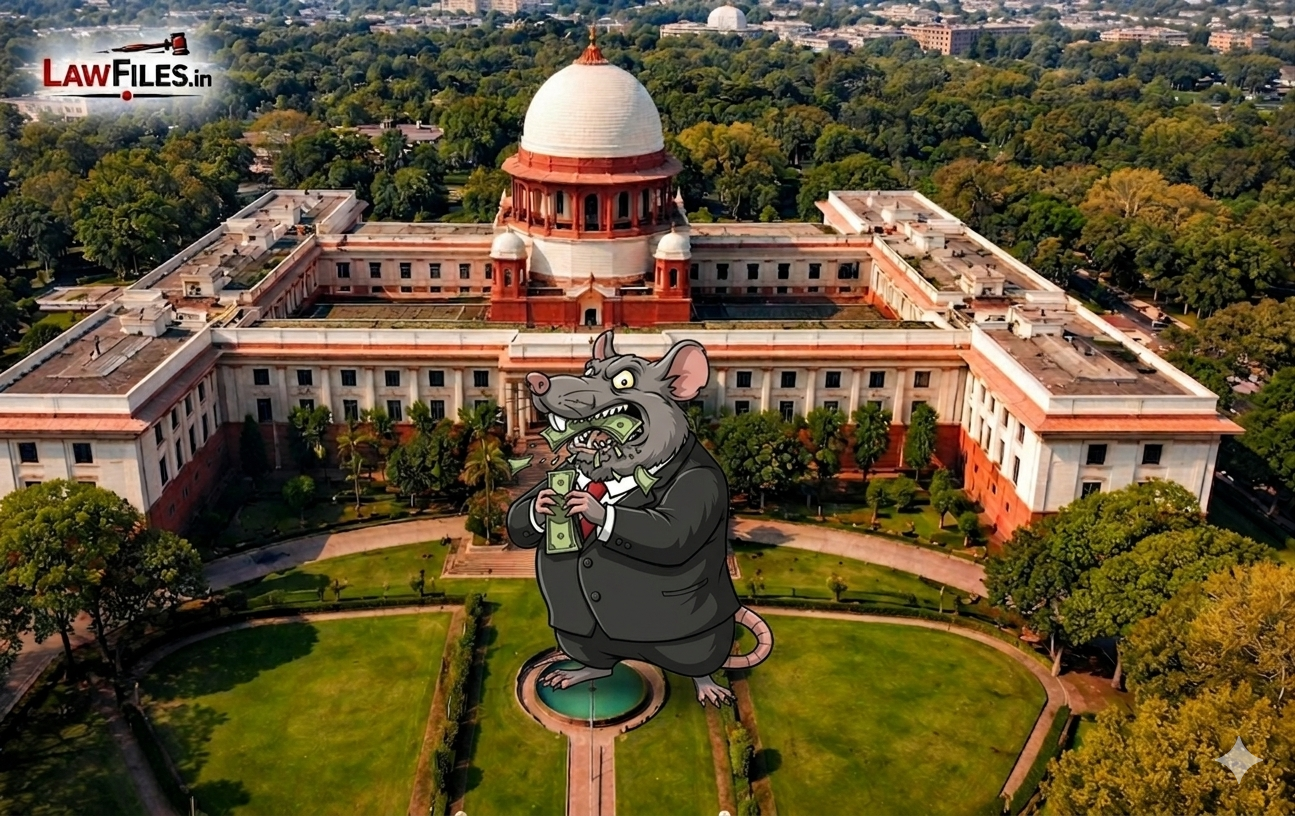
In a striking case that underscores both the fragility of evidence handling and the complexities of corruption prosecutions, the Supreme Court of India granted bail to a woman convicted under the Prevention of Corruption Act, 1988, while expressing serious concern over an unusual factual claim recorded by the High Court that seized bribe money in the case had allegedly been destroyed by rodents.
The matter came before a Bench comprising Justices J.B. Pardiwala and K.V. Viswanathan, which suspended the sentence of the convicted woman pending appeal. While granting relief, the Court did not merely focus on the individual circumstances of the accused but highlighted a deeper systemic issue: the handling and preservation of crucial material evidence in corruption cases. The Bench expressed surprise at the explanation that currency notes central to the prosecution’s case had been destroyed by rats, remarking that such a situation pointed to a serious institutional lapse.
At one level, the explanation borders on the improbable; at another, it reveals a troubling reality. What often appears in popular culture as an exaggerated defence where incriminating material mysteriously disappears has, in this instance, found mention in judicial records themselves. The transition of such narratives from fiction to courtrooms raises uncomfortable questions about the credibility of custodial mechanisms and evidentiary discipline.
At the doctrinal level, the case brings into focus the evidentiary framework under corruption law. Offences under the Prevention of Corruption Act are typically built on proof of demand, acceptance, and recovery of illegal gratification. The recovery of tainted currency often plays a pivotal role in corroborating the prosecution’s case. Where such evidence is compromised, the integrity of the prosecution itself may come into question.
Analytically, the case highlights a critical tension between conviction based on procedural compliance and conviction grounded in evidentiary certainty. The disappearance or destruction of primary physical evidence particularly without a credible and verifiable explanation undermines the evidentiary chain and introduces reasonable doubt into the prosecution’s narrative.
The Court’s decision to grant bail must also be viewed in light of appellate principles. Suspension of sentence pending appeal reflects a judicial assessment that continued incarceration may not be justified where serious questions arise regarding evidentiary integrity. In such circumstances, courts are compelled to ensure that conviction does not rest on a compromised foundation.
Beyond the immediate facts, the case raises broader institutional concerns. The alleged destruction of seized currency by rodents points to deficiencies in evidence storage, chain of custody, and accountability. When physical evidence becomes vulnerable to such lapses, the problem is not merely factual it is systemic.
From a policy perspective, the incident underscores the need for modernisation of evidence management systems. Secure storage, digital documentation, and strict audit trails are no longer optional they are essential safeguards. Without them, even strong cases risk erosion, not because the offence did not occur, but because the system failed to preserve proof of it.
In conclusion, the Supreme Court’s observations transform what might appear as an unusual factual claim into a deeper commentary on the state of criminal justice administration. The case serves as a reminder that in corruption prosecutions, the strength of the law is only as good as the integrity of its evidence. When that foundation weakens, even the most serious allegations risk being reduced to uncertainty blurring the line between accountability and doubt.
