


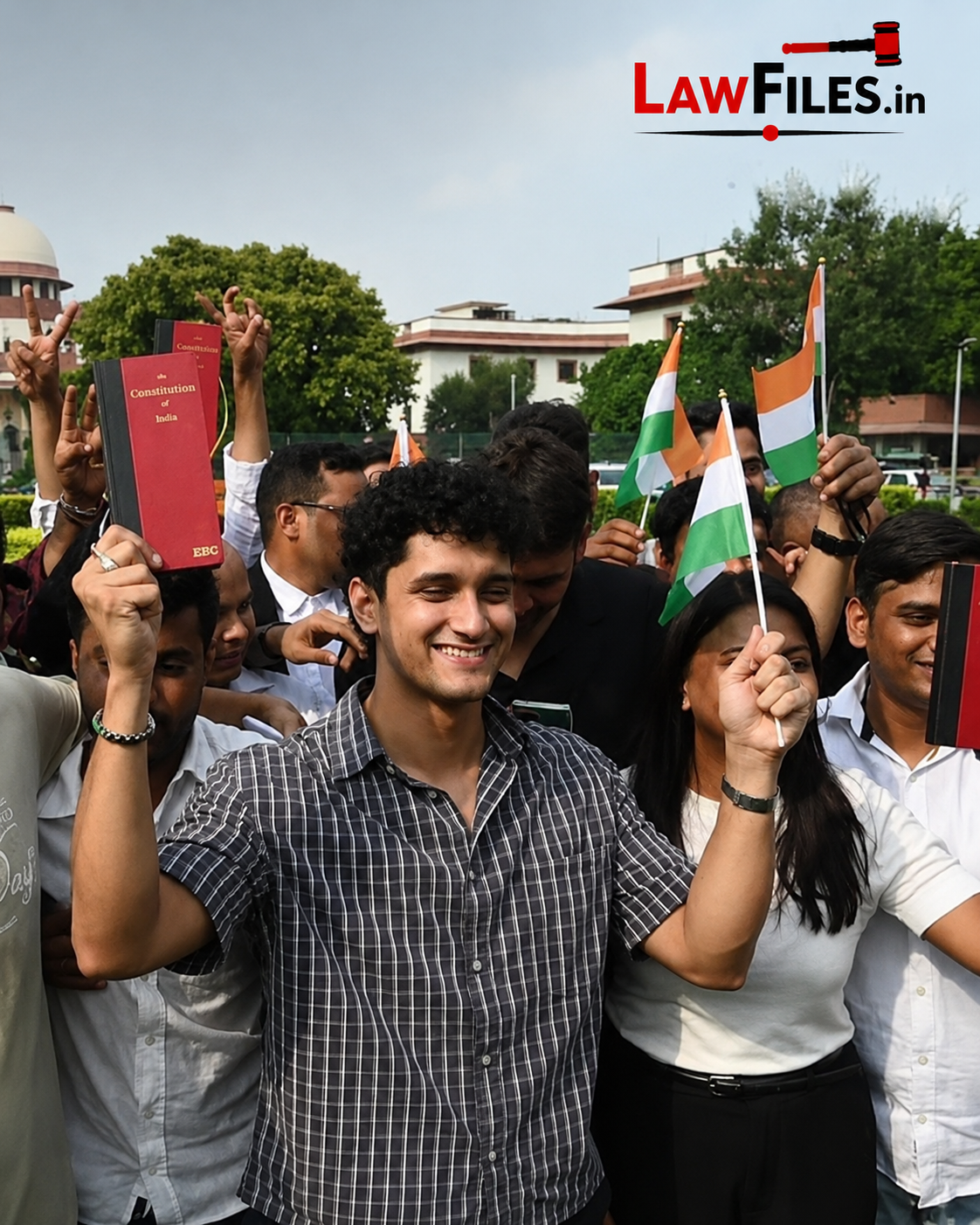
The Supreme Court has brought a significant legal conclusion to the criminal proceedings arising from the student protests held across the country between July 20 and July 25, directing that the FIRs registered in connection with those protests shall not be pursued or investigated and shall be treated as closed for all purposes. Going beyond the FIRs specifically placed before it by the Centre and the States of Bihar, West Bengal, Maharashtra and Assam, the Court extended the protective direction across all States and Union Territories. The Bench comprising Chief Justice of India Surya Kant, Justice Joymalya Bagchi and Justice V. Mohana invoked the Court’s extraordinary jurisdiction under Article 142 of the Constitution, expressly taking into account the future of students who had participated in the protests bona fide.
The proceedings arose against the backdrop of a nationwide student mobilisation concerning allegations surrounding the NEET-UG 2026 examination and broader grievances relating to examination irregularities and the education system. Students had participated in demonstrations in several parts of the country, including a march towards Parliament in Delhi. The protests subsequently generated a second legal controversy concerning police action, detention of protesters and the registration of criminal cases. What began as a dispute over examination administration therefore developed into a constitutional question concerning the relationship between peaceful protest, police powers and the criminal justice system.
The Supreme Court had already entered the controversy at an earlier stage when petitions were presented alleging excessive police force against students and other participants. Those proceedings were not confined to the question of whether particular protesters had committed offences. They also raised concerns regarding the manner in which demonstrations were handled by law-enforcement agencies. The Court had emphasised that peaceful and lawful protest enjoys constitutional protection and that the mere existence of an agitation cannot, by itself, justify excessive police action. It had also directed preservation of CCTV footage, drone recordings, body-worn camera footage, wireless communications and PCR records relating to the protests.
That earlier intervention is important to understanding the present order. The Court was dealing with two competing narratives. On one side were allegations that students had been subjected to excessive force and that criminal proceedings were being used against persons who had participated in protests. On the other were concerns regarding violence, injuries to police personnel, destruction of property and the possibility that persons with serious criminal backgrounds had entered or exploited the demonstrations. The Supreme Court’s approach was therefore not to assume that every protester was innocent of every allegation, but to distinguish bona fide student protesters from individuals against whom genuinely serious criminal allegations existed.
During the proceedings, the Solicitor General of India, Tushar Mehta, informed the Bench that the Centre had approached the Court in accordance with assurances given to representatives of the protesting organisation on July 25. The States of Bihar, West Bengal, Maharashtra and Assam subsequently filed similar applications. Collectively, the applications sought judicial closure of the FIRs arising from the protests and assurances that the same incidents would not generate fresh criminal cases.
The governmental position was significant because ordinarily an FIR, once registered, does not simply disappear because the executive authority changes its mind about pursuing the case. Investigation may have to be concluded through a closure report, and the jurisdictional Magistrate may independently consider whether such a report should be accepted. The procedural difficulty of withdrawing FIRs therefore became one of the reasons why the matter was brought before the Supreme Court for an appropriate constitutional solution.
The Court’s eventual reliance upon Article 142 is consequently central to the judgment. Article 142 empowers the Supreme Court to make orders necessary for doing complete justice in any cause or matter pending before it. The provision has repeatedly been understood as conferring an extraordinary remedial power intended to ensure that procedural limitations do not prevent the Court from fashioning an effective remedy in exceptional circumstances. At the same time, Article 142 is not a licence to disregard substantive law at will. Its exercise must remain connected with the constitutional objective of achieving justice in the case before the Court.
The present matter provides a particularly striking illustration of that principle. Instead of directing each State to initiate separate closure proceedings before the respective Magistrates, the Supreme Court exercised its constitutional authority to bring the litigation to an end comprehensively. The Court was conscious that the FIRs had been registered in different jurisdictions, yet the underlying factual context was substantially common—the student protests conducted during the specified period. A fragmented approach could therefore have resulted in students receiving different treatment depending upon the State in which an FIR happened to be registered.
The nationwide character of the order is one of its most consequential features. The Centre and four States had placed specific FIRs before the Supreme Court, but the Bench extended the benefit to similar cases throughout the country. The Court directed that FIRs concerning the student protests between July 20 and July 25 in any State or Union Territory should not be pursued or investigated and should be treated as closed for all purposes. It further directed that no State or Union Territory should register a fresh FIR concerning the incidents covered by the order.
The reasoning reflects an important constitutional consideration: the legal consequences of participation in a protest should not become an indefinite burden upon students when the State itself has chosen to withdraw the cases. An FIR may have consequences extending beyond the immediate criminal investigation. Even where a prosecution ultimately fails, the existence of a criminal case can affect educational opportunities, employment prospects, travel, professional licensing and the social standing of a young person. The Court’s reference to the future of the students therefore carries significance beyond the immediate question of criminal liability.
This aspect of the order demonstrates an understanding of what may be described as the “collateral consequences” of criminal proceedings. The criminal process is not merely a pathway to conviction or acquittal. Registration of an FIR can itself impose burdens on individuals, particularly young students who may have limited resources to contest prolonged proceedings. A case that technically remains pending for years can operate as a practical penalty even before a court determines guilt.
The Court’s intervention must nevertheless be distinguished from a declaration that all conduct during the protests was lawful. Article 19(1)(a) protects freedom of speech and expression, while Article 19(1)(b) guarantees the right to assemble peaceably and without arms. Both rights are expressly subject to reasonable restrictions under Articles 19(2) and 19(3), including restrictions imposed in the interests of public order. Consequently, the Constitution protects peaceful protest but does not immunise violence, destruction of property or other independently criminal conduct.
That distinction explains the Court’s treatment of the group of 2,873 persons identified by the Delhi Police as having serious criminal antecedents. The Supreme Court permitted the Delhi Police to pursue a separate FIR concerning these individuals in relation to allegations of bodily harm and destruction of property, subject to the limitations recorded by the Court. The exception was therefore not based simply upon the fact that these persons had participated in the protests; it arose from the State’s assertion that they had grave criminal antecedents and that serious offences required separate consideration.
The exception is constitutionally important because it prevents the order from being understood as an unconditional amnesty for every person present at every protest. The Supreme Court has drawn a line between participation in a student agitation and the commission of serious criminal offences. The constitutional right to protest protects the former; it does not extinguish the State’s power to investigate the latter.
The earlier hearings had already reflected this distinction. The Solicitor General had informed the Court that while the government was willing to support the withdrawal of cases against ordinary student protesters, persons accused of grave offences such as murder, rape or abduction could not simply be treated in the same category. The Court’s final directions preserve this underlying distinction while providing broad relief to the student protesters whose participation was not accompanied by serious criminal conduct.
The judgment is therefore best understood not as judicial endorsement of a particular political movement but as an exercise in constitutional classification. The Court was required to determine whether criminal law should continue operating against a broad group of protesters when the government itself had decided that the cases should be withdrawn. The answer was that, subject to the specified serious-criminal-conduct exception, continuing the cases would not serve the interests of justice.
The Court’s approach also has implications for the doctrine of prosecutorial discretion. Ordinarily, the executive authorities have substantial control over investigation and prosecution, but that discretion operates within the framework of criminal procedure and constitutional guarantees. Once the government itself approaches the Supreme Court seeking to withdraw cases, the question becomes whether the Court should facilitate that decision in a manner that produces finality. Article 142 provided the mechanism through which that could be achieved.
There is an important distinction here between the government asking for withdrawal and the Supreme Court independently ordering mass quashing. The State’s applications demonstrated that the executive had already reconsidered its position and sought closure. The Court’s role was to determine how that assurance could be translated into an effective legal outcome without leaving individual students to pursue separate proceedings across multiple jurisdictions.
The Court’s intervention also addresses the problem of uniformity of constitutional protection. If one State withdrew an FIR while another insisted upon continuing an identical case arising from the same protest, similarly situated students could face materially different legal consequences merely because of geography. By extending the order nationally, the Supreme Court attempted to avoid that arbitrary variation.
This nationwide direction is particularly notable because criminal investigation ordinarily falls within the domain of State authorities. Police powers are primarily exercised under the statutory framework applicable within each jurisdiction, and constitutional courts generally exercise restraint before interfering with ongoing investigations. The present order represents an exceptional intervention justified by the unusual combination of circumstances: common protest events, government assurances, multiple applications, the potential impact upon students and the need for a comprehensive resolution.
The decision therefore should not automatically be read as establishing that the Supreme Court can routinely quash criminal cases across State boundaries whenever public protests generate controversy. Article 142 is an extraordinary power, and the factual circumstances that prompted its exercise are central to the decision. The Court was dealing with a coordinated set of proceedings arising from a defined period of protest and an express governmental decision to discontinue them.
The constitutional importance of the ruling nevertheless extends beyond its immediate facts. India’s democratic structure assumes that citizens may express disagreement with governmental policy. Student protests occupy a particularly important position because universities have historically functioned as spaces for political discussion, dissent and civic engagement. The legal system must therefore distinguish between legitimate democratic participation and conduct that genuinely threatens public order or causes criminal harm.
The Court’s earlier observations regarding police action reinforce this constitutional principle. During the initial proceedings, the Chief Justice had indicated that peaceful agitation is protected by the Constitution and that the mere fact that a demonstration is taking place cannot justify a lathi-charge or excessive force. The Court had also emphasised the need for uniformity in police protocols for dealing with demonstrations.
This is an important judicial message because the policing of protests inevitably involves a delicate balance. Police authorities have a legitimate responsibility to prevent violence, protect public property and maintain public order. Protesters, meanwhile, have a constitutional right to assemble and express dissent. Excessive restrictions can chill legitimate participation, while insufficient policing can expose participants, bystanders and police officers to serious harm. The appropriate constitutional standard therefore lies neither in automatic deference to police action nor in treating every police intervention as unlawful.
The Court’s preservation of digital evidence during the earlier stage of proceedings is also noteworthy. Directions concerning CCTV footage, drone recordings, body cameras, wireless communications and PCR logs demonstrate a modern understanding of accountability in crowd-control operations. In contemporary protests, the factual record is no longer limited to witness testimony. Multiple digital sources can establish how a demonstration developed, whether force was used and whether particular individuals were involved in violence.
The Court also directed authorities not to place personal information and digital data of protesters in the public domain. That direction reflects an increasingly important constitutional concern: the right to protest should not become a gateway to permanent digital profiling. The preservation of evidence for judicial purposes and the public dissemination of personal data are fundamentally different things. The former may be necessary for accountability; the latter may expose students to reputational or professional consequences far beyond the original protest.
The Court’s latest order therefore completes a constitutional trajectory that began with concern over police conduct and ultimately resulted in the closure of criminal cases against bona fide protesters. The two developments should be understood together. The judiciary first sought to preserve evidence and prevent coercive consequences while examining allegations of excessive force. It has now ensured that the criminal cases arising from the protests do not continue indefinitely against students whom the government itself has chosen not to prosecute.
The role of the protesting organisation, identified in the proceedings as the Cockroach Janata Party, is also relevant to understanding the eventual settlement. The organisation had announced a fresh protest march in Delhi for September 5, citing alleged failure by the government to honour earlier commitments concerning the withdrawal of FIRs and compensation for families of students who had died by suicide following the cancellation of the NEET-UG examination. The proposed demonstration was to proceed towards the New Delhi Police Headquarters.
Following the Supreme Court’s order and the government’s assurances, spokesperson Saurav Das informed the Bench that the proposed September 5 march was being withdrawn. The statement was presented as a response to the legal finality provided by the Court’s directions and the steps taken by the government.
This development illustrates how constitutional litigation can sometimes perform a stabilising function in periods of public confrontation. The Court did not simply adjudicate an abstract dispute about FIRs. By converting the government’s assurances into enforceable judicial directions, it created a framework within which the protesters could withdraw their proposed further agitation and the State could demonstrate compliance through a legally supervised process.
The exchange also demonstrates the value of negotiated constitutional governance. The Solicitor General told the Bench that the Centre and the protesting organisation had engaged constructively and that the government’s applications were intended to honour commitments made during earlier discussions. The Court’s intervention transformed those political assurances into formal legal consequences.
However, the Court’s order concerning the FIRs should not obscure the underlying educational controversy that generated the protests. Criminal proceedings may have been closed, but questions concerning examination administration, allegations of irregularities, student distress and institutional accountability remain matters of public policy. The withdrawal of criminal cases resolves one legal consequence of the agitation; it does not itself determine whether the students’ substantive grievances were justified.
Similarly, the quashing of FIRs does not amount to a judicial finding that the police allegations were false in every instance. The order is directed towards the legal closure of the specified protest-related cases. Questions concerning individual incidents of police excess, injuries to protesters or police personnel and other disputed events may require separate treatment where they fall outside the scope of the Court’s final directions.
The ruling also offers a caution against the overuse of criminal law as an administrative response to public demonstrations. Registration of criminal cases can be justified where there is evidence of genuine criminal conduct. But if every act of protest that inconveniences the administration automatically results in FIRs, the criminal process can have a chilling effect on democratic participation. Students may reasonably refrain from lawful dissent if they believe that participation itself could generate a criminal record.
At the same time, a constitutional democracy cannot treat protest as an unlimited entitlement. Public demonstrations must remain subject to reasonable regulation, particularly where public safety is at stake. The Court’s exception for individuals with serious criminal antecedents and its preservation of the State’s ability to investigate specified serious conduct show that the judgment does not adopt an absolutist theory of protest rights.
The deeper constitutional principle is therefore one of proportionality. The State may regulate demonstrations; it may investigate violence; it may prosecute genuine criminal offences. But the legal response must correspond to the nature of the conduct. A peaceful student carrying a placard and a person accused of serious violence cannot be placed in the same legal category merely because both happened to be present at the same demonstration.
The order also reinforces the importance of Article 14 in administrative responses to protests. Equal treatment requires that similarly situated persons be treated alike while permitting rational distinctions based on relevant differences. The Court’s distinction between bona fide student protesters and persons with grave criminal antecedents illustrates this principle. The former category receives broad protection because the purpose of the proceedings no longer justifies their continuation; the latter remains subject to investigation because the alleged conduct presents a materially different legal concern.
The nationwide nature of the relief also reduces the possibility of selective enforcement. Where the government has decided to abandon prosecution arising from a particular category of protest incidents, allowing identical FIRs to survive in another State could produce arbitrary outcomes. The Court’s decision seeks to ensure that the legal consequences are determined by the nature of the incident rather than the accident of jurisdiction.
From a criminal-procedure perspective, the case also highlights the distinction between an FIR and proof of guilt. Registration of an FIR is only the initiation of the investigative process; it is not a finding that an offence has been committed by a particular accused. Conversely, quashing an FIR does not necessarily amount to a judicial finding that no wrongdoing occurred. The Court’s order operates at the level of the criminal process, bringing the specified cases to an end through constitutional power.
The invocation of Article 142 nevertheless deserves careful doctrinal attention. Extraordinary constitutional powers are most legitimate when ordinary procedural mechanisms are inadequate to produce a just and workable outcome. Here, the Court was specifically informed that conventional withdrawal of the FIRs would involve closure reports and possible judicial scrutiny before Magistrates. Requiring thousands of students and multiple State authorities to pursue fragmented proceedings could have defeated the government’s own commitment and prolonged uncertainty. Article 142 supplied a means of achieving finality.
The judgment therefore illustrates one of the most practical uses of Article 142: resolving procedural complexity where a single comprehensive order is necessary to do complete justice. But the extraordinary nature of the power remains important. Its use should not become a substitute for ordinary statutory procedures in routine cases.
The Supreme Court’s intervention also has implications for the future relationship between governments and protest movements. Government assurances made during negotiations with protesters may carry little practical value if they cannot be translated into legally enforceable commitments. By placing the assurances on the judicial record and passing a binding order, the Court has demonstrated how institutional mediation can provide credibility to negotiated settlements.
The decision also shows that judicial intervention can protect the State as much as protesters. Once the Court formally closes the specified FIRs and bars new cases concerning the same incidents, government authorities receive clarity regarding the extent of their obligations. The protesters, correspondingly, receive legal certainty that the same incidents will not continue generating criminal proceedings.
The resulting withdrawal of the September 5 march illustrates the practical value of that certainty. The protesters have obtained the principal relief concerning the FIRs, while the government has received closure of the immediate confrontation and the opportunity to implement its commitments without another round of litigation and protest.
There remains, however, a broader institutional lesson concerning student grievances. Criminal law should not become the primary language through which governments respond to educational dissent. Examination disputes, allegations of irregularities and demands for accountability are ordinarily matters that should be addressed through transparent administrative processes, independent inquiries and appropriate judicial review. Criminal prosecution should remain reserved for conduct that genuinely satisfies the ingredients of criminal offences.
Equally, student organisations must recognise that constitutional protection carries responsibilities. Peaceful assembly and expression do not authorise violence, destruction or intimidation. The credibility of a protest movement depends upon maintaining a clear distinction between legitimate dissent and unlawful conduct. The Supreme Court’s exception for persons facing allegations of serious criminality reflects this boundary.
The present order thus occupies a nuanced position within constitutional protest jurisprudence. It does not establish that every student protest is immune from criminal law. Nor does it hold that police authorities can never register FIRs during demonstrations. Instead, it responds to a specific national episode in which the government itself sought withdrawal of the cases and the Court found that comprehensive relief was necessary to protect students’ futures and achieve complete justice.
Ultimately, the Supreme Court’s decision is significant because it treats the right to protest and the consequences of criminal process as connected constitutional concerns. By invoking Article 142, the Court has brought the specified FIRs to a final end, extended relief beyond the States that formally approached it and prohibited fresh FIRs concerning the same protest incidents. At the same time, it has preserved a narrow but important exception for persons against whom serious criminal antecedents and allegations of grave offences justify separate investigation.
The broader constitutional message is that democratic dissent cannot be allowed to acquire a criminal afterlife merely because a protest became politically inconvenient. At the same time, constitutional protection of dissent cannot become a shield for serious criminal conduct. The Supreme Court has attempted to draw that line by protecting bona fide student protesters while retaining the State’s ability to pursue genuinely serious offences. The decision ultimately places proportionality at the centre of the relationship between protest and criminal law: peaceful dissent must remain protected, genuine violence must remain answerable to law, and the machinery of criminal justice should never be allowed to impose a continuing penalty upon young citizens merely for having participated in constitutionally protected democratic expression.
