


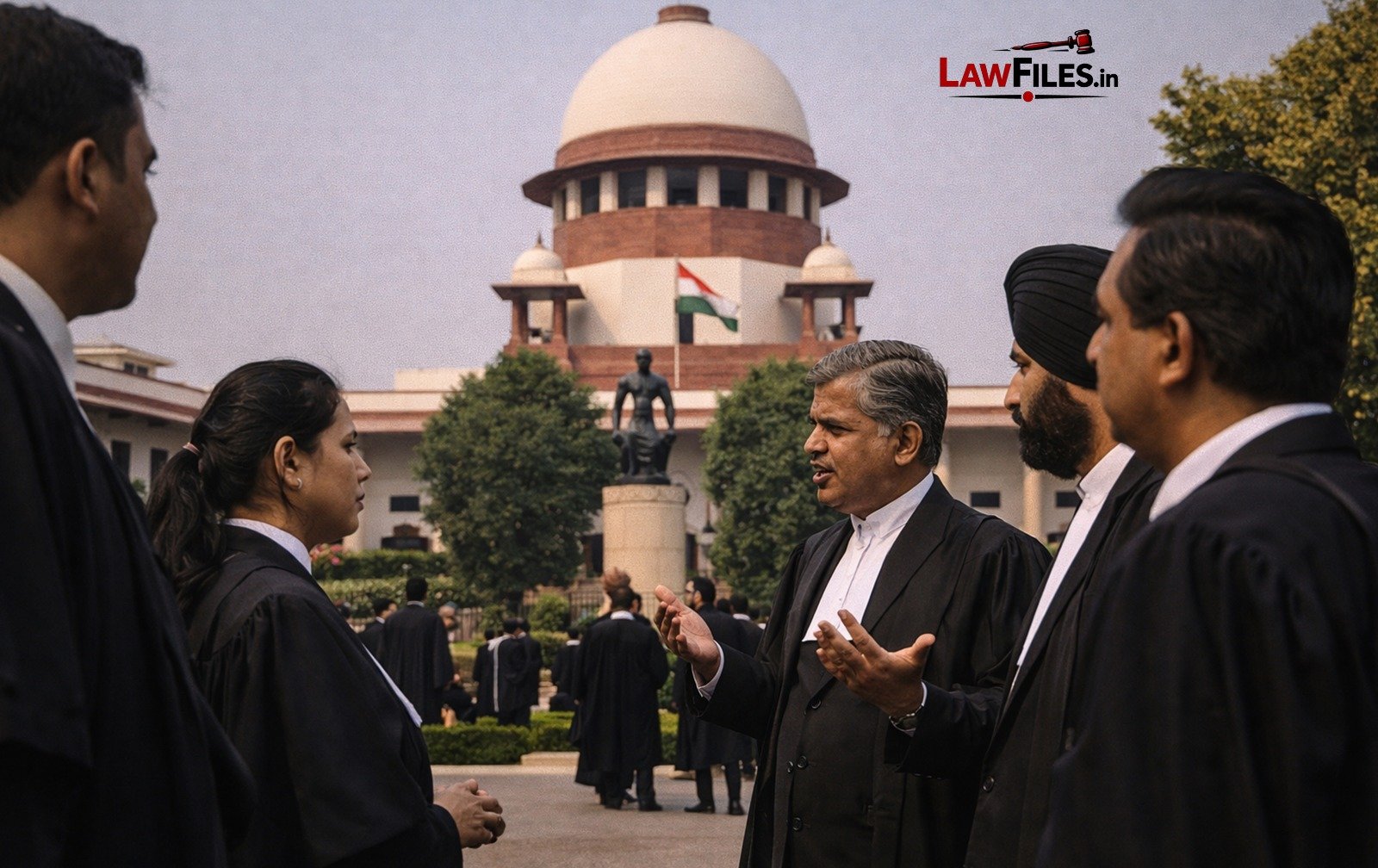
The Supreme Court has substantially altered the immediate operation of its controversial three-year practice requirement for entry-level judicial service, allowing law graduates to apply for Civil Judge (Junior Division) examinations notified between May 20, 2025 and March 31, 2027, notwithstanding the absence of three years of prior practice at the Bar. The Bench comprising Chief Justice of India Surya Kant, Justice Augustine George Masih and Justice K. Vinod Chandran, who delivered a dissenting opinion, has fashioned a transitional arrangement under which candidates applying during this limited period will be deemed to have completed one year of active practice. Those selected will thereafter undergo one year of intensive training and one year of structured law clerkship, with the Court treating these two years of institutional exposure as equivalent to the remaining two years of practice. The order therefore does not simply abandon the Court’s 2025 insistence that practical exposure is necessary for judicial service; rather, it attempts to reconcile that principle with the disruption caused to thousands of law graduates who had prepared for judicial examinations under a regime in which fresh graduates were eligible.
The significance of the ruling becomes clearer when the controversy is traced back to the Supreme Court’s judgment of May 20, 2025 in All India Judges Association v. Union of India. In that decision, the Court restored the requirement that candidates seeking direct recruitment to the post of Civil Judge (Junior Division) must possess at least three years of practice as an advocate. The Court had departed from the position adopted in 2002, when the practice requirement for entry-level judicial service had been removed following consideration of the recommendations of the Shetty Commission and concerns about the difficulties faced by fresh law graduates seeking judicial appointment. The 2025 judgment represented a major shift in the philosophy of recruitment: the Supreme Court reasoned that judicial officers entering the trial judiciary should have meaningful exposure to the functioning of courts, litigants, advocates, briefs, evidence and courtroom procedure before assuming adjudicatory responsibility.
The May 2025 judgment was nevertheless accompanied by a significant institutional difficulty. The three-year requirement was restored after more than two decades during which generations of law students had planned their careers on the assumption that they could directly compete for judicial service examinations after completing their law degrees. The Court had directed that the restored requirement would apply to future recruitment processes, and it also provided that the practice period would ordinarily be calculated from provisional enrolment with the State Bar Council. Experience gained as a law clerk was also recognised for the purpose of calculating the required period, while selected Civil Judge candidates were directed to undergo at least one year of training before presiding over courts.
The subsequent litigation demonstrated that the controversy was not merely about whether practical experience is desirable for a judge. It concerned the consequences of changing an eligibility condition after an entire generation of candidates had structured their educational and professional choices around the previous regime. Review petitions and connected proceedings brought before the Supreme Court argued that the sudden restoration of the requirement could exclude candidates who had already invested years in legal education and judicial-examination preparation. Some petitioners questioned whether three years of Bar practice was supported by sufficient empirical material, while others proposed alternative mechanisms such as structured training, judicial clerkships and supervised practical exposure. The Court’s March 2026 proceedings reflected this debate, with the Bench considering whether the objective of practical training could be achieved through a less disruptive model rather than through an inflexible three-year pre-entry barrier.
The present ruling is consequently best understood as a response to a transitional problem created by the Court’s own earlier intervention. The Bench recognised that the sudden restoration of the practice requirement had caused hardship to graduates who had planned their professional lives under the earlier regime. The Court’s reasoning is significant because it does not reject the underlying proposition that judicial officers require practical exposure. Instead, it acknowledges that the legitimate institutional objective of producing competent trial judges must be balanced against fairness to candidates who could not reasonably have anticipated that a new eligibility condition would be imposed after they had entered law school and prepared for competitive examinations under a different framework. This is why the Court has chosen a transitional mechanism rather than simply returning to the pre-2025 position.
The central direction is that all law graduates will remain eligible to apply for Civil Judge (Junior Division) recruitment notifications falling within the specified transitional window, even if they do not possess three years of prior practice. The Court has, however, not treated fresh graduates as entirely equivalent to candidates who already possess practical experience. Instead, candidates selected under these recruitments will initially enter service as Trainee Judicial Officers and will undergo one year of intensive training at the relevant State Judicial Academy followed by one year of structured clerkship. The clerkship itself is divided between six months under the supervision of a Principal District Judge, District and Sessions Judge or member of the Higher Judicial Service and six months under a sitting judge of the concerned High Court.
The architecture of this arrangement reveals the Court’s underlying philosophy. The concern expressed in 2025 was not simply that fresh graduates lack theoretical knowledge. A law degree provides that knowledge. The concern was that judicial decision-making involves practical dimensions that cannot be completely acquired through textbooks or examinations. A Civil Judge must deal with litigants, understand courtroom dynamics, manage proceedings, appreciate evidence, distinguish relevant from irrelevant submissions, draft orders, interact with the Bar and maintain judicial temperament. The new transitional scheme seeks to acquire precisely this practical competence, but through supervised institutional exposure rather than requiring every candidate to spend three years independently practising at the Bar before becoming eligible to compete.
The treatment of the two years of training and clerkship as equivalent to two years of Bar practice is therefore one of the most important features of the ruling. It implicitly recognises that the objective behind the practice requirement is practical competence rather than the mere passage of time on a Bar Council register. This distinction deserves serious attention. A lawyer may technically remain enrolled for three years without receiving meaningful exposure to trials, evidence or substantive arguments, particularly in the early years of practice. Conversely, a structured judicial clerkship under experienced judges may expose a candidate to hundreds of orders, pleadings, evidence records and courtroom proceedings in a concentrated and supervised manner. The Court’s new framework therefore moves the debate away from the crude question of how many years a person has been enrolled and towards the more meaningful question of what kind of professional exposure actually develops judicial competence.
That point also exposes one of the principal weaknesses of an inflexible practice-duration requirement. “Three years of practice” can mean very different things for different candidates. A young advocate working under a senior counsel in a busy trial court may receive extensive exposure to evidence and arguments, while another candidate may spend the same period primarily drafting or performing administrative work. First-generation lawyers, particularly those without established professional networks, may struggle financially during the initial years of practice and may have limited access to independent matters. Consequently, the number of years spent at the Bar is not necessarily a perfect proxy for the quality or depth of practical experience acquired during that period.
This concern had emerged during the review proceedings, where several stakeholders questioned whether the three-year rule had sufficient empirical justification. Suggestions placed before the Court included extending judicial training, recognising alternative forms of legal experience and creating structured pathways through clerkships and supervised professional work. Some law universities argued that the rigid requirement could disproportionately affect economically weaker candidates, women and candidates from institutions where structured clinical legal education already provides significant practical exposure. Others, including several High Courts and legal institutions, defended the requirement as an essential threshold for judicial competence and institutional credibility. The divergence of views demonstrates that the dispute was never simply a contest between fresh graduates and experienced lawyers; it concerned competing conceptions of how judicial maturity should be acquired and measured.
The views placed before the Court by different High Courts are particularly revealing. Several High Courts supported retaining a uniform three-year requirement, arguing that the entry-level judicial officer exercises substantial authority over civil rights, criminal liability, property and personal liberty and therefore should possess meaningful practical understanding of court procedure and professional ethics. The Allahabad High Court, for instance, indicated that it had amended its rules in compliance with the 2025 judgment and was conducting its first recruitment process under the new framework, while the Delhi High Court’s Rules Committee favoured uniformity and expressed concern that exemptions for particular categories could generate competing claims for relaxation. These positions demonstrate that the Supreme Court was not dealing with a rule that the subordinate judiciary uniformly regarded as unnecessary. There was substantial institutional support for the proposition that some practical experience should precede judicial appointment.
At the same time, the submissions from law schools and other stakeholders revealed the other side of the equation. Some argued that a rigid three-year requirement assumes that time spent at the Bar automatically translates into competence, whereas the quality of early legal practice can vary dramatically depending upon economic circumstances, location, mentoring opportunities and access to meaningful litigation. Suggestions were made for structured apprenticeships, paid legal training, judicial residencies and enhanced clinical education. Some proposals specifically suggested that law clerkships and supervised legal work should be treated as valid alternatives because they may provide more direct exposure to legal reasoning than years of nominal enrolment. The Court’s transitional model appears to incorporate part of this reasoning by formally converting judicial training and clerkship into recognised practical experience.
The ruling is also significant because it preserves the eventual one-year actual practice requirement after the transitional period. For recruitment notifications issued on or after April 1, 2027, candidates will need to possess at least one year of actual practice before appearing for the Civil Judge (Junior Division) examination. The Court has therefore moved away from the abrupt three-year threshold that generated the present controversy while retaining the underlying proposition that entry-level judicial candidates should not necessarily come directly from law school without any exposure to professional legal work. The selected candidates will still undergo one year of training and one year of clerkship, meaning that the system ultimately seeks to combine a modest period of actual Bar exposure with substantial supervised judicial experience.
This represents a substantial recalibration of the 2025 position. The earlier judgment treated three years of practice as an essential precondition to appearing for the examination. The present arrangement, at least for future recruitment after April 2027, reduces the actual pre-examination requirement to one year and shifts a considerable portion of the practical-experience burden into structured post-selection training. In institutional terms, that may be a more rational model because the State has greater ability to ensure the quality of supervised training than it has to control the quality of every candidate’s private practice at the Bar.
The Court’s approach also raises an important question concerning separation of powers. The rules governing judicial service recruitment ordinarily fall within the constitutional and statutory framework involving High Courts and State Governments. The Supreme Court’s directions in All India Judges Association have historically shaped judicial-service conditions across the country, particularly where institutional standards and uniformity are considered necessary. Yet prescribing detailed recruitment requirements and training structures inevitably brings the Court close to the domain of administrative rule-making. The present judgment appears to address this concern by grounding the intervention in the need to resolve a transitional situation while leaving the States and High Courts responsible for implementing the recruitment and training architecture.
The dissent of Justice K. Vinod Chandran is therefore constitutionally important even though the majority’s directions will govern. A dissent in a case involving judicial recruitment highlights the fact that the Court was not confronting a purely mechanical eligibility issue. The underlying question involves competing institutional judgments about what makes a competent trial judge and how much professional experience should be required before a person is entrusted with judicial power. The majority has chosen flexibility and transitional accommodation, whereas the dissent demonstrates that the issue admits of a serious alternative view. The existence of that disagreement strengthens the case for future policy to be based on empirical evaluation rather than assumptions about the relationship between years of practice and judicial competence.
The decision also has a direct equality dimension under Articles 14 and 16. The sudden restoration of an eligibility condition can have very different effects depending upon when a candidate entered law school, when the candidate graduated and whether the candidate had already committed to judicial-service preparation. A person graduating immediately before the 2025 judgment and a person entering law school after the judgment were not similarly situated in terms of reasonable expectations. The transitional window can therefore be understood as an attempt to prevent an abrupt regulatory change from disproportionately excluding candidates who had made career decisions under the previous framework. The Court has not declared the three-year rule itself unconstitutional; instead, it has recognised that fairness may require a transitional arrangement when a long-standing eligibility regime is substantially altered.
The treatment of candidates during the transitional period is also carefully structured. The Court has deemed them to have completed one year of active practice for purposes of their applications, and they need not produce a separate certificate of practice for that deemed period. This is practically important because requiring a candidate who has not actually practised to produce a practice certificate would create an obvious contradiction. The deeming mechanism therefore operates only for the purpose of eligibility during the transitional window. It should not be misunderstood as a declaration that the candidate has actually practised law for one year. The subsequent training and clerkship are what provide the practical experience that the Court considers necessary.
There is also a broader lesson here about judicial recruitment examinations themselves. Competitive examinations are designed primarily to assess knowledge, analytical ability and suitability under controlled conditions. They cannot perfectly measure courtroom temperament, interpersonal judgment, practical procedure or the ability to manage live litigation. The 2025 judgment attempted to solve that problem by requiring prior practice. The present ruling suggests a different possibility: rather than expecting the Bar to serve as an unstructured training ground for future judges, judicial institutions can themselves create a rigorous professional formation programme after selection. If properly implemented, such a model may provide more consistent training than relying upon the highly variable experience available to young advocates across different courts.
However, the success of the new framework will depend heavily upon implementation. A one-year judicial academy programme and one-year clerkship must be substantive rather than ceremonial. If the objective is to replace part of the practical value of three years at the Bar, trainees must receive meaningful exposure to trial proceedings, evidence, pleadings, interlocutory applications, case management, judgment writing and ethical responsibilities. They must observe actual courtroom functioning and be evaluated on their ability to translate legal knowledge into adjudicatory reasoning. The quality of the programme will therefore determine whether the Court’s compromise succeeds or merely shifts the practical-experience requirement from before selection to after selection.
The framework could also help address another longstanding concern within the subordinate judiciary: the transition from examination hall to courtroom. A fresh law graduate may perform exceptionally well in a written examination but still be unfamiliar with the institutional realities of adjudication. A structured trainee period can bridge that gap without forcing candidates to spend several financially difficult years attempting to establish themselves at the Bar before they even know whether they will enter judicial service. For economically disadvantaged candidates, this may be particularly significant because the traditional Bar route can be financially unsustainable during the initial years. A paid or adequately supported training structure could make judicial recruitment more genuinely accessible while preserving competence standards.
The broader professional implications for young lawyers are equally important. The Supreme Court’s 2025 judgment had created a significant shift in the career pathway for law graduates who aspired to the judiciary immediately after law school. The present transitional ruling gives those candidates additional breathing space until March 2027, but it also signals that the profession should prepare for a permanent system in which some actual Bar exposure will be expected before judicial recruitment. Candidates who intend to appear after April 2027 should therefore understand that the transitional relaxation is not a permanent return to the pre-May 2025 system. The Court has preserved the principle of practical exposure while changing the mechanism through which that exposure is acquired.
The decision may ultimately prove more consequential for the future architecture of judicial recruitment than the immediate relaxation itself. It recognises that “experience” should not be treated as a purely numerical concept and that professional competence can be developed through structured institutional pathways. At the same time, it retains the Court’s central concern that judges exercising trial jurisdiction should not enter the judiciary without meaningful understanding of the legal profession and courtroom processes. The challenge now shifts from constitutional adjudication to implementation: High Courts, State Governments and Judicial Academies must translate this framework into credible training programmes and recruitment rules.
The Supreme Court’s latest ruling in Bhumika Trust v. Union of India therefore represents a significant attempt to reconcile two competing ideas of judicial competence. The first treats practice at the Bar as indispensable because a judge must understand the profession from which advocates and litigants approach the court. The second recognises that the passage of three years on the Bar does not necessarily guarantee meaningful experience and that a rigid rule can unfairly exclude candidates who planned their careers under a different legal regime. By allowing law graduates to compete during the transitional period, deeming one year of practice for eligibility, and replacing the remaining experiential requirement with two years of structured judicial training and clerkship, the Court has attempted to preserve the objective without insisting upon the original form. The broader significance of the ruling lies in this shift from duration to quality of experience. If the new training model is implemented rigorously, it could offer a more coherent route into the subordinate judiciary one in which legal education, limited professional practice and supervised judicial formation operate together rather than treating the mere passage of time at the Bar as the sole measure of readiness to judge.
