


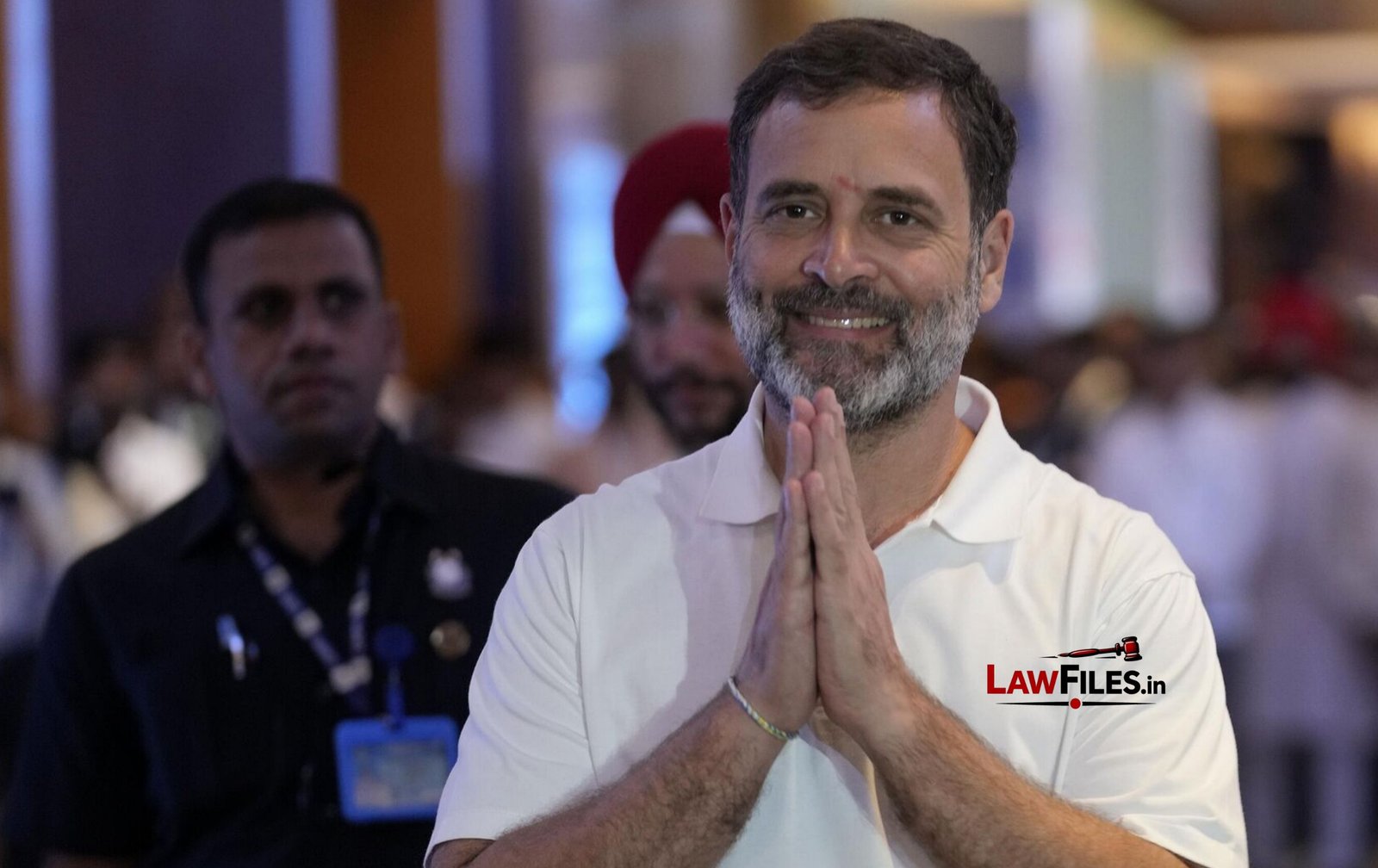
The Supreme Court has intervened in proceedings before the Allahabad High Court concerning allegations of disproportionate assets against Leader of Opposition in the Lok Sabha Rahul Gandhi, asking the High Court not to proceed further with the matter for the time being. The proceedings arise from a petition filed by Karnataka-based BJP worker S. Vignesh Shishir, who has sought investigation into allegations that Rahul Gandhi possesses assets disproportionate to his known sources of income. Gandhi approached the Supreme Court challenging the manner in which the proceedings had progressed before the Allahabad High Court, particularly questioning the fairness of the process and the directions issued in his absence. The intervention of the apex court is significant because the case sits at the intersection of criminal investigation, constitutional writ jurisdiction, political accountability and the procedural safeguards that must accompany allegations carrying serious reputational consequences.
The controversy has developed through a series of proceedings before the Lucknow Bench of the Allahabad High Court. The petition was instituted by Shishir, who sought an investigation by central agencies into allegations concerning Gandhi’s assets. The High Court, while considering the petition at the preliminary stage, called for responses from the Central Bureau of Investigation and the Enforcement Directorate and directed the agencies to apprise it of the progress concerning the complaint. The Court also brought other governmental authorities into the proceedings, including departments dealing with personnel, revenue and corporate affairs, in view of the nature of the allegations placed before it. The material submitted by the petitioner was directed to be preserved in sealed cover, reflecting the sensitive nature of the allegations and documents relied upon in support of the plea.
The initial order of the High Court did not itself amount to a finding that Rahul Gandhi had accumulated illegal wealth or that the allegations against him had been established. That distinction is fundamental. At the preliminary stage of a complaint, a direction to an investigative agency to examine allegations is legally different from a judicial determination that the allegations are true. Yet the practical consequences of such an order can be substantial, particularly when the person against whom allegations are made is a prominent political leader and the proceedings concern alleged financial wrongdoing. The Supreme Court’s intervention therefore brings procedural fairness into sharp focus.
The matter assumed greater significance after the Allahabad High Court considered the responses filed by the agencies. On July 20, the Court expressed dissatisfaction with the CBI’s affidavit, observing that it did not adequately explain the progress made on the complaint and directing a more detailed response from a senior officer of the agency. The Court also directed the Enforcement Directorate to proceed in accordance with law if, during its examination, it noticed any illegality or misconduct warranting further action. The proceedings were then kept pending for further consideration.
Rahul Gandhi subsequently moved the Supreme Court challenging the High Court proceedings and seeking transfer of the matter from the Allahabad High Court. His challenge raised concerns not merely about the allegations themselves but about the manner in which the proceedings had been conducted and whether the continuation of the case before the same Bench could inspire sufficient confidence in the fairness of the process. The petition invoked the Supreme Court’s power to transfer proceedings where such intervention is necessary to secure the ends of justice and preserve confidence in the administration of justice.
The Supreme Court’s decision to intervene at this stage is important because transfer jurisdiction is not ordinarily exercised merely because a litigant is dissatisfied with an interim order. A party cannot ordinarily seek transfer simply because the proceedings are moving in an unfavourable direction. There must be circumstances that justify the conclusion that continuing the matter before the existing forum may undermine the fairness or integrity of the proceedings. The principle is that justice must not only be done but must also appear to be done, particularly where questions concerning institutional impartiality are raised.
The controversy consequently raises a fundamental issue concerning the right to a fair judicial process before a politically sensitive investigation is permitted to advance. The constitutional courts possess wide powers under Articles 226 and 32, but those powers are accompanied by an obligation to ensure procedural fairness. When allegations of serious financial wrongdoing are brought before a court against a political figure, the court must be particularly careful to distinguish between determining whether a complaint deserves consideration and effectively giving it judicial legitimacy before the person accused has been afforded an adequate opportunity to respond.
This distinction becomes especially important in proceedings under Article 226. The writ jurisdiction of a High Court is extraordinarily wide and can be exercised for enforcement of fundamental rights as well as for other legal purposes. Courts have, in appropriate cases, directed investigations where statutory authorities have failed to act, particularly when allegations concern serious offences or public institutions. But the existence of writ jurisdiction does not eliminate the requirement that the court exercise that jurisdiction within settled principles of fairness, reasonableness and judicial restraint.
The Supreme Court has repeatedly recognised that a High Court can direct an investigation in appropriate circumstances, including by specialised agencies, but such power must be exercised sparingly. The judiciary is not ordinarily expected to convert every private complaint into a central-agency investigation. There must be sufficient material demonstrating that judicial intervention is warranted, particularly where the relief sought has significant consequences for the person against whom allegations are made.
The present matter therefore raises an important question concerning the threshold at which a complaint should move from being a private allegation requiring verification to a judicially supervised investigation. A complaint may contain serious accusations, but seriousness alone does not establish their truth. The court must examine whether there is credible material capable of justifying further action and whether the statutory authorities have been approached in accordance with the law.
The role of the investigative agencies also requires careful examination. The CBI and ED do not function merely as instruments through which private litigants can pursue allegations against political opponents. Each agency operates under a statutory framework and possesses defined powers and jurisdiction. A court may require an agency to consider a complaint or act in accordance with law, but it cannot ordinarily compel an agency to manufacture a case where the statutory ingredients are absent.
The distinction between verification and prosecution is therefore critical. If an agency receives a complaint alleging unexplained assets, it may examine the material and determine whether the allegations disclose a basis for further inquiry. That preliminary examination is not equivalent to a finding of guilt. Similarly, the existence of an inquiry does not mean that the accused has been judicially declared to have committed an offence.
This distinction is often lost in politically charged litigation, where the mere existence of an investigation can itself become part of the public narrative. That is precisely why courts must exercise particular caution in communicating and structuring preliminary orders.
The law relating to disproportionate assets also requires a precise understanding of the legal ingredients involved. The expression “disproportionate assets” is frequently used in public discourse as though the possession of substantial wealth automatically constitutes an offence. That is not the legal position. The relevant inquiry depends upon the applicable statutory provision, the status of the person concerned, the period under examination, the income legitimately available to the individual and the explanation for the assets identified.
The Prevention of Corruption Act, for example, contains a specific framework governing disproportionate assets in relation to public servants. Its application cannot simply be assumed against every person who is politically prominent. Whether a particular person falls within the statutory definition and whether the alleged conduct satisfies the ingredients of a specific offence are questions that must be examined independently. Political office, public prominence or wealth by themselves do not establish criminal liability.
This makes the legal character of the complaint against Rahul Gandhi particularly important. The allegation may warrant examination if it discloses a legally cognisable basis for investigation, but the investigative route must correspond to the applicable statutory framework. The mere use of the expression “disproportionate assets” cannot itself determine which agency possesses jurisdiction or what offence has been committed.
The Enforcement Directorate’s role is similarly governed by statute. The agency’s jurisdiction under the Prevention of Money Laundering Act is connected with the existence of proceeds of crime arising from a scheduled offence and the statutory conditions governing money laundering proceedings. The ED cannot simply treat every allegation of unexplained wealth as a money-laundering case. There must be a legally sustainable connection between the alleged proceeds, the scheduled offence and the statutory ingredients required under the PMLA.
This legal framework makes the Supreme Court’s intervention particularly significant. The apex court’s scrutiny can potentially ensure that politically sensitive allegations are processed through the correct legal channels rather than allowing the intensity of political controversy to determine the investigative response.
At the same time, the Supreme Court must also be careful not to prejudge the underlying allegations. The fact that Rahul Gandhi has challenged the High Court proceedings does not establish that the allegations against him are false. Similarly, the fact that the High Court directed the agencies to examine the complaint does not establish that the allegations are true. At this stage, the legal position must remain one of investigation and procedural determination rather than adjudicated guilt.
This principle of presumption of innocence assumes heightened importance when criminal allegations are directed against a public figure. The presumption is not merely a courtroom technicality. It protects the basic principle that the burden of establishing criminal wrongdoing rests upon the prosecution and that an accused person should not be treated as guilty merely because allegations have received judicial or media attention.
The present litigation also raises the issue of locus standi and the use of public law remedies by private individuals. Article 226 has been used extensively in India to bring matters involving public interest and allegations of governmental inaction before constitutional courts. This has significantly expanded access to justice. But the same jurisdiction can be misused if political actors or private individuals employ writ proceedings primarily as a means of generating investigations against political opponents without sufficient factual foundation.
The Supreme Court has repeatedly warned that PIL jurisdiction should not become a vehicle for settling political scores or pursuing private disputes under the appearance of public interest. The identity, motivation and conduct of the petitioner are not necessarily determinative, but they can become relevant where the court is asked to exercise extraordinary jurisdiction with far-reaching consequences.
That is particularly relevant here because Shishir has previously been involved in other legal proceedings concerning Rahul Gandhi, including litigation relating to allegations concerning his citizenship. His involvement in multiple proceedings does not by itself invalidate the present complaint, but it makes judicial scrutiny of the nature, basis and purpose of the litigation especially important. Courts must ultimately decide the case on the legal material before them rather than on political affiliation, but they are equally entitled to examine whether extraordinary jurisdiction is being invoked for a legitimate legal purpose.
The issue of judicial neutrality therefore becomes central. A court dealing with allegations against a major political figure must maintain a particularly careful separation between the legal merits of the complaint and the political environment surrounding it. The judiciary cannot become an arena in which political contests are converted into investigative proceedings without sufficient legal foundation. At the same time, the political prominence of the accused cannot provide immunity from legitimate scrutiny.
The correct principle is simple but difficult to apply: the law must operate against the powerful and the powerless by the same standards. If there is credible evidence that a powerful political leader has committed an offence, the fact that the person occupies the office of Leader of Opposition cannot shield him from investigation. But if the allegations are unsupported or legally misconceived, the political prominence of the accused cannot be used as a reason to lower the threshold for judicial intervention.
The Supreme Court’s intervention therefore potentially serves an institutional purpose beyond the immediate dispute. It can clarify how High Courts should approach politically sensitive petitions seeking central-agency investigations and what procedural safeguards should apply before such matters are permitted to progress.
The principle of audi alteram partem, or the right to be heard, is particularly relevant. Although a person against whom a complaint is made does not necessarily have to be heard before every preliminary investigative step, a court exercising extraordinary jurisdiction must consider whether the relief sought directly affects the person’s legal interests and reputation. Where a court’s order goes beyond merely requiring an authority to consider a complaint and begins directing investigative action, the question of hearing becomes substantially more significant.
This is particularly so when the allegations are serious and the person concerned occupies a constitutionally significant political position. The office of Leader of Opposition is not merely a political designation. It forms part of the parliamentary structure through which the opposition performs an institutional role in scrutinising the government. Legal proceedings against the holder of that office inevitably have a wider political and institutional context.
That does not place the Leader of Opposition above law. But it does reinforce the need for procedural safeguards because the consequences of a judicial order can extend beyond the individual and affect public confidence in constitutional institutions.
The Supreme Court’s consideration of the matter must therefore be understood as an exercise in maintaining institutional credibility. Courts must ensure that investigative agencies remain accountable to law, while investigative agencies must remain independent enough to examine allegations without political interference.
The problem is particularly acute where allegations are directed against opposition leaders. If central agencies are perceived as acting selectively against opposition figures, public confidence in enforcement institutions can suffer. Conversely, refusing to investigate allegations merely because the accused belongs to the opposition would equally undermine the rule of law.
Institutional neutrality requires consistency.
The High Court’s earlier direction to the CBI and ED to verify the allegations was framed in terms of action permissible under law. That language is significant because it preserves agency discretion and recognises statutory limitations. The subsequent demand for a more detailed affidavit from the CBI indicates that the High Court was seeking clarity about what had actually been done on the complaint. From an administrative-law perspective, requiring a statutory agency to explain the status of a complaint is not inherently equivalent to directing it to prosecute a person.
However, the Supreme Court proceedings suggest that the manner and sequence in which those directions were issued are now under scrutiny. This is where procedural fairness and institutional perception intersect.
The Supreme Court’s power to transfer proceedings is designed precisely for situations in which continuing before the existing forum may give rise to a reasonable apprehension that justice may not be perceived as sufficiently impartial. The standard is not whether a litigant subjectively dislikes a particular judge or fears an adverse order. Courts ordinarily require circumstances capable of objectively supporting the apprehension.
A transfer petition therefore cannot become a routine appellate mechanism. If every litigant could obtain transfer simply by alleging apprehension of bias after receiving an unfavourable order, judicial administration would become unworkable. But where circumstances raise legitimate concerns about the fairness or appearance of the proceedings, the Supreme Court possesses the power to intervene to protect the integrity of the judicial process.
This is particularly important because public confidence is itself an element of institutional legitimacy. Courts derive authority not from coercive power alone but from public acceptance of the fairness and independence of their decisions. In politically sensitive litigation, maintaining that confidence can be as important as deciding the underlying dispute.
The proceedings also highlight the significance of sealed-cover procedure. The High Court directed that documents and loose papers submitted by the petitioner be preserved in sealed custody. Such a mechanism may be justified where documents contain sensitive personal or financial information, but sealed-cover proceedings have long generated debate because they can reduce transparency and limit the ability of the opposing party to respond effectively.
The principle of open justice ordinarily favours transparency. If material is relied upon to justify judicial action against a person, fairness may require that the affected party have meaningful access to that material, subject to legitimate confidentiality concerns. Sealed covers can therefore be justified in exceptional circumstances but should not become a substitute for ordinary disclosure.
The Supreme Court’s intervention may consequently provide an opportunity to examine whether sensitive financial allegations should be processed through transparent procedural mechanisms rather than through proceedings in which one side relies upon documents that the other side cannot fully examine.
This is not merely a procedural technicality. In a democracy, allegations concerning the finances of a senior political leader have consequences for public perception. The stronger the allegation, the greater the need for evidentiary discipline.
A court must therefore be careful not to allow the gravity of an allegation to substitute for the quality of evidence supporting it. That principle should apply equally to every political party and every public figure. The broader lesson from the case is that judicial process itself must not become a substitute for investigation. Courts can activate legal mechanisms where agencies fail to act, but they must avoid creating a situation in which the court becomes the primary source of allegations, investigation and public determination simultaneously. The separation between accusation, investigation and adjudication must remain intact.
The Supreme Court’s intervention may ultimately reaffirm that a complaint is only a complaint until the law transforms it into something more through proper investigation and evidence. No individual should be convicted in the public mind merely because a court has directed an agency to examine allegations.
At the same time, public figures cannot demand that every allegation against them be dismissed merely because it is politically motivated. Political motivation and legal merit can coexist. A complaint may be politically motivated and yet contain genuine allegations. Conversely, a politically neutral-looking complaint may be legally baseless. The judiciary must therefore concentrate on evidence and law rather than attempting to determine political motivation as a substitute for legal analysis.
This approach is particularly important in cases involving central agencies because the CBI and ED possess considerable coercive powers. The initiation of a formal investigation can lead to summons, searches, questioning, attachment proceedings and other consequences. Such powers are necessary for serious economic offences, but they also require careful statutory discipline. The legal system must consequently ensure that investigative powers are neither paralysed nor weaponised.
The Supreme Court’s intervention in the Rahul Gandhi matter comes against a wider background of litigation involving the Leader of Opposition and demonstrates the increasingly complex relationship between political contestation and constitutional litigation. The fact that the same petitioner has pursued multiple legal avenues concerning Gandhi makes the present proceedings even more sensitive, although each case must ultimately be decided on its own legal merits.
What is ultimately at stake is not simply whether an investigation should take place. It is whether the machinery of criminal justice can remain credible when it operates in the midst of intense political conflict. The answer must be yes but only if courts and investigative agencies consistently adhere to the same legal standards irrespective of who is being investigated.
The Supreme Court’s intervention therefore deserves to be viewed neither as a shield for Rahul Gandhi nor as an endorsement of the allegations against him. It is, at this stage, principally an examination of the judicial process through which those allegations were being pursued. The underlying allegations remain matters requiring proof through lawful investigation and, if necessary, adjudication.
That distinction is essential to responsible legal reporting as well as constitutional adjudication. The case also reinforces the importance of judicial restraint. A court dealing with a politically explosive matter must resist the temptation to allow the surrounding political controversy to influence the legal threshold. The judiciary’s credibility depends upon its ability to treat politically powerful individuals neither as untouchable nor as convenient targets. The same standard must apply to the investigative agencies.
If the allegations disclose a legally cognisable offence supported by credible material, the appropriate agency must investigate in accordance with law. If the allegations do not satisfy the statutory requirements, the complaint must not be converted into a criminal proceeding merely because the person concerned is politically prominent.
Ultimately, the Supreme Court’s consideration of Rahul Gandhi’s plea raises a fundamental constitutional proposition: the rule of law is measured not by whether powerful persons are investigated, but by whether they are investigated according to the same legal standards that apply to everyone else.
The proceedings before the Allahabad High Court demonstrate why that principle matters. A private complaint can trigger judicial attention, but it cannot by itself establish criminal wrongdoing. A High Court can require agencies to act according to law, but it must remain conscious of the distinction between verification and adjudication. Investigative agencies can examine allegations, but they cannot treat political accusations as established facts. And the Supreme Court, while protecting the integrity of the judicial process, must ensure that its intervention does not itself prejudge the underlying allegations.
The case therefore presents a valuable opportunity to reaffirm the boundaries between complaint, inquiry, investigation and adjudication. Each stage serves a different legal purpose and carries different procedural safeguards. When those stages are collapsed, the risk of injustice increases.
For the moment, the Supreme Court’s intervention places the proceedings before the Allahabad High Court under scrutiny and reinforces the importance of procedural fairness in a case carrying considerable political and public significance. The eventual legal determination must rest not on the political identity of the complainant or accused, but on the statutory framework, the evidence and the safeguards of due process.
In the final analysis, the central issue is larger than Rahul Gandhi or the allegations levelled against him. It concerns the credibility of constitutional institutions when political power, investigative authority and judicial process converge in a single proceeding. A democracy cannot afford either selective immunity or selective prosecution. It requires a legal system in which allegations are investigated when the law requires investigation, individuals are heard before adverse judicial consequences are imposed upon them, and guilt is determined only through evidence and due process.
That is the standard against which the present proceedings will ultimately have to be judged. The credibility of the outcome will depend not merely on whether an investigation is eventually conducted, but on whether every institutional actor involved from the complainant to the investigative agencies and the courts remains within the discipline of law.
