


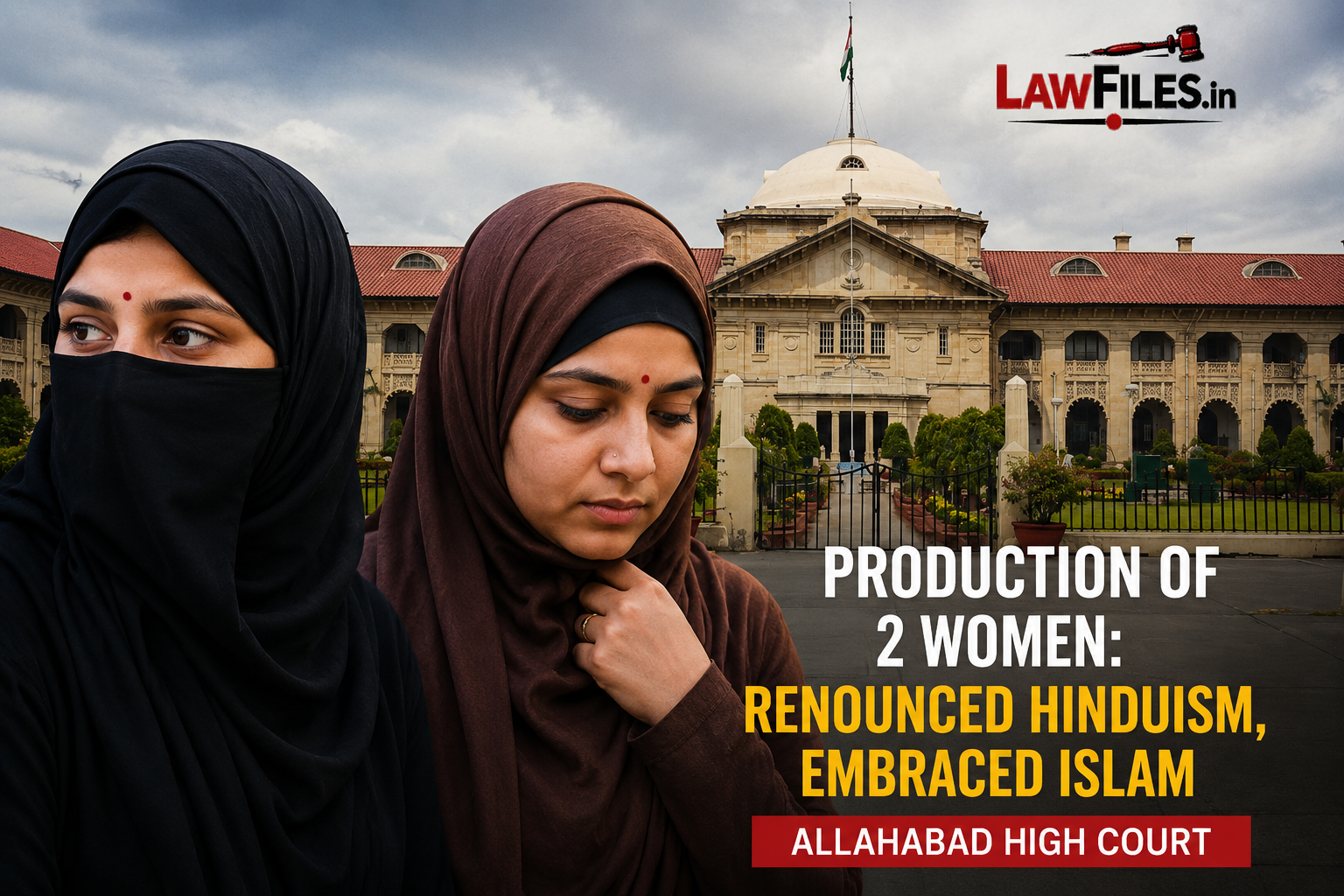
In a significant proceeding touching upon the constitutional guarantees of religious freedom, personal autonomy and individual liberty, the Allahabad High Court directed the production of two adult women who had allegedly renounced Hinduism and embraced Islam, observing that before any judicial conclusion could be reached, it was essential for the Court to interact with them personally and ascertain whether their decision had been taken voluntarily or under any form of coercion, inducement or unlawful restraint. The order came in a habeas corpus petition where allegations were raised that the women had been illegally detained following their conversion and marriage. Rather than accepting competing narratives advanced by either the petitioners or the State, the Court adopted the constitutionally cautious approach traditionally followed in habeas corpus jurisdiction by requiring the personal presence of the women before the Bench. The proceedings once again underline an important constitutional principle that in matters involving adult individuals, the primary concern of constitutional courts is not the approval of familial choices but the protection of free will.
The controversy emerged against the backdrop of increasing litigation involving inter-faith relationships and religious conversion in Uttar Pradesh following the enactment of the Uttar Pradesh Prohibition of Unlawful Conversion of Religion Act, 2021. According to the pleadings placed before the Court, the two women had embraced Islam after renouncing Hinduism and had allegedly entered into relationships or marriages in accordance with Islamic personal law. Their family members disputed the circumstances surrounding the conversion, raising concerns regarding voluntariness and alleging that the women were not acting independently. The petitioners, on the other hand, maintained that both women were majors who had consciously exercised their constitutional right to choose both their religion and their life partners. Faced with two completely divergent factual narratives, the High Court declined to prejudge the issue and instead considered it necessary to hear directly from the women themselves before exercising its extraordinary jurisdiction.
During the proceedings, the Court indicated that a habeas corpus petition is not intended to resolve ideological disagreements regarding religious conversion. Its limited constitutional purpose is to determine whether an individual is under illegal detention or whether his or her liberty has been unlawfully curtailed. Consequently, the Court considered that the most reliable method of determining the truth was to interact personally with the women, free from external influence. Such interaction enables the Court to ascertain whether the individual wishes to accompany any particular person, whether the conversion has been undertaken voluntarily and whether there exists any unlawful restraint requiring judicial intervention. This approach has consistently been followed by constitutional courts whenever allegations concerning adult autonomy are placed before them.
The order is significant because it consciously avoids reducing the controversy to a political or communal debate. Instead, the High Court located the dispute within the framework of Articles 21 and 25 of the Constitution. Article 21 guarantees every adult the right to personal liberty, while Article 25 secures freedom of conscience and the right freely to profess, practise and propagate religion, subject only to public order, morality and health. Together, these constitutional provisions recognise that faith remains an intensely personal matter incapable of being dictated either by the State or by family members. However, the Constitution equally permits the State to prevent conversion obtained through force, fraud or undue influence. The present proceedings therefore require the Court to carefully distinguish between voluntary conversion protected by the Constitution and unlawful conversion prohibited by statute.
The Court’s insistence upon personally interacting with the women reflects a well-established judicial practice. Constitutional courts have repeatedly held that once an individual attains majority, the wishes of parents cannot override the autonomous decision of that individual regarding religion, marriage or residence. At the same time, courts have recognised that allegations of coercion cannot simply be ignored. Consequently, the corpus is ordinarily produced before the Court so that judges may independently evaluate whether the individual’s statement appears voluntary. This procedure minimises the risk of judicial decisions being based solely upon competing affidavits or police reports.
The proceedings inevitably revive the continuing constitutional dialogue surrounding the Uttar Pradesh Prohibition of Unlawful Conversion of Religion Act, 2021. The legislation does not prohibit religious conversion as such. Rather, it criminalises conversion brought about through misrepresentation, force, undue influence, coercion, allurement or fraudulent means. The distinction is constitutionally important because freedom of conscience necessarily includes the freedom to change one’s religion. If conversion itself were prohibited, Article 25 would lose much of its practical significance. The legislative focus therefore remains upon the method by which conversion occurs rather than the mere fact that conversion has taken place.
In recent years, the Allahabad High Court itself has delivered several significant judgments clarifying this distinction. In some cases, the Court has extended protection to inter-faith couples voluntarily residing together, observing that adults possess an independent constitutional right to choose their partners and cannot be harassed merely because they belong to different religions. In other cases, however, where prima facie material suggested coercion or unlawful inducement, the Court declined to interfere with criminal investigations under the anti-conversion law. These apparently divergent outcomes are not contradictory. Rather, they demonstrate that constitutional protection depends primarily upon the existence or absence of free consent rather than upon the religious identities of the parties involved.
The present matter also illustrates the distinctive nature of habeas corpus jurisdiction. Unlike ordinary civil or criminal proceedings, habeas corpus is fundamentally concerned with personal liberty. The Court is not immediately called upon to adjudicate the validity of a marriage, the legality of religious conversion or competing inheritance claims. Its first constitutional obligation is to determine whether the individual is free to make independent decisions. If the corpus appears before the Court and voluntarily states that she is residing with a person of her own choice, constitutional courts have generally refrained from substituting parental preferences for individual autonomy.
From the standpoint of constitutional philosophy, the proceedings revisit the difficult relationship between family authority and individual liberty. Indian society traditionally accords considerable importance to familial participation in decisions concerning marriage and religion. Yet constitutional jurisprudence has consistently recognised that adulthood transforms the legal position. Once majority is attained, constitutional rights become directly enforceable by the individual. Personal autonomy, rather than parental approval, becomes the governing legal principle. This transformation does not diminish the emotional role of families, but it significantly limits their legal authority over adult decisions.
The case also raises broader questions regarding freedom of conscience, perhaps the most deeply personal of all constitutional freedoms. Religion occupies a unique constitutional position because belief cannot ordinarily be imposed through legal coercion. Courts therefore approach conversion disputes with considerable caution. A voluntary change of faith enjoys constitutional protection, while a conversion procured through fraud or coercion invites legitimate State intervention. The difficulty often lies in determining whether genuine free will exists. The High Court’s direction requiring personal production of the women seeks to resolve precisely that evidentiary challenge.
Equally noteworthy is the Court’s institutional restraint. Rather than expressing views on the desirability of conversion or inter-faith marriage, the Bench confined itself to constitutional principles governing liberty. Such restraint reinforces an important feature of constitutional adjudication: courts are guardians of rights, not arbiters of religious preference. Whether one religion is embraced or another renounced falls outside judicial concern unless the process violates constitutional or statutory norms.
The proceedings also resonate with landmark decisions of the Supreme Court, particularly Shafin Jahan v. Asokan K.M. (Hadiya Case) and Lata Singh v. State of Uttar Pradesh, where the Court recognised that adult individuals possess the right to choose both their faith and their life partners. In Shafin Jahan, the Supreme Court emphatically observed that neither courts nor parents can substitute their preferences for the autonomous choices of a competent adult. Personal liberty, the Court held, necessarily includes the freedom to make decisions that others may neither approve nor understand. The Allahabad High Court’s insistence upon interacting directly with the women reflects the same constitutional tradition.
At the same time, the order should not be interpreted as judicial endorsement of every claim of voluntary conversion. The Court has deliberately refrained from reaching any final conclusion before recording the statements of the women themselves. Such caution is particularly appropriate because allegations involving unlawful conversion frequently involve disputed questions of fact that cannot be satisfactorily resolved through pleadings alone. By requiring personal appearance, the Court ensures that any eventual decision rests upon direct judicial assessment rather than speculation or competing accusations.
The matter is likely to influence future litigation involving religious conversion, inter-faith relationships and habeas corpus petitions. It reiterates that constitutional courts will neither mechanically accept allegations of coercion nor automatically presume that every conversion is voluntary. Instead, judicial inquiry will continue to focus upon the autonomy of the individual concerned, treating personal choice as the central constitutional consideration.
Ultimately, the Allahabad High Court’s order represents far more than a procedural direction for production of two women before the Court. It reflects the constitutional commitment that questions concerning faith, identity and companionship must ultimately be answered by the individual whose liberty is at stake. In an era where disputes concerning religion and personal relationships increasingly reach constitutional courts, the order serves as a timely reminder that the judiciary’s role is not to determine which faith an adult should profess but to ensure that every such decision emerges from free conscience rather than coercion, informed choice rather than compulsion, and constitutional liberty rather than external control. That constitutional distinction remains the foundation upon which India’s guarantees of religious freedom and personal autonomy continue to rest.
