


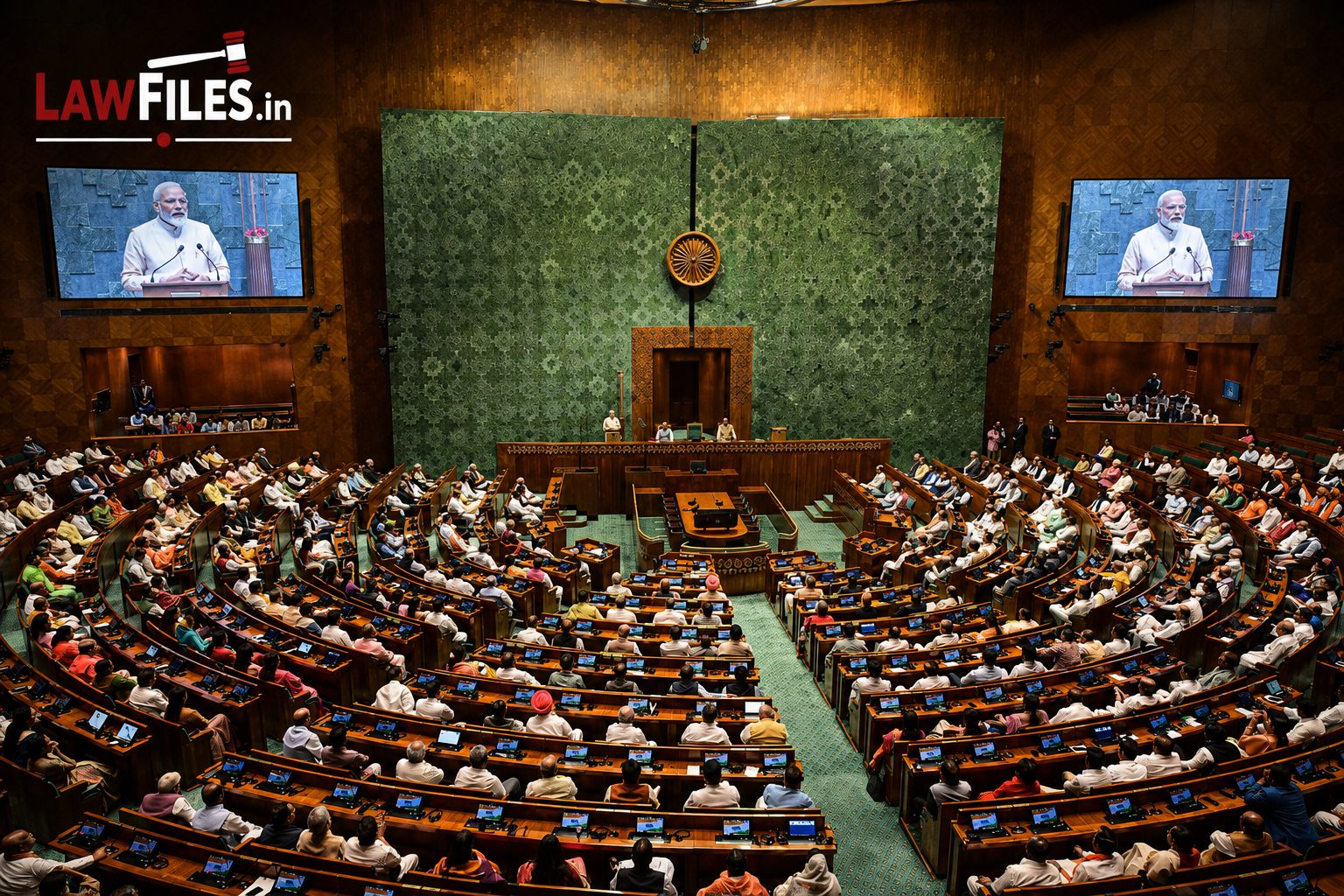
In a significant legislative development aimed at strengthening India’s apex judicial institution, the Union Government has introduced the Supreme Court (Number of Judges) Amendment Bill, 2026 in the Lok Sabha to formally increase the sanctioned strength of judges of the Supreme Court from 34 to 38, including the Chief Justice of India. Introduced by Union Law Minister Arjun Ram Meghwal during the ongoing Monsoon Session of Parliament, the Bill seeks to replace the Ordinance promulgated earlier this year which had already enhanced the Court’s sanctioned strength by amending the Supreme Court (Number of Judges) Act, 1956. The proposed legislation marks another important step in India’s continuing attempt to address mounting judicial pendency, increasing constitutional litigation and the expanding workload of the country’s highest constitutional court. Yet, beyond the numerical increase lies a far more important legal question: Can expanding judicial strength alone cure the systemic challenges confronting the Indian justice delivery system, or does the problem require deeper structural reform?
The Bill is rooted in Article 124 of the Constitution of India, which provides that the Supreme Court shall consist of the Chief Justice of India and such number of other judges as Parliament may by law prescribe. Unlike amendments affecting the constitutional structure of the judiciary, alteration of the Court’s numerical strength does not require a constitutional amendment. Parliament may simply amend the Supreme Court (Number of Judges) Act through ordinary legislation passed by a simple majority. Exercising this legislative authority, Parliament has periodically increased the Court’s strength in response to the growing demands placed upon the apex court. The latest amendment continues this legislative tradition by increasing the number of puisne judges from 33 to 37, thereby raising the total sanctioned strength to 38 including the Chief Justice of India.
The legislative proposal follows the Supreme Court (Number of Judges) Amendment Ordinance, 2026, promulgated by the President earlier this year after receiving the approval of the Union Cabinet. The Ordinance amended Section 2 of the 1956 Act by replacing the figure “33” with “37”, thereby immediately enhancing the Court’s sanctioned capacity pending parliamentary approval. The present Bill seeks to replace that Ordinance with permanent legislation, in accordance with the constitutional requirement that ordinances receive legislative approval if they are to continue beyond the prescribed constitutional period.
The expansion comes at a time when the Supreme Court continues to shoulder an extraordinarily diverse constitutional and statutory docket. Today, the Court is not merely a constitutional court deciding questions under Part III or adjudicating federal disputes under Article 131. It simultaneously functions as the country’s highest appellate court in civil, criminal, commercial, tax, arbitration, insolvency, environmental, election, service, consumer and regulatory matters. The breadth of its jurisdiction is unparalleled among constitutional courts globally. Consequently, every increase in litigation across these sectors directly translates into additional institutional pressure upon the Supreme Court.
One of the principal justifications underlying the legislative proposal is the persistent growth in case pendency. Although judicial vacancies have often attracted greater public attention than sanctioned strength, the two issues are analytically distinct. Increasing the sanctioned strength merely creates additional judicial positions. Those positions must still be filled through the constitutional appointment process involving the Collegium system and Presidential appointments under Article 124. As of the introduction of the Bill, despite the enhanced sanctioned strength of thirty-eight judges, the Supreme Court continues to function with a considerably lower working strength because several vacancies remain to be filled. Thus, expansion of sanctioned capacity represents only the first step; timely appointments remain equally essential for the reform to produce practical results.
Historically, Parliament has periodically revised the strength of the Supreme Court in response to the institution’s expanding role. The Court began functioning in 1950 with eight judges, including the Chief Justice. As India’s constitutional and economic landscape evolved, Parliament repeatedly enlarged its strength through legislative amendments. The most recent increase before the present proposal occurred in 2019, when the number of judges rose from 31 to 34 including the Chief Justice. The present amendment therefore reflects a continuing institutional recognition that the Court’s jurisdiction has expanded far beyond what earlier judicial strengths were designed to accommodate.
However, from a constitutional perspective, the proposal raises a more fundamental institutional question. Does increasing the number of judges necessarily translate into faster justice? Judicial administration research across jurisdictions suggests that while additional judges undoubtedly improve disposal capacity, pendency often reflects multiple systemic variables extending beyond judicial strength alone. Delay frequently arises from repeated adjournments, procedural complexity, inadequate courtroom infrastructure, shortage of support staff, delayed appointments in subordinate courts, increasing government litigation, fragmented digital integration and the sheer breadth of appellate jurisdiction exercised by constitutional courts.
Indeed, the Supreme Court itself has repeatedly observed that the Government remains the largest litigant in India. A substantial percentage of the Court’s docket consists of appeals involving governmental authorities. Consequently, meaningful reduction in pendency requires improvements not merely in judicial capacity but equally in governmental decision-making, dispute resolution mechanisms, administrative efficiency and responsible litigation policies. Increasing judicial strength undoubtedly addresses one aspect of the challenge, but it cannot independently resolve every structural cause of delay.
Another significant dimension concerns the nature of the Supreme Court’s constitutional role. Unlike several constitutional courts across the world that primarily decide constitutional questions, the Supreme Court of India continues to function as a general court of appeal under Article 136, which confers extraordinarily wide discretionary jurisdiction through Special Leave Petitions (SLPs). Thousands of SLPs reach the Court annually across virtually every branch of law. Successive Law Commission Reports and expert committees have periodically suggested that the Court should gradually transform into a predominantly constitutional court, leaving routine appellate litigation to specialised or regional appellate forums. The present legislative amendment does not directly address this longstanding institutional debate.
The proposal also rekindles discussions concerning regional benches of the Supreme Court. For decades, legal scholars, bar associations and successive Law Commission reports have recommended the establishment of regional benches to improve geographical accessibility. At present, litigants from every part of the country ordinarily travel to New Delhi to pursue appeals before the Supreme Court. While increasing judicial strength may facilitate constitution of additional Benches within Delhi, it does not itself decentralise access to the apex court. Consequently, questions concerning regional accessibility remain unresolved notwithstanding the increase in judicial capacity.
Equally significant is the impact of enhanced judicial strength upon Constitution Benches. Under Article 145(3), substantial questions relating to constitutional interpretation require adjudication by Benches comprising at least five judges. Constitution Bench matters frequently involve issues of immense national importance, ranging from federalism and fundamental rights to electoral reforms, taxation, reservation and separation of powers. Larger judicial strength theoretically enables the Chief Justice to constitute more Constitution Benches without significantly affecting the Court’s regular appellate work. This institutional flexibility may prove particularly valuable as constitutional litigation continues to expand in complexity and volume.
From the standpoint of judicial administration, the amendment also reflects a broader recognition that institutional capacity is itself a constitutional value. The right to access justice under Article 21 increasingly encompasses not merely the existence of courts but their ability to deliver timely and effective adjudication. Excessive delay weakens public confidence in the legal system, increases litigation costs and may ultimately impair substantive rights themselves. Enhancing judicial strength therefore serves not merely administrative convenience but the constitutional objective of ensuring meaningful access to justice.
Nevertheless, the effectiveness of the amendment will ultimately depend upon speedy judicial appointments. Vacant sanctioned posts contribute little towards reducing pendency. The constitutional process involving recommendations by the Collegium, executive scrutiny and Presidential appointments must therefore operate efficiently if the legislative objective is to be realised. Simultaneously, adequate courtroom infrastructure, research assistance, registry support, technological integration and digital case management remain indispensable for enabling additional judges to function effectively.
The proposal also carries symbolic significance. It reflects Parliament’s continuing acknowledgement that the Supreme Court’s institutional responsibilities have expanded dramatically since the Constitution came into force. Contemporary constitutional adjudication encompasses issues ranging from artificial intelligence and digital privacy to climate litigation, insolvency, competition law, data protection, electoral finance and complex commercial disputes. Each of these emerging legal fields places additional demands upon the Court’s constitutional and appellate jurisdiction. Expansion of judicial strength may therefore be viewed as legislative recognition of the changing character of constitutional governance itself.
Yet, the larger debate cannot be ignored. Increasing the number of judges addresses the supply side of justice delivery. Equally important are reforms addressing the demand side reducing avoidable litigation, strengthening mediation, expanding commercial dispute resolution, encouraging institutional arbitration, improving tribunal functioning, modernising procedural law and enhancing the efficiency of subordinate courts where the overwhelming majority of litigation originates. Without corresponding systemic reforms, numerical expansion alone risks treating the symptoms rather than the underlying causes of judicial delay.
Ultimately, the Supreme Court (Number of Judges) Amendment Bill, 2026 represents an important institutional reform, but it is best understood as one component of a much broader conversation on judicial transformation. The legislation acknowledges an undeniable reality that a constitutional court entrusted with safeguarding fundamental rights, resolving complex commercial disputes and deciding questions of immense national importance requires adequate judicial capacity. At the same time, the amendment implicitly reminds policymakers that justice delivery cannot be measured solely by sanctioned strength. The true effectiveness of the reform will depend upon whether increased judicial numbers are accompanied by timely appointments, administrative modernisation, technological innovation and structural reforms capable of making the constitutional promise of speedy, accessible and effective justice a practical reality rather than an aspirational ideal.
