

Close Menu
LawFilesLawFiles

    Subscribe to Updates

    Get the latest creative news from FooBar about art, design and business.

    What's Hot

    Supreme Court Reaffirms Finality of CoC-Approved Resolution Plans: Why This Judgment Matters for Future Insolvency Professionals

    June 1, 2026

    Supreme Court Reaffirms Finality of CoC-Approved Resolution Plans: Why This Judgment Matters for Future Insolvency Professionals

    June 1, 2026

    NUSRL Ranchi Invites Submissions for “Kautilya’s Take” Policy Blog: A Valuable Opportunity for Law Students and Young Researchers

    June 1, 2026
    Facebook X (Twitter) Instagram Threads
    Monday, June 1
    LawFilesLawFiles
    Facebook X (Twitter)
    • Home
      • Who We Are
      • Our Mission
      • Advisory board
      • Contact US
    • Supreme Court
    • High Courts
      • Gujarat High Court
      • Jharkhand High Court
      • Rajasthan High Court
      • Karnataka High Court
      • Andhra Pradesh High Court
      • Allahabad High Court
      • Himachal Pradesh High Court
      • Chhattisgarh High Court
      • Jammu & Kashmir and Ladakh High Court
      • Kerala High Court
      • Punjab and Haryana High Court
      • Patna High Court
      • Madhya Pradesh High Court
      • Madras High Court
      • Bombay High Court
      • Orissa High Court
      • Calcutta High Court
      • Meghalaya High Court
      • Delhi High Court
      • Manipur High Court
      • Gauhati High Court
    • Corporate
    • Taxation Laws
      • Income Tax
      • GST
      • Customs & Excise
    • Global Affairs
    • Articles
      • Sitting Judge’s’ Views
      • Senior Advocate
      • Policy Analysis
      • Tax Expert
    • PILS
      • Free/Affordable Legal Aid
      • PIL Cell
      • Law student Volunteer Cell (research & Drafting)
      • NGO & Legal services Authority Tie-ups
      • Online Legal Formats
      • Online Legal Help Form
    Subscribe Premium
    LawFilesLawFiles
    Home»High Courts»Calcutta High Court Questions ‘Exclusive’ Central Control in Vote Counting: Presumption of ECI Neutrality Meets Federal Concerns
    High Courts

    Calcutta High Court Questions ‘Exclusive’ Central Control in Vote Counting: Presumption of ECI Neutrality Meets Federal Concerns

    Anvita DwivediBy Anvita DwivediApril 30, 2026No Comments4 Mins Read
    WhatsApp Facebook Twitter Copy Link
    Share
    Facebook Twitter Pinterest Copy Link WhatsApp

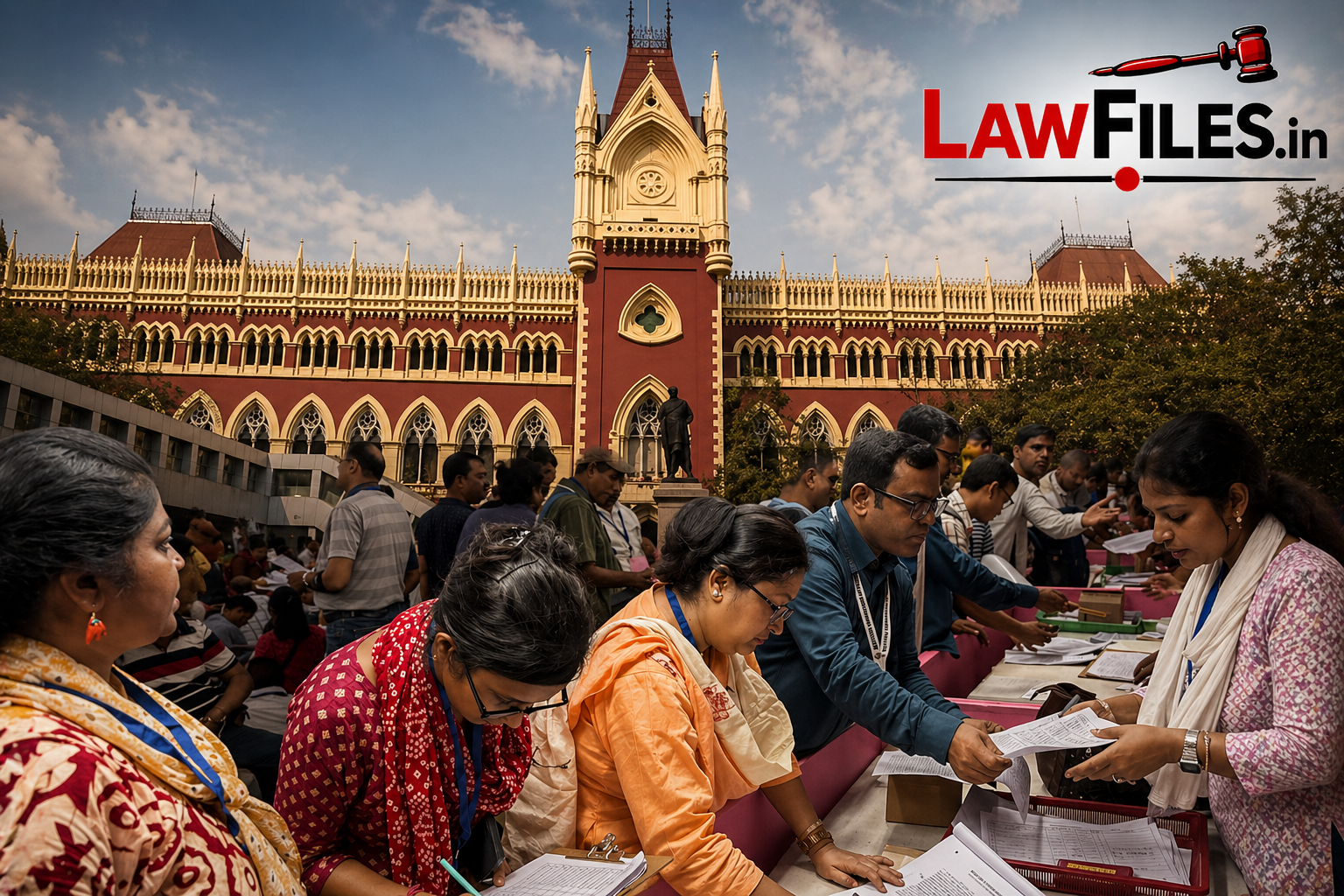
    The Calcutta High Court has once again found itself at the centre of electoral governance debates, as it heard a challenge to the deployment of only central government and public sector undertaking (PSU) employees as counting supervisors in the ongoing West Bengal Assembly elections, 2026. The controversy, though administrative in appearance, raises deeper constitutional questions about electoral neutrality, federal balance, and institutional trust in the conduct of elections.

    The plea before the Court challenges a recent directive issued by the Chief Electoral Officer mandating that at least one counting supervisor at each table must be drawn exclusively from central government or PSU personnel. Petitioners have argued that such a policy results in the systematic exclusion of state government employees, thereby potentially distorting the representative balance in the counting process. At its core, the petition frames the issue not merely as procedural irregularity, but as a structural deviation from principles of fairness and inclusivity in election administration.

    During the hearing, the Court underscored a foundational principle governing electoral jurisprudence the presumption of bona fides in favour of the Election Commission of India. This presumption, rooted in Article 324 of the Constitution, acknowledges the Commission’s wide discretionary powers in ensuring free and fair elections. By invoking this principle, the Court signalled judicial restraint, emphasising that interference with election processes must be exercised sparingly and only upon clear demonstration of arbitrariness or mala fides.

    However, the Court’s approach also reveals a subtle balancing act. While affirming institutional trust in the Election Commission, it did not summarily dismiss the concerns raised. Instead, the proceedings indicate a willingness to scrutinise whether such exclusivity in staffing decisions can withstand constitutional scrutiny—particularly under Articles 14 and 21, which guard against arbitrariness and ensure procedural fairness.

    The timing of the litigation is equally significant. The West Bengal Assembly elections, conducted in two phases on April 23 and April 29, 2026, are at a critical juncture, with counting poised to determine the electoral outcome. Courts have traditionally exercised caution in intervening during active election cycles, wary of disrupting administrative continuity. Yet, as past precedents from the same High Court demonstrate—ranging from restrictions on preventive detention to modifications of Election Commission directives—the judiciary has not hesitated to intervene where fundamental rights or procedural integrity are at stake.

    From a constitutional perspective, the controversy raises an important doctrinal question: does the centralisation of election personnel enhance neutrality, or does it risk undermining the federal character of India’s electoral framework? Proponents of the Commission’s approach argue that reliance on central staff ensures independence from local political pressures, particularly in states with a history of electoral violence. Critics, however, contend that such exclusivity may create an impression of over-centralisation, potentially eroding the participatory role of state machinery in elections.

    The case also reflects a broader judicial trend in election-related litigation. The Calcutta High Court, in recent weeks, has actively engaged with multiple facets of election governance from deployment of personnel to restrictions on administrative powers often walking a fine line between deference and intervention. This evolving jurisprudence suggests that courts are increasingly willing to interrogate the procedural dimensions of electoral fairness, even while respecting the constitutional autonomy of the Election Commission.

    Critically analysed, the present proceedings highlight the limits of the “presumption of bona fides” doctrine. While it serves as a necessary safeguard against excessive judicial interference, it cannot operate as an absolute shield insulating administrative decisions from scrutiny. Where a policy appears to create structural exclusion such as the complete sidelining of a class of public servants the Court may be compelled to examine whether such exclusion is justified by compelling administrative necessity.

    Ultimately, the outcome of this case may not hinge on a binary determination of legality, but on the Court’s ability to reconcile competing constitutional values: institutional autonomy of the Election Commission, principles of federal balance, and the overarching mandate of free and fair elections. In doing so, the Calcutta High Court’s ruling is likely to contribute meaningfully to the evolving jurisprudence on electoral governance in India.

    As the electoral process reaches its decisive stage, this litigation underscores a larger truth free and fair elections are not merely a function of outcomes, but of the processes that produce them. The Court’s engagement with the issue of counting supervisors thus goes beyond administrative detail, touching upon the very architecture of democratic legitimacy.


    Calcutta High Court Questions ‘Exclusive’ Central Control in Vote Counting: Presumption of ECI Neutrality Meets Federal Concerns
    Share. WhatsApp Facebook Twitter Pinterest Email
    Anvita Dwivedi

    Related Posts

    Supreme Court Rejects Demolition of Navi Mumbai Mall, Signals Shift from Punitive Urban Governance to Proportional Justice

    June 1, 2026

    Supreme Court Questions Waqf Bodies’ Claim to Court Fee Exemption, Reopens Debate on Legal Privileges and Procedural Equality

    June 1, 2026

    Supreme Court Refuses Last-Minute Push for Computer-Based NEET Re-Test, Signals Limits of Judicial Intervention Amid Exam Crisis

    June 1, 2026
    Add A Comment
    Leave A Reply Cancel Reply

    Demo
    Top Posts

    Wrongful Claim Rejection Amounts to Deficiency in Service: Delhi Consumer Commission Holds Star Health Liable

    March 16, 202667 Views

    Bombay High Court Quashes POCSO Case, Directs Accused to Fund MacBook for Victim’s Education

    February 28, 202650 Views

    Siyahat Meri Syahi Se: A Journey That Transforms Travel into Thought and Entrepreneurship

    March 18, 202643 Views

    Banking Negligence and Consumer Accountability: Supreme Court Reinforces Duty of Care in Cheque Handling

    April 16, 202635 Views
    Don't Miss

    Supreme Court Reaffirms Finality of CoC-Approved Resolution Plans: Why This Judgment Matters for Future Insolvency Professionals

    By Anvita DwivediJune 1, 2026

    In a significant ruling under the Insolvency and Bankruptcy Code, 2016 (IBC), the Supreme Court…

    Supreme Court Reaffirms Finality of CoC-Approved Resolution Plans: Why This Judgment Matters for Future Insolvency Professionals

    June 1, 2026

    NUSRL Ranchi Invites Submissions for “Kautilya’s Take” Policy Blog: A Valuable Opportunity for Law Students and Young Researchers

    June 1, 2026

    Allahabad High Court’s Intervention in Conversion Plea Rekindles Debate on Religious Freedom, Administrative Power, and UP’s Anti-Conversion Law

    June 1, 2026
    Stay In Touch
    • Facebook
    • Twitter

    Subscribe to Updates

    Get the latest creative news from SmartMag about art & design.

    Top Posts

    Wrongful Claim Rejection Amounts to Deficiency in Service: Delhi Consumer Commission Holds Star Health Liable

    March 16, 202667 Views

    Bombay High Court Quashes POCSO Case, Directs Accused to Fund MacBook for Victim’s Education

    February 28, 202650 Views

    Siyahat Meri Syahi Se: A Journey That Transforms Travel into Thought and Entrepreneurship

    March 18, 202643 Views
    Don't Miss

    Supreme Court Reaffirms Finality of CoC-Approved Resolution Plans: Why This Judgment Matters for Future Insolvency Professionals

    By Anvita DwivediJune 1, 2026

    In a significant ruling under the Insolvency and Bankruptcy Code, 2016 (IBC), the Supreme Court…

    Supreme Court Reaffirms Finality of CoC-Approved Resolution Plans: Why This Judgment Matters for Future Insolvency Professionals

    June 1, 2026

    NUSRL Ranchi Invites Submissions for “Kautilya’s Take” Policy Blog: A Valuable Opportunity for Law Students and Young Researchers

    June 1, 2026

    Allahabad High Court’s Intervention in Conversion Plea Rekindles Debate on Religious Freedom, Administrative Power, and UP’s Anti-Conversion Law

    June 1, 2026
    Stay In Touch
    • Facebook
    • YouTube
    • TikTok
    • Instagram
    Top Trending
    About Us
    About Us

    LawFiles.in is a comprehensive legal news platform delivering real-time updates from the Supreme Court, High Courts, Tribunals, Corporate and Tax law, Regulators, Politics, Crime, Consumer cases, and Global Affairs.

    Email Us: lawfilesoffical@gmail.com
    Contact: +91 8800026066

    Contact Us:
    India International Centre
    40, Max Mueller Marg
    Lodhi Estate, New Delhi-110003

    Facebook X (Twitter)
    Our Picks

    Supreme Court Reaffirms Finality of CoC-Approved Resolution Plans: Why This Judgment Matters for Future Insolvency Professionals

    June 1, 2026

    Supreme Court Reaffirms Finality of CoC-Approved Resolution Plans: Why This Judgment Matters for Future Insolvency Professionals

    June 1, 2026

    NUSRL Ranchi Invites Submissions for “Kautilya’s Take” Policy Blog: A Valuable Opportunity for Law Students and Young Researchers

    June 1, 2026

    Allahabad High Court’s Intervention in Conversion Plea Rekindles Debate on Religious Freedom, Administrative Power, and UP’s Anti-Conversion Law

    June 1, 2026

    Supreme Court Rejects Demolition of Navi Mumbai Mall, Signals Shift from Punitive Urban Governance to Proportional Justice

    June 1, 2026
    Most Popular

    ED Can Arrest Even If FIRs Are Added to ECIR Later: Punjab & Haryana High Court

    January 30, 20260 Views

    Custodial Death and State Liability : A Critical Analysis of the Allahabad High Court’s ₹10 Lakh Compensation Judgment

    February 22, 20260 Views

    Gujarat High Court Commutes Death Sentence in Child Rape-Murder; Reinforces Capital Sentencing Standards in Light of MP High Court Precedent

    February 23, 20260 Views

    Delhi Family Court Rules Against Enforcement of Australian Property Orders in Shikhar Dhawan Matrimonial Dispute

    February 25, 20260 Views

    Supreme Court Stays Criminal Proceedings Against Jharkhand CM Hemant Soren Over Alleged ED Summons Defiance

    February 25, 20260 Views
    © 2026 LawFiles. Owned by Varta24 Media.
    • Articles
    • Careers
    • Corporate
    • Global Affairs
    • Law Firms & Lawyers
    • PILS
    • Regulatory

    Type above and press Enter to search. Press Esc to cancel.