


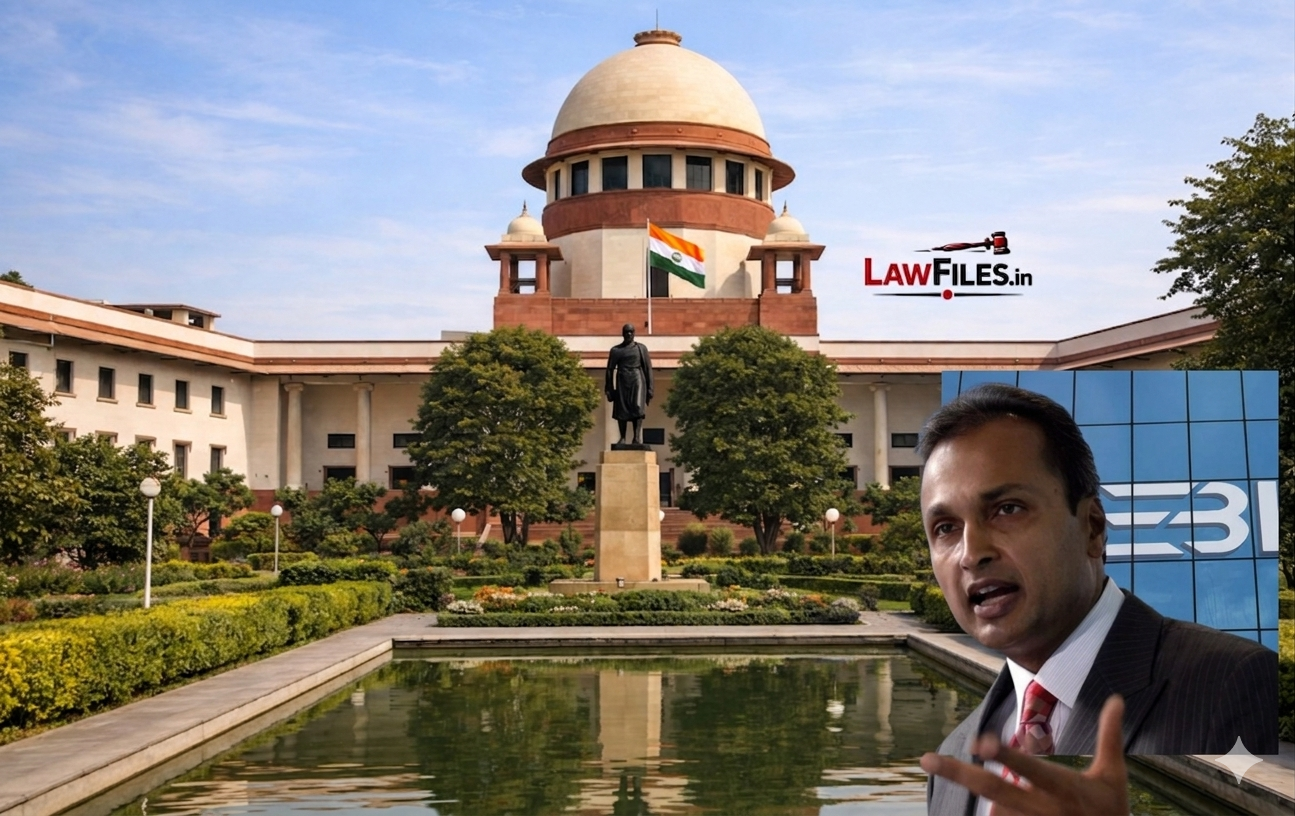
In a development with consequences extending well beyond one industrialist’s dispute with lenders, the Supreme Court on April 16, 2026 refused to stay fraud-classification proceedings initiated against Anil Ambani’s loan accounts by Bank of Baroda, Indian Overseas Bank and IDBI Bank under the Reserve Bank of India’s 2024 Master Directions on fraud risk management. The Court also recorded Ambani’s statement that he wished to settle the matter with the banks, while expressly clarifying that it had not expressed any opinion on that proposal; at the same time, it directed that the trial of the connected suit be expedited, subject to the cooperation of the parties.
At one level, the order is narrowly procedural. The Court has not finally adjudicated the legality of the fraud tag itself. Yet, in practical terms, the refusal of interim protection is far from routine. In fraud-classification disputes, interim relief often becomes the real battlefield because the consequences of such a label are immediate, reputationally destructive, and commercially disabling. The Bombay High Court itself had earlier recognised that classification of a loan account as fraud entails “very serious consequences,” including exposure to penal measures and future credit restraints for promoters and directors.
That is precisely why the Supreme Court’s stance matters. It suggests a judicial reluctance to use interim orders as a shield against the regulatory machinery of banking fraud enforcement, especially where the dispute sits within a broader matrix of forensic audit findings, lender action, and parallel proceedings. The controversy around Ambani’s accounts is not entirely new. The underlying litigation before the Bombay High Court involved challenges to a report dated October 15, 2020, a show-cause notice dated January 2, 2024, and a fraud-classification order dated September 2, 2025, all of which were specifically targeted in the suit and interim prayers.
The larger legal context makes the order even more significant. In State Bank of India v. Rajesh Agarwal (2023), the Supreme Court had held that principles of natural justice must be read into the fraud-classification framework, meaning borrowers must receive notice and an opportunity to respond before such a declaration is made. That ruling triggered a wave of challenges across High Courts, with borrowers arguing that fraud classification could not be sustained unless the process satisfied stringent procedural fairness requirements. The regulatory response came in the form of the RBI’s 2024 Master Directions on Fraud Risk Management, which now provide the operative framework for banks proceeding against borrowers in such cases.
Only days before the Ambani matter was dealt with, the Supreme Court in State Bank of India v. Amit Iron Private Limited clarified the procedural content of that fairness requirement. The Court held that borrowers are not entitled to a personal or oral hearing before fraud classification, but they must be furnished the forensic audit material relied upon and given an opportunity to make a written representation before a reasoned decision is taken. This clarification is central to understanding why courts may now be less inclined to grant blanket interim stays: the doctrinal uncertainty that once surrounded the process has begun to narrow.
Seen in that light, the Supreme Court’s refusal to halt proceedings against Ambani reflects more than case-specific discretion. It marks a shift from an era in which borrowers could plausibly argue that the regulatory process itself was legally unstable, to a phase in which the Court appears more willing to let banks act within the revised framework, reserving deeper scrutiny for final adjudication rather than interim interruption. Put differently, once the procedural architecture has been judicially stabilised, the argument for extraordinary interim restraint becomes harder to sustain.
There is also a deeper institutional message here. Indian courts have long been conscious that fraud classification is not merely a private dispute over debt recovery. It sits at the intersection of financial governance, market integrity and systemic banking discipline. The RBI framework is designed not only to identify loss, but to detect diversion, misuse and layered misconduct that may affect the broader credit system. The Court’s refusal to interfere at the threshold therefore aligns with a more regulatory, rather than purely bilateral, understanding of banking disputes.
At the same time, the case exposes the unresolved tension at the heart of fraud-classification law. On one side lies the banking system’s need for speed, internal vigilance and credible deterrence. On the other lies the borrower’s claim that a fraud declaration is a quasi-punitive act with civil, commercial and reputational consequences so grave that judicial oversight must remain robust. The Bombay High Court records in the Ambani litigation themselves reflect this tension, with the suit seeking recall of the show-cause notice and fraud declaration and a restraint against dissemination or reliance upon those measures.
What makes the Ambani episode analytically striking is the Court’s decision to pair denial of interim relief with an order for expeditious trial and an express preservation of other legal remedies. That combination reveals a calibrated approach: the Court is not foreclosing adjudication, but it is signalling that adjudication should occur on an accelerated merits track rather than through prolonged interim insulation. This is an important distinction. It suggests that the judiciary is not abandoning procedural fairness; rather, it is relocating the contest from the domain of stay orders to the domain of substantive proof and timely trial.
Ambani’s recorded willingness to explore settlement adds another layer. The Court’s choice to record that statement but disclaim any view on it appears carefully crafted. It preserves room for negotiated resolution without allowing the statement to dilute the legal posture of the banks or prejudge issues pending elsewhere. LiveLaw reports that the Solicitor General opposed recording the statement on the ground that it might affect other proceedings, including criminal investigation, and the Bench nonetheless recorded it with a cautionary clarification. That exchange itself reveals how banking-fraud litigation now increasingly overlaps with a wider enforcement environment, where civil, regulatory and criminal implications are often intertwined.
For India’s banking law jurisprudence, the immediate importance of the order lies in the message it sends to both lenders and promoters. For lenders, it is an endorsement at least at the interim stage of proceeding under the RBI’s revised fraud-risk framework, provided the minimum procedural safeguards identified by the Supreme Court are respected. For promoters and borrowers, it is a warning that the older strategy of securing broad interim protection on the basis of procedural ambiguity may no longer be as effective after Amit Iron.
In that sense, this is not merely a story about Anil Ambani. It is about the maturation of a doctrine. Fraud classification in Indian banking law has moved from being a contested administrative black box to a structured regulatory process bounded by notice, disclosure and reasoned decision-making, but no longer necessarily stalled by courts at the outset. The Supreme Court’s latest order indicates that once those procedural guardrails exist, judicial sympathy may increasingly shift toward allowing the banking system to function, while ensuring that legal errors are corrected through expedited merits review rather than interim paralysis.
The result is a sharper, more exacting legal landscape. Borrowers remain protected against arbitrary action, but not against the process itself. And that may be the most consequential lesson of the case.
If you want, I can also turn this into a more publication-style Law Files article with a stronger headline and a tighter editorial tone.
