


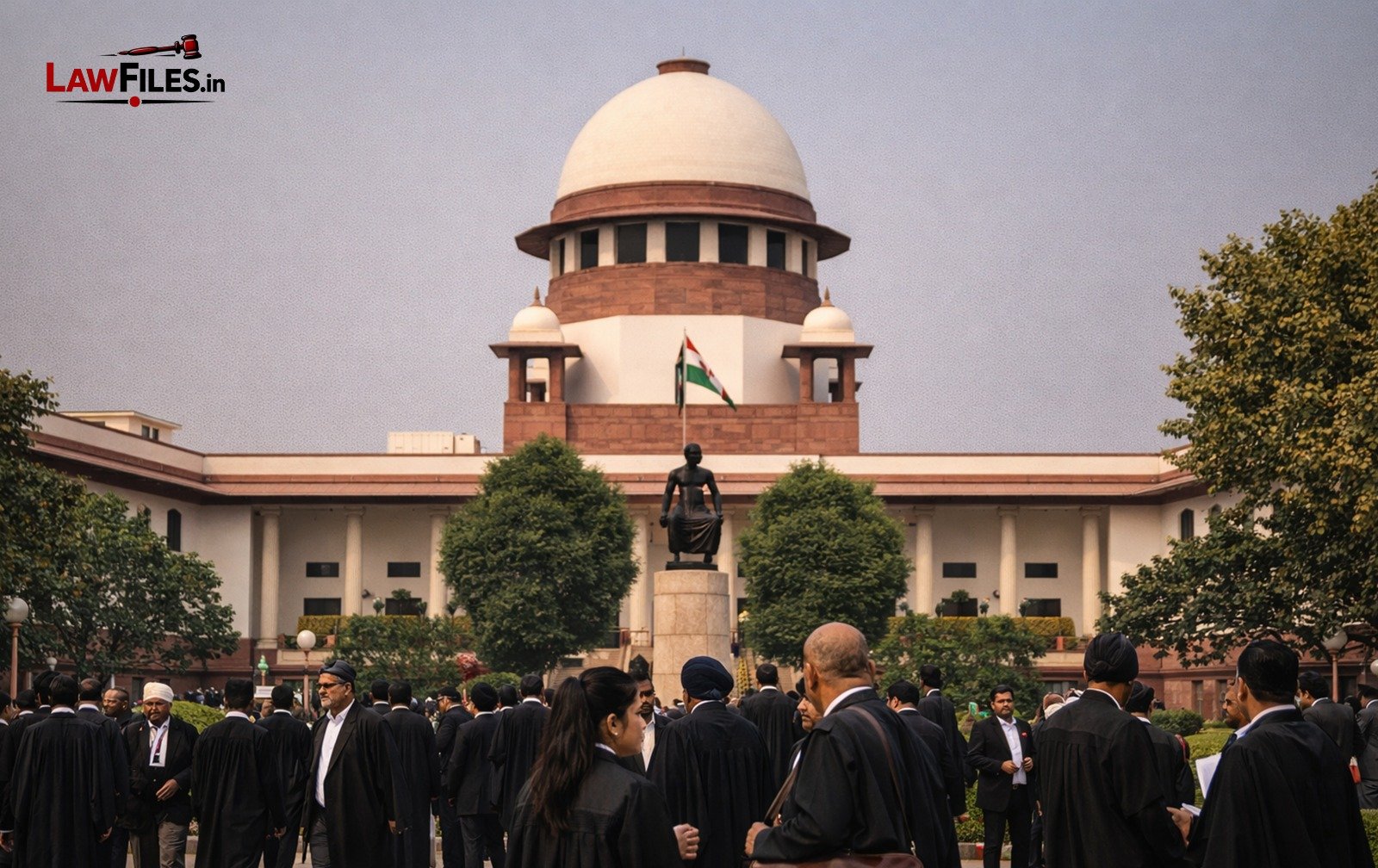
The Supreme Court has issued a series of directions aimed at preventing foreign nationals accused under the Narcotic Drugs and Psychotropic Substances Act from securing bail through fictitious or impersonated sureties and subsequently absconding from the country. The directions have emerged from a case which initially concerned the bail granted to a Nigerian national in a serious narcotics prosecution but gradually developed into a much broader examination of the functioning of the bail and surety system across the country. What began as a dispute over one accused person’s release has consequently exposed a systemic vulnerability in criminal courts: the possibility that a judicial order granting bail may be rendered ineffective when the identity and financial capacity of the surety supporting that release are never adequately verified.
The proceedings arise from the Union Government’s challenge to the Bombay High Court’s order granting bail to Chidiebere Kingsley Nawchara, a Nigerian national facing prosecution in an NDPS case. According to the prosecution, approximately 4.9 kilograms of heroin had been recovered in the case and the accused had been implicated as an alleged accomplice. The Bombay High Court had granted him bail in May 2025, principally taking into account the period of incarceration. The Union subsequently approached the Supreme Court, pointing out, among other circumstances, that the accused had previously been convicted in relation to an offence of a similar nature and that the seriousness of the allegations had not been adequately addressed while granting bail.
The matter took a more serious turn when the Supreme Court stayed the operation of the High Court’s bail order and directed the Maharashtra authorities to take immediate steps to locate and arrest the accused. Despite those directions and the issuance of a lookout notice, the accused could not be traced. The Court was subsequently informed that efforts were also being made to locate him through the sureties and the Foreigners Regional Registration Office. It was during this process that the genuineness of the surety furnished before the trial court came under serious scrutiny.
The investigation into the surety revealed circumstances that raised questions far beyond the individual case. The surety was found to be fictitious, with the address not corresponding to an actual person and the purported employer denying any association with the individual. The financial and identity documents produced in support of the surety were also found to be unreliable. The prosecution subsequently brought to the Court’s attention other instances in which foreign nationals accused in narcotics cases had allegedly absconded after obtaining bail on the strength of sureties that were later discovered to be fake.
The Supreme Court’s concern was therefore not merely that one accused person had allegedly managed to evade the process of law. The larger concern was how such a situation could arise after a judicial officer had formally accepted the bail bonds. If the documents submitted to a court can be fabricated, if the person standing as surety can be an impersonator and if the address or financial capacity represented to the court does not actually exist, the problem affects the credibility of the entire bail administration system. A bail order is premised upon the accused remaining available to face the criminal process, and the surety mechanism is intended to provide an additional layer of assurance in that regard.
The Bench accordingly began examining whether existing mechanisms for verification of sureties are adequate and whether courts across the country are following uniform and effective procedures. The Court had earlier questioned the functioning of the National Informatics Centre’s surety verification module and sought information concerning the systems available to trial courts for determining whether a person produced as a surety is genuine. The Unique Identification Authority of India was also brought into the proceedings because the Court was considering whether existing digital identity infrastructure could play a role in preventing impersonation and fraudulent documentation.
The significance of this development lies in the fact that the surety system has historically depended to a considerable extent upon documentary verification and the satisfaction of the court regarding the identity and solvency of the person standing surety. The statutory framework itself recognises the importance of a sufficient surety. Under the present criminal procedure regime, the court has authority to require bonds and sufficient sureties before releasing an accused. The purpose, however, is not to impose a financial punishment upon the accused or to create an additional barrier to liberty. Its principal object is to secure the accused’s appearance and compliance with the conditions of release.
That purpose becomes particularly complicated when the accused is a foreign national. A foreign accused may have no permanent residential address in India, no family ties within the jurisdiction and no established social or economic relationship with the community in which the criminal proceedings are pending. Once such a person leaves India, securing their presence for trial can become considerably more difficult. The possibility of flight is therefore a legitimate consideration while framing bail conditions, particularly in serious NDPS prosecutions involving large quantities of prohibited substances.
However, the constitutional position does not permit foreign nationals to be treated as persons without rights. Article 21 applies to every person within the territory of India and not merely to Indian citizens. A foreign national accused of an offence remains entitled to the protection of personal liberty and fair procedure, subject of course to the restrictions imposed by valid law. The Supreme Court has previously made clear in bail jurisprudence involving foreign nationals that inability to furnish a particular form of surety cannot automatically become a substitute for a judicial determination on bail.
This distinction is critical because the present problem cannot be solved simply by making bail more difficult for every foreign national. If the existing verification mechanism is defective, increasing the number or financial value of sureties may not solve the underlying problem. Two fake sureties are still two fake sureties. A very high bond amount does not ensure that the person standing behind the bond is genuine. What is required is not merely a more onerous bail condition but a more reliable verification process.
The Supreme Court’s approach therefore appears directed towards strengthening the institutional machinery rather than treating nationality itself as a reason for automatic denial of liberty. This is legally significant because the NDPS Act already imposes a stringent statutory framework for bail. Section 37 requires the court to be satisfied, among other things, that there are reasonable grounds for believing that the accused is not guilty of the alleged offence and that the accused is unlikely to commit an offence while on bail in cases falling within the provision. The prosecution therefore already receives a heightened statutory safeguard in serious NDPS cases.
The challenge is to ensure that once a court has concluded that the statutory conditions for bail are satisfied, the subsequent conditions attached to release actually serve legitimate purposes and do not become either ineffective or oppressive. Bail conditions must have a rational connection with the purpose they are intended to achieve. A condition designed to secure the accused’s presence must genuinely assist the court in ensuring that presence. A fictitious surety obviously defeats that objective.
The case has consequently evolved into a larger examination of the bail bond system itself. The Supreme Court has sought information from States, Union Territories and High Courts concerning the applicable provisions and the forms used for furnishing bail and surety bonds. This exercise is important because there appears to be considerable variation in how different jurisdictions verify sureties and the documents submitted by them. A fragmented system creates opportunities for organised intermediaries to exploit procedural differences between courts.
The problem of fake sureties is also not confined to foreign nationals or NDPS prosecutions. The Supreme Court had previously taken note of the wider problem of impersonation and fraudulent sureties in criminal proceedings. Courts in different States have encountered instances involving forged identity documents, fabricated property papers and persons appearing in court in the name of somebody else to stand as surety. The present case has therefore brought renewed attention to a problem that has existed for years but has often been treated as an administrative irregularity rather than as a serious threat to the integrity of the criminal justice process.
The distinction between a genuine procedural lapse and an organised surety racket is particularly important. If a person deliberately produces a fictitious surety with the intention of facilitating the accused’s disappearance, the conduct is not merely a failure to comply with bail conditions. It potentially involves fraud, impersonation, forgery and interference with the administration of justice. The system must therefore ensure that responsibility is not placed entirely upon the accused while the persons who manufacture or facilitate false sureties escape scrutiny.
This also raises questions concerning the responsibility of advocates and other intermediaries involved in the bail process. The Supreme Court had earlier impleaded a person associated with the accused’s representation who was stated to have furnished the surety papers, and it directed notice to that individual. The Court also sought a detailed report from the trial court judge concerning the manner in which the sureties had been accepted and the statutory requirements that had been followed. The purpose of such an inquiry is not to presume wrongdoing by a judicial officer or lawyer, but to identify where the verification chain failed.
Judicial scrutiny of this nature is important because the bail process ultimately depends upon institutional trust. A trial court is entitled to rely upon official documents and representations placed before it, but that reliance must be supported by a system capable of detecting fabricated documentation. If verification becomes merely mechanical, the court’s satisfaction regarding the surety can become an empty formality.
The Supreme Court’s intervention therefore has an important administrative-law dimension. It is seeking to move the system from document-based trust towards verifiable authentication. Modern identity infrastructure provides possibilities that were unavailable when traditional surety procedures were developed. Real-time verification of identity documents, integration between judicial databases and government records, verification of addresses and digital tracking of bond histories could potentially reduce the scope for impersonation.
Technology, however, cannot itself become a substitute for constitutional safeguards. An Aadhaar number or other digital identity document can establish identity, but identity verification does not necessarily establish the financial capacity or bona fides of a surety. Nor can technological access automatically justify unrestricted surveillance of an accused person. Any technological system introduced into the bail process must therefore be designed around the principle of proportionality.
This becomes particularly important when considering suggestions such as GPS tracking, automatic travel restrictions or extensive digital monitoring of foreign accused persons. Such measures may assist the State in preventing absconding in appropriate cases, but they cannot be imposed mechanically merely because the accused is a foreign national. Restrictions upon movement and privacy implicate Articles 14 and 21 and must have a legitimate objective, a rational connection with that objective and safeguards against unnecessary intrusion.
The Supreme Court’s broader bail jurisprudence supports this approach. Bail conditions cannot be so excessive or impractical that they effectively nullify the grant of bail. Once a court has determined that continued incarceration is not necessary and grants bail, conditions must be directed towards ensuring the integrity of the trial rather than imposing an additional punishment before conviction. The seriousness of an NDPS allegation certainly justifies careful scrutiny, but seriousness alone cannot eliminate the constitutional requirement that restrictions remain proportionate.
At the same time, the special circumstances surrounding foreign nationals cannot be ignored. A person without established ties to India may present a different risk profile concerning flight from the jurisdiction. Courts can therefore legitimately require surrender of passports, restrict travel, require regular reporting, obtain information from immigration authorities and impose other reasonable safeguards where the circumstances justify them. The critical point is that these measures must be judicially tailored rather than applied as automatic consequences of nationality.
The Supreme Court has also been considering broader proposals concerning professional bail bondsmen. The idea is to create a regulated system under which licensed persons or entities could provide surety services subject to financial, ethical and regulatory requirements. Such a model, if carefully structured, could potentially address one of the weaknesses of the existing system, particularly for accused persons who genuinely cannot find a relative or acquaintance willing to stand surety.
A regulated professional system could create an institutional trail of responsibility. A licensed bondsman would have a financial interest in ensuring that the accused complies with the terms of release, while the regulatory authority could maintain records of defaults, fraud and repeated violations. Such a framework would be fundamentally different from the informal network of individuals who may appear in courts as sureties without any meaningful accountability.
However, professionalisation itself carries risks. If the system is not tightly regulated, it could produce a commercial market in which economically vulnerable accused persons are charged excessive amounts for access to liberty. Any such framework would therefore have to include licensing standards, financial safeguards, restrictions on coercive practices, transparency requirements and effective disciplinary mechanisms. The objective must be to make the surety system more reliable without converting liberty into a commodity available only to those who can afford it.
The case also presents a larger constitutional tension between the presumption of innocence and the State’s interest in ensuring that an accused remains available for trial. The fact that a person is charged with an offence, even a grave offence under the NDPS Act, does not amount to a finding of guilt. The bail process therefore has to preserve the presumption of innocence while simultaneously ensuring that the criminal proceeding is not frustrated by flight.
For foreign nationals, this balance can be particularly difficult because the State may have fewer practical mechanisms for securing their presence once they leave the country. The solution, however, should lie in better institutional safeguards rather than in an assumption that every foreign accused is a potential absconder. Judicial discretion remains essential because the circumstances of a foreign student, a long-term resident, a person with family in India and an accused with no meaningful connection to the country may be entirely different.
The facts of the present case demonstrate why individualised scrutiny remains necessary. The allegations concern a substantial quantity of heroin, and the prosecution also relied upon the accused’s previous conviction in relation to an offence of a similar nature. These factors were relevant to the Union’s challenge to the Bombay High Court’s bail order. But the subsequent discovery of the allegedly fictitious surety transformed the case into a systemic inquiry into how bail orders are implemented.
That transformation is perhaps the most important aspect of the proceedings. The Supreme Court has moved beyond asking whether one individual should have been granted bail and is examining whether the criminal justice system possesses adequate institutional safeguards to ensure that a person released on bail actually remains subject to the jurisdiction of the court.
The Court’s direction to obtain information from States and High Courts is significant in this respect. Criminal procedure is now governed by the Bharatiya Nagarik Suraksha Sanhita, but the practical operation of bail bonds still depends heavily upon court procedures, local rules and administrative practices. A uniform national understanding of minimum verification requirements could reduce the possibility of fraudulent sureties exploiting differences between jurisdictions.
Such uniformity would also benefit genuine accused persons. At present, excessive emphasis on local sureties can itself create difficulties for people who do not have family or property connections in the jurisdiction where their case is pending. The Supreme Court has repeatedly recognised that inability to produce a particular kind of surety should not automatically result in prolonged incarceration after bail has been judicially granted. The answer to fake sureties should therefore not be a system that makes legitimate sureties even harder to obtain.
The better approach would be to separate two questions that are often conflated: whether the accused deserves bail, and whether the person offered as surety is genuine and capable of undertaking the legal obligation. The first is a judicial assessment of liberty and the merits of the bail request. The second is a verification exercise. Improving the second should not unnecessarily distort the first.
This distinction is especially important under the NDPS Act because Section 37 already creates a stringent threshold for bail in serious cases. Once that statutory threshold has been crossed, the subsequent bail conditions should serve the legitimate objectives of securing attendance, preventing interference with evidence and ensuring compliance with the trial process. They should not become a mechanism through which an accused remains incarcerated indefinitely simply because the administrative system cannot verify a surety efficiently.
The Supreme Court’s intervention may therefore ultimately lead to a more rational bail architecture. A centralised digital system could allow courts to verify the identity of sureties, examine their previous history as sureties, determine whether their documents have previously been used in other cases and identify suspicious patterns. Such a system could also enable authorities to identify persons repeatedly appearing as sureties across unrelated cases and potentially participating in organised fraud.
But institutional accountability must accompany technological reform. If a verification system is available and court officials fail to use it, there must be appropriate mechanisms for determining whether the failure resulted from negligence, lack of infrastructure or deliberate misconduct. Technology cannot become a shield behind which responsibility disappears.
The Supreme Court’s inquiry consequently raises a broader question about the modernisation of criminal procedure. Much of the bail system continues to operate through paper-based practices developed in an earlier administrative environment. Digital identity, electronic court records and inter-agency databases now make more sophisticated verification possible. The challenge is to integrate those systems without compromising privacy, fairness or judicial independence.
The present case also serves as a reminder that bail is not merely a preliminary stage of a criminal case. It is a constitutional mechanism through which the State balances individual liberty against the interests of justice. The effectiveness of that mechanism depends upon both sides of the equation. If bail is granted too casually, an accused may evade trial. If bail conditions become excessively difficult, an accused may remain incarcerated despite having been judicially found entitled to release.
The Supreme Court’s directions attempt to address the first problem without sacrificing the second. That balance will determine whether the reforms ultimately strengthen or distort Indian bail jurisprudence.
The immediate concern may have arisen from foreign nationals accused in NDPS cases, but the implications are much wider. A reliable surety-verification system would benefit every criminal court dealing with bail. It could reduce impersonation, prevent fraudulent bonds, improve enforcement of bail conditions and ensure that judicial orders are not defeated through fabricated documentation.
At the same time, the reform process must remain conscious of the constitutional principle that liberty cannot depend exclusively upon wealth or social connections. A poor accused may have no property-owning relative capable of standing surety, while a financially powerful accused may have access to multiple persons willing to provide guarantees. The law should not allow the surety mechanism to become an indirect system of economic discrimination.
The Supreme Court’s present intervention therefore has the potential to reshape an often-overlooked component of criminal procedure. The integrity of a bail order depends not merely upon the judge who grants it but upon the administrative system that verifies the conditions attached to it. If that system can be manipulated through fictitious identities and forged documents, the authority of the judicial process itself is compromised.
The challenge before the Court is consequently to design safeguards that are stringent enough to prevent organised misuse but sufficiently restrained to preserve constitutional liberty. For foreign nationals facing serious NDPS allegations, courts may legitimately require enhanced safeguards where the facts justify them, but nationality cannot become a substitute for judicial reasoning. Similarly, technological verification can strengthen the system, but it cannot justify indiscriminate surveillance.
The case ultimately presents a valuable opportunity to modernise India’s bail architecture without abandoning its constitutional foundation. The State has a legitimate interest in ensuring that accused persons appear for trial, particularly in serious narcotics prosecutions involving foreign nationals and large quantities of contraband. But that objective must be pursued through reliable verification, proportionate conditions and accountable institutions rather than through blanket restrictions on liberty.
The Supreme Court’s intervention therefore goes beyond the immediate problem of a foreign accused allegedly disappearing after obtaining bail on a fraudulent surety. It exposes a structural weakness in the criminal justice system and places the responsibility upon courts, governments and administrative authorities to ensure that the mechanism intended to secure an accused person’s presence does not itself become vulnerable to fraud.
The larger lesson is that effective bail administration requires both liberty and accountability. A judicial order granting bail must be capable of being trusted, a surety must be capable of being verified, and restrictions imposed upon an accused must remain proportionate to the legitimate purpose they serve. If the Supreme Court’s continuing proceedings result in a uniform, technologically supported and constitutionally balanced verification framework, the case could become an important turning point in strengthening the credibility of India’s bail system while preserving the fundamental principle that deprivation of liberty must remain the exception rather than the administrative default.
