


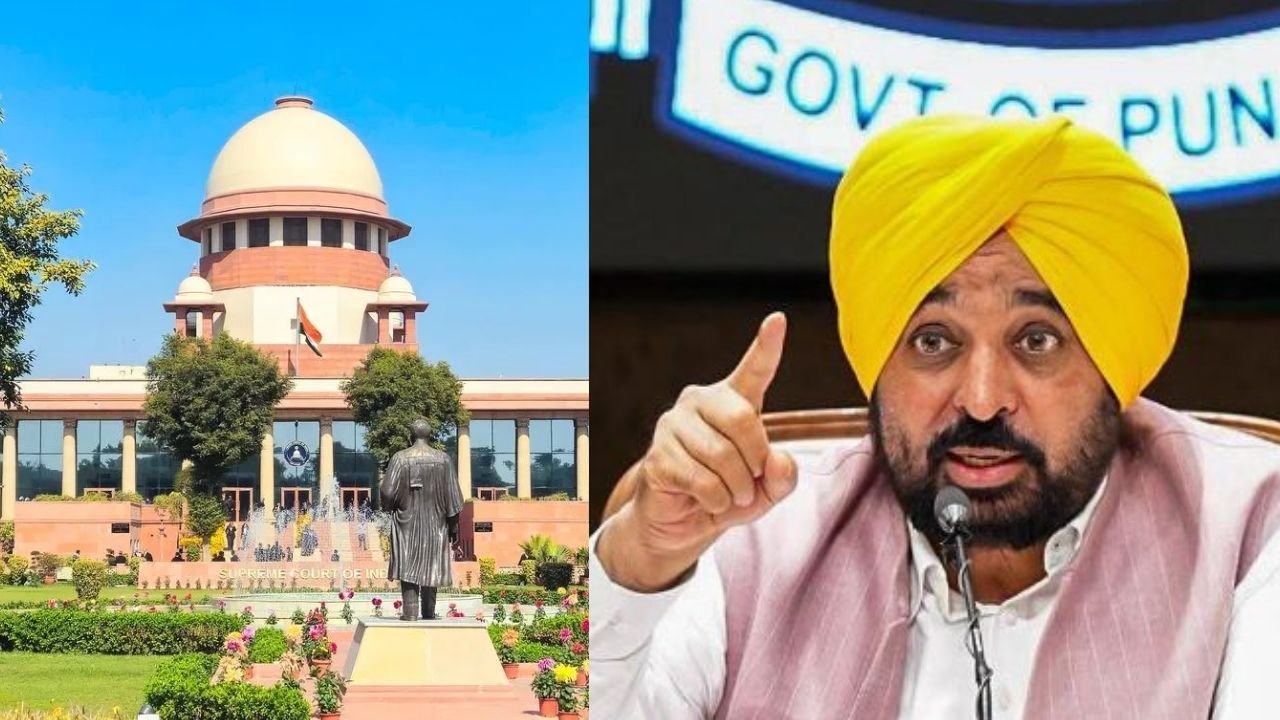
The Supreme Court on October 12, 2026, declined to stay a Central Bureau of Investigation (CBI) First Information Report registered in connection with corruption allegations against Rajbir Singh Ghuman, Officer on Special Duty (OSD) to Punjab Chief Minister Bhagwant Mann, while directing that no coercive steps be taken in the matter during the pendency of the proceedings. A Bench comprising Justice M.M. Sundresh and Justice Prasanna B. Varale issued notice on the petition filed by the State of Punjab challenging the Punjab and Haryana High Court’s direction to the CBI to register a criminal case and investigate the allegations. The Bench expressly clarified that it was not staying the FIR, distinguishing the protection against coercive action from an order that would halt the criminal investigation itself. The State was also required to cooperate with the investigation. The order, therefore, grants interim protection without extinguishing the CBI proceedings or finally deciding whether the High Court was justified in directing a central agency to investigate allegations involving the Chief Minister’s Office.
The case, titled State of Punjab v. Nikhil Saraf, arises from a public interest litigation filed by advocate Nikhil Saraf before the High Court. The PIL alleged that the Punjab Police had failed to take appropriate action despite communications from the Enforcement Directorate (ED) seeking investigation into suspected corruption and influence-peddling involving persons allegedly connected with the State government. The High Court, comprising Chief Justice Ashwani Kumar Mishra and Justice Rohit Kapoor, directed the CBI on October 5, 2026, to register a criminal case and investigate the allegations. It also directed the Punjab government and the State Police to provide the agency with the records and assistance necessary for a fair investigation. The CBI subsequently registered an FIR naming Ghuman and five other accused, besides referring to unidentified public servants and private persons. The High Court had also directed the agency to submit a report on its investigation within two months, placing the inquiry under judicial scrutiny from its inception.
When the State’s challenge came before the Supreme Court, Senior Advocate Vikas Singh appeared for Punjab. Senior Advocate Dama Seshadri Naidu, appearing for the respondent and original PIL petitioner, submitted that his client was facing what he described as vindictive action by the State government and that his property had been demolished. He sought protection against further harassment. The proceedings had been placed before the Bench of Justice Sundresh and Justice Varale after Justice Sheel Nagu recused himself from the matter when it was earlier listed before a Bench comprising Justice Dipankar Datta and Justice Nagu. The recusal was significant to the procedural history because Justice Nagu had previously served as Chief Justice of the Punjab and Haryana High Court. The recusal itself was not a finding on the merits of the allegations or the legality of the CBI investigation; it was a step concerning the constitution of the Bench hearing the State’s challenge.
The Supreme Court’s interim order must be understood in its precise terms. The Court did not quash the FIR, declare it illegal or direct the CBI to suspend its investigation. Instead, it issued notice on the State’s petition and restrained coercive steps while the challenge remained pending. The distinction is essential because an FIR is the formal starting point of a criminal investigation, not a determination of guilt. A direction against coercive action protects the persons covered by the order against specified forms of immediate compulsion, but it does not ordinarily prevent the investigating agency from examining documents, collecting evidence or pursuing lawful investigative steps that are not barred by the order. Its exact scope must be governed by the language of the judicial direction, rather than by a general assumption that the accused have been granted immunity from the investigation.
The Bench’s refusal to stay the FIR is equally important. A stay of the criminal case at its threshold would have substantially restricted the investigation while the State challenged the High Court’s intervention. By declining that relief but granting interim protection, the Court preserved the investigation while ensuring that coercive action would not proceed unchecked during the pendency of the challenge. This is a procedural balance, not a final endorsement of either side’s position. It would therefore be inaccurate to describe the order as a complete victory for the State government, just as it would be premature to treat the refusal to stay the FIR as a final judicial finding that the allegations against Ghuman and the other accused are true.
The allegations that prompted the investigation concern the suspected use of intermediaries to obtain government favours in exchange for monetary or other benefits. According to information reportedly communicated by the ED to the Punjab Director General of Police, one Nitin Gohal allegedly acted as an intermediary between private individuals seeking official favours and persons said to have access to government decision-makers. The alleged transactions concern transfers and postings of public officials, tender conditions, administrative approvals, policy decisions, licensing matters, arms licences and land-related dealings. The material also reportedly refers to alleged access to confidential government documents and drafts of official orders or policies before their formal issuance. The CBI’s case is that these matters warrant investigation into possible corruption and the improper use of official influence. These allegations remain subject to investigation and must not be treated as established misconduct by the named individuals.
The reported origin of the allegations lies in an ED investigation involving suspected irregularities connected with a housing society and the process of obtaining change-of-land-use permission. During that investigation, the ED reportedly gathered information concerning alleged intermediaries, suspected benefits and possible interference in administrative processes. The agency then communicated its concerns to the Punjab Police, seeking criminal action. The State Police’s handling of that information became central to the PIL: the petitioner alleged that the authorities had not taken adequate action despite receiving material that, in his assessment, warranted registration of an FIR. The High Court examined the material placed before it and concluded that a criminal investigation by the CBI was necessary. The Supreme Court is now being asked to examine the legality of that intervention, rather than to determine the ultimate truth of every allegation contained in the ED’s communications.
The controversy raises a fundamental question about the duty of the police when information suggests the commission of a cognisable offence. The State’s challenge has questioned the legal basis of the High Court’s direction, including its treatment of information forwarded by the ED under Section 66(2) of the Prevention of Money Laundering Act, 2002. That provision permits the sharing of information with other agencies in circumstances specified by law. However, the communication of information by one agency does not automatically establish the commission of an offence, nor does it relieve the receiving agency of its duty to assess the material under the applicable criminal law. The relevant question is whether the information, taken at the appropriate procedural stage, discloses a cognisable offence requiring registration of an FIR or further lawful action.
The principles laid down by the Supreme Court in Lalita Kumari v. Government of Uttar Pradesh, (2014) 2 SCC 1, remain relevant to that inquiry. The Constitution Bench held that registration of an FIR is mandatory where the information received by the police discloses a cognisable offence, subject to limited circumstances in which a preliminary inquiry may be permissible to determine whether such an offence is disclosed. A preliminary inquiry is not intended to conduct a full assessment of the truth of the allegations before registration. Its purpose is to determine whether the information reveals the commission of a cognisable offence. In a corruption-related matter involving public servants, this general principle must be read alongside the specific statutory safeguards governing inquiries and investigations into official decisions. The law neither permits police authorities to disregard credible information arbitrarily nor requires criminal proceedings to be initiated without considering the applicable statutory framework.
A central issue in the State’s challenge concerns the protection available to public servants under Section 17A of the Prevention of Corruption Act, 1988. The provision requires prior approval in specified circumstances before an inquiry, inquiry or investigation can be conducted into an alleged offence relatable to a recommendation made or decision taken by a public servant in the discharge of official functions, subject to the statutory exceptions. Its purpose is to prevent honest public servants from being subjected to criminal proceedings merely because they have taken official decisions. The provision is not, however, a blanket immunity for conduct connected with government administration. Whether it applies depends on the nature of the alleged act, the public servant’s role, the statutory conditions and any applicable exception.
The distinction between a disputed administrative decision and an alleged corrupt transaction is especially important in this case. Transfers, postings, tenders, licences and policy decisions are ordinary features of government functioning. Their existence, or the fact that an official had access to the Chief Minister’s Office, cannot by itself establish a criminal offence. But where the allegation is that official influence was allegedly traded for pecuniary benefits, or that confidential government material was supplied to private persons for an improper purpose, the issue may extend beyond the merits of administrative discretion. The legal inquiry must focus on whether the alleged conduct discloses an offence under the applicable law and whether the procedural requirements for investigating it have been met. The statutory protection for bona fide official decision-making cannot be converted into an unrestricted shield against investigating corruption; equally, the allegation of corruption cannot be used to bypass safeguards Parliament has expressly enacted.
The Punjab government has also characterised the High Court’s direction as raising concerns about the federal structure, particularly because a central investigative agency has been directed to investigate allegations involving the administration of an elected State government. This argument engages a longstanding constitutional tension between State autonomy and the need for an independent investigation where the impartiality of the State machinery is questioned. The CBI is not automatically entitled to investigate every matter arising within a State merely because an allegation has been made. Its authority must rest on a legally sustainable basis. Yet the fact that an investigation concerns State officials does not, by itself, prevent a constitutional court from directing an independent agency to investigate in an appropriate case.
The Constitution Bench decision in State of West Bengal v. Committee for Protection of Democratic Rights, (2010) 3 SCC 571, is relevant to this issue. The Supreme Court held that constitutional courts exercising their powers under Articles 32 and 226 may direct a CBI investigation without the consent of the State concerned. Such power is exceptional and must be exercised sparingly, cautiously and in appropriate cases. The ruling recognises that State consent cannot operate as an absolute barrier where a constitutional court considers an independent investigation necessary to protect the rule of law. At the same time, the existence of that power does not mean that every allegation against a State official warrants a CBI probe. The reasons for transferring the investigation, the material available and the adequacy of the existing investigative response remain central to judicial scrutiny.
The High Court’s order must consequently be evaluated by examining why it considered the CBI necessary and whether the material before it justified that conclusion. According to the reports of the proceedings, the High Court was concerned that the ED had furnished information indicating possible cognisable offences involving persons connected with high public office, while the State Police had not registered an FIR. The High Court also questioned the adequacy of the preliminary inquiry conducted by the State authorities. If the material reasonably suggested that the existing investigative process was not addressing the allegations adequately, the need for an independent inquiry could become a relevant constitutional consideration. Conversely, the State is entitled to argue that the High Court failed to give sufficient weight to statutory requirements or intervened beyond what the material justified. Those competing positions require judicial determination; neither the political sensitivity of the case nor the involvement of a central agency resolves the legal issue by itself.
The wider political context has sharpened the dispute. The Punjab government has alleged that central investigative agencies are being used to target an opposition-ruled State, while the Chief Minister has publicly questioned the timing and purpose of the CBI action. Such allegations of political motivation are serious, but they must be assessed through evidence and legal scrutiny rather than treated as established facts. Equally, allegations involving a public office cannot be presumed genuine merely because they have been referred to a central agency. The rule of law requires an investigation capable of examining the material objectively, preserving relevant records and distinguishing between political allegations, administrative disagreements and conduct that may amount to a criminal offence.
The case also illustrates why the distinction between institutional accountability and individual criminal liability must be maintained. Ghuman’s position as OSD to the Chief Minister may explain why allegations concerning access to the government and influence over administrative decisions have attracted heightened scrutiny, but designation alone does not establish criminal responsibility. The investigation must establish what each accused allegedly did, whether any benefit was sought or received, whether official powers were misused and whether the evidence satisfies the ingredients of the offences invoked. Nor can allegations against an aide automatically be attributed to the Chief Minister or the government as a whole without evidence establishing the relevant individual’s participation, knowledge or legal responsibility. Criminal law proceeds on proof of conduct and legally attributable responsibility, not association.
The evidence likely to be material to the investigation includes communications between alleged intermediaries and public officials, financial transactions, departmental files, tender records, policy drafts, transfer and posting orders, licensing documents and records relating to land-use permissions. The CBI will need to determine whether the alleged pattern reflects ordinary administrative dealings, improper influence without a criminal offence, or transactions involving conduct punishable under the Prevention of Corruption Act and other applicable laws. The mere existence of a communication or a change in an official decision is not conclusive proof of bribery. Equally, a pattern of communications, financial benefits and unexplained interventions may acquire significance when assessed together with the surrounding evidence. The investigation must establish the connection between the alleged benefit and the exercise or influence of public power, rather than rely on suspicion alone.
The interim order also raises the practical question of how an investigation can proceed while coercive action is restrained. Investigative agencies possess several lawful methods of gathering evidence that do not necessarily involve arrest or other coercive measures. Documentary records can be examined, witnesses may be approached in accordance with law, and electronic or financial evidence may be collected subject to applicable safeguards. The Court’s direction does not eliminate the need for cooperation or the preservation of relevant material. Nor does it allow the investigating agency to disregard the restraint by adopting a different label for action that is, in substance, coercive. The agency must comply with the order while continuing such investigative steps as remain legally permissible.
The Court’s direction requiring cooperation is therefore not a minor procedural detail. A State government challenging an investigation is entitled to pursue its legal remedies, but the pendency of that challenge does not automatically authorise it to withhold records or obstruct investigative steps that have not been stayed. Cooperation, however, should not be confused with acceptance of the CBI’s allegations or surrender of the State’s legal objections. The Punjab government can maintain its challenge to the High Court’s order while complying with the operative directions of the Supreme Court. This distinction helps ensure that judicial review and criminal investigation proceed simultaneously without one being used to frustrate the other.
The proceedings also demonstrate the importance of protecting the rights of persons who bring allegations of public wrongdoing. During the Supreme Court hearing, counsel for Nikhil Saraf submitted that the petitioner was facing vindictive action and that his property had been demolished, seeking protection from further harassment. Those submissions have not been established as judicial findings in the present proceedings. Nevertheless, allegations of retaliation against a complainant or public interest litigant raise a separate rule-of-law concern: individuals must be able to approach constitutional courts without facing unlawful reprisals. Any such allegation must be examined on its own evidence and legal footing, independently of whether the underlying corruption allegations are ultimately proved.
The Supreme Court has not yet determined whether the High Court’s order directing a CBI investigation should be set aside. The notice issued on the State’s petition initiates further consideration of the legal challenge, while the refusal to stay the FIR leaves the criminal case operative. The direction against coercive action provides interim protection but does not amount to a final finding that the CBI lacks jurisdiction, that the FIR is invalid or that the accused have been exonerated. Similarly, the High Court’s direction to investigate does not amount to a finding that corruption has occurred. The final outcome will depend on the Court’s assessment of the statutory framework, the reasons supporting the High Court’s intervention and the arguments advanced by the parties.
The broader significance of State of Punjab v. Nikhil Saraf lies in the constitutional balance it brings into focus: public servants must be protected against arbitrary prosecution, but public office cannot become a shield against credible allegations of corruption. State autonomy is an important feature of Indian federalism, yet it must coexist with the constitutional responsibility of courts to ensure that serious allegations are investigated through lawful and impartial processes. Central agencies must likewise remain accountable to statutory limits and judicial directions. The Supreme Court’s interim approach preserves these competing considerations without prematurely deciding the merits. By refusing to stay the FIR while restraining coercive action and requiring cooperation with the investigation, the Bench has kept the legal challenge alive while leaving the underlying allegations to be tested through evidence. Ultimately, the credibility of the process will depend not on the political identity of the government or the agency involved, but on whether the investigation is lawful, impartial and capable of distinguishing suspicion from proof.
