


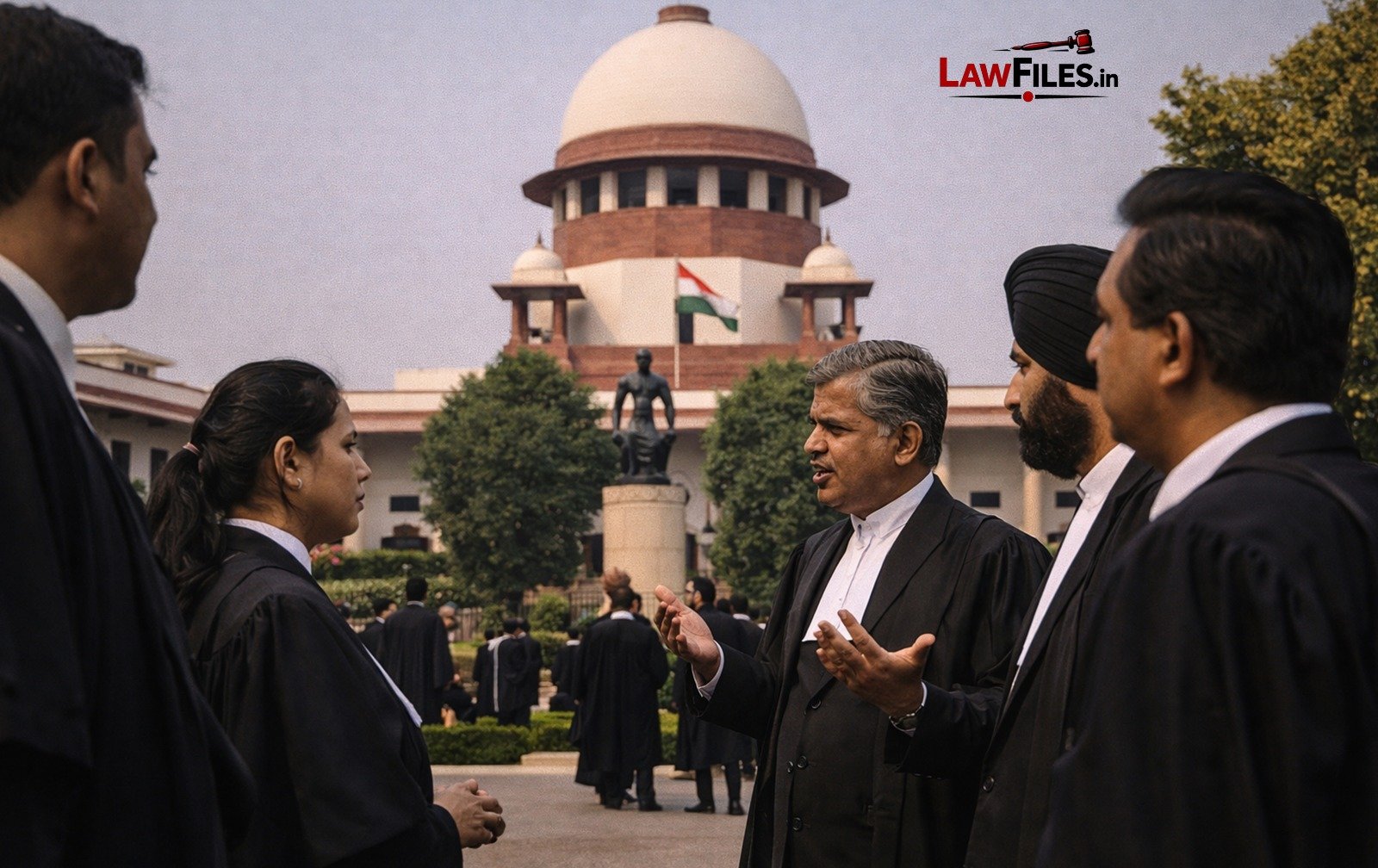
The Supreme Court on October 5 came down heavily on actor Rajpal Yadav for repeatedly failing to comply with directions to deposit money in connection with seven cheque dishonour cases, observing that the Court was inclined to dismiss his challenge to the conviction but was giving him another opportunity in an effort to secure payment for the complainant. A Bench comprising Chief Justice of India Surya Kant, Justice Joymalya Bagchi and Justice V. Mohana expressed strong displeasure at Yadav’s conduct and questioned why he had neither complied with the Court’s earlier direction nor sought an extension of time. The Court ultimately granted what it described as a final opportunity to make the required deposit by the following day and posted the matter for October 7.
The proceedings arise from the long-running dispute between Yadav and M/s Murli Projects Pvt. Ltd., relating to financial assistance obtained for the production of his film Ata Pata Laapata. The dispute has travelled through criminal complaints under Section 138 of the Negotiable Instruments Act, 1881, and has now reached the Supreme Court in a challenge to the conviction and sentence imposed upon Yadav. The present proceedings are therefore not an adjudication of a fresh allegation against the actor but arise from his attempt to obtain relief against an existing conviction while simultaneously complying with conditions imposed by the courts for protecting him from immediate surrender.
The underlying financial transaction dates back to 2010, when Yadav and his wife obtained approximately ₹5 crore from Murli Projects in connection with the film venture. The arrangements between the parties subsequently underwent changes and ultimately resulted in cheque-related disputes. According to the material placed before the courts, multiple cheques issued in the course of the transactions were dishonoured, leading to seven separate criminal complaints. The litigation consequently moved beyond a purely commercial disagreement because dishonour of a cheque, when the statutory requirements are satisfied, constitutes an offence under Section 138 of the Negotiable Instruments Act.
The legal framework surrounding Section 138 is important to understanding why the matter has persisted for so long. The provision was introduced to strengthen the credibility of negotiable instruments in commercial transactions by attaching penal consequences to dishonour of cheques in circumstances prescribed by the statute. At the same time, the Supreme Court has repeatedly emphasised that the provision is not intended to convert every commercial dispute into a mechanism for criminal recovery. The statutory ingredients must be established, including presentation of the cheque within the prescribed period, its dishonour, issuance of the requisite statutory notice and failure to make payment within the stipulated period.
In Yadav’s case, however, the criminal courts ultimately found him liable in the seven cheque dishonour proceedings. The Delhi High Court, in its July 10 order, upheld the convictions and imposed three months’ simple imprisonment in each of the seven cases, directing that the sentences run concurrently. The High Court also required payment of approximately ₹1.05 crore in each case to the complainant, with the larger component directed as compensation and a smaller amount payable to the State. The High Court took into account the fact that approximately ₹2.25 crore had already been paid during the course of the litigation and directed that this amount be adjusted while determining the outstanding liability.
The High Court’s order is particularly relevant because the dispute had already witnessed repeated attempts to secure compliance through undertakings and settlement proposals. The court had earlier extended opportunities to Yadav to make payment, and the matter was also referred to mediation. The High Court ultimately concluded that the repeated failure to honour commitments could not continue indefinitely. The suspension of sentence and the time granted to approach the Supreme Court were therefore not an unconditional exoneration but a limited procedural protection enabling Yadav to challenge the judgment before the country’s highest court.
When the matter reached the Supreme Court on September 8, the Bench granted interim exemption from surrender, but expressly attached a financial condition. Yadav was directed to deposit ₹5 crore with the Court Registry. The significance of this condition lies in its nature: the Supreme Court was not, at that stage, finally deciding the criminal appeal or setting aside the conviction. It was balancing the appellant’s request for interim protection with the complainant’s legitimate interest in securing at least a substantial amount towards the monetary liability arising from the proceedings.
The September 15 hearing demonstrated that the condition had not been complied with. Senior Advocate P.S. Patwalia, appearing for Yadav, sought additional time and submitted that the actor did not presently have the required liquidity, although he intended to make the payment. The Court was told that property could be sold to raise the amount and that a concrete proposal involving an initial payment of ₹2 crore would be presented. The Bench granted another two weeks but made it clear that this was a final opportunity. It also directed Yadav to surrender his passport and extended the protection from surrender until October 5.
It was against that background that the October 5 hearing became particularly contentious. The Court noted that even the September 15 direction requiring the ₹2 crore payment had not been complied with. Counsel for Yadav produced photocopies of demand drafts of ₹50 lakh each and stated that the drafts had been issued in Maharashtra and were being brought to Delhi. The complainant’s counsel questioned the authenticity and reliability of relying upon photocopies rather than an actual deposit. The submission was that the Court had ordered payment, not merely the preparation or circulation of documents purporting to represent payment.
The Bench was visibly dissatisfied. Justice Joymalya Bagchi questioned why the earlier directions had not been obeyed and why Yadav had not even filed an application seeking additional time. The Court noted that the September 15 order had provided fifteen days and that the period had already expired. The fact that the petitioner had neither complied nor formally approached the Court for an extension was treated as a serious matter of procedural disregard. The Court’s remarks concerning “arrogance” therefore arose in the context of repeated non-compliance with judicial directions rather than as a finding that the actor had committed any new offence during the present proceedings.
The Bench also made an unusually candid observation that it was inclined to dismiss the petition but was attempting to ensure that some money reached the complainant. The Court’s approach reveals the delicate balance involved in exercising appellate and interim jurisdiction after conviction. Once a person has been convicted by the criminal courts, the presumption of innocence no longer operates in the same manner as it does at the trial stage. An appellate court can suspend the sentence and grant interim protection, but such relief remains subject to judicial conditions designed to ensure that the appellate process is not used to indefinitely postpone the consequences of conviction.
This aspect is particularly important in cases involving Section 138 of the Negotiable Instruments Act. The Supreme Court has consistently encouraged mechanisms that ensure compensation to complainants and reduce prolonged criminal litigation arising from cheque dishonour. Section 143A permits interim compensation in appropriate cases, while Section 148 empowers the appellate court, in an appeal against conviction under Section 138, to order the appellant to deposit a minimum prescribed percentage of the fine or compensation awarded by the trial court. These provisions reflect a legislative recognition that the criminal process should not become a means by which a convicted drawer can indefinitely delay the financial consequences of dishonoured cheques.
Section 148 is especially relevant to understanding the Supreme Court’s insistence upon payment. The provision permits the appellate court to direct the appellant to deposit at least twenty per cent of the fine or compensation awarded by the trial court, subject to the statutory framework. In Surinder Singh Deswal v. Virender Gandhi, the Supreme Court emphasised the object of this provision and held that it was introduced to discourage frivolous appeals and protect the interests of the complainant. The legislative policy is therefore not that a convicted person loses his right of appeal upon filing the appeal, but that the appellate process cannot necessarily operate as an unconditional shield against enforcement of the monetary consequences of conviction.
At the same time, the Supreme Court’s present conduct should not be understood as meaning that payment of money automatically determines the correctness of the conviction. The criminal appeal remains a distinct proceeding. The deposit is a condition associated with interim protection and the equitable balancing of interests; it does not by itself constitute an adjudication that the conviction is legally flawless. If the Supreme Court ultimately finds a legal infirmity in the conviction, the consequences will have to follow from that determination. Conversely, if the conviction is upheld, the financial deposit may become an important component of the complainant’s recovery.
The procedural history also illustrates why courts become increasingly reluctant to grant repeated indulgence when undertakings are not honoured. Judicial orders depend upon compliance. An undertaking given to a court is not merely a statement made during oral arguments; once acted upon by the court, it forms part of the basis upon which judicial discretion is exercised. If a litigant repeatedly seeks protection on the basis of proposed payments and subsequently fails to honour those commitments, the court is entitled to reassess whether the litigant continues to deserve discretionary protection.
This principle is not unique to criminal proceedings. Across civil, commercial and constitutional litigation, courts have consistently treated deliberate or repeated non-compliance as a factor capable of disentitling a litigant from equitable relief. The reason is institutional rather than punitive. A court cannot effectively administer justice if its orders are treated as negotiable suggestions. Judicial discretion necessarily assumes reciprocal respect for judicial directions.
The passport direction issued by the Supreme Court adds another dimension. By requiring Yadav to deposit his passport while granting temporary protection from surrender, the Court was exercising a conventional form of judicial control intended to secure his presence during the pendency of the proceedings. The fact that even this direction was subsequently raised by the complainant’s side demonstrates the Court’s concern that the interim protection was not being matched by corresponding compliance with the safeguards imposed upon it.
There is, however, an important legal distinction between enforcing a monetary obligation and exercising criminal jurisdiction. Section 138 proceedings are criminal in form but have a substantial compensatory dimension. The complainant’s interest in receiving the money is undeniably important, but the criminal court must still independently determine the statutory ingredients of the offence. The present Supreme Court proceedings therefore illustrate the hybrid character of cheque dishonour litigation: the offence is penal, yet the legislative and judicial framework places considerable emphasis on compensation, settlement and restoration of the complainant’s financial position.
The history of the case also demonstrates the limitations of repeatedly seeking settlement after conviction. Settlement can be encouraged at different stages of cheque dishonour litigation, and the statutory scheme itself permits compounding. But where several opportunities have been offered and undertakings repeatedly remain unfulfilled, the court is not required to keep the criminal process indefinitely suspended in the hope of an eventual settlement. The integrity of the judicial process requires that an accused seeking discretionary relief demonstrate bona fides through actual compliance rather than repeated assurances of future compliance.
The Supreme Court’s remarks should nevertheless be understood in their proper procedural setting. The Court has not, by today’s order, finally dismissed Yadav’s challenge to his conviction. Nor has it finally determined the monetary liability beyond the directions already made by the courts below. What the Court has done is to provide one final opportunity for compliance while making it clear that failure to comply may have immediate consequences for the interim protection that has allowed Yadav to remain outside custody. The matter has been posted for October 7.
The broader lesson from the proceedings concerns the relationship between appellate relief and obedience to judicial orders. An appeal is a statutory remedy, and a convicted person is entitled to pursue it. But the existence of an appeal does not create an automatic right to remain outside custody, particularly after a competent court has imposed a sentence. Suspension of sentence is discretionary and may be accompanied by conditions designed to balance the interests of the appellant, the complainant and the administration of justice. Once those conditions are accepted, their observance becomes integral to the continuation of the interim relief.
The Court’s approach also demonstrates that judicial patience has limits. The September proceedings had already given Yadav additional time after his counsel sought “breathing space” to arrange the money. The October hearing revealed that the promised compliance had again not materialised. From the Court’s perspective, the issue was consequently no longer simply whether the actor was financially capable of making the deposit. It was whether a litigant who had received repeated indulgence could continue seeking discretionary protection without demonstrating concrete compliance with the conditions upon which that protection had been granted.
There is an equally important lesson for litigants generally. Courts can accommodate genuine financial difficulty, particularly where a party demonstrates good faith and approaches the court transparently with a realistic proposal. But the correct course where compliance becomes impossible is to seek modification or extension before the deadline expires. Silence followed by non-compliance can have a very different legal consequence from a bona fide application explaining why an order cannot be complied with and proposing an alternative arrangement. The Supreme Court’s criticism that Yadav had not even sought an extension brings this procedural principle into sharp focus.
Ultimately, the Rajpal Yadav proceedings are less about celebrity status than about a recurring problem in the administration of cheque dishonour litigation: how long can a convicted drawer continue to obtain protection while the complainant waits for the money that courts have already directed to be paid? The answer cannot be that every accused must immediately surrender his appellate rights, nor can it be that repeated assurances indefinitely postpone the consequences of conviction. The judicial task is to maintain equilibrium between the right to challenge a conviction and the complainant’s right to meaningful enforcement of the relief already granted.
The Supreme Court’s latest order accordingly carries a wider message about the authority of judicial directions. The Court has shown that interim protection is not an entitlement detached from compliance and that repeated opportunities, once exhausted, cannot be converted into an indefinite postponement of the consequences of conviction. Whether Yadav ultimately succeeds in his challenge to the seven convictions will be decided on the merits of the criminal appeals. But for the present, the Supreme Court has made one principle unmistakably clear: a litigant seeking the protection of the Court must demonstrate corresponding respect for the orders through which that protection has been granted.
