


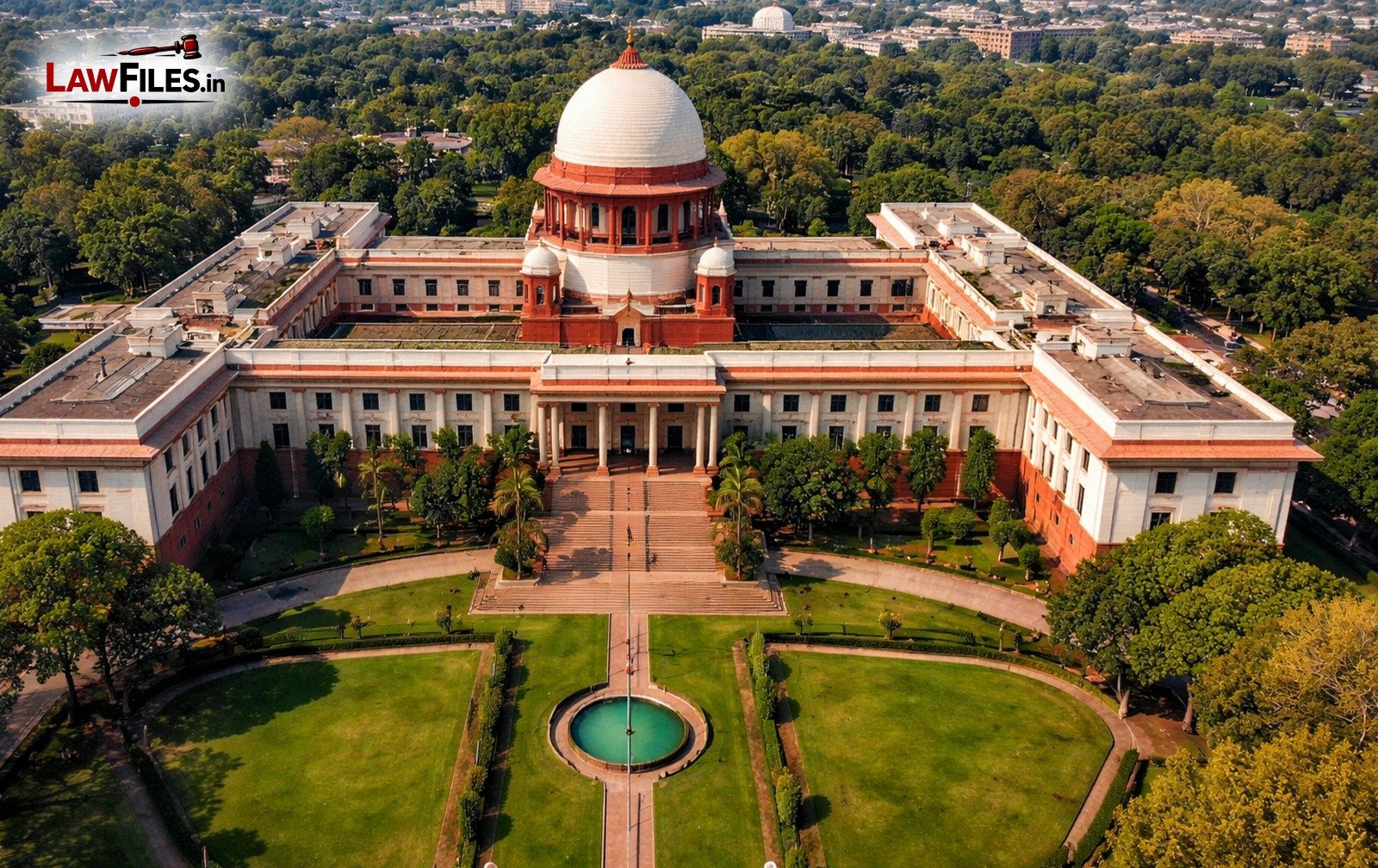
In a significant judgment that is likely to reshape the trajectory of indirect tax litigation across the country, the Supreme Court has held that disputes concerning the “excisability” or “taxability” of goods under the Central Excise Act fall within the exclusive appellate jurisdiction of the Supreme Court and cannot be entertained by High Courts. The ruling not only resolves a long-standing jurisdictional debate but also provides important clarity on the relationship between questions of manufacture, taxability, and the statutory appellate framework under the Central Excise Act, 1944.
The judgment was delivered by a Bench comprising Justice J.B. Pardiwala and Justice R. Mahadevan while deciding an appeal arising from a dispute between the Revenue Department and M/s Alupro Building Systems Pvt. Ltd. The Court set aside the Karnataka High Court’s decision and reaffirmed that whenever the core issue concerns whether goods are excisable, the matter must travel directly to the Supreme Court under Section 35L of the Central Excise Act.
At the heart of the dispute lay a seemingly technical but commercially significant question: does cutting, grooving, and bending Aluminium Composite Panels (ACPs) for installation on building facades amount to “manufacture” under excise law? The answer to this question would determine whether excise duty could be levied on the activity.
The controversy originated when Alupro Building Systems, a company engaged in façade and cladding solutions, imported pre-coated ACP sheets for use in construction projects. Before installation, the panels were cut to required dimensions, grooved at the edges, and bent to facilitate attachment to structural frameworks. According to the company, these activities merely adapted the panels for installation and did not transform them into a new commercial product. The Revenue Department, however, took a contrary view and alleged that the process resulted in the emergence of a distinct marketable commodity, thereby attracting excise duty.
Based on this interpretation, the Department raised substantial duty demands along with interest and penalties. The company challenged the assessment before the Customs, Excise and Service Tax Appellate Tribunal (CESTAT), which ruled in its favour and held that no manufacturing activity had taken place. The Tribunal concluded that the ACP panels retained their original identity despite the modifications carried out for installation purposes.
Unhappy with the Tribunal’s decision, the Revenue Department appealed before the Karnataka High Court under Section 35G of the Central Excise Act. The High Court entertained the appeal, framed substantial questions of law, and ultimately reversed the Tribunal’s findings, thereby restoring the tax demands against the company. It was this exercise of jurisdiction by the High Court that became the central issue before the Supreme Court.
Before the Apex Court, the company raised a fundamental objection: the Karnataka High Court lacked jurisdiction to hear the appeal in the first place because the dispute related to the excisability of goods. The argument required the Court to examine the interplay between Sections 35G and 35L of the Central Excise Act.
Section 35G permits appeals to High Courts on substantial questions of law arising from orders of the Tribunal. However, the provision specifically excludes matters relating to the rate of duty or valuation of goods for assessment purposes. Such disputes are reserved for direct appeal to the Supreme Court under Section 35L. The crucial question, therefore, was whether “excisability” forms part of a dispute relating to the rate of duty and assessment.
The Revenue argued that the case merely involved determining whether a particular activity constituted manufacture, making it a pure question of law suitable for adjudication by the High Court. The Supreme Court rejected this submission and adopted a broader understanding of taxability. The Bench observed that before any rate of duty can be applied, it must first be determined whether the goods are excisable at all. Consequently, the question of excisability is intrinsically connected with the rate of duty and assessment process.
In a significant observation, the Court held that determination of excisability is a “precursor” to deciding questions relating to duty and valuation. Therefore, such disputes automatically fall within the exclusive appellate jurisdiction of the Supreme Court. The Bench emphasised that jurisdiction cannot be conferred merely by framing a dispute as a substantial question of law when Parliament has expressly excluded the subject matter from the High Court’s appellate domain.
The judgment also examined the legislative intent behind the Finance Act, 2014, which introduced Section 35L(2). The amendment clarified that disputes concerning the “determination of any question having relation to the rate of duty” include issues relating to taxability and excisability. While the Revenue attempted to argue that this clarification operated prospectively, the Supreme Court held otherwise.
According to the Bench, Section 35L(2) is clarificatory in nature and merely expresses what Parliament always intended. It does not create a new legal principle but explains the true scope of the original statutory scheme. As a result, even disputes that arose prior to the 2014 amendment and concern excisability would fall within the Supreme Court’s exclusive jurisdiction. This aspect of the ruling is likely to have significant consequences for pending tax litigation involving jurisdictional objections.
Having concluded that the Karnataka High Court lacked jurisdiction, the Supreme Court could have disposed of the matter on that ground alone. However, the Bench proceeded to examine the substantive issue as well—whether the processing of ACP sheets amounted to manufacture.
The Court answered the question in unequivocal terms. It held that the process of cutting, grooving, and bending ACP sheets did not result in the emergence of a new product with a distinct name, character, or use. What entered the process as an ACP sheet emerged as an ACP sheet, albeit modified in dimensions for a specific installation requirement. The essential identity of the product remained unchanged throughout.
The judgment reiterates a settled principle of excise jurisprudence: manufacture requires the creation of a commercially distinct commodity. Mere adaptation, preparation, sizing, shaping, or installation-related modification is insufficient to attract excise duty unless it results in a fundamentally new product recognised in the market as separate from the original goods. The Court therefore restored the Tribunal’s finding that no manufacture had taken place and that the activity was not excisable.
Beyond the immediate dispute, the ruling carries broader implications for India’s tax administration framework. Jurisdictional certainty is a critical component of tax law because it determines the forum in which disputes are adjudicated. By drawing a clear line between matters that may be heard by High Courts and those reserved for the Supreme Court, the judgment seeks to prevent inconsistent interpretations emerging from multiple High Courts across the country.
For businesses, the decision provides welcome clarity regarding appellate strategy in indirect tax matters. Companies involved in disputes concerning classification, taxability, excisability, and assessment can now better identify the appropriate appellate forum. For tax authorities, the ruling serves as a reminder that statutory appellate routes cannot be bypassed by creatively characterising disputes as general questions of law.
For law students and young practitioners, the judgment is particularly instructive because it sits at the intersection of statutory interpretation, tax jurisprudence, and jurisdictional law. It demonstrates how procedural questions can often become as significant as substantive tax disputes themselves. The case also illustrates the importance of legislative intent and clarificatory amendments in resolving interpretative controversies.
Ultimately, the Supreme Court’s decision is about more than aluminium panels or excise duty. It is a reaffirmation of a fundamental legal principle: jurisdiction flows from statute and cannot be assumed merely because a legal question exists. By holding that questions of excisability belong exclusively before the Supreme Court, the Court has brought much-needed certainty to an area of tax litigation that has witnessed considerable confusion over the years.
The ruling will likely serve as a leading precedent in future disputes involving indirect taxation, appellate jurisdiction, and the interpretation of the Central Excise Act, while simultaneously reinforcing the principle that not every tax dispute can travel through the High Courts before reaching the nation’s highest court.
