


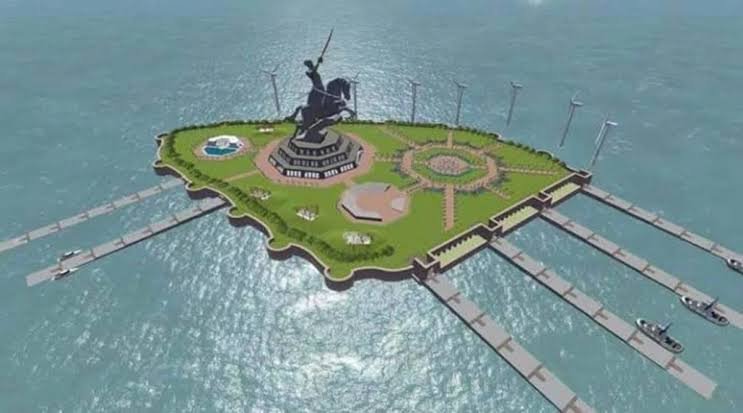
In a significant reaffirmation of the constitutional principle that public sentiment cannot legitimise an illegality, the Supreme Court declined to interfere with the Bombay High Court’s order directing the removal of a Chhatrapati Shivaji Maharaj statue erected on land belonging to the Mormugao Port Authority in Goa. A Vacation Bench comprising Justice M.M. Sundresh and Justice Sheel Nagu expressed its disinclination to entertain the Special Leave Petition challenging the High Court’s decision. Faced with the Bench’s observations, the petitioners sought permission to withdraw the matter, which was accordingly dismissed as withdrawn with liberty to approach the Bombay High Court by filing an appropriate application seeking modification or variation of its earlier order. While the Supreme Court did not enter into the merits of the dispute, its refusal to exercise discretionary jurisdiction under Article 136 of the Constitution effectively leaves the High Court’s directions undisturbed for the time being and underscores the judiciary’s consistent approach that even symbolic or culturally significant structures must conform to the rule of law.
The controversy originated before the Bombay High Court after the Mormugao Port Authority approached the Court alleging that a group of local persons had forcibly entered Port land at Vasco-da-Gama and installed a statue of Chhatrapati Shivaji Maharaj without obtaining any statutory permission or authorisation from the land-owning authority. The Port Authority contended that despite repeated complaints to the Bogda Police Station and other civil authorities, no meaningful action was taken to prevent the alleged encroachment or to remove the unauthorised construction. It further alleged that the encroachment had occurred despite clear objections and that local authorities remained passive even after being informed about the continuing occupation of public land.
A Division Bench of the Bombay High Court comprising Justice Valmiki Menezes and Justice Amit Borkar (Jamsandekar as reported in some accounts) examined the matter and came down heavily on both the local administration and the State Government for what it described as a complete failure to discharge their statutory obligations. The High Court held that the statue had been installed in “gross violation” of applicable laws and that the authorities had virtually remained spectators while public property belonging to a major port was encroached upon. The Court observed that the issue before it was not the identity of the historical personality whose statue had been installed, but whether occupation of public land without legal sanction could be tolerated in a constitutional democracy governed by the rule of law. It therefore directed removal of the unauthorised structure while emphasising that constitutional governance cannot permit illegal occupation of public property merely because the subject matter carries emotional, political or historical significance.
One of the most striking aspects of the High Court’s reasoning was its criticism of the Goa administration’s response to the incident. During the proceedings, the State sought to argue that the property belonged to the Mormugao Port Authority, which is protected by the Central Industrial Security Force (CISF), and therefore the Port Authority itself ought to have taken steps to safeguard its land. Rejecting this contention, the High Court observed that maintenance of law and order remains the constitutional responsibility of the State Government irrespective of the ownership of the property concerned. The Court remarked that if similar encroachments occurred upon airports, railway properties or other installations under the protection of central agencies, the State could not simply abdicate its policing responsibilities by shifting the burden to those institutions. Such an approach, the Court observed, would undermine the federal distribution of constitutional responsibilities concerning public order and policing.
The High Court further recorded serious concern over the conduct of the local police authorities. It observed that the allegations disclosed in the complaints prima facie revealed cognisable offences, including criminal trespass, requiring appropriate action in accordance with the Bharatiya Nyaya Sanhita and the Bharatiya Nagarik Suraksha Sanhita. Nevertheless, despite repeated representations, the police allegedly failed to take timely action either to prevent the encroachment or to initiate criminal proceedings. According to the Court, such administrative inaction effectively emboldened the unauthorised occupation of public land and reflected a disturbing reluctance to enforce the law in a fair and impartial manner.
When the matter reached the Supreme Court, counsel appearing for the petitioners argued that the Bombay High Court had effectively granted final relief at an interim stage by directing removal of the statue without a complete adjudication of the underlying dispute. The petitioners therefore sought intervention under Article 136, contending that the High Court ought to have deferred such drastic directions until final disposal of the proceedings. However, after hearing preliminary submissions, the Supreme Court indicated that it was not inclined to interfere with the impugned order. In view of the Court’s observations, the petitioners withdrew the Special Leave Petition. While granting liberty to seek appropriate relief before the High Court, the Supreme Court refrained from expressing any opinion on the merits of the controversy.
From a constitutional perspective, the dispute illustrates the judiciary’s continuing insistence that symbolic considerations cannot eclipse statutory compliance. Indian constitutional jurisprudence has consistently recognised the immense historical and cultural significance of national icons such as Chhatrapati Shivaji Maharaj. However, courts have equally maintained that reverence for national figures cannot become a legal justification for bypassing planning regulations, property rights or statutory permissions. The legal issue before the courts was therefore not the propriety of honouring Shivaji Maharaj but the legality of installing any permanent structure upon public property without following the procedure established by law.
The judgment also reinforces the constitutional doctrine that the State bears an affirmative obligation to protect public property from unlawful encroachments. Article 300A of the Constitution protects property from deprivation except by authority of law, while statutory authorities such as Port Trusts and Port Authorities exercise powers over public assets in trust for the public. Illegal occupation of such land therefore affects not merely proprietary interests but also the integrity of public administration. By directing removal of the unauthorised structure, the High Court reaffirmed that governmental authorities cannot selectively enforce the law depending upon the popularity or symbolic value of the persons associated with an encroachment.
Another significant aspect of the proceedings concerns the scope of the Supreme Court’s jurisdiction under Article 136. The Constitution does not confer an automatic right of appeal against every High Court order. The power exercised under Article 136 remains discretionary and is ordinarily invoked only where substantial questions of law, grave miscarriage of justice or exceptional circumstances are demonstrated. The Supreme Court’s refusal to interfere in the present matter illustrates this settled principle. Rather than substituting its own view at an interlocutory stage, the Court permitted the petitioners to pursue appropriate remedies before the High Court itself, thereby respecting the procedural hierarchy governing judicial review.
The litigation also carries broader implications for governance and public administration. Across the country, disputes frequently arise concerning unauthorised religious structures, memorials, statues and commemorative installations on government land. Constitutional courts have repeatedly emphasised that public authorities must act uniformly in dealing with such encroachments, irrespective of the identity of the person commemorated or the sentiments associated with the structure. Selective enforcement risks violating Article 14 of the Constitution, which mandates equality before law and prohibits arbitrary State action.
Ultimately, the Supreme Court’s decision is less about the removal of a particular statue and more about reaffirming a foundational constitutional principle that the rule of law must prevail over administrative inaction and extra-legal occupation of public property. By declining to interfere with the Bombay High Court’s order, the apex court has reinforced the proposition that constitutional governance requires every public authority to discharge its statutory duties impartially, without allowing political sensitivities or popular sentiment to dilute legal obligations. The proceedings therefore serve as an important reminder that in a constitutional democracy, respect for historical icons and adherence to the law are not competing values; rather, both are best preserved when public action remains firmly anchored in legality, institutional accountability and equal application of the law.
