


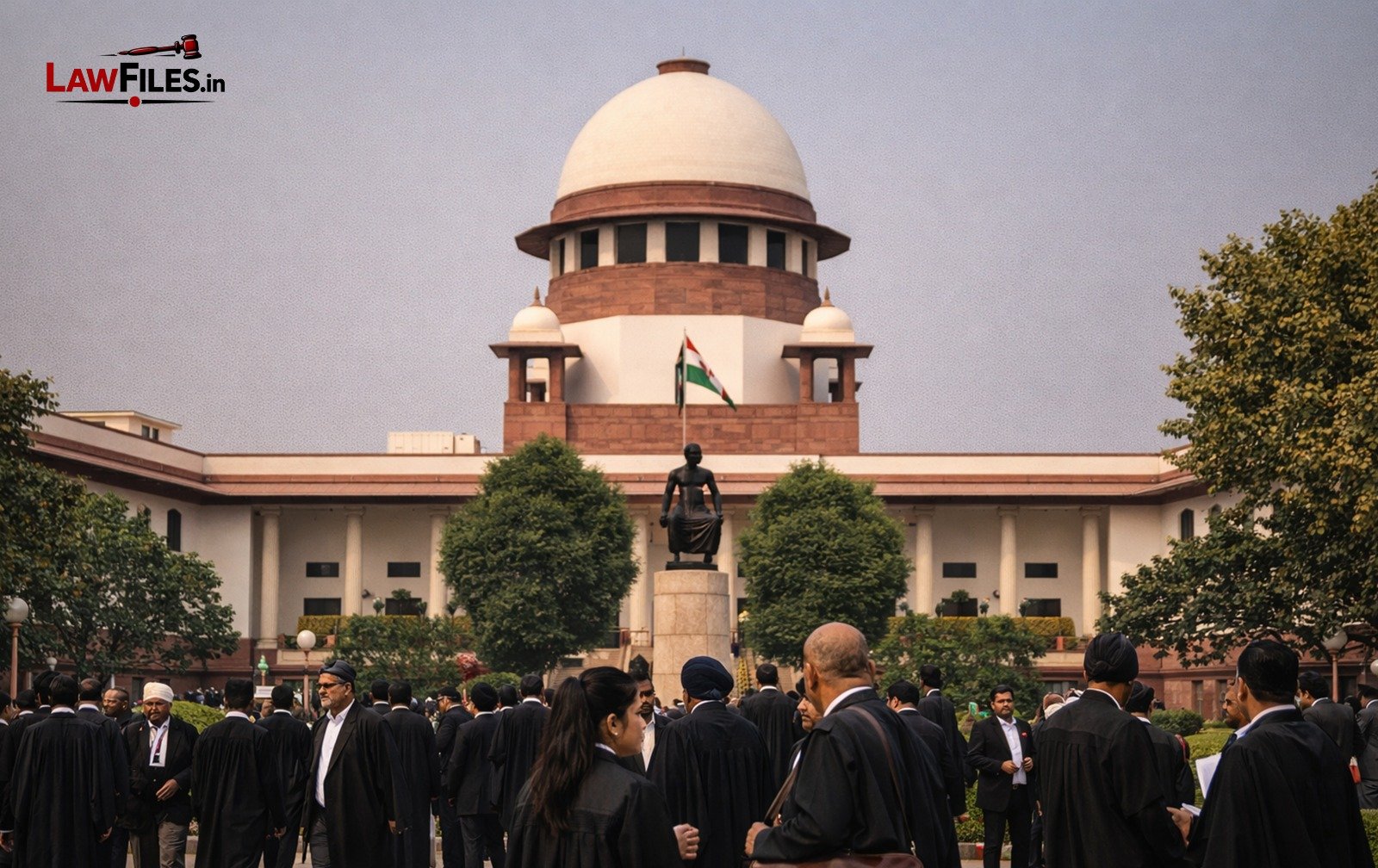
The Supreme Court has commuted the death sentence imposed on Waris, a man convicted of the rape and murder of his six-year-old stepdaughter in Madhya Pradesh, while upholding the finding of guilt recorded against him. A three-Judge Bench comprising Justices Vikram Nath, Sandeep Mehta and Vijay Bishnoi dealt with Criminal Appeals Nos. 429-430 of 2020 and declined to disturb the conviction, but concluded that the capital punishment imposed by the courts below could not be sustained. The decision once again places the constitutional philosophy of sentencing at the centre of a case involving one of the most serious categories of offences under Indian criminal law.
The case had reached the Supreme Court after the Special Court under the Protection of Children from Sexual Offences Act, Jaora, District Ratlam, convicted Waris on December 17, 2018 for offences including Sections 376(2)(f), 376(2)(n), 376AB, 302 and 201 of the Indian Penal Code, together with Sections 5 and 6 of the POCSO Act. The trial court imposed death sentences for rape of a child below twelve years and murder, apart from a five-year rigorous imprisonment sentence for causing disappearance of evidence. The Madhya Pradesh High Court, by its judgment dated November 18, 2019, confirmed both the conviction and the capital sentence.
The factual allegations emerging from the prosecution case were exceptionally grave. The deceased child was the daughter of Waris’s third wife from her previous marriage and had been brought into the matrimonial household. The prosecution relied substantially upon the evidence of the child’s mother, medical evidence and DNA evidence. The post-mortem examination recorded multiple injuries and attributed the death to asphyxiation caused by throttling. The DNA examination also indicated that male Y-chromosomal material recovered from the child’s clothing corresponded with Waris’s Y-chromosome profile. The High Court had consequently treated the evidentiary chain as establishing sexual assault followed by homicidal violence.
The prosecution case further alleged that the sexual violence was not an isolated act. The child’s mother stated that the accused had assaulted the girl previously and that on the relevant occasion she heard muffled cries before finding the accused withdrawing his hands from the child’s neck. The prosecution also relied upon the subsequent conduct attributed to Waris, including the alleged concealment of the child’s clothes, failure to obtain timely medical assistance and an attempt to have the body cremated before the police were alerted. The High Court treated these circumstances as demonstrating not merely the commission of the offence but an effort to conceal its consequences.
The defence, however, had raised an important procedural issue which ultimately brought the matter back to the Supreme Court in a manner that went beyond the ordinary question of whether the evidence was sufficient to sustain a conviction. When the case was originally tried, the accused’s engaged counsel failed to appear on the date fixed for examination of the principal prosecution witness, the child’s mother. The trial court appointed legal-aid counsel on the same day and proceeded with the witness’s evidence and cross-examination without giving the newly appointed lawyer adequate time to study the record and prepare the defence. In a capital case, where the consequence of an inadequate defence can be irreversible, this became constitutionally significant.
In May 2025, the Supreme Court had therefore already intervened in Waris v. State of Madhya Pradesh, holding that an accused facing a possible death sentence cannot be treated as having received effective legal representation merely because a lawyer was formally appointed. The Court found that the legal-aid counsel had been required to cross-examine the star prosecution witness on the very day of appointment and that the record did not even demonstrate that the counsel had been supplied with the relevant prosecution documents in sufficient time. The Court consequently directed further examination of the witness and emphasised that competent legal representation is an essential component of a fair trial.
That earlier intervention is important to understanding the present decision. The Supreme Court was not simply confronted with a request to show leniency towards a person convicted of a horrific crime. The case had already demonstrated that capital adjudication requires heightened procedural safeguards at every stage. The Court’s earlier ruling treated effective legal aid as part of the fundamental guarantee of a fair trial under Article 22(1), particularly where the prosecution seeks to deprive the accused of life itself. The present decision therefore represents the later stage of a judicial process in which both conviction and punishment have been separately scrutinised.
The sentencing question is governed by a constitutional principle that has remained central to Indian death-penalty jurisprudence since Bachan Singh v. State of Punjab: life imprisonment is the norm and death is an exception, permissible only where the case falls within the narrowly defined category of the “rarest of rare” cases and the alternative option is unquestionably foreclosed. The gravity of the offence is undeniably relevant, but it cannot be treated as the sole determinant of sentence. The court must examine the circumstances of the crime alongside the circumstances of the offender.
This distinction becomes particularly important in offences involving children. Parliament has progressively increased the statutory severity applicable to sexual offences against young children. Section 376AB of the IPC, inserted in 2018, contemplated death as one of the punishments for rape of a woman below twelve years of age. Section 6 of the POCSO Act similarly prescribes exceptionally severe punishment for aggravated penetrative sexual assault. Yet the existence of a statutory option of death does not convert capital punishment into an automatic consequence of conviction. The statutory maximum and the constitutional threshold for actually imposing death operate at two different levels.
The Madhya Pradesh High Court, when it originally confirmed the sentence in 2019, had applied the framework associated with Bachan Singh, Macchi Singh and Shankar Kisanrao Khade. It treated the case as satisfying what has come to be described as the “crime test” and “criminal test” framework, concluding that the brutality of the crime, the age and vulnerability of the victim, the relationship of trust involved and the subsequent attempt at concealment collectively placed the case within the rarest-of-rare category.
The Supreme Court’s present decision demonstrates why that analysis cannot stop with the description of the crime. Capital sentencing is not a competition between the brutality of the offence and the sympathy of the Court. It is a constitutional exercise requiring a judicial determination of whether the extreme punishment is actually necessary after considering the offender as a human being capable, in law, of rehabilitation unless the evidence establishes otherwise.
The Supreme Court has repeatedly cautioned that the nature of the offence, however revolting, cannot by itself answer the question whether the offender should be executed. In Shankar Kisanrao Khade, for instance, the Court explained that aggravating circumstances are not exhaustive and that mitigating circumstances must receive genuine consideration. Earlier decisions such as Bantu v. State of Madhya Pradesh, Raju v. State of Haryana and State of Maharashtra v. Suresh demonstrate that even rape and murder of very young children have not invariably resulted in confirmation of death sentences.
The development of this jurisprudence is important because the phrase “rarest of rare” can easily become diluted if it is treated merely as a judicial description of an exceptionally shocking offence. The constitutional test is considerably more demanding. The Court must determine whether there remains a realistic possibility of reformation and rehabilitation and whether life imprisonment, including an appropriately structured period of incarceration where legally justified, can adequately serve the purposes of punishment.
The Supreme Court’s broader sentencing jurisprudence has increasingly emphasised that mitigation cannot be reduced to a ritual recital of factors such as age, family background or jail conduct. Modern capital sentencing requires information capable of assisting the court in assessing the offender’s personality, background, behaviour, capacity for reform and prospects of rehabilitation. The sentencing hearing is therefore not a procedural formality following conviction; it is an independent constitutional stage at which the court determines the appropriate response of the State to the crime.
This becomes particularly relevant in a case such as the present one because the prosecution evidence, as recorded by the courts below, made the crime exceptionally grave. The child was allegedly assaulted by a person occupying a parental position within the household. The alleged conduct therefore involved not only physical violence but a profound breach of familial trust. The Court, however, was required to separate its moral condemnation of the offence from the distinct legal question whether the State had established that the offender was beyond the possibility of reform to the degree required before taking his life.
The distinction is fundamental. A criminal court may conclude that an offence deserves the strongest possible condemnation and simultaneously conclude that execution is not constitutionally justified. Commutation of a death sentence does not dilute the finding of guilt, minimise the suffering of the victim, or amount to judicial approval of the conduct. It reflects the separate constitutional status of punishment and the special restraints imposed upon the State when the punishment is irreversible.
The case also illustrates the importance of the Supreme Court’s earlier intervention on legal aid. The Court’s 2025 ruling had observed that the accused was a semi-literate person from a poor background who could not afford the lawyer originally engaged by him. The Court specifically emphasised that in a capital case the quality of representation cannot be measured merely by the fact that counsel was present in court. A lawyer must have adequate time, access to the record and a genuine opportunity to prepare.
This aspect of the case raises a wider institutional question concerning capital trials in India. The death penalty demands the highest level of procedural reliability because a wrongful conviction resulting in ordinary imprisonment can theoretically be corrected, whereas an execution cannot. Consequently, effective legal aid, complete disclosure of prosecution material, meaningful cross-examination, mitigation investigation and reasoned sentencing are not peripheral safeguards. They form part of the architecture that makes capital punishment constitutionally defensible at all.
The procedural history also provides an important lesson about appellate criminal jurisdiction. The Supreme Court did not treat the earlier defect in legal representation as an automatic basis for acquittal. Instead, it adopted a corrective approach by directing further examination of the crucial prosecution witness and requiring that the defence be given a meaningful opportunity to prepare. The present stage of the proceedings, therefore, demonstrates the distinction between curing a procedural defect and abandoning the prosecution case altogether.
The decision must also be situated within the continuing evolution of the “rarest of rare” doctrine. Indian courts have moved progressively away from an approach in which the brutality of the crime almost mechanically determines punishment. Decisions such as Rajendra Pralhadrao Wasnik, Sangeet, Manoj v. State of Madhya Pradesh, Dattatraya Rokade and later capital-sentencing cases have stressed that the offender cannot disappear from the sentencing inquiry merely because the crime is horrifying. The Supreme Court has repeatedly required the State and the courts to investigate the possibility of reform rather than assume its absence.
There is an important conceptual difference between saying that an offender may be dangerous and establishing that he is beyond rehabilitation. The first is a prediction about risk; the second is a conclusion with constitutional consequences. Death sentencing requires the latter to be established through a principled assessment rather than inferred solely from the character of the offence.
At the same time, the jurisprudence should not be misunderstood as requiring courts to ignore the protection of society. Where the facts demonstrate that ordinary life imprisonment would be inadequate, courts have, in appropriate cases, structured life sentences requiring exceptionally long periods of actual incarceration. Such sentences attempt to reconcile competing constitutional considerations: society’s interest in incapacitation and proportional punishment on one hand, and the constitutional reluctance to impose an irreversible penalty on the other. The Supreme Court has adopted such calibrated sentencing in a number of serious sexual-offence and murder cases.
The present ruling is therefore better understood not as a softening of the law concerning sexual offences against children, but as an affirmation that the seriousness of an offence and the legality of a particular punishment are separate questions. POCSO and the IPC permit severe punishment because the legislature recognises the extraordinary vulnerability of children. The Constitution, however, continues to regulate how that punishment is selected in an individual case.
There is also a broader lesson in the Court’s insistence upon examining the accused’s circumstances. Criminal justice cannot become entirely offence-centric without undermining the individualised sentencing principle embedded in Indian law. Two crimes may be similarly brutal, yet the circumstances of the offenders, their backgrounds, prior conduct, prospects of reform and other mitigating material may differ substantially. A sentencing court is consequently required to individualise punishment rather than simply classify the offence.
The Waris litigation is particularly instructive because the case travelled through multiple judicial stages before the final question of punishment could be meaningfully determined. The trial court imposed the extreme penalty; the High Court confirmed it; the Supreme Court first intervened to repair a serious fair-trial deficiency; and, after the subsequent proceedings, the Supreme Court has now upheld the conviction while commuting the death sentence. The chronology demonstrates that capital cases demand a level of appellate scrutiny that goes beyond checking whether the trial court reached a plausible conclusion.
Ultimately, the judgment reinforces a proposition that lies at the heart of Indian constitutional criminal law: the more irreversible the punishment, the more rigorous must be the judicial inquiry preceding it. The Court has not erased the gravity of the offence or disturbed the finding that Waris is criminally responsible for the offences proved against him. What it has done is maintain the constitutional distinction between conviction and capital punishment.
The significance of Waris v. State of Madhya Pradesh therefore extends beyond the individual case. It demonstrates that “rarest of rare” is not a label to be attached merely because a crime shocks the conscience. It is a constitutional conclusion that must emerge only after the court has examined the crime, the criminal, the quality of the evidence, procedural fairness, mitigating circumstances and the possibility of rehabilitation. The ultimate question in a death case is not simply whether the crime was terrible enough to deserve the strongest condemnation, but whether the Constitution permits the State to cross the irreversible boundary from imprisonment to execution in that particular case.
