


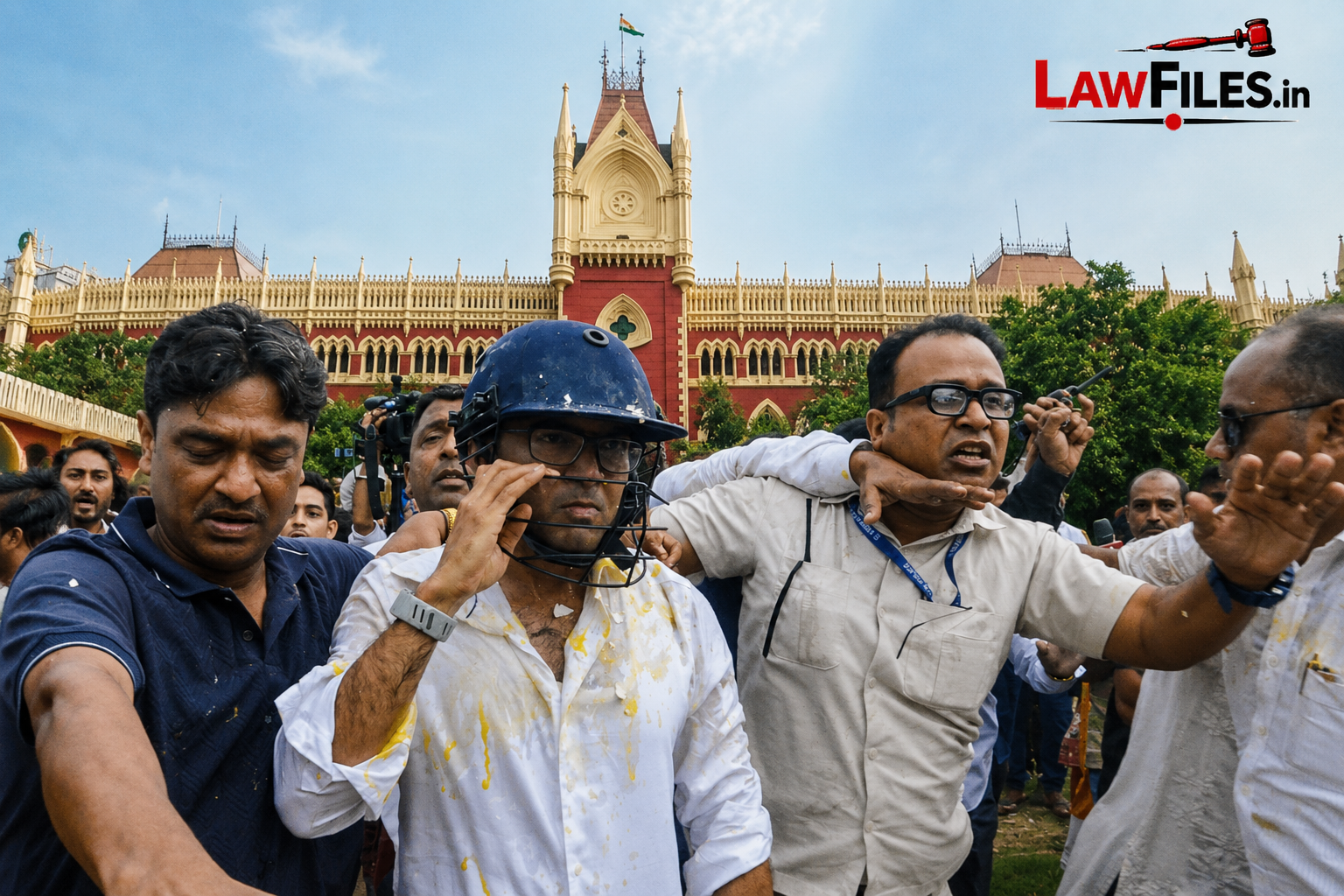
The Calcutta High Court is set to hear a significant application filed by Trinamool Congress MP Abhishek Banerjee seeking judicial permission to travel abroad for specialised ophthalmic treatment, a request made in compliance with earlier directions governing his interim protection from coercive action in pending criminal proceedings. Although the application concerns an individual litigant, the legal questions before the Court transcend personal circumstances. At the heart of the proceedings lies a recurring constitutional issue—how should courts balance an individual’s right to access specialised medical treatment abroad against the necessity of ensuring the integrity of ongoing criminal investigations? The hearing is expected to revisit the scope of judicial discretion in relaxing travel restrictions imposed as conditions of interim protection and will likely contribute to the evolving jurisprudence on personal liberty, medical necessity and judicial supervision during criminal proceedings.
The application has been filed in the backdrop of earlier proceedings in which the Calcutta High Court had granted interim protection from coercive action, including protection against arrest, in connection with criminal proceedings pending against Banerjee. However, while granting such relief, the Court had imposed a specific condition restraining him from leaving the country without obtaining prior judicial permission. That condition reflected a common practice in criminal jurisprudence, where courts attempt to preserve both the liberty of the accused and the effectiveness of the investigation by ensuring that the person remains available whenever required by investigating authorities. The present application, therefore, does not seek to challenge the earlier restriction itself but requests a limited relaxation solely for obtaining specialised medical treatment overseas.
According to submissions made on behalf of the petitioner, the request is based upon a continuing ophthalmic condition arising from a serious eye injury suffered several years ago. It has been argued that Banerjee has undergone previous surgical procedures and has been receiving specialised treatment from medical experts abroad for an extended period. The petitioner therefore seeks permission to undertake a temporary foreign visit exclusively for medical evaluation and treatment, assuring the Court that he will return within the stipulated period and continue cooperating with the investigation. These submissions are presently matters placed before the Court, and no judicial finding has yet been returned regarding the necessity or extent of the proposed treatment.
The present hearing assumes significance because the High Court had earlier declined requests for urgent listing of the travel application. On previous occasions, the Court observed that the plea could be considered in the ordinary course and also noted that advanced medical facilities were available within India. In subsequent proceedings, the Court even suggested that the petitioner first obtain an expert medical evaluation from Kolkata’s SSKM Medical College and Hospital, indicating that the question of foreign treatment should be examined after considering domestic medical opinion. The present listing therefore represents the next stage in judicial examination of the petitioner’s request after compliance with earlier procedural directions.
From a legal perspective, the proceedings bring into focus the constitutional guarantee of personal liberty under Article 21. The Supreme Court has consistently held that the right to life encompasses not merely protection against unlawful deprivation of liberty but also the right to receive appropriate medical treatment. Courts have repeatedly recognised that where specialised treatment is genuinely unavailable within the country, the right to seek medical care abroad may, in appropriate circumstances, fall within the protective ambit of Article 21. However, this right is not absolute when a person is simultaneously subject to ongoing criminal proceedings. Judicial discretion therefore becomes necessary to reconcile competing constitutional considerations.
The case also highlights the legal distinction between grant of interim protection and unrestricted freedom of movement. Interim protection from arrest is intended to shield an individual against immediate coercive action while legal issues remain under judicial consideration. Such protection, however, is frequently accompanied by conditions requiring cooperation with investigation, appearance before investigating agencies and restrictions upon foreign travel. These conditions are designed not as punishment but as safeguards ensuring that judicial protection does not inadvertently frustrate the investigative process. The present application therefore requires the Court to determine whether temporary overseas travel can be permitted without compromising those objectives.
Another noteworthy aspect concerns the standard applied by constitutional courts while considering requests for foreign travel during pending investigations. Indian courts have generally examined several factors before granting such permission, including the genuineness of the medical requirement, availability of comparable treatment within India, duration of the proposed visit, past conduct of the applicant, likelihood of returning to India, degree of cooperation shown during investigation and the stage of the criminal proceedings. No single factor is decisive. Rather, courts undertake a holistic assessment balancing individual rights against public interest in effective investigation.
The proceedings also illustrate the increasing judicial reliance upon medical evidence rather than mere assertions of urgency. Earlier observations of the High Court indicate that expert medical opinion would assist the Court in determining whether foreign treatment is genuinely indispensable or whether equivalent treatment remains available domestically. Such an approach reflects an important principle of judicial restraint. Constitutional courts ordinarily avoid substituting their own medical assessment for that of qualified specialists and instead base their decisions upon objective medical material placed before them.
Equally important is the institutional message conveyed by the Court’s handling of the matter. The High Court has neither mechanically rejected the request nor automatically accepted it. Instead, it has insisted upon procedural compliance, medical substantiation and judicial scrutiny before relaxing an earlier condition imposed to protect the integrity of criminal proceedings. This approach reflects the broader constitutional philosophy that personal liberty and investigative necessity are not mutually exclusive values but competing considerations requiring careful judicial balancing.
The hearing also has implications for the jurisprudence governing conditional judicial relief. Interim protection orders frequently contain conditions relating to surrender of passports, prior permission for travel, periodic appearance before investigators or cooperation with inquiries. Such conditions derive their legitimacy from the principle that extraordinary judicial protection should not prejudice the administration of justice. At the same time, courts retain continuing jurisdiction to modify these conditions where circumstances materially change. Applications seeking foreign travel for medical treatment therefore fall within the Court’s supervisory powers to appropriately balance evolving factual circumstances against the original purpose of the protective order.
From the standpoint of criminal procedure, the matter demonstrates that judicial permission to travel abroad does not amount to dilution of the investigation. Courts routinely impose safeguards such as limited travel periods, disclosure of travel itinerary, furnishing of contact details, return within specified dates and continued cooperation with investigating agencies. Such conditions ensure that temporary travel does not result in evasion of legal proceedings while simultaneously respecting the applicant’s legitimate personal requirements.
The proceedings also revisit an important constitutional question concerning medical autonomy. Modern constitutional jurisprudence increasingly recognises that individuals possess the autonomy to choose the medical treatment they consider appropriate, subject to reasonable legal restrictions. However, when that choice intersects with pending criminal proceedings, courts must determine whether the proposed treatment justifies temporary relaxation of judicial restrictions. The present case therefore illustrates the intersection of criminal procedure, constitutional liberty and healthcare rights.
Another noteworthy feature is the Court’s continuing emphasis on cooperation with investigation. Earlier orders granting interim protection had specifically directed Banerjee to cooperate with investigating authorities while simultaneously protecting him from coercive action. This demonstrates that judicial protection is conditioned upon reciprocal compliance by the beneficiary. The present travel application is therefore likely to be examined in light of the petitioner’s conduct during the investigation, ensuring that liberty and accountability continue to operate together.
From a broader institutional perspective, the case reinforces the role of constitutional courts as balancing institutions. Courts neither function as investigating agencies nor as medical authorities. Their role is to ensure that executive action remains consistent with constitutional guarantees while preserving the effectiveness of the criminal justice system. Applications seeking permission to travel abroad during pending investigations therefore require nuanced judicial assessment rather than rigid application of predetermined rules.
Importantly, the present proceedings should not be viewed as determining the merits of the criminal allegations pending against the petitioner. The issue before the Court is confined to whether the earlier travel restriction should be temporarily relaxed for medical reasons. Any observations made during the hearing concerning medical necessity or conditions of travel will have no bearing upon the substantive criminal proceedings, which will continue independently in accordance with law.
Ultimately, the Calcutta High Court’s consideration of Abhishek Banerjee’s plea represents far more than a routine application for overseas travel. It presents an opportunity for the judiciary to reaffirm a central constitutional principle—that restrictions imposed during criminal proceedings must remain proportionate, reasonable and responsive to genuine personal necessities without undermining the administration of justice. Whether the Court ultimately grants or declines permission will depend upon the medical evidence, the circumstances of the investigation and the conditions considered necessary to safeguard the judicial process. Regardless of the eventual outcome, the proceedings underscore that in a constitutional democracy, personal liberty and criminal investigation are not competing absolutes but values that must be harmonised through careful, evidence-based judicial adjudication.
