


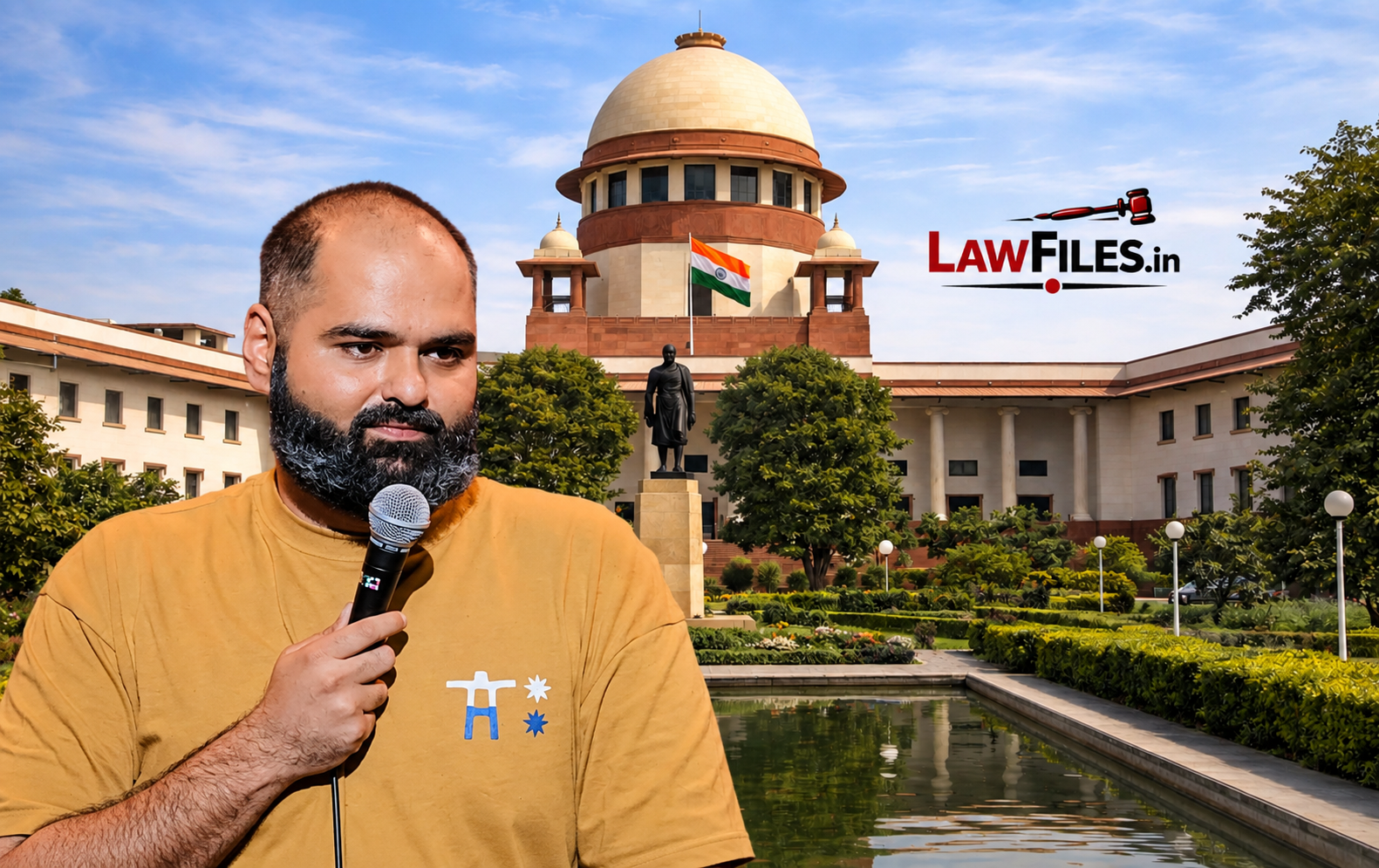
The constitutional boundary between legislative privilege and the freedom of speech of citizens is set to come under renewed scrutiny before a seven-Judge Bench of the Supreme Court, with comedian Kunal Kamra seeking permission to intervene in the long-pending proceedings concerning the scope of privileges enjoyed by State Legislatures. Kamra’s intervention application acquires particular significance because he is himself facing breach of privilege proceedings before the Maharashtra Legislature arising from a satirical performance concerning Maharashtra’s political developments. He has contended that the constitutional questions pending before the Supreme Court have a direct bearing on his own proceedings and, more broadly, on the ability of citizens to comment, criticise and satirise elected representatives without being subjected to legislative privilege proceedings.
The Supreme Court is scheduled to commence hearing the seven-Judge reference from October 6 in N. Ravi v. Speaker, Legislative Assembly, Chennai. The reference originates from proceedings concerning the Tamil Nadu Legislative Assembly’s action against senior journalists of The Hindu in 2003 after the newspaper published an editorial criticising the functioning of the then State Government. The constitutional questions raised by that controversy have remained unresolved for more than two decades, particularly the relationship between Article 194, which deals with the powers and privileges of State Legislatures, and Article 19(1)(a), which guarantees freedom of speech and expression.
Kamra’s intervention thus brings a contemporary factual controversy into a constitutional reference rooted in an entirely different episode. The underlying cases concern journalists who criticised a government and were threatened with legislative action; Kamra’s own case concerns a comedian whose political satire resulted in privilege proceedings. The common legal question, however, is whether a legislative House’s power to protect its authority and functioning can extend to disciplining persons outside the House for speech that is critical, satirical or allegedly derogatory towards legislators or political leaders.
That question cannot be answered simply by placing “privilege” and “free speech” on opposite sides of a constitutional scale. Legislative privilege itself has a constitutional purpose. Articles 105 and 194 protect the functioning of Parliament and State Legislatures by conferring specified freedoms, immunities and privileges upon their Houses, members and committees. The rationale is institutional: elected representatives must be able to deliberate, debate, vote and perform legislative functions without being obstructed by external pressures or threatened with legal consequences merely for participating in parliamentary proceedings.
The controversy begins when that institutional protection is invoked against persons who are not members of the legislature. A journalist, comedian, academic, activist or ordinary citizen does not enjoy the constitutional freedom of speech inside the House under Articles 105 or 194. Such a person instead relies principally upon Article 19(1)(a), subject to the restrictions constitutionally permitted under Article 19(2). The question then becomes whether legislative privilege can be deployed as an independent source of coercive authority against such external speech, and if so, what constitutional limitations govern its exercise.
Kamra’s intervention application takes a clear position on that question. He has argued that legislative privilege cannot become a mechanism for suppressing citizens’ speech and that a conflict between legislative privilege and the fundamental right to freedom of speech must be resolved consistently with constitutional democracy. His plea specifically contends that using privilege to “stifle” citizens’ speech would have implications extending beyond his individual case, particularly for journalists and other persons commenting upon the conduct of elected representatives. These are submissions made by Kamra and remain subject to consideration by the Supreme Court.
The legal significance of the intervention lies in the distinction between speech about the legislature and conduct that obstructs the legislature. A constitutional privilege designed to protect legislative functioning cannot logically be divorced from that function. The difficult question is determining when criticism of legislators remains external political expression and when the manner or content of that expression crosses into conduct capable of attracting a legitimate privilege jurisdiction.
Indian constitutional jurisprudence has increasingly approached legislative privileges through this functional lens. In State of Kerala v. K. Ajith concerning the 2015 Kerala Legislative Assembly ruckus, the Supreme Court emphasised that privileges and immunities exist to facilitate the discharge of legislative functions and are not status-based privileges placing legislators above ordinary law. The Court observed that legislative privilege is not a gateway to exemption from criminal law and that acts such as destruction of public property could not be transformed into protected legislative activity merely because they occurred inside the House.
That reasoning is important to the present reference even though the factual setting is different. Physical disruption of legislative proceedings and satirical criticism of a political figure obviously cannot be treated as identical forms of conduct. Yet both controversies require the Court to identify the constitutional purpose of privilege rather than treating the existence of privilege as an unlimited source of authority.
The Supreme Court’s decision in Sita Soren v. Union of India in 2024 further developed this functional approach. A seven-Judge Bench held that privileges under Articles 105 and 194 must be tethered to the collective functioning of the House and that their necessity must bear a functional relationship to the essential duties of legislators. The judgment also clarified that parliamentary privilege does not provide immunity for bribery connected with parliamentary speech or voting. The decision consequently moved the law away from an understanding of privilege as an unrestricted constitutional shield and towards a doctrine anchored in legislative function.
The present reference nevertheless involves a different and potentially more difficult question because it concerns the speech of a person who is not a legislator. Article 19(1)(a) is an individual fundamental right. It protects not only speech that is agreeable to the government or popular opinion but also criticism, dissent, satire and political commentary, subject to the restrictions specified in Article 19(2). The constitutional question is therefore whether legislative privilege operates independently of Article 19(2), or whether its exercise against citizens must itself be tested against the fundamental-right framework.
The historical origin of the reference makes the issue particularly significant. In 2003, The Hindu published an editorial titled “Rising Intolerance”, criticising the functioning of the then Tamil Nadu Government. The State Assembly subsequently treated the publication as a breach of privilege and resolved to take coercive action against members of the newspaper’s editorial team. Arrest warrants were issued, although the journalists were not ultimately taken into custody after the Supreme Court intervened. The journalists approached the Supreme Court arguing that legislative privilege could not override the freedom of the press protected by Article 19(1)(a).
The Supreme Court, while considering the matter in December 2003, identified substantial constitutional questions concerning the interaction between Articles 194(3), 19(1)(a) and 21. It also noticed an apparent conflict between earlier decisions dealing with legislative privilege and fundamental rights. A five-Judge Bench consequently referred the matter to a seven-Judge Bench in 2004. The case has since remained pending through several stages before being revived for substantive hearing in 2026.
The historical delay itself is noteworthy. Constitutional questions concerning the limits of legislative privilege have remained unresolved while the nature of public communication has changed dramatically. The dispute originally concerned a newspaper editorial. The contemporary controversy involves YouTube videos, social-media circulation, stand-up comedy, digital audiences and political satire. The legal principle may be old, but the practical consequences of the eventual ruling could extend to an entirely different communications environment.
Kamra’s own case arose after a satirical performance in his show Naya Bharat. The performance referred to the political split within the Shiv Sena in 2022 and included a song in which Maharashtra Deputy Chief Minister Eknath Shinde was described as a “traitor”. Following the circulation of the performance, a breach of privilege complaint was initiated before the Maharashtra Legislature, while a separate criminal case was registered by the Mumbai Police. The criminal proceedings have separately been challenged before the Bombay High Court.
The Bombay High Court, while granting Kamra protection from arrest in April 2025, did not finally decide the merits of the criminal allegations. The Court permitted the investigation to continue while directing that he not be arrested during the pendency of the proceedings. Kamra’s counsel had argued that the performance constituted protected political satire and that the criminal process should not be employed merely because a public figure objected to the content. The State, on the other hand, argued that criticism could not be used as a shield for targeted and allegedly defamatory conduct. The competing arguments illustrate the difference between the constitutional protection of expression and the separate question of whether a particular statement satisfies the ingredients of a criminal offence.
The privilege proceedings raise a further question because legislative privilege is not simply another criminal offence. The power arises from the constitutional framework governing legislatures and is connected with the legislature’s institutional autonomy. This gives privilege proceedings a distinctive character. They are not necessarily dependent upon the ordinary criminal-law machinery, and the House possesses certain powers to protect its functioning and authority. The difficulty is identifying the constitutional boundary beyond which such power becomes an instrument for controlling speech unrelated to legislative functioning.
This is where the distinction between institutional dignity and individual dignity becomes legally important. Legislators, like all individuals, possess personal dignity and may have legal remedies for defamation, threats or other unlawful conduct. But legislative privilege is constitutionally conferred upon the House and its members for legislative purposes. The mere fact that a statement embarrasses, ridicules or strongly criticises a legislator does not by itself explain why the House requires a privilege power to respond to it. The Court may therefore have to examine whether the alleged contempt or breach has a sufficiently close relationship with the functioning of the legislature.
The question becomes more complicated in political satire. Satire is, by its nature, often exaggerated, provocative and irreverent. It may use parody, irony, caricature and deliberately sharp language to comment upon political conduct. Whether a particular statement constitutes legitimate satire or unlawful defamation is ordinarily a context-specific question. The constitutional status of satire, however, cannot be decided solely by the subjective reaction of the person who is its target.
At the same time, freedom of speech is not an unlimited defence. Article 19(2) expressly permits reasonable restrictions on speech in the interests of specified grounds including defamation, public order, decency or morality, contempt of court and the sovereignty and integrity of India. Therefore, the question before the seven-Judge Bench is not simply whether citizens possess free speech. They unquestionably do. The more difficult question is whether legislative privilege constitutes a distinct constitutional power capable of operating beyond the Article 19(2) framework and, if so, what safeguards must accompany its exercise.
The Supreme Court’s own jurisprudence indicates that Article 19(1)(a) and legislative freedom of speech are conceptually distinct. In Sita Soren, the Court explained that the freedom of speech enjoyed by legislators under Articles 105 and 194 is institutionally different from the fundamental right under Article 19(1)(a). Legislative freedom is connected with membership and legislative proceedings, whereas Article 19(1)(a) belongs to every citizen and is subject to Article 19(2).
That distinction could prove central to the pending reference. A citizen cannot claim Article 194 immunity merely because the subject of the speech concerns Parliament or a State Legislature. Conversely, the House cannot necessarily assume that the existence of Article 194 gives it an unrestricted power to punish every person whose criticism it considers insulting. The Court may need to construct a doctrinal bridge between institutional privilege and individual constitutional freedom.
Another important issue concerns judicial review. Legislative privileges are intended to preserve legislative autonomy, and courts have historically exercised caution in entering the internal proceedings of legislatures. The constitutional separation between the judiciary and legislature means that courts cannot ordinarily supervise legislative debate simply because a particular parliamentary or assembly decision is controversial.
But judicial restraint is not identical to judicial abstention. Where a constitutional question concerns the existence or limits of a privilege, the judiciary may be required to interpret the Constitution. The Supreme Court’s own intervention in the N. Ravi proceedings demonstrates this point: the reference exists precisely because the Court has recognised that the constitutional relationship between legislative privilege and fundamental rights requires authoritative interpretation.
The challenge for the seven-Judge Bench will therefore be to preserve two constitutional values simultaneously. Legislatures require sufficient autonomy to conduct their business without external obstruction. Citizens require meaningful protection for political expression, including criticism of those who exercise public power. A doctrine that gives absolute priority to either side could undermine the constitutional structure in a different way.
If privilege is interpreted too broadly, an elected House could potentially become an additional forum for sanctioning speech that is merely politically inconvenient. That could have a chilling effect on journalism, satire and public criticism. If privilege is interpreted too narrowly, however, the legislature could find itself unable to protect its proceedings against genuine obstruction, intimidation or conduct that directly interferes with the discharge of legislative functions.
The functional test emerging from recent Supreme Court jurisprudence offers one possible analytical framework. The question could be whether the exercise of privilege is necessary to protect an essential legislative function and whether the conduct complained of has a sufficiently direct relationship with that function. Such a framework would not automatically immunise criticism of legislators, nor would it deprive the House of power to respond to genuine interference with its proceedings. It would instead require the asserted privilege to be justified by its constitutional purpose. This is an analytical possibility arising from existing jurisprudence, not a prediction of the seven-Judge Bench’s eventual ruling.
The intervention application also highlights a contemporary concern that did not exist in the same form when the N. Ravi dispute began. A newspaper editorial had a defined publication date, identifiable editorial authorship and a relatively limited circulation compared with today’s digital ecosystem. A satirical video can now be reproduced, clipped, reposted and distributed across multiple platforms within minutes. A legislative privilege proceeding initiated against one speaker may therefore have consequences for a much wider class of commentators.
Kamra has asserted that the proceedings against him have already affected his ability to organise performances and have generated uncertainty over whether similar proceedings could be initiated if he comments upon the conduct of elected representatives elsewhere. These are his claims in support of intervention, not judicial findings. Their legal relevance lies in the broader “chilling effect” argument: a speech restriction can affect not only the person formally proceeded against but also others who may subsequently moderate their expression because of uncertainty about the legal consequences.
That concern is familiar in constitutional free-speech jurisprudence. In Shreya Singhal v. Union of India, the Supreme Court distinguished between discussion, advocacy and incitement while invalidating Section 66A of the Information Technology Act for vagueness and overbreadth. Although that case concerned a statutory restriction rather than legislative privilege, its broader lesson is relevant: restrictions on expression require sufficiently identifiable legal boundaries so that citizens can understand what conduct attracts legal consequences.
The pending privilege reference could consequently have implications for the constitutional understanding of political criticism even beyond privilege proceedings themselves. A clear judgment could explain the circumstances in which a legislative House may invoke privilege against an outsider, the relationship between such privilege and Article 19(1)(a), the role of judicial review, and the relevance of necessity and proportionality in determining the scope of legislative authority.
At the same time, the Court will have to avoid converting the reference into a general constitutional immunity for all forms of speech directed at legislators. Political expression can coexist with legal accountability. Defamatory statements, threats, incitement and other conduct falling within constitutionally permissible restrictions remain subject to law. The fact that speech concerns a public figure does not automatically make it lawful, just as the fact that a public figure feels insulted does not automatically make it unlawful.
This distinction is particularly important for a constitutional court because the dispute is ultimately not about whether Kunal Kamra’s particular satire was funny, offensive, justified or politically appropriate. Those are largely matters of public and artistic judgment. The legal question is narrower and more fundamental: what constitutional authority does a legislative House possess when speech outside the House concerns its members or its functioning, and where does that authority stop when it encounters a citizen’s fundamental right to speak?
The seven-Judge Bench’s answer could also bring greater doctrinal clarity to an area of constitutional law that has historically developed through scattered rulings and convention. Legislative privileges were inherited substantially from parliamentary practice and have not been exhaustively codified by Parliament or State Legislatures. The constitutional text recognises the privileges while leaving substantial questions about their contours to constitutional interpretation.
This partially uncodified character makes judicial clarity particularly valuable. Uncertainty about the scope of privilege can itself create institutional friction. Legislatures may regard strong criticism as an attack on their authority, while journalists and citizens may perceive privilege proceedings as a threat to democratic accountability. A clearly articulated constitutional test could help distinguish legitimate protection of legislative functioning from attempts to control external political commentary.
The timing of the reference is consequently significant. More than twenty years after the original N. Ravi proceedings began, the constitutional question is now being considered against a radically transformed media environment and after the Supreme Court has developed a more sophisticated jurisprudence concerning legislative privilege, fundamental rights and constitutional accountability.
Kamra’s application adds a live factual dimension to that otherwise historical reference. Whether or not he is permitted to intervene, his case demonstrates that the issue is not confined to journalists covering legislative proceedings. It potentially concerns comedians, commentators, academics, activists, political critics and citizens who speak about those exercising legislative power.
The eventual judgment will therefore have to preserve an important constitutional distinction: legislative privilege protects the legislature as an institution so that it can perform its constitutional functions; it should not be assumed merely from the existence of that privilege that every criticism of a legislator becomes a matter for legislative punishment. Equally, free speech protects citizens from unlawful restrictions but does not place all speech beyond the reach of generally applicable law.
The constitutional balance will ultimately depend upon how the Court defines the relationship between privilege, legislative necessity and fundamental rights. The N. Ravi reference provides the seven-Judge Bench with an opportunity to move beyond the binary question of whether “privilege overrides free speech” and instead examine the constitutional purposes served by each provision. Such an approach could produce a more durable doctrine—one that protects the legislature from genuine obstruction without converting institutional dignity into a general power to regulate public criticism.
For Kamra, the intervention application is connected directly to proceedings already pending against him. For constitutional law, however, the significance is considerably wider. The case asks how a democracy should treat criticism of those who exercise democratic power. The answer will require the Court to reconcile two institutional commitments that are both essential to constitutional government: a legislature capable of functioning independently and a citizenry capable of speaking freely about those who govern in its name.
The seven-Judge hearing beginning October 6 will therefore not merely revisit a two-decade-old dispute arising from a newspaper editorial. It will require the Supreme Court to examine whether the constitutional concept of legislative privilege has a functional boundary and, if so, how that boundary interacts with the modern citizen’s right to criticise, question and satirise elected representatives. The resolution of that question could become an important reference point for the relationship between legislative autonomy, judicial review and freedom of expression in India’s constitutional democracy.
