


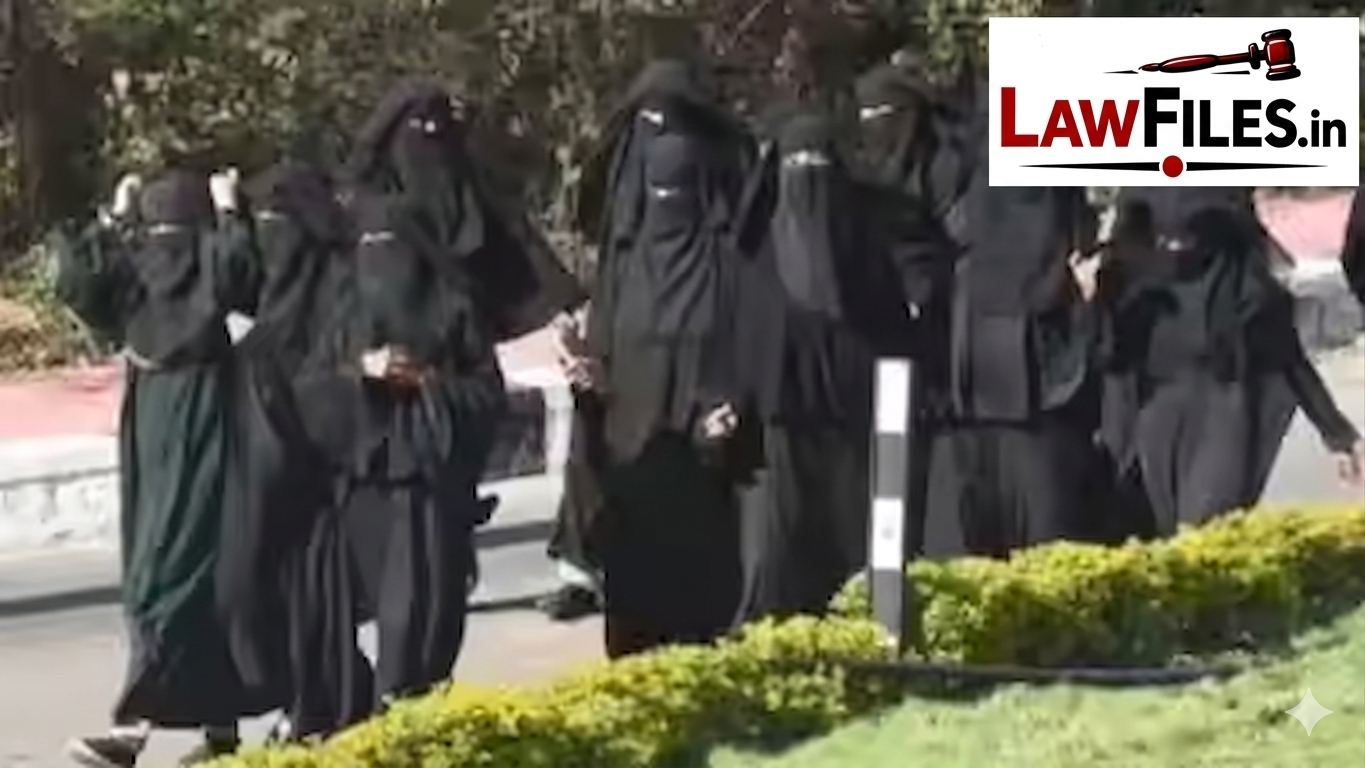
In a politically and constitutionally consequential move, the Karnataka government has formally withdrawn the controversial 2022 order that had effectively prohibited the wearing of hijab and other overt religious symbols in government educational institutions. The decision marks a dramatic reversal of one of the most polarising educational and constitutional controversies in recent Indian legal history and revives larger national debates concerning secularism, religious identity, institutional discipline, and individual liberty within public spaces.
The Karnataka government reportedly informed the Supreme Court that it had withdrawn the February 5, 2022 Government Order issued by the previous Bharatiya Janata Party administration. The earlier order had directed educational institutions to enforce prescribed uniforms and prohibit clothing that disturbed “equality, integrity and public order,” language that was subsequently used to prevent Muslim girl students from wearing hijabs in classrooms.
The withdrawal of the order carries significance far beyond educational administration because the hijab dispute had evolved into a defining constitutional confrontation over the nature of Indian secularism itself. At the heart of the controversy lay competing visions of constitutional identity: whether secular educational spaces require visible religious neutrality, or whether constitutional secularism instead protects pluralistic expression of faith within public institutions.
The original controversy began in early 2022 when Muslim students in Karnataka’s Udupi district alleged that they were denied entry into classrooms for wearing hijabs. The issue rapidly escalated into a statewide and eventually national political controversy, with protests, counter-protests, and communal polarisation spreading across educational institutions. Several colleges witnessed confrontations between groups supporting hijab rights and students wearing saffron scarves as symbols of religious assertion.
Subsequently, the Karnataka High Court upheld the government order in Aishat Shifa v. State of Karnataka, holding that wearing the hijab was not an “essential religious practice” in Islam protected under Article 25 of the Constitution. The High Court further ruled that school uniforms constituted a reasonable restriction promoting discipline and equality within educational spaces.
However, when the matter reached the Supreme Court, a split verdict emerged in October 2022. Justice Hemant Gupta upheld the Karnataka High Court judgment and supported the restrictions, whereas Justice Sudhanshu Dhulia struck down the ban, holding that the issue should fundamentally be viewed from the perspective of individual choice, dignity, and access to education. Justice Dhulia memorably observed that “a girl child already faces many barriers” and questioned whether denying education over a headscarf was constitutionally justified.
Because of the split verdict, the matter remained pending before a larger Bench of the Supreme Court. The Karnataka government’s withdrawal of the original order may now significantly alter the future trajectory of the litigation, although larger constitutional questions concerning religious symbols in educational institutions could still survive for judicial determination.
The Siddaramaiah-led Congress government had politically opposed the hijab restrictions even before assuming office. During the 2023 Karnataka Assembly elections, the Congress repeatedly characterised the hijab ban as discriminatory and communal. Following electoral victory, Chief Minister Siddaramaiah publicly stated that individuals should remain free to wear clothing of their choice and criticised the previous government for politicising dress codes.
Legally, the withdrawal of the order raises profound constitutional questions regarding the relationship between institutional uniformity and individual freedoms. Supporters of the ban had argued that uniforms are intended to erase markers of social, religious, and economic difference, thereby creating equal educational environments. According to this view, permitting visible religious symbols risks fragmenting institutional neutrality and encouraging identity-based assertion within educational spaces.
Opponents, however, argued that Indian secularism differs fundamentally from strict Western models of public neutrality. Rather than erasing religious identity from public life, Indian constitutionalism historically accommodates visible pluralism while preventing State preference for any religion. From this perspective, prohibiting the hijab represented not neutrality but selective suppression of minority religious expression.
The Karnataka government’s reversal effectively endorses this latter understanding of constitutional secularism. By permitting religious symbols in educational institutions, the State appears to affirm that secular governance need not require homogenisation of identity. Instead, secularism may coexist with visible expressions of religious and cultural diversity so long as public order and institutional functioning remain unaffected.
Critically analysed, the controversy reflects a deeper constitutional tension concerning the meaning of equality itself. One constitutional approach conceptualises equality as uniformity where identical rules applicable to all create neutral spaces devoid of visible difference. Another approach views equality as accommodation where institutions adjust to protect individual identity and substantive inclusion. The hijab litigation exposed the collision between these competing constitutional philosophies.
The withdrawal of the order additionally carries major implications for gender rights discourse. During the earlier litigation, the hijab became simultaneously framed as a symbol of patriarchal control by some and as an expression of agency and identity by others. Justice Dhulia’s Supreme Court opinion significantly shifted the constitutional conversation by centring educational access rather than theological debates. His reasoning suggested that constitutional analysis should focus less upon whether hijab is “essential” to Islam and more upon whether exclusion from classrooms disproportionately burdens Muslim girls’ access to education.
This aspect remains especially important because the hijab controversy disproportionately affected young Muslim women at the intersection of gender, religion, and educational marginalisation. Reports during the dispute indicated that several students either discontinued education or shifted institutions due to restrictions on wearing hijab. Consequently, the constitutional debate cannot be divorced from broader concerns regarding inclusion and equal educational opportunity.
The decision also reveals how constitutional litigation in India increasingly operates within intensely polarised political environments. The hijab dispute was never merely a legal disagreement concerning uniforms; it became embedded within wider national political narratives concerning religious identity, minority rights, nationalism, and cultural assertion. Judicial proceedings therefore unfolded amid extraordinary public scrutiny and political mobilisation.
Another legally significant aspect concerns the continuing relevance of the Essential Religious Practices (ERP) doctrine. The Karnataka High Court’s reasoning heavily relied upon determining whether hijab constituted an essential Islamic practice deserving constitutional protection. Critics of the doctrine argued that secular courts should not function as theological arbiters deciding doctrinal centrality within religions. The present withdrawal may reduce immediate litigation pressure, but the larger constitutional uncertainty surrounding ERP jurisprudence remains unresolved.
The reversal may also have implications for similar disputes across India. Several educational institutions and State authorities had cited the Karnataka litigation while debating dress codes and religious symbols. Karnataka’s withdrawal could therefore influence future policy approaches concerning accommodation of religious identity within schools and colleges.
At another level, the decision symbolises the fragility of rights when constitutional interpretation becomes deeply entangled with electoral politics. The same State machinery that once defended the hijab restrictions as necessary for discipline and secularism has now withdrawn them under a different political administration. Such reversals demonstrate how constitutional rights discourse in India often remains contingent upon changing political configurations rather than stable constitutional consensus.
The controversy additionally revives a broader question central to Indian constitutionalism: whether public institutions should aspire toward uniform civic identity or pluralistic coexistence. The framers of the Constitution consciously rejected the idea of a homogenized national identity and instead envisioned India as a multicultural constitutional democracy accommodating diverse languages, religions, and traditions. The Karnataka government’s decision appears more aligned with this pluralist constitutional imagination.
Importantly, the withdrawal does not conclusively settle the constitutional debate. Questions regarding permissible regulation of religious symbols in schools, institutional autonomy in prescribing uniforms, and balancing religious freedom with educational discipline are likely to continue resurfacing before courts. The Supreme Court may still eventually decide the larger constitutional issues raised by the split verdict.
Ultimately, the Karnataka government’s withdrawal of the hijab ban order represents more than an administrative policy reversal. It reflects the continuing constitutional struggle over how India understands secularism, diversity, and citizenship in deeply plural public spaces. Whether viewed as restoration of religious freedom or dilution of institutional neutrality, the decision has once again placed constitutional questions of identity, liberty, and inclusion at the centre of India’s democratic discourse.
